Turmoil is at the heart of so much change in our world – relentless change that we report on the airwaves, the media and the internet. My dad passed at 95, but for him turmoil was at the root of his character and his mechanisms for coping with life. He never understood the internet, nor did he always grasp what was happening in the media. In the end, he couldn’t grasp that we had a new Prime Minister in the country. A story that is so familiar amongst immigrant families. Yet even now, I can hardly grasp what it was that shaped his life and made him the person he was.
 Born in Stari Futog back in 1913, the world was a very different place. But for my dad Joseph, and the members of his family, turmoil was already part of their history. His village was not far from Novisad (Uj Videk in Hungarian), and dad always remembered his street (Railway Street), and the surroundings of his childhood village. That I can link to this information in Wikipedia shows how our own world has changed. Years ago the search for information online was much more difficult!
World War II changed his life totally. During the conflict he fought for the right of all. He never believed in the ethnic differences, and always accepted all religions, creeds, and colours at a time when this was not normal. His mother grounded his views, right from the day when as a tiny boy he ran into his house frightened by soldiers who were all coloured in with shoe polish! Many times he told that story of his mum, and the words that clearly remained with him for his life – “all men are equal and our brothers”.
No question though, my dad was different. Though his mother and subsequently his wife were gentle Hungarians, he had that sharp Serbian edge that made him a natural leader, but also one who would not suffer fools lightly. For him, a good discussion was a good verbal fight – and a challenge to see who won!
Dad’s village was the site of religious/ethnic cleansing. Massacres of the Serbian Orthodox population were also carried in numerous parts of his home country. But the most numerous massacres occurred in Novi Sad from January 21-23 of 1942, when nearly a thousand Serbs were martyred. Some of them were even thrown into the ice-covered river while still alive. [Serbian Orthodox Martyrs]
At the end of the war, dad got word that all his family and friends were murdered and he vowed never to return to his homeland – the site of such atrocities. He set his sights on a new future. (Could I do this?) By then he had settled in with the American Army in Lanshudt, Germany, as an interpreter (dad spoke many languages fluently).
Eventually he met up with my mum’s extended family, and he made the journey out to Australia in 1950, arriving to the immigration centre at Wacol near Ipswich, Queensland, where at the age of 36 he married my mum who was just 19, and started a family of his own in a new land. Once again he suffered a rebuff. Raised as a Serbian Orthodox, he was excommunicated for marrying ouside of his church. Many years later he was approached by the church and the excommunication was removed – naturally he refused to rejoin the church since in his view the church had been so stupid!
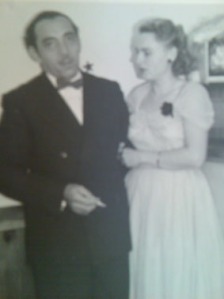 A new adventure began, and Dad got stuck into it with his usual determination. Dad made his way through the adminstration ranks of the Australian Immigration Centre organisation, and became the chap responsible for catering for various ‘camps’.
My childhood is marked by these various ‘camps’ – and I lived in these multicultural centres till the age of 12, in various parts of Australia. As a result my childhood was enriched by playing with kids from so many different backgrounds newly arrived in the country, and eating food that was not at all available in mainstream Australia. I couldn’t stand an Aussie pie (made me gag) and never ate a ‘banger’ until I went to Girl Guides. We played ‘hide and seek’ by copying – each kid counting to 100 in their own language – and before long each new kid in the playground could speak some English!
Dad was the complete handyman – and I was his apprentice. I learned to love gadgets (still do!), to drill and to hammer, and to strip down two Fiat 500 cars and help rebuild it into my first car – a complete ‘double clutch’ number that I tuned myself, and ran on 60cents a tank. I had my very own tool kit by the age of three, to carry around as dad’s shadow. Took years to convince my family that my most desired mother’s day present would be a tool kit of my very own, that no-one else was permitted to touch! He also grew wonderful vegetables, and had fabulous fruit trees that mum made stunning jam from. That was something I wasn’t so fond of, as being an only child, it was my duty (no one to pass the buck to) to water the garden each day, and in winter to chop the kindling, light the fire, and clear the grate on weekends.
In this time dad developed a real love of parties, friendship – and lawn bowls. A competition winner, he worked hard with Colonel Quinn at the centre at Bonegilla to establish a competition standard bowling green for the officers and administration staff of the Centre. Dad was a very bossy kind of man, and ruled his family with a verbal rod of iron. But he was proudly Australian – so much so, that when I started school he insisted that we converse in English at home. Hence my Hungarian is now somewhat sketchy as I only really heard it at the gathering of friends, or when I visited my mother’s family who lived a long way off from us near Newcastle (not an easy trip in those days).
Finally, mum and dad settled in Albury, and I began a more ‘normal’ youth, attending St Joseph’s Ladies College till Year 12. Dad was a hard task master. I was expected to do well at school, and when I was unfortunate to be placed second in my class in tests, the response I always got was anger and ‘why are you not first’! I slacked off in High School, so I hid my school reports, or tore them up for many years – claiming that the nuns didn’t write reports! In the end it didn’t matter, because dad was thrilled when I scored a scholarship to attend Sydney University – at that time it was not possible for ordinary country folk to send a child off to tertiary study – so for both of us this was a dream come true.
I went off to university, and stayed in Sydney after that upon finding my hubby and soul-mate. My dad loved the kids and over his life gave us a tremendous hand particularly when we were starting out. His trips to Sydney were a tight schedule of repairs, and building of things around our house – so wonderful as we didn’t have much money around to do these things. Mum made the kids clothes, and knitted some fabulous jumpers to keep the girls warm.
Dad had a passion for classical music, which he passed on to me. He had an awesome LP collection, and loved opera and a good tenor too! He also used his fantastic sound system to copy so many LPs onto tape for my little girls, so that we had many hours of listening for car journeys, and to help settle youngsters into bed. We still use his sound system at home – after all these years it is still superb! He loved movies and the TV – and told many stories about the silent movies of his youth, and the magic of the pianist creating musical drama by simply watching the screen and improvising right along. He also loved Science Fiction and spoke often to me of Jules Verne and his predictions. Science Fiction became a passion of mine also – though not solely via dad’s stories, but by stumbling on Isaac Asimov in the Adult library at the age of 12! Thanks to his passion I was allowed to stay up late and watch Star Trek – the only show I had permission to watch when mum and dad had retired!
Eventually the family grew up and away from dad – whose grasp of English became weeker as he grew older. It was impossible to explain some things, or for him to understand complex things. Dad had a passion for soccer, so for many years that was a great joy for him to watch long after he had to give up playing bowls. He lost mum 20 years ago, another huge change and challenge – one that was almost too hard for him to endure.
And then he became a little old man, in the care of others at Borella House, where he lived till his last days. They knew nothing of his story. But there were friends who did, who continued to visit him till the end. His funeral was a small but beautiful finish to a long and turmoil-filled life. Family, friends, and kind people from earlier years in Albury were there to say goodbye.

The challenge for us all is to see what we can make of our lives, and what legacy we can leave behind – particularly when we haven’t had to experience the turmoil and change that dad and others like him have had to endure and conquer.
Dad’s personal history and turmoil meant that he could never share his story with his family – we know so very little about his first 36 years. But we did know that his journey of turmoil started with the loss of his brother Michael who drowned when they were teenagers. He was his big brother’s best friend and shadow, and dad missed him all his life.
My heart goes out to all those in our land who have suffered personal turmoil or such change from war or invasion, and who are contributing in such positive ways to our Australian society.
The Bonegilla Migrant Camp (where we lived for the longest time) is now the Bonegilla Migrant Camp Block 19 Heretige Site. Block 19 was included in the National Heritage List on 7 December 2007. The Heritage office is my old home – and my bedroom is part of a heritage listed facility! I’ve driven past, but next time I’m down that way I shall be sure to call in and take a pic! Bonegilla was one of the first, and the largest and longest-lived migrant reception and training centre. Altogether over 300 000 people spent some time at Bonegilla, before the centre closed in 1971. Bonegilla marked the height of dad’s personal work achievements, so I’m glad Block 19 is still there!
This is a story of my dad Joseph (Josip Ilija) Ilic – known as Joe, until the last few years when he demanded to be called Joseph again!
I’m sharing this brief story with all my friends who have asked to hear a little of his story – a different kind of story for sure! Thanks everyone 🙂

 Oh yeh, San Franciso was covered in a haze of smoke the whole time that we were there, and our asthma played up! and we all got sick with some kind of virus leading to much swapping of lozenges, tablets and more. One of our party had to head for the doctor by the time we got to San Antonio. Why am I telling you this? Because we are soooo busy, and having such a great time, that I just haven’t kept up with all the blogging.
 hosting this first Study tour to NECC. The Australian Council for Computers in Education is our national peak body representing technology educators in schools here in Australia. It is not a group I personally have had any involvement with so far. But this tour has given me the opportunity to meet many of the key people active in the group – and for me I am wondering why I didn’t know such a fantastic and inspirational group of people? I have mentioned before how I believe we should have stronger relationships between groups – if only to draw on the strength and knowledge of the ‘best’ between them. If Australians are going to promote education more effectively, we have to work with and through the amazing talents of people such as those I have been touring with on the road to NECC.
 Actually, there is too much to report, and not time to report it! However, I have to note that the opportunity to visit Orace, Apple and Google was just fantastic. Yes, there are many tours that visit these places, but it was a first for ACCE and we are the inaugural group to see how worthwhile (or not) it is to include these in a tour. It was particuarly interesting to hear the story from each of these companies. Oracle delivered a particularly interactive session engaging us in a discussion about education futures, as well as showing us what Oracle is doing through the Oracle foundation. Good news for us is that there is likely to be an Australian/New Zealand version of the ThinkQuest competition – making this a fantastic addition for our schools. I am hopeful that ACCE will partner with Oracle to deliver this opportunity.
 Awesom stuff again, though if you are not already an Apple user or familiar with Apple products, then an opportunity missed to do an expose of the innovative capacities of Apple products. No access to an Applie iPhone for us yet either! It’s worth noting that some of the tour group are using Applie iPhoto devices. They are just amazing the way they connect to the Internet and allow regular twitter updates. I felt like a dinosaur without one!
 This day of the tour was a highlight for sure. Oracle was awesome; Apple was amazing; and Google was sensational. The food at Google was amazing too – and stationed everywhere. The decore was …. well sooooo Google. If you are following along some of the pics of the tour, you will notice the little animal friend that freatures in so many pics. That is for the mini-legends, as our famous Al Upton is on tour with us too!
 We spend Wednesday in Auckland visiting some outstanding schools – then hopped on a place early in the evening to fly across the international dateline to arrive in San Franciso (you guessed it!) on Wednesday.
 We saw the students run through an entire show – and then they turned the tables on us, and asked us, the visiting teachers, to be the various news readers so we could see what it was really like. Our teacher readers had a bit of a struggle managing the prompt, catching their queue, and keeping a straight face. We got quite a few laughs out of that!
 on the same day, and before we knew it, we were off for another tour of city sites taking in the Golden Gate Bridge of SanFranciso and more. We were exhausted, but undeterred, we continued to Fisherman’s Wharf and Pier 49 to relax, and check out the views of Alcatraz (on a very smoke-filled evening), before struggling home for a rather well deserved night’s sleep.
 Note that delegates can attend one or more of the sessions – you can choose the ones that suit your schedule or interests. It is a SL track for a real life education conference taking place in Sheffield. It includes a “crossover” session interacting with the real life conference: Lyn Parker (a librarian at Sheffield Uni) will be leading that discussion in real life. Anyone who wants to attend in SL should email LTEA2008inSL@gmail.com including their real life and SL names. There is full info on the sessions at

 Today, Sunday, I am frantically chasing my disorganized tail trying to pack my essentials (and non-essentials) to head off on a fantastic Study Tour hosted by
  I will also be looking forward to meeting up with people who have joined

 In Australia we have the
  Gary Putland, General Manager
  judyoconnell.com