While technology is changing the information environment (including information places and spaces), the transactional nature of information interactions and knowledge flow underpins learning. Information can comprise both physical and virtual parts for operation and interaction.
I see that a major challenge for education is to enable and facilitate the generation of new knowledge via an appropriate information environment, to facilitate integration of new concepts within each person’s existing knowledge structure.
Information ecology presents the contexts of information behavior by analogy with ecological habitats and niches, identifying behaviours in biological terms such as ‘foraging’ (Bawden & Robinson, 2012. p.199). In this context of adaptive and responsive co-construction of knowledge, we can facilitate a viable praxis in digital environments, influenced by concepts of rhisomatic learning. Seen as a model for the construction of knowledge, rhizomatic processes hint at the interconnectedness of ideas as well as boundless exploration across many fronts from many different starting points. (Sharples, et al. 2012 p.33).
By creating curriculum and subject delivery which can be reshaped and reconstructed in a dynamic manner in response to changing environmental conditions or the personal professional needs of students, a digital information ecology provides the opportunity to work with information in the construction of knowledge in more dynamic ways, connecting learning experiences across the contexts of location, time, devices and platforms.
Researching how digital technologies may be used to create a more responsive learning ecology both in use of online tools and assessment practices can provide a valid way of examining effectiveness if the link between the use and the learning is explicit. Research to date rarely makes this link explicit and evaluations appear to be based on researcher beliefs about learning which are either not expressed or vague (Starkey 2011, p20.)
Starkey (2011) provides an excellent summary of the key concepts of critical thinking skills, knowledge creation and learning through connections that epitomizes 21st century learning. Technology can be used to evaluate learning, though the link between digital technologies and student performance is complex. Yet the digital age students, who can think critically, learn through connections, create knowledge and understand concepts should be able to connect and collaborate with others beyond a constrained physical environment; understand that knowledge is created through a range of media and created through networks, connections and collaborations; be able to think critically and evaluate processes and emerging ideas. The ability to evaluate the validity and value of information accessed is essential.
In such a context and information ecology, enabling learning involves the creation of assessments and environments for knowledge building to enhance collaborative efforts to create and continually improve ideas. This approach to knowledge building exploits the potential of collaborative knowledge work by situating ideas in a communal workspace where others can criticize or contribute to their improvement (Scardamalia 2012 p.238 ).
A communal workspace, a collaborative and formative framework for assessments, and research into the impact of all this on learning futures – now that would be grand to see!
Rhizomatic learning new to you? You might like this fireside presentation from Dave Cormier about embracing uncertainty.
References
Bawden, D. & Robinson, L. (2012). Information behaviour. In Introduction to information science (pp. 187-210). London : Facet.
Scardamalia, M., Bransford, J., Kozma, B., & Quellmalz, E. (2012). New assessments and environments for knowledge building. In Assessment and teaching of 21st century skills (pp. 231-300). Springer Netherlands.
Sharples, M., McAndrew, P., Weller, M., Ferguson, R., FitzGerald, E., Hirst, T., & Whitelock, D. (2012). Innovating Pedagogy 2012: Open University Innovation Report 1. Milton Keynes: The Open University.
Starkey, L. (2011). Evaluating learning in the 21st century: A digital age learning matrix. Technology, Pedagogy and Education, 20(1), 19-39.
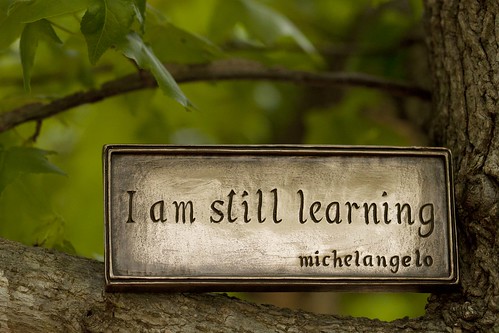
Image: Learning (Photo credit: Anne Davis 773)




 judyoconnell.com