Now go collect!

If you like organising your things, and maybe even cataloguing things….if you like Library Thing, and if you are a collector of things, then Squirl might be the place for you.

Just this weekend I have been musing over my vast CD music collection, and thinking that a Library Thing approach to my CDs and even my vintage collectibles wouldn’t be such a bad idea!

So being alerted to Squirl seemed timely and ‘kinda fun!’ Now I just want to see how many of my Library Thing friends make the jump! You have the option of creating a public or private collection, and a number of templates are provided. Squirl also incorporates the option of organising your book collection too – good if you want to keep things that you organise within the same management space.

Web 2.0 Sushi train moves on

After spending an exhilerating couple of days at the Global Summit, I am happy to say that the opportunities for more learning haven’t stopped yet. Now it’t time to dip into the K12 Online conference which is already well underway.

Nevertheless, the roundup of the Global Summit has been a bit hard to track, therefore for anyone who missed out finding or following the Global Summit, here is the link that will give you all the papers, presentations, podcasts and related links. You’ll want to save some of these for later!

SummitPapers

But for now, if you haven’t already caught up with the news of the K12 Online Conference, go to it now! There has been some criticism of this initiative by some blogosphere gurus.

My take on this is that they are great leaders, but perhaps they could do with some grassroots involvement to see how important the material coming out of K12 online is for teachers and people like myself working with teachers who are wanting to learn more about Web 2.0.

I have promoted K12 Online to my schools – and at a Web 2.0 Workshop I ran last week was delighted to find that some teachers had picked up on the promotion, and were ‘cherrypicking’ the conference papers – and were very pleased with the information they were getting. I guess Stephen’s pessimistic comments aren’t true – at least not ‘downunder’.

I want to really thank those people who put up such great material in Week 1. This hands-on, step-by-step compilation of training and motivation via Web 2.0 is terrific and just what we need! I am not a great fan of online conferences personally, simply because I find it hard to follow online along with my usual busy day at work. But being able to pull down all the material during or after is ‘just the ticket’.

So the Web 2.0 sushi train has goodies from the Global Summit, and now K12 Online. Very nice thank you.

Some further thoughts.

I really like the idea of ‘grass-roots’ driven professional learning. After a couple of school terms promoting Web 2.0 via a number of routes, I am delighted to report that people are now ‘asking‘ to have a hands-on workshop – not formal training, but a ‘sandpit’ ‘lets learn this together’ approach.

In keeping with the informal but informative approach, and using Web 2.0 tools exclusively, I have begun to use delicious (with the tag ‘training’) (includes the link to set up the IE extension as part of the workshop – nice one!) and flickr to provide materials for these sessions – the point being that I provide these at the same time as working with folks to set up their own social bookmarking, and discovering what photosharing can do. Another one coming up this thursday….hard to keep up with the demand 😉

In addition, I held a full day session with school leaders of the Stanhope School Project – involving 3 schools. Greg Whitby was interviewed by Leigh Blackall about this. We have actually started the journey of change and this workshop was one of many more sessions to come. You can pick up a very short, very rough record of the day at Heyjude’s BlipTV.

Learning Agenda Web 2.0 style

While some of my colleagues are at the Australian Computers in Education conference in Cairns, I am catching up on another batch of marking for Charles Sturt University before flying out to HongKong for a very well earned rest. When I get back it will almost be time for the Global Summit, where I hope to see a few of my fellow bloggers.

John Connell will join us at Catholic Education, before the Global Summit, ‘in conversation’ and to inspire us with his work in Scotland. Might have a podcast to share afterwards if John is happy with the idea. If you haven’t dipped into John’s blog, I highly recommend it. I have no idea how one person can think and write so much, but be assured that you will be challenged by the diversity of his posts.

I’ve been doing some writing for the office in the last couple of weeks, teasing out ideas around future directions and our learning agenda. One concept that has tested thinking for a few people has been around the whole issue of learning management systems (LMS) and virtual learning environments (VLE). Funnily enough some of my colleagues get stuck on debating semantics and how to describe systems that we are rolling out for our schools. As if describing the system will somehow make it more worthwhile or more relevant?

In fact, what we should be focussing on is the Web 2.0 world of our students and their personal learning environments (PLE). Remember, its a combo-world. In Macca’s sales speak – we are constantly ‘upsizing’ and offering ‘fries with that’ because we have to!

Today we can deliver TO student expectations beyond the LMS and VLE that have emerged in recent times as the answer to learning for a 21st century technology world.

The emergence of Web 2.0 and social software moves us beyond the use of integrated LMS or VLE to social networking and education immersed in the future world of our students. No use debating which LMS to buy, or what a VLE is! Understand MySpace and you will understand the shape, meaning, value, future directions of student learning.

In fact, any discussion of the educational value of LME or VLE, and the integration or separation of social software must must be grounded in new ‘MySpace pedagogy’ and must include a genuine understanding by educators of the Web 2.0 world of our net-savvy students.

I suggest that we need a combination of a number of tools: a management system, personal tools and social networks. Our integrated solution requires this personal learning environment, because the very nature of what our students do and how they use online spaces extends their learning beyond the classroom and the present …. right into the future …. for life and for lifelong learning.

In fact, ‘Web 2.0 as platform’ is the natural implementation and platform for 21st century learning.

It’s time to dream the impossible dream and leap beyond the context of our current understandings.

Flexibility and personalisation are at the core of our re-purposing of education. If students think about the internet as a virtual locker, backpack and notebook, then we must create flexible learning environments which support the use of multipe resource tools, including Web 2.0.

If we do this, then we will have a learning framework that is Web 2.0, 24/7, global, contextual, personalised, real, physical, virtual, and visceral.

We’ll help our students be passionate about their personalised learning!

Now, off to HongKong 🙂

MySpace additions – wow networking!

Following up from my post on Social Networking Explained

…..it is good to find that my group of schools will be encouraged to take a more postive approach to the value and purposes of social networking right down to flexible use of MySpace.

Back on Tuesday 17 May at a K-12 School Library network meeting, Jan and myself raised the matter of MySpace and tried to encourage people at the meeting to take a positive view of the opportunities that MySpace represents. My post MySpace and School Libraries resulted in some feedback to me from some teacher librarians saying that they had changed their view of MySpace and were now looking at how to develop a better approach.

So of course this recent post by Jane’s E-Learning Pick of the Day on Zapr reminded me of the highly flexible possibilities that MySpace or similar offer.

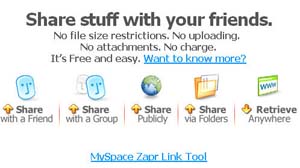
zaprEasy communication and transfer of information is what MySpace is all about. Zapr includes a MySpace Zapr Link Tool . Zapr lets you create links to any files on your PC. Then you can send these links to friends (via email or IM) and they can get the files directly from your computer via their browser.

Is this important. You bet! Jan at Delaney College explains that students are using MySpace for storing their learning ideas and learning resources. They are bamboozled when they get to school and suddenly can’t access their own work, their own files, and continue right on with the learning from where they left off the night before.

You might like to add Jan’s del.icio.us to your network, or Jan’s del.icio.us work with teachers to your network. Thanks to Jan for sharing her enthusiasm.

Creative Commons and Second Life

Apologies for cross-posting – but this is too cool not to share 🙂

Creative Commons – this is important for educators. Creative Commons and Second Life combo – gives us an amazing digital event.

From the Creative Commons blog:

Mark your calenders: On Thursday, September 14 at 5PM (SL/Pacific), PopSci.com and Creative Commons will be hosting a special concert in Second Life featuring Jonathan Coulton as well as popular Second Life musicians Melvin Took, Kourosh Eusebio, Etherian Kamaboko, and Slim Warrior. From Jonathan Coulton’s blog:

I will be playing live from a secure, undisclosed location in the real world, but you will see my handsome avatar onstage at a venue called Menorca in the Second Life universe. You can also listen to the concert via a number of streaming type websites … The whole concert, audio and video, will be Creative Commons licensed, so feel free to record it.

More information is available on this wiki. We’ll post more information on the CC blog as soon as it becomes available.

Literacy and learning

This morning I have gone back to an article I wrote -seemingly before the dawn of time – well, before the dawn of the internet as we know it, and Web 2.0. I said that we need to examine literacy directly in relation to thinking, and as a tool for learning and the creation of meaning. In other words ‘meaning’ is an aspect of literacy. It is both context and content specific, and is with regard to something, some aspect of knowledge and experience.

To quote myself correctly this time:

Literacy has a specific cognitive dimension, and is a powerful enabling mechanism for thinking and learning. Through the skills of literacy, conscious and deliberate exploitations of text are possible, so facilitating a more abstract, reflexive stance towards information and the processing of meaning.

The problem is of course that since I wrote this much has changed and there are a plethora of ‘literacies’ that are discussed – sometimes in isolation from what I think of as the core concepts of literacy. This is to the detriment of the essential and fundamental purpose of literacy – creating, developing, understanding and sharing meaning!

I really liked the thoughts expressed by Ulises A. Mejias (discussed by Will Richardson and James Farmer) on Social Literacies.

The word literacy is used loosely these days to define all sorts of competences (viz. visual literacy, musical literacy, computer literacy, and so on). Here, I am using Kress’ more exact definition: literacy as the “term which refers to (the knowledge of) the use of the resource of writing” (2003, p. 24). This definition makes it possible to separate literacy from other resources (such as speech), as well as other ‘metaphorical extensions’ of the concept (such as musical literacy, cultural literacy, etc.).

He discusses wiki which make social literacy apparent by allowing us to witness the evolution of text in time, an evolution that reflects the decisions not of a single individual, but of a community.

Thank you! The powers unleased through the invention of printing have enabled thinking… by sharing. For me the fact that we can do this sharing simultaneously and online is not so revolutionary as evolutionary – particularly if we remember that our Web 2.0 literacy is “as the continuation of the struggle that began when Guttenberg released free speech first in our tradition”.

So I don’t totally agree that Wikis engender a new form of literacy: a social literacy. New framework? Yes. But what we are seeing is the actualisation of the full possibility of our literacy potential which began with Guttenberg and which was essentially about social communication as well as information dissemination. Having said that, the social literacy of Web 2.0 tools IS creating a renaissance in our time that will be reflected in creative changes as dramatic as the original Renaissance.

Anyway, to top it all off, I have to express my thanks to Stephen Downes for his post Things you really need to learn. While I’m rambling about literacy and the way it underpins everything! Stephen has given us yet another throught-provoking read that digs into learning.

He switches us over to consider in a deep way what literacy is about: description, arguement, explanation and definition. Yes, these emerge from core literacy and can translate to any context or environment we choose – and as you develop your literacy you are in fact doing what Stephen describes as creating ‘patterns of connectivity’ in your brain ………and enhancing what I understand as the capacity for cognition and metacognition.

This capacity for cognition and metacognition is for me the purpose and value of literacy acquisition, development, and extension in old and new contexts.

Web 2.0 as platform

Vision is one thing, but getting down to it and doing what’s needed to unite 32 local authorities to create a fully authenticated national learning community is quite another!

The latest podcast from John Connell says it all! In addition to describing the growth of the Scottish Schools Digital Network and its next phase of implementation through GLOW, we are given an execellent overview of social software, purposeful learning, current technology developments and future capabilities of “Web as platform”.

….the time will come sooner or later where all I will need to be fully productive will be a number of browsers, possibily just one, the device interface itself will simply be the browser.

Tracking the seemingly daily developments in web apps it is easy to see this ‘future’ rushing towards us. However, John’s observation that Web as platform will contribute most to closing the digital divide is of particular interest and worth hanging out for.

With bandwidth and infrastructre costs, coupled with problems of distance, Australian school communities will be real winners in this new environment. But for now Australian school systems struggle with delivering standards that match the SSDN and GLOW developments. While individual schools have faced the challenges head on, and systems have done various things in different parts of the county (some very effective), the country as a whole will find it very difficult to match the Scottish initiatives for quite some time.

This podcast is well worth a listen!

Social networking explained

I know many teachers I talk to struggle to understand what the social networking world of MySpace etc is really all about. Even if our teachers see students accessing MySpace or similar sites, what this social networking software augers for the future is beyond their ken.

So Facebook – the complete Biography from Mashuble is a very useful document – the sort of thing that you can hand out or email to teachers to read. Teachers understand biographies!

What is worth noting is the shift in communication patterns. Teachers and parents will tell you that kids live on msn or other instant messaging. Yes…and more…..

I am just waiting for an aussie to post a message about social networking behaviours, like this one from Bokardo

I recently talked with a father of a MySpace user who said that he tried to email his daughter using regular email and she never responded. He asked her why and she said, “I use MySpace for email. Send me mail there”. So he created an account and now he messages her there. Wow.

I would like to find out more about school email accounts and what kids think about them. Are we applying a digital version of “desks in rows in the classroom” approach to our school communications? How do we expand out thinking in this?

Teacher as Learner in Web 2.0 – doing it!

Scan is a quarterly journal produced by the NSW Department of Education and Training which focuses on the interaction between information and effective student learning.

Scan contains articles on:

  • teachers and teacher-librarians collaborating
  • information literacy and supporting reading
  • integrating ICT (information communication technology) in teaching and learning
  • practical programming and teaching ideas
  • practical ideas for library management.

Thanks to the up-to-the minute relevance of this journal, and a fun morning of talking enthusiastically about Web 2.0 – I ended up being asked to write an article about Web 2.0 for them. Lucky!

I did that, and wrote it for our teacher learners who are still going to wake up one fine Web 2.0 morning and discover there is a new world out there.

For those who don’t have access to the article, Engaging the Google generation through Web 2.0 you can get a copy here or from the Resource section of this blog. Usual copyright and correct attribution rules around use of this article apply, being printed in SCAN Vol 25 Number 3 August 2006.

Remix epitomises Web 2.0

A concept I like to present when doing professional development about Web 2.0 is the idea of “remix”. If we look at millenials, we see that all their digital actions are associated with remixing and personalising of music, video, pictures, information – whatever really!

So the reappearance of Writely as a Google product, is another example of a writing tool that allows students to cut and paste, as well as combine and create, all in the one online tool. It features collaborative editing — multiple editors on the same doc at once — and can be used as the editor for writing your blog, saving out to a post instead of a file on your machine.

Writely – the Web 2.0 word processor is now accepting signups again.
We cannot escape ‘remix’ – nor would I suggest that we should! What is more critical is that educators come to better understand the shifting agenda in this ‘remix’ culture, and appreciate the strength of this approach and integrate it into our educational aims. Of course we have to work out what this means – and how ‘remix’ can be about developing creativity, fostering critical thinking, collaboration, and knowledge creation.

So a post on this topic from Sheila Webber is timely, as she alerts us to to the fact that Colin Lankshear and Michele Knobel have generously posted Chapter 3 (“New literacies: concepts and practices”) of the forthcoming 2nd edition of their book New Literacies http://www.geocities.com/newliteracies/ and on their blog they had also posted Chapter 4 (“New literacies in everyday practice”) as well.

Three experts from Part 2: New literacies in everyday practice make a good summary of my views on ‘remix’:

Until recently the idea of ‘remix’ as a practice of taking cultural artifacts and combining and manipulating them into a new kind of creative blend was associated almost entirely with recorded music.

While this remains the dominant conception of remix, its conceptual life has expanded recently in important and interesting ways within the context of increasing activism directed at copyright and intellectual property legislation.

We accept this conceptual extension of ‘writing’ to include practices of producing, exchanging and negotiating digitally remixed texts, which may employ a single medium or may be multimedia remixes. At the same time we also recognize as forms of remix various practices that do not necessarily involve digitally remixing sound, image and animation, such as fanfiction writing and producing manga comics (whether on paper or on the screen).