Google proof your image attributions

Often, you are in a great need for some pictures to freshen up your webpage and would like to include one of these images. If you want to do this, there are quite a lot of steps necessary:
  • Make sure you understood the license correctly
  • Get the correct HTML code for the IMG tag
  • Link the image back to the Flickr photo page
  • Give the author of the image proper credits (Attribution)
  • Link to the Flickr profile of the author
  • Link to the license the image is licensed under

Flickr currently hosts more than 75 million images that are licensed under a Creative Commons license.  Depending on the license, you may use the images on your private or commercial webpage, or make changes to it.

ImageCodr solution

With ImageCodr.org, there is no need to do all this manually!!

You simply grab the URL of the picture page that you are interested in.

Drop it into ImageCodr.
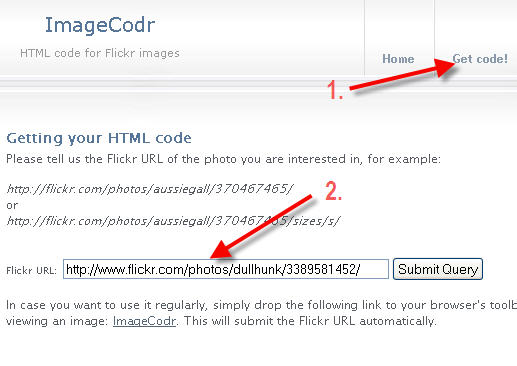
Then ImageCodr.org will generate the ready-to-use HTML code for you to drop into your online platform of choice.

It will also display a brief and easy license summary, so you don’t get in legal trouble because you missed something.

I know that students (and teachers) just like to copy and paste images from anywhere into anything. But we really can’t afford to miss the opportunity to teach our kids real digital citizenship skills even if it’s just about how to use images.

From small acorns, big trees grow! What seeds are you planning on help grow today?

Well, that’s done!

Yesterday I came to the end of a rather hectic 3 years at St Joseph’s College, having filled the role of Head of Library and Information Services.
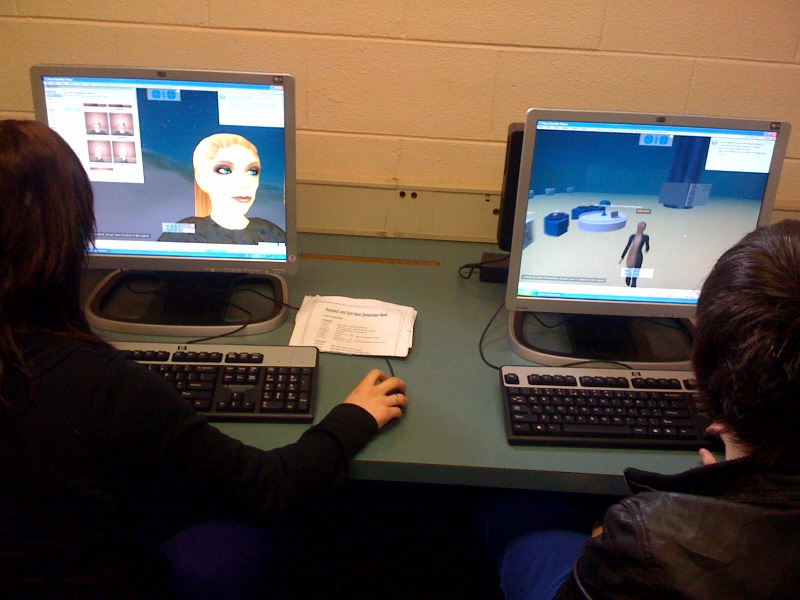
At my farewell the Headmaster, Ross Tarlinton,  explained to all the  major brief  he had gave me in coming to the position.  He looked for the renewal of the College library as a Centre of Learning – and this required pedagogical and physical changes.

He acknowledged that the journey was not easy! But he was delighted that we had made it and that recently he was pleased to be interviewed about our developments at the College.

While it was certainly an exciting challenge, and one that I am proud to have been able to undertake, it’s also an era of my life that I am very glad to see come to an end.  I have many stories to tell (happy ones and sad ones)  and many experiences to share.

But all that will have to wait for another time, another cup of coffee.

In 2011 I am off to my new role as Lecturer in the Faculty of Education with Charles Sturt University. I’ll be joining a wonderful team of educators in the School of Information Studies, and am really looking forward to working with teachers and teacher librarians in schools, helping them bring the best out of the learning environments that they find themselves in.

Until I have my  image portfolio better organised, here are some before and after photos of our makeover to share!!

THE PICTURE STORY

This slideshow requires JavaScript.

You can always find the full set at HeyjudeGallery.

eXtending the Web – a gaze into the future

The Virtual World of Gifted Kids

Following my last past on virtual worlds and their place in the learning environment in our schools, I was pleased to learn from James Corbett about  an Irish initiative in primary schools that also provides a source of inspiration to us ‘downunder‘.

Daynuv is  an Irish social enterprise working in partnership with GiftedKids.ie in  primary schools  to bring virtual worlds into education. Not surprisingly, they are seeing some tremendous results.

At the Gaelscoil Eoghain uí Thuairisc in Carlow, Ireland where lessons are taught in Irish they are implementing the use of 3D technology for the learning support of gifted children. This is the first time that this technology has been used in Ireland to teach part of the school curriculum. The interactivity and detail of the 3D technology means that anything you can do or build in the real world can be replicated in this virtual world.   The Virtual World of Gifted Kids.

Now that their pilot program has been a success they are  planning on rolling the project out nationwide in 2011 and  will be  looking to make links with schools internationally. They use Opensim too,  which has the  advantages of the Hypergrid protocol which makes possible the option to teleport ( have  virtual field trips) between schools. Using Opensim, schools can safely collaborate with each other, and grow their virtual networks at a pace that suits their student’s own learning needs.

It’s  great to see groups and organisations helping to promote virtual worlds learning environments!

Virtual Worlds are genuinely real spaces for learning

The school year is rushing to an end. Amazingly, we’re soon closing off the first decade of the new century that was going to be our hallmark of innovation and change. We promised ourselves we would put industrial models of schooling behind us.

For some this leap into new modes of learning is more than they can take on. For others it’s the natural extension of what learning has to be for our connected, mobile-enhanced learners.

I hope the next decade brings magical things for us all.

One thing we know is that we need to bring ‘out of school’ gaming and virtual worlds activities into the daily learning cyles of our students. We need to bring back the connections between school and home, and be prepared to provide environments that are authentic to the technology use of our students.

Here’s an article titled Virtual Worlds are genuinely real spaces for learning which I’ve had published in the recent issue of Access, the national journal of  the Australian School Library Association.   Have a read!

Thank you to my various friends and colleagues who so willingly shared their knowledge and information about their own explorations of virtual learning environments.

Kids of Dreams – 2010 marks 21 years!

This slideshow requires JavaScript.

It’s not long since our wonderful Friday evening launch and celebration of the 21st edition of our annual Kids of Dreams publication which celebrates literary and artistic talent. Student’s  prose, poetry and artwork from Years 7-12 are included in the publication.

It was an amazing night! Why?  Well it was ‘special’ for a number of reasons.  I was the main editor of the production this year, along with my wonderful Teacher Librarian colleague Kirsten Reim (who wrote a wonderful editorial for me), supported by my ever efficient library team. We came to the job a little late this year, so it was a complete scramble to the end, making sure that everything was as right as possible.  So much writing, so much art, so many decisions about layout and presentation. It was an amazing and rewarding experience to be able to work on a publication that showcases the work of our students who have the courage to speak up in artistic forms.

Author Brian Caswell provided the judging of the student’s literary works. Brian was Writer in Residence at the College earlier in the year.  Brian’s comments for each item he chose for an award are worth reading – so much so, that this year I included the judge’s comments within the publication itself  as a record of achievement for the students.

Kids of Dreams was  launched on Friday 19th November with the help of my talented Twitter friend Mark Pesce (inventor, writer, theorist, panelist on #newinventors, obsessed with language, communication, social networks).  I was able to tell the audience that Mark was the first VIP guest to come to the College as a result of an invitation arranged through Twitter!

Mark provided an inspirational keynote/official launch presentation – and focussed on the power of creativity to drive our learning and thinking. Creativity and inspiration is inside us all, and around us every day. How we harness these talents and opportunities is up to us, and how we share them with others is the key to change and development of value in all we do.

Hey! I never thought I would be MC at an event with Mark!!  Thanks very much Mark for making out 21st celebration a stunning success.

Australian School Library Review – wow!

Australian Teacher Librarians and school libraries,  received some good (awesome!)  news today from Australian House of Representatives Liaison & Projects Office.

The media alert outlines the preliminary details:

School libraries review relaunched

The House of Representatives Standing Committee on Education and Employment has been asked by the Federal Minister for School Education, Early Childhood and Youth, the Hon. Peter Garrett AM MP, to complete an inquiry into the role, adequacy and resourcing of school libraries and teacher librarians in Australia’s public and private schools, that was begun in the previous Parliament.

The Terms of Reference require that the Committee specifically focus on:

  • the impact of recent policies and investments on school libraries and their activities;
  • the future potential of school libraries and librarians to contribute to improved educational and community outcomes, especially literacy;
  • the factors influencing recruitment and development of school librarians;
  • the role of different levels of government and local communities and other institutions in partnering with and supporting school librarians; and
  • the impact and potential of digital technologies to enhance and support the roles of school libraries and librarians

Announcing the inquiry, Committee Chair Ms Amanda Rishworth, MP, said, “The Committee is very pleased that this matter will be revisited by the new Education Committee. Teacher librarians make a significant contribution in our schools and we look forward to sharing our findings on how to enhance this valuable community resource. ”

The Committee will have reference to all the written submissions and evidence gathered at public hearings conducted by the former Education Committee in the previous Parliament.

QR code infographic

According to Nathan King at QR Code Awareness, mobile devices have changed the way consumers access the Internet as well as the way marketers are trying to reach customers. QR codes – which direct you to a website, phone number, SMS or other call to action when scanned with your smartphone – are showing up everywhere.

Although QR codes and mobile barcodes have been around for several years, the explosion of the smartphone market allowed barcode scanning to grow 700 percent from January 2010 to July 2010.

I’ve started spotting them on the back of  new books that we are buying for students!  I haven’t spotted anyone scanning the QR code as yet 🙂

Twenty things I’ve learned in Twitter

I really like this great presentation from Rodd Lucier, Canada!

Sink your iTeeth into Dracula

Prepare to sink you teeth into the most immersive iPad experience with Bram Stoker’s  Dracula – released in time for Halloween! Phil Bradley explains:

I have to say that it’s absolutely tremendous, and I’m really enjoying it. My one gripe is that it’s abridged, which is annoying. However, once you get over that, the way in which the iPad has been used to emphasis the text is fantastic. I’m reading about Harker’s coach trip, and I hear the sounds of the horses hooves and the wheels going over cobbles. I see that he has a letter, and I can flick the envelope onto the screen, open it, and read the handwritten letter. There’s a description of Renfield and his flies, and you hear them, and see their shadows buzzing over the page. It’s absolutely fascinating.