LazyFeed – lazy and productive

I admit to being a web wanderer – lazy random browsing in the topic areas that interest me is wonderful,  and it’s amazing what new things you find, what you can enjoy, and what you can learn. My RSS reader is  ‘chockers’ – so I can’t just keep adding possible feeds for reading.

Rather belatedly  I’ve also discovered LazyFeed.  Perfect!

If you are more into tracking stories on a particular subject like technology, music etc rather than tracking specific blogs then LazyFeed could be the tool you need. You just need to sign up and add your favourite topic…. via MUO.

I’ve been using it for a few months now, and just love the flexible way of trawling on my favourite  topics. OK, it’s not going to aggregate and store the same way as my RSS reader (Google + Feedly) but it’s going to keep sifting and providing an online reading experience for me any day that I want to drop by!

According to the founder, LazyFeed is like instant messenger for your topics. It’s a tech tool that suits the slow adopters of technology! Got some nice enhancements in January too!

Another recommendation came my way via @RadHertz.

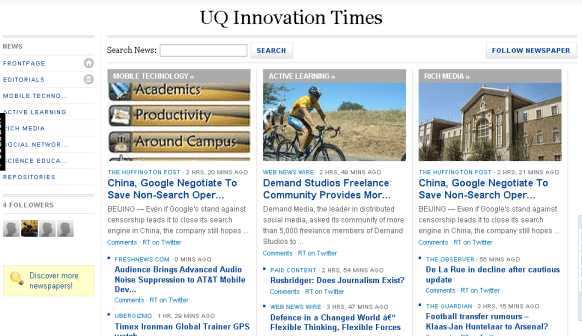
NewsCred lets you launch an online newspaper in minutes. Cool!  Read more about this from Louis Gray.

Here’s an example from UQ Innovation Times.  Nice :-).

A novel way to cover your MacBook!


A novel way to cover MacBook.

The real story. No two are alike.

Each BookBook is brought to life with hand craftsmanship and distressing, ensuring no two are exactly alike. From dual zippers with leather pulls, that at first glance look like bookmarks, to the sturdy reinforced hardback covers, BookBook is a vintage work of art built to protect modern day Macs.

I think I would like to see one of these in real life 🙂

Starwars ~ fine bit of whimsy

Last day of the school holidays – yes indeed! Tomorrow is the first day of a new academic year.  Surely that makes it a good excuse to share a bit of starwars fun to round off the summer holidays.

Stormtroopers 365 is a funny collection of daily shots of StarWars Stormtroopers. Some of these really are funny and the collection is a great bit of whimsey.

Stormtroopers 365 is a photo project starring TK455 and TK479, Stormtroopers in the Galactic Empire Army. The project began on April 3rd 2009 and should end on April 2nd 2010. Each day during this year, a new picture is added to the series. The pictures are posted to Flickr. This is where you need to go. You can also go to the Gallery page here but honestly that’s the same, you’ll eventually end up on Flickr. Face it, there’s no escape.

I’m having fun with Star Wars weather forecast today as well – and posted a screen shot from my iPhone to my 2010 photo blog too.

Time to dig out my StarWars mousemat I think!

World Data: Keeping governments accountable

Data, data, data. There’s loads of it out there and more coming your way as governments open their statistics vaults around the world. First the US with data.gov, then Australia and New Zealand followed suit. Now it’s the UK’s turn with data.gov.uk.  (via Datablog)

Berners-Lee said about government data:

the public has in effect already paid for it through taxes; people can find patterns in the data that might not otherwise be obvious; and there is huge potential for new businesses, which would bring in tax revenues.

There are  now many sites around the world providing  access, but how can you find them?

Simple!  Just go to the  World Government Data Store!

At World Government Data you can:

• Search government data sites from the UK, USA, Australia, New Zealand and London (this comes under United Kingdom, if you want to browse) in one place and download the data (more sites to come)
• Help us find the best dataset by ranking them
• Collect similar datasets together from around the world
• Browse all datasets by each country

Each country has their own entry portal to the World Government Store as well.

Australia: data.australia.gov.au

New Zealand: data.govt.nz

UK: data.gov.uk;

London, UK: data.london.gov.uk

Many States in the USA.  Will any European countries join this endeavour?

Keeping governments accountable!


Vodpod videos no longer available.
more from Tim Berners-Lee about UK’s free data website, posted with vodpod

Understanding games education – an open (re)source

ETC Press is a publishing imprint with a twist, being interested in the participatory future of content creation across multiple media.

Great credibility and open source  adds up to a great way to transform learning!

ETC Press  is an academic, open source, multimedia, publishing imprint affiliated with the Entertainment Technology Center (ETC) at Carnegie Mellon University (CMU) and in partnership with Lulu.comETC Press has an affiliation with the Institute for the Future of the Book and MediaCommons, sharing in the exploration of the evolution of discourse.

ETC Press also has an agreement with the Association for Computing Machinery (ACM) to place ETC Press publications in the ACM Digital Portal, and another with Feedbooks to place ETC Press texts in their e-reading platform. Also, ETC Press publications will be in the ThoughtMesh.

ETC Press publications focus on issues revolving around entertainment technologies as they are applied across a variety of fields.

Thanks to a tweet from @lernys I’ve now happily downloaded a copy of Ludoliteracy: Defining, Understanding, and Supporting Games Education, by José P. Zagal.

[cover thumbnail]This is free and looks like a very worthwhile read. Grab yourself a copy.

Book Description:

It seems like teaching about games should be easy. After all, students enjoy engaging with course content and have extensive experience with videogames. However, games education can be surprisingly complex.

This book explores ludoliteracy, or the question of what it means to understand games, by looking at the challenges and problems faced by students taking games-related classes. In response to these challenges, this book then describes how online learning environments can be used to support learning about games by helping students get more from their experiences with games, and helping students use what they know to establish deeper understanding.

Based on the findings from a series of research studies, Ludoliteracy examines the broader implications for supporting games education.

Check out more Current Titles on games, media, design, communications and social networks.

Sweet Search: search tool for students

Most search engines search billions of Web sites and return tens of millions of results; some are from reliable Web sites, some are not.  SweetSearch searches only 35,000 Web sites that have been evaluated and approved by a staff of Internet research experts at Dulcinea Media, and its librarian and teacher consultants.

SweetSearch allows students to choose the most relevant result from a list of credible results, without the distraction of unreliable sites.

SweetSearch may be worth testing to see how it compares with the Australian Study Search – a custom Google search tools for Primary and Secondary schools.

(via AltSearchEngines)

The Art of (old) Books – publishers’ bindings

Publishers Bindings Online, 1825 – 1930: The Art of Books is a wonderful gallery of decorative bindings with supporting essays.

The aim of this digital collection of decorative bindings, along with a comprehensive glossary and guide to the elements of these objects, is to strengthen the growing interest in and create broader awareness for the “common” object called the book.

The digital galleries of bindings  reflect distinct eras, geographic locations, and single authors and titles. They are useful for learning about aspects of 19th- and early 20th-c. American history, life, and culture.

You may just like to browse the Artistic Movements Galleries. Publishers bindings are an interesting way of exploring the advent of modern art and the impact on the artistic styles of the time on book design.

Also includes historical galleries; literary galleries; teaching tools and lesson plans; research tools and bibliography resources.

Worth a visit!

Mobile Medline Plus ~ shows us the way

So why haven’t more libraries adopted mobile tools? asks Eric Rumsey as he considers the advantages of mobile friendly design on iTouch/iPhone or like devices.

I agree –  we do need to get on the mobile wagon as quickly as we can. There are many popular mobile compatible sites these days, and blogs are well-optimised on the mobile too. WordPress is a great platform for achieving an integrated look in relation to this, and the mobile-based management tools for WordPress is also impressive.

So it was most interesting to read  Mobile Medline:Plus: A Great Example for Libraries. The mobile version of MedlinePlus that was released by the American National Library of Medicine last week is an elegant example of  libraries making their sites mobile-friendly. Eric gives a good run-down of  MedlinePlus on the mobile.

Eric is on Twitter @ericrumsey

photo910772

I confess – I access a lot of things via my iPhone instead of on a regular computer. The portability and immediacy of access is irresistibly convenient.  Whether this is a good thing or not is vaguely irrelevant – the mobile is embedded in youth behaviours.

Anyone got a good example of this kind of application in schools or school libraries?

Better get our blogs and information services mobile minded soon!

Give credit where credit it due

Another year of school and the vital need to think through ‘plagiarism’ rears it’s ugly head again – particularly as the Open Content movement gains strength. The recently released Horizon Report 2010 explains:

A new educational perspective, focused on collective knowledge and the sharing and reuse of learning and scholarly content, has been gaining ground across the globe for nearly a decade. Open content has now come to the point that it is rapidly driving change in both the materials we use and the process of education. At its core, the notion of open content is to take advantage of the Internet as a global dissemination platform for collective knowledge and wisdom, and to design learning experiences that maximize the use of it.

Collective knowledge and wisdom depends on one thing though – giving credit where credit is due, whether it is courses, information, ideas, inspiration, motivation, etc. In fact, development of knowledge and scientific research has always depended on this.

But with the global reach of information and info-trash the ‘times, they are a changing‘.  Misinformation can become information. Knowledge can too readily become bias. So learning to give credit where credit is due is a critical and essential information fluency skill for our students to acquire.

Creative Commons

Let’s demonstrate to our students how easy it is to acknowledge inspiration in an online learning world. It takes a quote or a backlink – that’s all. What does it achieve?  Well, first and foremost, it builds learning conversation and creative endeavour,  and secondly it demonstrates that a learner is able to analyse and synthesize thinking from a global repository of possibilities. Sharing is so important, but so is sharing openly and inclusively.

It’s so easy to plagiarise, and call something your own!

Well why not, you might ask? Mashup? what’s wrong with that? There’s plenty of that around and it doesn’t really hurt does it?

Let’s face it, if I take myself as an example – I’m one in millions writing online. What does it matter if someone takes what I say and publishes it in China, or Russia or Timbuktu. Not much really, other than it misses the chance to develop better resources or better information about a topic.

However, educators and managers of technology supporting educational institutions online  understand the need to build that online info-puzzle together. We’re a big crowd with the potential to influence things!

That’s where book publishing and refereed journals  still have it ahead of the internet at this point in time – up to a point anyway. In addition, the notion of acknowledging ideas is a tradition in Western scholarship which for me has value in building credibility, personality, creativity, knowledge, and quality facts.

[Of course, what I’m talking about here is a very simplistic peek at the much more complex topic of knowledge  sharing which is at the heart of what we need to introduce our students to. Do drop over and read  If We Can’t Even Describe Knowledge Sharing, How Can We Support It? A nice ‘peppery’ look at the complexity of knowledge behaviours.]

How can we change the tendency in an online world to ‘copy and paste’ what suites for personal profit or gain?

Together, let’s entice our students into being captivated by the amazing opportunities that online learning presents. Introduce them to Creative Commons Licensing. Make sure that when they grow up they understand the power of the “By licence” (via Beth Kanter).

Teach your students the wisdom and value of giving credit where credit is due.

Subscribe

If you are enjoying reading this blog, please consider subscribing to my RSS feed. Thanks for visiting!

Espresso on demand – and that’s not coffee!

Xerox has entered the 21st Century publishing game, reaching a joint selling and marketing agreement with On Demand Books— the company that makes the amazing Espresso Book Machine that can churn out a book in a few minutes. There are only 21 stores and libraries that currently have the machines, but through this agreement, you can bet you’ll see more of them. On Demand hopes to get 80 machines in the world by the end of 2011.

(via GalleyCat and @creativepenn)

The Espresso Book Machine