Participatory culture through wikipedia

Leigh Blackall : Keynote address: Thursday : From the Navcon07 conference, Generation.com. Where to next? Gosford, Australia.

Leigh’s keynote covered a range of topics – all designed to show how a participatory culture is what will turn learning around – whether through wikipedia or good use of Creative Commons, or more. It was really interesting to hear Leigh talk about Otago Polytechnic, and their shift to Creative Commons for the production of all their learning materials.

Nice one! Bit different from what happens in schools now – and really worth thinking about. All part of the Open Source movement of course – but this is not yet in the discussion horizon in most schools yet. Hopefully the pieces will fall into place sometime soon.

Leigh focussed on modernism and postmodernism, and points to his notes here:

modernism and old schools

  1. A state of mind
  2. Fascism
  3. Access DETnied
  4. Memex

Postmodernism and new schools learning

  1. Deschooling Society
  2. Pedagogy of the Oppressed
  3. Groups and Networks
  4. Individualism and the best and worst of times.

Models?

  1. Loganlea State High – Jenny Shale
  2. Catholic School – Greg Whitby
  3. New American School House
  4. Youtube in school
  5. History of Social Software

Here is Leigh in a snippet about participatory culture enabling learning…..

Image: The pieces are falling into place.
  • Love your wiki – wetpaint style!

    Instead of focusing on the mechanics of a wiki, this video from Commoncraft Productions is much more about how a wiki can become an expression of passion and why someone would want a wiki.

    AND Wetpaint released a Facebook app that enables Facebook members to create full Wetpaint wikis within Facebook. Very cool!

  • Those “iBook” options just keep getting better..

    litgo.jpg I’m more and more impressed by the options available to provide good reading and literature options in iPod format.

    Lit2Go is a free online collection of stories and poems in Mp3 (audiobook) format. You can:

    • Download the files to your Mp3 player and listen on the go,
    • Listen to the Mp3 files on your computer,
    • Download the files directly into iTunes,
    • View the text on a webpage and read along as you listen,
    • Print out the stories and poems to make your own book.

    Extensive database provided by Florida’s Educational Clearninghouse – and growing all the time.

    Brilliant!

  • Blade Runner – A classic cut restored

    I list Blade Runner as my favourite movie in my Facebook profile. So naturally I am pretty interested in the release of “Blade Runner: The Final Cut” on DVD.

    IT’S been 25 years since the release of “Blade Runner,” Ridley Scott’s science fiction cult film turned classic, but only now has his original vision reached the screen.

    The film, based on Philip K. Dick’s novel “Do Androids Dream of Electric Sheep?,” takes place in Los Angeles in 2019. It follows a cop named Deckard (played by Harrison Ford) who hunts down androids — or, in the film’s jargon, replicants— that have escaped from their slave cells on outer-space colonies and are trying to blend in back on Earth.

    For the new director’s cut, the special-effects footage was digitally scanned at 8,000 lines per frame, four times the resolution of most restorations, and then meticulously retouched. The results look almost 3-D.

    The story also takes on some new twists and turns , providing a darker perspective of future society – read more at the New York Times, and be sure to view the FilmFuture clip with Fred Kapplan’s commentary of the future as depicted in Blade Runner.

    Likely to be an even more hypnotic and challenging movie! A media studies must!

    Yes, via boingboing 😉

    A directory of wonderful things

    For our schools it is time to take a well-earned break with the term 3 holidays now underway. So it’s time for me to have a bit of fun on this blog too before I get back to more serious matters….

    Time to talk about wonderful things…boing boing style …. prompted by my lightweight breakfast reading of the Sun Herald (no, not my choice of paper).

    An article there about a device that creates plates, bowls and other tableware on demand and recycles them (a Star Treck fan like me recognises this!) , produced as a prototype by MIT led me to comment “I bet they got that from boing boing!”

    A little research showed me that Boing Boing listed the story Dishmaker: Printer for Dishes on February 12, which came from Gizmodo, who had linked to this story 12 months earlier at TreeHugger. Well, here’s a video about the earlier prototype…you are looking at the beginning of replicators for us all 🙂

    By the way, boingboing is a weblog of cultural curiosities and interesting technologies, and is listed by Technorati as Number two blog in the world, with Engadget, the number one blog in the world, having replaced boing boing at the top.

    Boing Boing is a ‘beaut’ blog full of eclectic news!

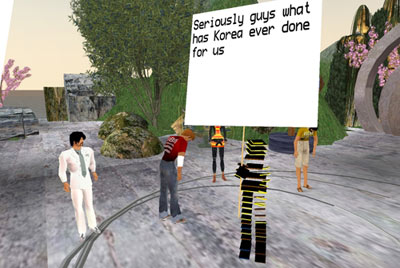
    Today I read about a recent “in-world” labor protest that took place in Second Life. The company in question: IBM. The aggrieved: 1850 avatars, including some bananas and triangles. Link.

    I discovered a beautiful Gallery of Illustrated Endpapers. What are they? Endpapers are the inside covers and facing pages of books. Today, endpapers are almost always blank. But our more sophisticated forebears made good use of endpapers by adding thematic illustrations to them.

    Look at the endpapers here.

    I also found out about a Terry Pratchett DiscWorld reading order guide; thought about the Walk to Rivendell challenge; and saw how mobile technology worked for a reporter in Myanmar who had had his camera confiscated.

    There’s lots more to read on Boing Boing every day – so add it to your RSS reader! Lots of good ideas to provoke discussions in your classrooms.

    Now, settle back and watch another video – Dice Stacking – reported by Boing Boing of course!

  • Creating possibilities in learning

    For two days, we are being engaged in a trip into the roots of education – an important step of revision and re-visioning our ideas and purposes for learning.

    Our task? To begin to understand ways of actualising a new Parramatta Catholic Education Framework.

    Our leader in this process is Yoram Harpaz, founding Director of the Community of Thinking programme at the Branco Weiss Institute in Jerusalem.

    We are doing this in order to help us draw a new conceptual map of education to define our aims and means of education. Schools are in deep crisis – they no longer work effectively for 21C – but for now we don’t have strong alternatives in place.

    We need to ask ourselves some fundamental questions – and the most fundamental is “what is education?” and “what does it mean to prepare students for their lives in the 21st century”?.

    Yoram mentioned many times that schooling has been a very successful sociological experiment, but a failure for our students because of our inconsistency in our pedagogical frameworks.

    Yoram jokingly says that we operate as if it “Doesn’t matter what you teach so long as it’s boring!”

    Essentially we have to find, what Yoram calls, “our pedagogical sentiment”. There are lots of slogans, but what is our real authentic pedagogy or stance? How do we turn our classrooms into a community – a community of thinkers? He wants students to experience knowledge as human creation.

    The thing we are investigating is Yoram’s Third Model which is about ‘disruptive intelligence’, about sharing ideas, working together because

    thinking is a dialogic and societal process.

    Our purpose should be about putting dialectic pressure on students. If we are flexible and sensitive then teaching can support learning. I love the idea of ‘teacher as therapist!’

    Yoram is also a strong advocate of ‘story’, and the human narrative, which fits very well with digital story in a Web 2.0 context as well. As he explains, knowledge is created by human beings – it is storytelling which helps put order into our chaotic life and insert some logic into the mystery of life. We want our students to create their own stories, their own interpretation, and original ways to solutions.

    Knowledge is not an object – Knowledge is a ‘story that works’

    The Department of Education and Children’s Services in South Australia provides a good series of informative links for Dr Yoram Harpaz.

    Harpaz & Lefstein: Changing Schools – What sorts of changes in schools should we be putting energy into?

    I’ve got more to write about this on another day….

    Image from jakedobkin.
  • E-Learning 2.0 …that’s immersive and personal learning

    Can’t say it better than Stephen Downes.

    I want and visualize and aspire toward a system of society and learning where each person is able to rise to his or her fullest potential without social or financial encumberance, where they may express themselves fully and without reservation through art, writing, athletics, invention, or even through their avocations or lifestyle.

    Where they are able to form networks of meaningful and rewarding relationships with their peers, with people who share the same interests or hobbies, the same political or religious affiliations – or different interests or affiliations, as the case may be.

    From Brandon Hall Research Innovations in Learning Conference, San Jose, September 25, 2007

    If you haven’t already done so, add Today’s News in OLDaily to your RSS reads.

  • K12 Online – the conference is coming!

    The 2nd annual K12 Online virtual conference is just about a month away. The 2007 conference is scheduled to be held over two weeks, October 15-19 and October 22-26 of 2007, and will include a preconference keynote during the week of October 8.

    The conference theme is “Playing with Boundaries.”

    Make sure you attend, or attend the conference archive. The event is completely free. Important thinkers and dreamers and practitioners will present. Connect yourself with their visions of how our schools are evolving, how learning is changing.

    The presenters this year have been invited to create short, online videos (published to a website like YouTube or TeacherTube) which will give attendees a better idea of what their presentation will address. These videos provide a fabulous way of deciding which presenters to listen to first! Check the blog out now, and you’ll be in for a treat!

    Stay in touch with the lead-up to the conference by following the K12 Online conference blog, and enjoy!

  • Here’s one mighty mini-library on Facebook

    GerryMcKiernan reports on the mini-library application for the social networking site Facebook – which makes me very envious!

    Named Mini Library it is now available for searching The European Library, an online portal to major European OPACs.

    The portal allows users to search through the resources of 30 of the 47 national libraries involved in The European Library. Currently The European Library gives access to 150 million entries across Europe.

    I WANT one of these for Australia!

  • From text to iPod – in one easy step

    Use Text2Go to transfer information from the web to your iPod, so you can listen to it on the go. Sound like a gimmick? Maybe, but just think about the educational implications of such a tool for our students – anyone who needs audio support to access and enjoy text.

    From Melbourne, this software (for a very small cost) could be used to turn free eBooks available at Project Gutenberg into audio books for your library, to loan out on your ipods or mp3 players.

    In fact, anything that might be available in digital format could be converted this way. Are there limitations? I don’t know. The idea is a very good one for schools to look into further.

    From LifeHacker Australian edition.