Libraries on the Pillars of Web 2.0

From Information Today:

FEATURE
Building a Library Web Site on the Pillars of Web 2.0
by Karen A. Coombs

Web 2.0 is often defined by the technologies that are part of it: social software, Weblogs, linklogs, folksonomies, wikis, podcasts, RSS feeds, and Web services. Because of this, some see Web 2.0 as merely hype. However, if you examine the technologies to see what they have in common a pattern emerges. “Web 2.0” is transforming the Web into a space that allows anyone to create and share information online—a space for collaboration, conversation, and interaction; a space that is highly dynamic, flexible, and adaptable.

Further discussion and reading led me to design six pillars of Web 2.0 that we wanted to use as the foundation for rebuilding our library Web site. These six pillars are as follows:

1. Radical decentralization
2. Small pieces loosely joined
3. Perpetual beta
4. Remixable content
5. User as contributor
6. Rich user experience

This paper is an interesting analysis of the Web 2.0 thinking in the re-design of the University of Houston libraries.

I like how they have Subject Blogs.

Dig that tiny URL!

I thought I would do a little ‘refresher’ for those who are just getting into regular online ‘mischief’ and who haven’t heard about simple ways of managing loooooong URLs.

The problem: Long Web addresses (URLs) are difficult to remember and say, and become broken when sent by email.

The solution: Use an online tool that shortens the long address to overcome these problems.

DigBig

How does DigBig work?


Three simple steps:

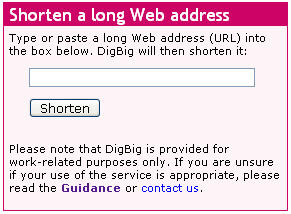
  1. You paste a Web address into the DigBig box and click the button
  2. DigBig converts it into a much shorter version
  3. You copy the new short address and use it instead of the long one

digbig.jpgWhen someone visits the short address, DigBig converts it back to the original one, and sends the visitor to that original Web page.

TinyURL does the same job, and also allows you to add TinyURL to your IE browser toolbar – if you want.


Technorati Tags:

Happy Australia Day – Aus Mac Ed

We have celebrated Australia Day, 29 January, in style. Google Australia did us proud!

The same aussie day was chosen for launch post of the Aus Mac Ed group blog.

Paul writes:

As promised I’ve been working on a multi-user blog for Australian educators using Macs and iPods (and iPhones). The goal of AusMacEd is to bring our vibrant discussions about the huge potential of Apple based solutions in Australian education out onto the internet in a pro-active and web2.0 manner.

ausmaced.jpg Nice one Paul! 🙂

Come on over, and join the conversation.

Of course, that’s not all there is!Digital Chalkie mascot

Australia Day also saw the news that Edublogs Award Nominee DIGITAL CHALKIE will continue in 2007.

If you aren’t familiar with Digital Chalkie, drop over and read a little about its success and enjoy the interesting contributions in this group blog.

Flock Fever

The Social Web Browser. Frustrated at work today by technology issues on my IBM computer (and too lazy to open my MacBook Pro) I decided to go back and give another run of Flock.

I wrote blogged about Flock (and more) back in July 2006 – but my Flock use has slipped away since then.
So I downloaded the update – and Bingo! I was a winner. I have blogged several posts since then, and love being able to blend my Delicious and Flickr accounts into Flock

What a great decision! I’m sold on the fantastic integration and functionality that Flock provides me. Cuts my blogging time in half!

Don’t just take my word for it. Read a comprehensive review of Flock written by Kathleen Gilroy at Library 2.0 back in July last year.

This will give you a good idea of the combined functionality of this excellent browser.

Technorati Tags: , ,

Their space: Education for the Digital Generation

From Scotland via Derek Robertson at Hotmilkydrink:

On my way through to Edinburgh this morning I decided to listen to the latest edition of the BBC’s Digital Planet podcast. This is a really good show that never fails to throw up something of interest and relevance to me in my professional and personal dealing with technology.

The first article featured a new research paper from DEMOS called Their Space: Education for the Digital Generation. It proved to be quite an enlightening listen because they actually had a digital native on the programme! This 15 year old girl talked about how she and her friends used ICT in an invisible way in their lives. The only time it became overtly visible she claims was when teachers, (due to government regulations no doubt she mutters under her breath) told pupils that ‘this is a mouse’ or ‘save your file to the appropriate folder’!!! The contempt was tangible I tell you.

The DEMOS paper draws on qualitative research with children and polling of parents to counter the myths obscuring the true value of digital media. Some quotes from the Executive Summary of this 81 page document gives an indication of the content:

  1. In an economy driven by knowledge rather than manufacturing, employers are already valuing very different skills, such as creativity, communication, presentation skills and team-building.
  2. Schools are at the front line of this change and need to think about how they can prepare young people for the future workplace.
  3. Schools need to recognise the new digital divide – one of access to knowledge rather than hardware – and start to redress some of the existing imbalances.
  4. Students are changing the society they live in along the progressive lines that are built into the technology they use everyday – of networks,
    collaboration, co-production and participation. The change in
    behaviour has already happened.We have to get used to it, accept that the flow of knowledge moves both ways and do our best to make sure that no one is left behind.


Technorati Tags: , , , , ,

Leadership Waves

A recent post by John Connell Hexagonal Leadership draws our attention to the use of metaphor in making sense of our actions and reactions in our education endeavours. John was responding to Don Ledingham’s Seven Sides of Educational Leadership.

John’s thoughts on the use of metaphor were timely, and made me realise that in my own way I also make use of metaphor to make sense of and to energise my work in ICT and learning. John referred to Greg Whitby’s Distributive Leadership ideas – and with a certain amount of synergy – here I was yesterday presenting Web 2.0 and some introductory material on blogging to Greg’s leadership team – using a metaphor of creating an impressionist painting together, full of light and shade, energy and vibrancy – new and different and contributed to by each member of the team in some way yet to be defined.

Yesterday’s session was about creating those first sweeping brushstrokes – shaping outlines of our new educational vision for 2007.

Hokusai wave

Monet himself provided a new vision of movement for Western Artists – drawn from tradition and cultures already in existence. His art is based on the use of color, which has to “draw” the motive without resorting to line.

I see our 2007 Web 2.0 initiatives very much in terms of the colour and vibrancy of Monet, and in the shape of the Hokusai wave! We are poised for significant changes.

Our system of schools will launch into a new era of Web 2.0 with the start of the new academic year. Amongst other things, one of our first priorities will be the use of blogging to empower communication, information dissemination, reflection, dialogue, inspiration etc. We have created a network of leadership blogs that will link the emerging energy of ideas and innovation in learning and teaching between all parts of our educational enterprise.

Nothing new to John and the scottish GLOW initiatives – but a great leap forward for us in our group of schools ‘downunder’.


The [library] world is flat – too!

We have a central library catalogue (SirsiDynix Unicorn) serving 77 schools K-12 plus some specialist libraries, which allows for individualisation and sharing of information – we can search our own library or all libraries across all our schools as well as the specialised support libraries.

Unicorn’s architecture makes it easy to change databases and to implement new functionality. We have ‘content enrichment’ – book jackets, reviews, teacher notes and more also added to our basic catalogue. We could extend our services to include electronic packets (learning objects) and electronic files, provide federated searching of our resources, which includes an excellent range of subscription databases such as Britannica and EBSCO.

We could launch an enterprise portal solution, or implement any number of excellent options that SirsiDynix offers to revolutionise access to digital knowledge resources, as well as bibliographic resources.

At this stage, we have not rolled out the really effective enhancements that makes this system of delivery revolutionary…….. information anywhere, anytime.

We ‘stand out‘ in the school library sector in Australia for having implemented this system – yet we are hindered in making further developments because ………the potential of the innovation goes unrecognised! Urrrrggghhhh – so frustrating! Such Web 1.0 thinking. So yesterday!

The Information Network for Ohio Schools has done much of this, and is worth exploring to see some of the possible ways of supporting learning and teaching across schools.

I am delighted that at least a public library in Australia is leading the way in Web 2.0 using the same platform as our own (Unicorn), though obviously for a much smaller group of libraries.

The SirsiDynix WebSeminar “Hopping into Library 2.0: Experiencing Lifelong Learning” will be presented by Christine Mackenzie —Chief Executive Officer, Yarra Plenty Regional Library, in Melbourne, Australia. She will talk about why they decided to implement Learning 2.0 and how this has equipped them to get bold in their thinking about social networking. They’ll discuss 4 themes for their Library worker 2.0 staff development program in 2007 – getting information, enabling learning, creating content and celebrating culture; and how they are encouraging an environment of lifelong learning within the organization. Grab the podcast if you can’t join in the conversation. Of course there is also an excellent Yarra Plenty Library Blog, currently promoting great summer reading.

Singapore National Library shows an interesting MashUp with BookJetty. Some nice Web 2.0 enhancements, and a curious blend with Amazon. Can’t borrow the book? I guess you can buy it! My test searches provided pretty interesting results – in some cases, only providing Amazon information. Port the same search across to WorldCat – and get a very comprehensive result – all the information leads you could want for collection development, research sources, or unusual collections. Why not put the WorldCat search box on your site?

In terms of nice innovation, I love what MIT libraries have done! MIT Libraries now have RSS feeds for new additions to their catalogue.

Of course, they have lots of other nice things too, but RSS feeds for new resources is a cool Web 2.0 touch for keeping informed!

Technorati Tags: , , , , , ,

Student opinions on Social Networking

As a followup from my last post on MySpace, I recommend a visit to Vicki Davis – Edublog Award winner for Best Wiki with her Flat Classroom Project wiki. Vicki leads in Web 2.0 thinking.

On her Westwood School Wiki you will find a comprehensive virtual survey of her 9th and 10th grade classes on MySpace and social networking. If you haven’t got a list of your own for discussions with your students, Vicki’s list provides a great starting point.

Vicki’s Westwood Wikispace was listed as December’s Space of the Month by Wikispaces.

Catch Vicki at Del.ici.ous as brightideasguru, or on her Cool Cat Teacher blog.

Technorati Tags: , , , ,

MySpace connected generation

Media reports have emerged about four families whose daughters were sexually assaulted by predators they met on the popular internet social network MySpace. They sued owner News Corp this week for negligence and fraud, the lawyers representing the families said in a statement.

At the same time, the latest ISTE SIG News for January lets us know that ISTE is in Myspace, reaching out to the connected generation.

This juxtaposition is a critical reminder of the need to establish and promote good online culture and behaviours. Technology educators realise that ‘the times, they are a changing’! and as Suzanne says

Wonderful! ISTE is on myspace! This will be a great resource for educators who check their myspace as often as they check their email.

While I admit to not being a regular user of MySpace yet, I know that Australian educators are rapidly moving into online places and spaces. Much has been written about these online issues, so we know that we have our work cut out for us in 2007 to improve our understanding and usage of online spaces.

The MySpace safety guide for parents from Teen Magazine is a helpful handout. As far back as March 2006 Stephanie summed up by saying:

Let’s be honest about what MySpace really is: It’s an online networking tool, orginally developed for the self-promotion of unsigned musicians and bands. There is nothing inherently evil or dangerous about MySpace.

However, like many online tools, it can be abused, and yes, there is danger when inexperienced web users like children and teenagers use a networking or communications tool with complete trust and little scrutiny of who they are communicating with.

My Space is a busy place! According to SirsiDynix OneSource June 2006, it is busier than Google, with 150,000 accounts being created daily. In the same article Stephen Abram asks important questions about the potential of MySpace and other social networking places.

MySpace can foster the learning of new literacies, and present opportunities for self-expression and friendship building. Our students are global citizens who are becoming smarter about new sources of information. What does it mean to be a good global citizen? Amongst other things, it means learning safe and ethical behaviours.

In the end, by being responsible adults on line, educators can act as role models for appropriate online behavior, providing a positive presence online for kids in their classrooms.

ISTE shows us one way!

I know our students are ‘digitally mobile’ (some would say fickle) and I haven’t had a personal need to get into MySpace or Beebo or any other online social networking homebase yet. That will come. The issue for me is not so much about what we use, but more about creating opportunities for learning (and responding) within the Web 2.0 world of our students.

Choose your tool(s) and get on with it 🙂

PS. Thanks to ISTE for listing HeyJude in
Our Top Ten Favorite Ed Tech Blogs for January

Technorati Tags: , , , , ,

Five Things – 2007 frivolity!

It doesn’t pay to have a ‘holiday’ from blogging! In just a few short weeks, five or more people have ‘tagged’ me in the ‘five things you don’t know about me’ meme. While I kept up a bit of reading there was no time for writing….but a lot of time for groaning….”no, not again!” So, I’ll start my 2007 blogging with a bit of 2007 frivolity – and hopefully stop the tag stream to me 🙂

So, in very short points, here is my humble contribution:

1. We ‘tag’ students new to Australia, or born of non-Australian parents as being of ‘non-english speaking backgroud (NESB) or speaking English as a second language (ESL). Not sure where I fit in this, except that English was my third language, but is now my primary language. My parents came to Australia post WWII, and for the first 10 years of my life I lived in different immigration centres around QLD, NSW and VIC (father being in a senior position), playing with kids who spoke dutch, german, and a host of other european languages other than english! As a pre-schooler, I was the ‘party trick’ – adults would speak to me in Hungarian, German or English, and I would reply accordingly, quite fluently. Sadly, I am now only fluent in English, due to my parents desire to have me grow up ‘Australian’. They switched to speaking english at home when I started school. Now I don’t understand German, I can ‘hold my own’ as a tourist in Hungary, and as an English speaker I am the target of many family jokes as my ‘hint’ of ESL background results in me regularly mixing my metaphors.

2. Being excruciatingly shy, and an only child, my life was lived in books, inspite of the fact that I could not learn to read at first. I can still recall the utter frustration and embarrassment of that maze of letters in the John and Betty readers that my peers could read aloud when called upon. Entering Year 2 (third year at school) I decided this was enough of feeling stupid! I vividly recall sitting on my bed with my pile of Golden books day after day, trying to work out how to read, and eventually ‘cracking the code’ myself. I am sure that reading instruction at school gave me some keys, but it was the search for patterns in meaning that opened the world of reading for me.

3. Once reading, I could not stop. My local public library despaired of me in Year 6, as I had read everything in the junior library and I was given permission to join the adult library. I spent all the following years reading virtually nothing but science fiction. Even during my BA years, with a major in English, Science Fiction was my main fodder. A big mistake, and one I will only have time to properly rectify when I retire! However, it seeded my passion for technology, learning in new worlds, and the need to embrace change as quickly as possible. I am a trekky, and of course, I subscribed to the SciFi channel the day it was released on cable in December06. For me the world is finally starting to catch up!

4. I remain fascinated by new things, and cannot tolerate boredom or the lack of opportunity to explore and innovate. I own and read an eclectic range of books. I prefer to change jobs rather than keep doing the same thing. I love working with people and kids in different environments and like to ‘mix and match’ different things. The best combo was when I took a year off to do full-time study for my first Information Science degree – I also took on being the Manager of the Western Youth Symphony Orchestra at the same time. (I only studied music formally myself till the final year of High School, but to the surprise of my teachers managed to score ninth place in the public exams in the state of NSW in my graduating year).

5. I’m embarrassed to say that I don’t have any interesting anecdotes to tell anyone, but I am fascinated by the passion that came through in other peoples points about themselves. I remain a country girl at heart – and tolerate life in the ‘big smoke’. I have never ‘run with the crowd’, and prefer to stand aside and ‘observe’. I love country Australia, but wish I lived in the UK, or Europe – even for a short burst – because Australia is so far away from everyone else and half my heart is in Europe! Reading, music, and technology will always remain central to my intellectual and recreational activities. My favourite author right now is Nicholas A. Basbanes ( Patience & Fortitude; A Gentle Madness; A Splendor of Letters) and his wonderful books on reading, libraries, and booklovers, and the permanence of books in an impermanent world. From the Preface of A Splendor of Letters:

Over time, communication across the generations has typically come by way of the written word, carried out in a striking variety of ways and recorded on an astonishingly rich medley of surfaces, the impulse always being to make contact and to give an account of ourselves – which, it turns out, is the point of the exercise .

Our technological world has simply added to the ‘rich medley of surfaces’!

PS. As for opportunities missed? Why on earth didn’t this ‘five things’ meme include a recommended technorati tag? I would have liked to track them further afield! I’m not going to tag anyone as I have come into it quite late in the piece.

Technorati Tags: , ,