About Judy O'Connell

Educator, learner, blogger, librarian, technology girl, author and consultant. Transforming education and libraries. Innovation for life.

Plant a little library

Seems that small is good, in even more ways than I realised.  Take a look at these Tiny House Libraries – this  free sharing initiative also helps communities promote the  fun of reading!
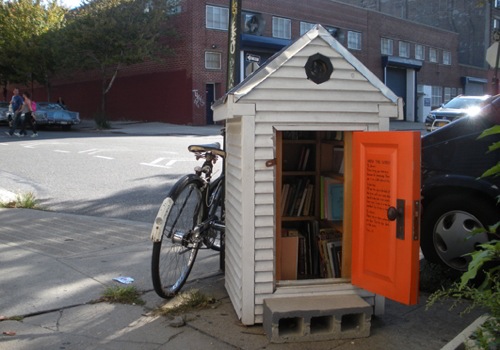
These Little Free Libraries are about ‘paying it forward’. People can take a book and return a book when they can. The scheme is simple and generous. Plant a small box, kind of like a bird house for books, atop a post. Fill it with about 20 books. Tell friends…

Read more about it at http://www.littlefreelibrary.org .  Some of these are just so cute!

Small is an important [re]action in libraries

Seems the wheel keeps turning, when it’s powered by cultural and community interest.  I remember when I first moved to my suburb with a young family, over 20 years ago. Beecroft had it’s own children’s library, run and staffed entirely by volunteers. This was the greatest thing, and perfect for an age of literacy, knowledge, curiosity and excitement which was powered by the best in youth works in both fiction and non-fiction collections.

Beecroft Children’s Library was a vibrant and significant part of the Beecroft-Cheltenham community for over 50 years.  It was important for two reasons:

  • it was an important resource for the area’s youth, complementing the high quality schools the area is renowned for; and
  • it was a good example of volunteerism, with it’s fund-raising social activities a focal point for the community, as well as the volunteer staffing of the library.

In our connected era, the notion, purpose, and function of libraries are being challenged. In this context, it’s great to see the ways in which grass-roots action is positioning ‘volunteer’ libraries once again in new ways to meet new needs.

I love the the trend of teeny-weeny libraries in little playhouses. The Corner Library is the latest in a slew of “micro-libraries” cropping up at different locations across the United States. Currently situated in Williamsburg, Brooklyn, this treehouse-sized book shop is the brainchild of artist Colin McMullan. A mini replica of the classic public library, it contains everything from books to ‘zines to newspapers to comics, all available to check out for free- all you need is access to the lock code. Browse the titles and learn more here!

In much the same way the Great British Phone Box seems to be living on as a tiny library. The red telephone box is a British design classic. And many of these iconic boxes, as well as more modern boxes are getting a new lease of life as part of our innovative Adopt a Kiosk programme. Sometimes this newley adopted phonebox becomes a micro-library.

Meanwhile, the Town of Clinton in New York’s Hudson Valley recently christened a bright red British telephone kiosk as “America’s Littlest Library.” The Book Booth, a branch of the Clinton Community Library houses about 100 books and is part of the library’s book exchange program. Staino in the Library Journal  explains how the library’s Friends’ group created the branch library from the classic British telephone booth. The idea came from Claudia Cooley, a library Friend, who was familiar with the recent British trend of transforming no longer used booths into art galleries, toilets, and, in one case, a pub. Cooley envisioned upcycling the booth, which had long stood outside a local café, as a way to bring together a community that does not have a town center.

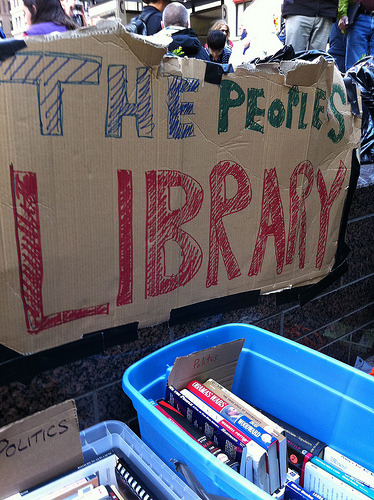
The Occupy Wall Street library encouraged readers to set up People’s Libraries around the country: “if you’d like to open a branch of the People’s Library in your New York neighborhood, find a [Privately Owned Public Space], bring down some books and meet your neighbors. It all starts with a few books in a box.”

Wow – public spaces that people own adopted for ‘libraries by people’ is great!

GalleyCat also suggests that we explore free eBook collections at eBookNewser, Project Gutenberg or the Internet Archive for ideas. Post your list on your blog, Facebook page, LibraryThing page, Twitter account, Goodreads page or Tumblr blog.

Seems to me that the small [re]action in libraries has a lot going for it!  It’s all part of the cultural voice crying out that LIBRARIES MATTER.

Zotero and the e-book winner!

Today I made my mind up – I had to get myself a copy of Zotero: A Guide for Librarians, Researchers, and Educators.

Zotero is an important part of my productivity suite., and I wanted to grab a copy of the book to make sure that I was actually using Zotero to its full potential. This guide is written by Jason Puckett who is the the Communication Librarian at Georgia State University Library in Atlanta, where he teaches library classes on research and information literacy skills, bibliographic software, and library technology topics.

If you work in schools then you need to read what Stacey Tayor has written about  Using Zotero with Students.

Now it’s time for me to ‘fess up to my personal book trail, and how e-book services again won the day.

  1.  Read a post that reminded me that I want to get a copy of the book, and I really should get on with it.
  2. Check availability on Book Depository. Fail.
  3. Check my university library. Fail. (Amazing – so I placed a purchase request)
  4. Check Amazon. $32.40 for print copy.
  5. Whispernet to my iPad for $12.00.
Whose services are the winner here?  This time it was not my library!

Kids and innovation! Step aside…

While adults continue to debate technology, innovation and the future of learning in our schools, there are kids who are just getting on with it. Step aside and help. You will build the future faster that way!

Joining Pandora – Australia’s web archive

The National Library of Australia aims to build a comprehensive collection of Australian publications to ensure that Australians have access to their documentary heritage now and in the future.

The National Library is an amazing organisation. The theme promoted on the homepage says it all: Thinkers Wanted  – Take a fresh look at the National Library. Remarkable.

You should stop by and discover Australia’s Collections: Trove; Picture Australia, Pandora, Music Australia, Australia Dancing and Australian Newspapers.

The one that I am excited about today is PANDORA – Australia’s Web Archive.

PANDORA was set up by the Library in 1996 to enable the archiving and provision of long-term access to online Australian publications. Since then they have been identifying and archiving online publications that meet their collecting scope and priorities.

Imagine my excitement to receive a request to include this blog in the  PANDORA Archive. I have now granted permission under the Copyright Act 1968, to copy Heyjude into the Archive and to provide online public access to them via the Internet. This means that the Library has permission to retain the published blog in the Archive and to provide public access  in perpetuity. How cool is that?

Access is then facilitated in two ways:  via the Library’s online catalogue and via subject and title lists maintained on the PANDORA home page .

I am delighted to be added to the collection! I know others have been granted this privilege long before me, but I’m amazed non-the-less.

Now my digital musings are no longer floating free on the internet, and I have one of the best back-up systems in the world.

Image: Laptop Floating on a Digital Sea from Bigstock

Don’t like the new Google Reader?


To be honest, I’ve always hated Google Reader, so the current round of complaints since the update have had no impact on my RSS reading habits.  One quick look tells me that the interface is more palatable, having adopted the new Google look common to it’s other product upgrades. However, my RSS reads also tell me that many are unhappy, and that one of the key issues is the social interface.

Google Reader’s  redesign  removes social features to other websites. The Google Reader team has prepared for the release to be unpopular with some users in the userbase saying in a preemptive post “we recognize, however, that some of you may feel like the product is no longer for you” adding that they extended the amount of exportable data.  “Starting today we’ll be turning off friending, following, shared items and comments in favor of similar Google+ functionality” and iterated “we hope you’ll like the new Reader (and Google+) as much as we do, but we understand that some of you may not. Retiring Reader’s sharing features wasn’t a decision that we made lightly, but in the end, it helps us focus on fewer areas, and build an even better experience across all of Google”.

Google Reader is certainly changing. In truth I am not at all ‘qualified’ to comment on the current iteration of Reader. Why?

I’m been a long time fan and user of Feedly. If you’ve been around in any of my presentations, you’ll know that I like Feedly so much that I recommend it all the time.


cc licensed ( BY SD ) flickr photo shared by heyjudegallery

If you currently manage all your feeds in Google Reader, Feedly is a nice way to transition to a different style of feed reader. Feedly syncs with your Google Reader account, but uses a more magazine-style interface. The minimalist interface thankfully doesn’t put as much emphasis on whitespace as the new Google Reader, either. The service offers support for a plethora of social media services, but doesn’t include any built-in substitute for Google Reader’s social features.

Just in time for the launch of the new Google Reader, Feedly also just launched version 7 of its web service

As an added bonus, there are also  various mobile and tablet apps for Feedly which work nicely now. However, when it comes to my iPhone I also have a friendly relationship with FeedlerPro!

Top image: cc licensed ( BY ) flickr photo by stylianosm

Revolutionizing Libraries with Social Media

We are seeing faster and faster changes in the technological
landscape. In fact, in the past few years cloud computing has gone from an abstract idea to state-of-the art storage that we cannot do without.

Within this shifting environment we find libraries in a wide range of organisations (academic, public, corporate, special, schools)  re-visiting, re-imagining and re-branding their spaces, functions and service design.

In the full panalopy of library services, one aspect that occupied a busy group of people last Monday was social media in all its many dimensions. Don’t just think of Twitter, Facebook or Google+. Engaging in a conversation around social media opportunities is much more than than just choosing tools and  developing a social media strategy.

At the heart of the conversation was the issue of purpose, and the factors to consider in developing a social media strategy. As Bradley and McDonald write in the Harvard Business Review blog:-

What is a good purpose for social media? Would you recognize one if you saw it? And if you could identify a good purpose, would you be able to mobilize a community around it and derive business value from it?

Success in social media needs a compelling purpose. Such a purpose addresses a widely recognized need or opportunity and is specific and meaningful enough to motivate people to participate. Every notable social media success has a clearly defined purpose.

However, as librarians, we should have an interest that transcends that business approach. We are curators of knowledge and culture and embed products, tools, objects and strategies  to add value to the trans-literate environments of our communities.

At the day-long seminar Revolutionizing Libraries with Social Media,  co-ordinated by ARK Group Australia,  I explored  these issues with the attendees, ranging from the obvious, to the ambiguities of workplace structures, digital preservation issues, content curation options, community, collaboration, personal social networking vs corporate social strategy, e-services, and more. My colleague Lisa Nash from the Learning Exchange, Catholic Education, Parramatta Diocese also explored eBooks and eServices.

Always at the heart is our  need to ensure that  social media empowers connections within and beyond the library. We are ‘letting go’ – in order to allow our customers, patrons, or corporate clients to shape these services with Apps,  eResources, recommendation services, or strategic information delivery systems. Not every library will benefit from the same social media tools. But every library can develop new options for marketing their services and change the way their clients or community interact with the library.

In fact, there was so much to consider in one day, that the day was really just the start of more planning when the librarians got ‘back to base’.  To facilitate this I put together a LibGuide as a digital handout. The advantage of this was that we could  add requested items immediately as the day progressed , and can continue to curate this resource for future workshops as well as for those who so willingly engaged with us on Monday.

You can visit this guide at Revolutionizing Libraries with Social Media


Image 1  cc licensed ( BY SD ) flickr photo shared by heyjudegallery
Image 2 cc licensed ( BY SD ) flickr photo shared by heyjudegallery

Teacher librarians are important


Web 2.0 revolutionized the means at our disposal to filter and share information. Whether by managing information by social bookmarking or RSS reads and feeds, or communicating with our school community via blogs, wikis, podcasts, YouTube, or Facebook, students, teachers and school librarians have entered into digital conversations. Widgets, portals, Apps, Feeds and Aggregators and more now provide us with our ‘tools of trade’ for information curation.

The importance of the teacher librarian is intrinsically linked to effective and responsive information curation and dissemination in distributed environments within and beyond the school. Use of Web 2.0 tools has become embedded in good practice, and information curation has extended beyond the library catalogue to library and school information management systems for bibliographic and media resources, and various organizational tools that reside beyond the school in web environments, such as Libguides, Diigo, Live Binders, wiki, Delicious, Google tools, RSS, media tools, netvibes, iGoogle, and many more.

But when a technology focus subverts students’ conversation and development of critical thinking skills (and their ability to evaluate and analyze the information at hand), the mental processes that change knowledge from information to concept are not learned (Bomar, 2010). With the maturation of Web 2.0 tools the importance of nurturing information literacy skills and strategies has shifted to become a meta-literate approach to engagement with information.

This is exactly why teacher librarians are re-thinking what ‘collection’ of information means, thereby supporting personalized and collaborative information seeking and knowledge conversations. The new core information research tools available for students, teachers and school librarians adopting information literacy in a networked environment includes:

  • Microblogging tools for information sharing by teachers, students, classes and the school community in primary and secondary schools.e.g. Edmodo, yammer, Google+, or Twitter
  • Social Bookmarking and tagged collections e.g. Diigo, Delicious, PearlTrees, Flickr, Vodpod
  • Collaborative writing, editing, mindmapping and presentation tools e.g. Google docs, Exploratree, Voicethread, Mindmeister, Wikispaces
  • Research tools for online information management, writing and collaboration e.g. Zotero, Endnote, EasyBib, Bibme, Mendeley, Refworks,
  • Information capture in multiple platforms and on multiple devices .e.g. Evernote, Scrible
  • Library catalogues, databases, and open-access repositories – all used for information collection, RSS topic and journal alerts, and compatible with research organization tools
  • Aggregators, news readers, and start pages e.g. iGoogle, Netvibes, Symbaloo, Feedly
  • Online storage, file sharing and content management, across multiple platforms and computers e.g. Dropbox, Box.net, Skydrive

These tools have allowed us to re-frame information collection as highly flexible and collaborative information and knowledge conversations, while also facilitating information organization.

Technology and online integration can facilitate critical thinking and knowledgeable actions, rather than merely permitting the access and transformation of information as part of the information literacy skills set. The point is to engage our students in multiple conversations and research pathways that reflect the changing nature of scholarship in multimodal environments. As Lankes (2011) explains, at last we have a departure from information, access and artifacts as the focus.

In the lens of conversation, artifacts and digital access are only useful in that they are used to build knowledge through active learning.

Content exploration and learning demands a mix-and-match approach:

  • Search strategies
  • Evaluation strategies
  • Critical thinking & problem solving
  • Networked conversation & collaboration
  • Cloud computing environments
  • Ethical use and production of information
  • Information curation of personal and distributed knowledge.

Be sure you are understand online learning environments and the extra-ordinary potential of the social-media mind. Be sure you are involved with and present new ways and new information strategies to your teachers when  working within the curriculum and the full knowledge dimension of learning. Be sure you bring with you a full understanding of information literacy and information fluency as the underpinning of all that you do.

Bomar, S. (2010). A School-Wide Instructional Framework for Evaluating Sources.Knowledge Quest, 38(3), 72-75.
Lankes, D.R. (2011). The Atlas of New Librarianship. Massachusetts Institute of Technology.

Image cc licensed ( BY NC ) flickr photoshared by mikefisher821

Doing social media ~ experience the space


Since some time in July  I have been wrangling with the multiple dimensions of social media as they impact on the spaces of information professionals. I chose that word deliberately, because doing social media so it matters is at the heart of the what it means to be a socially networked information professional. It’s only by becoming active in social media spaces that you can really hope to be able to determine the best  social networking strategies for your library services.

You cannot read and write about social networking in order to learn social media strategy without engaging in the full dimensions of it. It is only through engagement that practice turns theory into understanding.

I always felt that had to be the case, but my recent teaching in INF206 Social Networking for Information Professionals has brought that message home to me loud and clear.

I have had the outstanding opportunity to engage with a group of information professionals scattered across Australia who are working in as diverse a range of libraries as you could ask. The services their institutions provide are, in some cases, second to none, and I was delighted to see that during the course of our study program some of the students were able to step up to join committees  formulating and/or delivering social networked services.

Tweeting for Trove, Australia’s national online resource of books, images, historic newspapers, maps, music, archives ?

How good is that!

What is unquestionably the case for anyone wishing to delve into the spaces of social media is that engagement is participation! How else can you determine what, how, when, or why you might adopt a particular tool or strategy for your organisation?

There is no single “right” social media service that will fit every library. Comparing social media sites is part of the research, as is determining what kind of social media your library is interested in. Given that social media sites come and go, side-by-side comparison charts will not give you all the answers. Interaction and conversation with others active in social media will be an essential part of your litmus test while you keep your library’s objectives in mind.

My main message is that a participatory culture is unavoidably participatory!  I have discoved that students in a program about social networking,  who do not actively embrace experimenting and exploring, inevitably have gaps and weaknesses in applying social networking to the provision of library services. But by jumping in and giving it a go, fluency begins to emerge, and the transformation is quite exilerating!  Library 2.0 is vibrant, viral, communicates, promotes, and engages with it’s ‘people’.

It’s like learning a new language and going on a trip to a new country – you can get by with a tourist translation or develop fluency that allows you to become immersed and enjoy every aspect of the new cultural experience.

I know which option I prefer!

Top Image: cc licensed ( BY NC SD ) flickr photoshared by Έλενα Λαγαρία
Bottom Image: cc licensed ( BY SD ) flickr photo shared by heyjudegallery

New content and better access = content curation

It seems that the latest buzzword around the web is ‘content curation’. There are literally millions of posts about this already, and new tools and new marketing strategies are being deployed to meet this new demand.  Even the kids are curating, and in so doing are learning that Curation is the new search tool.

Take a look at Content Curation, Social Media and Beyond. This is a quick showcase of a Scoop.It tool ( a tool I also use) on the topic of this post – using this newish aggregation tool to gather and share information in a way that is not social bookmarking, but is in keeping with a new wave of content curation developments.

Content Curation: Definition and Generation, raises a few essential points:

Finding the best content. Content Curation works only if the person who publishes the curated content knows extraordinary well his industry target too.

Adding value. It is imperative to provide comments and perspectives that add value to the curated content.

Crediting. It is critical to properly credit, providing clear links to additional sources that underlie the final content.

So in a way, a content curator is continually asked to assume stewardship responsibility for digital content in ever increasing number, size, and diversity of type.

Just as I rely on information discovery to push my own thinking, I also rely on content curators to add value and credibility to the information that they share with me.

I can only manage my information and my knowledge work online by accepting that information seeking means being involved in personalized and collaborative information aggregation and knowledge sharing.

Content curation is part of an overall strategy to tame information chaos. For me, it’s all about knowing, learning, sharing and teaching, all in one!   In addition, by providing a social infrastructure which facilitates sharing, the human aspects of the scholarly knowledge cycle may be accelerated and time-to-discovery reduced.

In a socially connected world, it’s amazing what a difference a few months can make. Joyce Valenza‘s post A few good scoops for us shows the transformation taking place in the world of ScoopIt. Grab yourself the links…they will help your own learning journey.

When I started up Digital Citizenship in Schools and Social Networking for Information Professionals this whole curation buzz was just emerging – and that was just a few months ago!

Authority will become the next sought-after currency for the App-Generation.

So I believe that  libraries and educational organisations should consider being involved in spreading their message far and wide, sharing best practice in standards and development, and offering advice for others.  Socially powered content curation is probably here to stay.

Image: cc licensed ( BY NC SD ) flickr photo shared by César Poyatos