A curious intellect

Curiosity is at the heart of our educational endeavour. For me curiosity has been the driving force of my life – it really has. Right back at school (yes, that was a long time ago!) I clearly remember standing in line waiting to go to my Year 10 English class (yes, we lined up then) reading a book on psychology – a new topic I had discovered. My English teacher Mrs Ferguson (yikes, we didn’t like her much) simply looked at the book and stated “you have a curious intellect”. Was that a compliment or a criticism? I was never quite sure, but I never forgot that moment. Somehow my burning curiosity rated a mention!

What I now know is that as a teacher I have to take pride in curiosity and creativity, and to harness that natural enthusiasm through creating new opportunities for learning.

I’ve lived with curiosity all my life – and I’m sure you have too! It’s gotten me into mischief more times than I like to admit. It’s gotten me into strife more times than I like to admit. But I love it nonetheless 🙂

Seth Godin‘s short video about curiosity hit home for me the importance of curiosity. He says:

For 7, 10, 15 years of school, you are required to not be curious. Over and over and over again, the curious are punished.

Scott McLeod at Dangerously Irrelevant recommends that every educator (and other change agents) should see Seth’s speech at TED.

Be yourself – stand out with edutagger

Remember when Del.ici.ous and other social bookmarking sites were new….. and hardly anybody knew what they were let alone used them? Remember when we discovered Digg?

Well here’s your chance to see something else new with great potential, which is designed specially for K-12 teachers. Edutagger is in its early days (not much there yet) so will depend on us, the online educators of the world, to build up its capacity to store and promote the best resources we can find and share with each other. Think Delicious tagging + Digg and you’ll have an understanding of what it might do.

Blending the use of categories and tags, Edutagger it is an online organisational space for sharing and pooling our resources. Could this be the breakthrough that we have all been looking for?

I recommend that you take a look, create an account, and add some links. Before you know it we could build a critically useful collection for us all.

Edutagger still sports Google ads – like other online tools before it, Edutagger relies on this to get started. Don’t let that stop you exploring and contributing to Edutagger.

For me the other great thing is that this product is made by an aussie, who works in one of our schools in Melbourne, Australia. Email chatting with Edutagger’s creator today I discovered that he was a wee bit busy preparing a video presentation for parents! Nice touch..someone who ‘gets’ education!

Our busy life never stops does it? So let’s share the load and ‘be happy’!

Photo: Be yourself

Update: Information provided by email by Mark Schuman, from his school in Melbourne. Mark supports and trains staff in the use of e-Learning technologies and has become known as “Mr Moodle” – his name is around the Moodle forums a fair bit. Thanks to Stephen Downes for ‘picking me up’ on not providing information about Mark (blame late-night blogging!). Stephen provides a profile and some comments about the tool.

Google docs … at it again!

googledocs.jpg

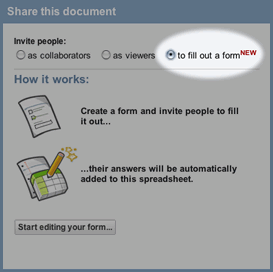
From Arthus on Twitter came the news that Google Docs now brings us forms!

Create a form in a Google Docs spreadsheet and send it out to anyone with an email address. They won’t need to sign in, and they can respond directly from the email message or from an automatically generated web page. Creating the form is easy: start with a spreadsheet to get the form, or start by creating the form and you’ll get the spreadsheet automatically.

Responses are automatically added to your spreadsheet!

  • Information and knowledge alert!

    There is a bit of a thing happening with Campus Editions. First I learnt about Edublogs Campus, a nice new offering…. and then rather belatedly I  heard about Firefox Campus Edition.

    The Firefox campus edition comes pre-installed with StumbleUpon (for discovering websites, photos and videos), FoxyTunes (lets you control almost any media player and find lyrics, covers, videos, bios and much more with a click right from your browser) and Zotero (for clipping web notes and to help you collect, manage, and cite your research sources.

    Providing this tool will make it imperative for us that students have good information and critical literacy skills to navigate successfully in this environment in order to think deeply, creatively and fairly rather than plagiarising or operating outside a creative commons approach to online media.

    It’s marketed as being everything you need for a well-rounded College Life!

    According to Mashable

    It’s probably fair to say this is a marketing drive to get Firefox installed on student laptops before they head back to school.

    I wonder, did anyone actually install this on their student machines? I like to be quite choosy about the Firefox addons I use – some of which are great. I think I would prefer to apply the same approach to customizing student delivered web browsers.

  • A Whole New Mind – Pink style

    6.00 am on Saturday morning, and at last it was my turn to join one of the classes for live blogging A Whole New Mind with students from Arapahoe High School.

    Some weeks ago Karl Fisch (you’ll remember his Did You Know 2.0? video) put out a call for people to participate in ‘live blogging’ over a series of weeks, and you can see the timetable of these events at AWNMLiveBlogging. Luckily for me I could make the Period 6 timeslot on a few of the dates.

    I’ve just completed my first session with these fabulous students. The record of just this one class group is at Smith 9H07-08.

    What I can’t capture here was the opportunity to hear the fishbowl discussion technique in action. Using MeBeam, a web-based video chat tool, I heard every fabulous word of discussion, along with my fellow bloggers Christian Long and Gary Stager.

    Yet another wonderful way to add flexibility and creativity to learning as a multimodal conversation.

    Photo: 油姬

    Network fatigue and the remixable web

    That’s what it’s all about …. lets keep an eye on these developments!

    The DataPortability technical blueprint uses OpenID to provide decentralized identity. OpenID 2.0 Attribute Exchange (AX) is utilised for discovery of user service details. XRDS/YADIS are utilised to provide the details of the various services a user employs.

    As users, our identity, photos, videos and other forms of personal data should be discoverable by, and shared between our chosen (and trusted) tools or vendors. We need a DHCP for Identity. A distributed File System for data. The technologies already exist, we simply need a complete reference design to put the pieces together.

  • ISTE…..and the unsung heroes!

    International Society for Technology Education’s (ISTE) Second Life space provides a venue for educators to network and learn from each other about real-life education opportunities and best practices in Second Life.

    ISTE sponsors an ‘in world’ group, hosts weekly networking socials and topical events, and sponsors a twice-monthly speaker series. At their recent meeting (1 pm Sydney time on Tuesday) Jo Kay aka jokay Wollongong was the guest speaker. Jo shared information about the various projects she is involved with in Second Life, including the Islands of jokaydia, where she is supporting a growing community of educators and artists in Second Life who are exploring various strategies for the use of virtual worlds in their practice.

    Yep, I’m a resident of Jokaydia – so I went along help out, and to listen to Jo, to share with the ISTE colleagues, and to learn more about educational opportunities or events held on Jokaydia.

    The Unsung Heroes

    What I was amazed about was the fact that I could attend this meeting – on the third day of work in my new school. In my school district role last year, I was not able to get access to Second Life on the district network. Nor can most schools seem to get this organized. But sometimes we have unsung heros amongst us. The Joeys Head of ICT – Gary Evans – had me up and connected in 24 hours ! Fabulous work Gary. As a result he had time to drop by the meeting, and join Simon and Andy who I hope will assist me in some SL work later in the year. (Normally Gary is in his shirt and tie! like all staff at Joeys- this pic was taken on a frantic non-teaching day).

    Perhaps it’s the Marist School that makes a difference. Back in my district of Catholic schools, it was Dean Groom, the Head of ICT at Parramatta Marist College, who made SL access possible – so that the students could join with the TeenLife project, Skoolaborate. Brother Pat at ParraMarist is as passionate about educational opportunities for his boys as my own Headmaster is for our Joeys boys!

    In all this, its our IT managers who are the unsung heroes, without whom we could not do all that we do in our schools in all forms of e-learning.

    Thanks Dean for all you did to help out last year. Won’t forget to keep reading your blog and learning from your work with your boys. PLUS your hacking of technology objects are the best 🙂

    Thanks Gary for all you’ve done to help me out this year already. Joeys is very fortunate to have your leadership. Can’t wait to see what else is possible. Perhaps the sky’s the limit?!!

  • Quantifying the impact of social media

    Kerrie Smith asked some discerning questions about my last post Google Generation and Virtual Libraries, making the link to the debate that’s going on over on the Economist.com about whether social networks do/can/will have a positive impact on education.

    I do believe that blogs can provide solid, authoritative “knowledge” – but as these bloggers are doing the research (leg work) to investigate topics, doing the critical analysis and synthesis of what they have found – they are few and far between. That is not to say that other bloggers are any less valuable – just that they are fitting a different social network niche. Bloggers that more easily fit this category of comprehensive reflective research and analysis are Stephen Downes, Will RichardsonChristopher Sessums, Dough Johnson, and Ewan McIntosh as examples. Many blogs are reflective conversations, others are disseminators of information or providers of tips and tricks in ‘how to’ do things – and are part of that personal learning environment at each of us is building around ourselves to help us in our networked world.

    Can blogs be authoritative resources? I thinks so – sometimes. At other times they are informative or trivial, relevant or off-beat, extroverted or muted – but whatever form they take they will have relevance to someone somewhere.

    Technobabble 2.0 provides a white paper outlining the thoughts and views of several key stakeholders who met late last year to discuss the issue of measuring online influence.

    Download: “Distributed influence: quantifying the impact of social media” (PDF)

    The catalyst behind this document was the publication of Edelman’s Social Media Index in July 2007 with David Brain. This attempted to propose a new way of calculating an individuals online influence beyond the ‘traditional’ method of analysing a blog’s inbound links to incorporate other social media tools such as Twitter and Facebook.
    The issue of influence is an important dimension of the creation of authority – particularly in the field of blogging and social networks. This is a concept we need to think about, and understand in the creation of knowledge networks.

    Read the paper. I look forward to Stephen’s analysis of the white paper 🙂

    From my point of view it raises some critical issues in relation to data mining and information manipulation that takes place in such arenas as marketing or monetizing of information.

    What do I think of ‘authority’ when this sort of activity is common. For example, its fascinating to follow Caroline Middlebrook, who has shared all her work extensively, and in the process allowed educators like myself to gain a little insight into the strategies adopted by those who wish to earn a living by disseminating information – pure and simple.

    I started with a single article which I re-wrote four times and then mashed up manually using the article mashup method I have blogged about to stretch that to 16 articles.

    I guess my answer would be that the material being produced would not fit into my understanding of ‘authority’. At what point then does blogging and other social networking activities become more noise (staff room/coffee shop babble) rather than activities in the pursuit of learning. I don’t know. Who am I to judge anyway?

    Photo: I make stuff up.

    Magic carpet ride …. to NECC!

    If you’ve noticed the new by-line on my blog header then let me fill you in on the source of this. This comes from my guest column Learning is a Multimodal Conversation,” appearing in the Blogger’s Cafè section of ISTE’s December-January issue of Leading & Learning with Technology.

    I know some international colleagues won’t have access to download this short column so I’m providing a copy of the article here.

    So it seems that ISTE is a bit of theme for me this year…..or more correctly, the NECC conference in San Antonio. I’ve visited ISTE HQ quite a few times, and have enjoyed a warm welcome each time. magiccarpet.jpgI really enjoyed meeting up with Docent KJ Hax (Kevin Jarrett) who took Sue Waters and myself on a fabulous magic carpet ride around ISTE island and beyond. Kevin blogged about this adventure at When Virtual Worlds Collide!

    Today I chatted with Clare Lane (Lisa Linn), first on twitter, then a bit of skype chat, and then ended up dropping into ISTE HQ to ‘meet’ her. I stayed at the ISTE social, and had a great campfire chat led by KJHax and his friends.

    Meanwhile, I’m busy planning my trip to San Antonio, and am really looking forward to meeting so many of the people from my read/write world.

    OH, and I’ll be joining a fabulous group of teacher librarians to present a panel session at the conference. I’m joining with Joyce Valenza, Cathy Nelson, Carolyn Foote, Diane Cordell and Anita Beaman – which will be a bit of magic for me for sure!

    That’s what I love about the holidays! When I am back at school I won’t be able to stop in the middle of my day and go and relax ‘in world’ or just launch skye for a quick chat before diving off to the real world shops for some fun and mischief or wandering off to the terrace to do a bit more reading.

  • Students 2.0 – fantastic initiative!

    I hope you’ll find it as exciting as I do. This new initiative from Clay (thanks for sharing the Delicious ranking success with us in Twitter) has the potential to create fairly seismic effects, over time, in the edublogosphere – by elevating student edubloggers!

    The students ask us to

    Check out this post by Clay Burell, the teacher who sponsored our collaborative, world-wide project, for ideas on how to spread the word.

    Students 2.0 looks like being the first of its kind! Grand stuff indeed….. and the site design is just fabulous. Go visit!

    Administered, designed, edited, and written by a global mix of students of varying ages, interests, voices, and points of view, Students 2.0 will feature content written by both staff writers and guest contributors. From Hawaii and Washington, from St. Louis and Chicago, from Vermont, New York, Scotland, Korea, and other points on the globe, these writings will be united in one central aspect: quality student writing, full-voiced and engaging, about education.
    The moment for a student-centered edublogosphere has come. The staff at Students 2.0 invite their adult partners in education to treat their posts as they treat all others: as serious writing, as invitations to their readers to listen, reflect, agree, disagree, extend ideas – and above all, to create new possibilities, understandings, and insights in education.