The internet, yesterday, today and tomorrow

Extraordinary as it may seem, we are living through a significant part of world history, as startling as the changes heralded by the invention of the Gutenberg press.

futures

Whether of not you need convincing that radical times are upon us, you can’t afford to miss exploring Imagining the Internet. Here you will find past, present and future; voices, predictions, visionaries and kids; as an ongoing record and dialogue of developments. Best fun of all is reading theVox Populi – crazy and thought-provoking!

The debate and developments around MySpace continues. Mashable reports on MySpace alliance with Seventeen as well as the development of the MySpace Guardian toolbar.

Seventeen has a Saftey Guide for Parents available for download.

We are working hard to stay in touch with Internet developments, and help our teachers and school community work effectively with the developing internet and Web 2.0 tools.

At a technology forum earlier in the year I was invited to talk about Web 2.0 and the shape of learning for our Google kids. Though not sophisiticated you might like to view/listen to the presentation. Thanks to Stephen Abram for sharing some slides for the presentation.

MySpace additions – wow networking!

Following up from my post on Social Networking Explained

…..it is good to find that my group of schools will be encouraged to take a more postive approach to the value and purposes of social networking right down to flexible use of MySpace.

Back on Tuesday 17 May at a K-12 School Library network meeting, Jan and myself raised the matter of MySpace and tried to encourage people at the meeting to take a positive view of the opportunities that MySpace represents. My post MySpace and School Libraries resulted in some feedback to me from some teacher librarians saying that they had changed their view of MySpace and were now looking at how to develop a better approach.

So of course this recent post by Jane’s E-Learning Pick of the Day on Zapr reminded me of the highly flexible possibilities that MySpace or similar offer.

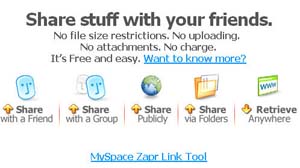
zaprEasy communication and transfer of information is what MySpace is all about. Zapr includes a MySpace Zapr Link Tool . Zapr lets you create links to any files on your PC. Then you can send these links to friends (via email or IM) and they can get the files directly from your computer via their browser.

Is this important. You bet! Jan at Delaney College explains that students are using MySpace for storing their learning ideas and learning resources. They are bamboozled when they get to school and suddenly can’t access their own work, their own files, and continue right on with the learning from where they left off the night before.

You might like to add Jan’s del.icio.us to your network, or Jan’s del.icio.us work with teachers to your network. Thanks to Jan for sharing her enthusiasm.

Shifting technologies

So back to the idea of the telephone or the printing press as change agents. A post from Stephen’s Lighthouse on The Primary Web Device provides some growth figures on mobile phone consumer technology.

He quotes from The Register 

The cellular industry took 20 years to reach one billion connections, three years to reach two billion connections and is on target to reach its third billion in a period of just over two years,” Wireless Intelligence director Martin Garner said. “Worldwide growth is currently running at over 40m new connections per month – the highest volume of growth the market has ever seen,” he added. According to Garner, most of the current growth is coming from emerging markets with low levels of penetration, rather than from mature regions such as Europe.

Stephen covers some cool ideas in what this means for libraries. Bit different to our schools where mobile phones are usually seen as something to be locked away or banned.

His last two questions are the best. Are we preparing for new software and device modalities? Are we in K-12 prepared for the largest generation in history – with phones attached?

Frankly we have hardly begun to think this through. Will the next 12 months see a bit of a shakedown in some schools? I have had a secondhand report today that one of my Teacher Librarians is preparing to embark on a metamorphisis of her library, and in addition to reconfigurine learning spaces she will add mobile devices into the library device pool. Excellent. Let the experiments and lateral thinking begin!

What we are doing is creating a learning community. We do this by using Web 2.0 tools and a social constructivist approach to learning. Jo McLeay asked How do we know that blogs and podcasts improve student learning? The comments are well worth a read, as they show that it is learning in a Web 2.0 community that works, not technology as tool – which is what Web 1.0 was all about and which is where many of our teachers are still.

John Connell pointed to Don’s Blog and and his comments about his son’s Study Blog. His son Lewis’ learning community extended beyond his school leading to be a very productive learning experience.

Lewis received his first comment on a blog post yesterday from someone in Dublin, Ireland, in connection with a post he had put up about Proportional Representation. It’s made a real impact as he now realises there are people out there are reading what he writes. It also helped him to better understand what he is studying.

David Warlik got this feedback from his teachers about Why Kids Blog:

Even when they’re out sick, students work on their blogs.

Carol Barsotti

I’ve got 6th graders coming in during their lunch and after school to add articles to their blog and to respond to their classmates’ articles

Al Gonzalez

My students are floored when, as they say, “some random person from Texas commented on my blog!!” The students are getting real world experience with writing.

Brian McLaughlin

Why would my students want to write on paper for their teacher to see, when they could write on their blog for the whole world to see.

Kathy Cassidy

In fifteen years of teaching, I have never seen anything come along even CLOSE to motivating students to write – like blogging does.

Mark Ahlness

Our learning spaces need to get into mobile technology, mobile computing and social software to engage with the students in their world. From where teachers stand it is all about new literacies and new ways of communicating and negotiating content and meaning.

So back to that mobile phone. Take a read of Smith’s Ninth Grade Blog and To Cell Phone or Not to Cell Phone.

So today I tried something new…I had the kids turn on their cell phones and ring in their answers.

Did you guess what the students had to say about the incorporation of mobile phones into their learning experience?

Ways of learning need to change, and I like to think that the required pace of change is oh so! neatly highlighted by the growth in mobile phone connections.

Streaming media

I agree with Stephen Abram’s of Stephen’s Lighthouse….streaming media is definitely breaking out 😉 The Good, the Bad and the Ugly are definitely out there!

My workplace has yet to step into the streaming media phase – but we will be doing this with a rush and with considerable (learners!) enthusiasm very soon as we transform the lansdcape of our personalised learning environment. Stephen’s questions are important ones for us to consider right now.
Stephen says:

If it doesn’t already, your employer will be creating, licensing, storing and offering education, training, meeting, and communication events to its employees, partners and clients and maybe even the general public. Whether these are called streaming media, webcasts, e-learning, webinars, podcasts, Video On Demand, VODcasts, or whatever, we, as information professionals, should be ready. How do you use them? How are they acquired and what rights are licensed? How are they indexed, archived and made accessible? Can they be put into the OPAC and/or intranet? How are they preserved and stored? Can their contents be searched? Are there better formats and what are the trends? What recommendations should we be making for our companies intranet, Blackberries, browser plug-ins, etc.? There are plenty of questions!

From Islands in the Stream, Infotech Column, Information Outlook, July 2006 issue

Literacy and learning

This morning I have gone back to an article I wrote -seemingly before the dawn of time – well, before the dawn of the internet as we know it, and Web 2.0. I said that we need to examine literacy directly in relation to thinking, and as a tool for learning and the creation of meaning. In other words ‘meaning’ is an aspect of literacy. It is both context and content specific, and is with regard to something, some aspect of knowledge and experience.

To quote myself correctly this time:

Literacy has a specific cognitive dimension, and is a powerful enabling mechanism for thinking and learning. Through the skills of literacy, conscious and deliberate exploitations of text are possible, so facilitating a more abstract, reflexive stance towards information and the processing of meaning.

The problem is of course that since I wrote this much has changed and there are a plethora of ‘literacies’ that are discussed – sometimes in isolation from what I think of as the core concepts of literacy. This is to the detriment of the essential and fundamental purpose of literacy – creating, developing, understanding and sharing meaning!

I really liked the thoughts expressed by Ulises A. Mejias (discussed by Will Richardson and James Farmer) on Social Literacies.

The word literacy is used loosely these days to define all sorts of competences (viz. visual literacy, musical literacy, computer literacy, and so on). Here, I am using Kress’ more exact definition: literacy as the “term which refers to (the knowledge of) the use of the resource of writing” (2003, p. 24). This definition makes it possible to separate literacy from other resources (such as speech), as well as other ‘metaphorical extensions’ of the concept (such as musical literacy, cultural literacy, etc.).

He discusses wiki which make social literacy apparent by allowing us to witness the evolution of text in time, an evolution that reflects the decisions not of a single individual, but of a community.

Thank you! The powers unleased through the invention of printing have enabled thinking… by sharing. For me the fact that we can do this sharing simultaneously and online is not so revolutionary as evolutionary – particularly if we remember that our Web 2.0 literacy is “as the continuation of the struggle that began when Guttenberg released free speech first in our tradition”.

So I don’t totally agree that Wikis engender a new form of literacy: a social literacy. New framework? Yes. But what we are seeing is the actualisation of the full possibility of our literacy potential which began with Guttenberg and which was essentially about social communication as well as information dissemination. Having said that, the social literacy of Web 2.0 tools IS creating a renaissance in our time that will be reflected in creative changes as dramatic as the original Renaissance.

Anyway, to top it all off, I have to express my thanks to Stephen Downes for his post Things you really need to learn. While I’m rambling about literacy and the way it underpins everything! Stephen has given us yet another throught-provoking read that digs into learning.

He switches us over to consider in a deep way what literacy is about: description, arguement, explanation and definition. Yes, these emerge from core literacy and can translate to any context or environment we choose – and as you develop your literacy you are in fact doing what Stephen describes as creating ‘patterns of connectivity’ in your brain ………and enhancing what I understand as the capacity for cognition and metacognition.

This capacity for cognition and metacognition is for me the purpose and value of literacy acquisition, development, and extension in old and new contexts.

Social networking explained

I know many teachers I talk to struggle to understand what the social networking world of MySpace etc is really all about. Even if our teachers see students accessing MySpace or similar sites, what this social networking software augers for the future is beyond their ken.

So Facebook – the complete Biography from Mashuble is a very useful document – the sort of thing that you can hand out or email to teachers to read. Teachers understand biographies!

What is worth noting is the shift in communication patterns. Teachers and parents will tell you that kids live on msn or other instant messaging. Yes…and more…..

I am just waiting for an aussie to post a message about social networking behaviours, like this one from Bokardo

I recently talked with a father of a MySpace user who said that he tried to email his daughter using regular email and she never responded. He asked her why and she said, “I use MySpace for email. Send me mail there”. So he created an account and now he messages her there. Wow.

I would like to find out more about school email accounts and what kids think about them. Are we applying a digital version of “desks in rows in the classroom” approach to our school communications? How do we expand out thinking in this?

Students, technology and literacy

Students tend to be up-to-date with technology, and increasingly own an expensive range of personal items such as MP3 players, iPods, laptops and widescreen televisions according to a BBC News report last year. This is of course the whole thing about education and teachers – keeping up with the intuititive adoption of technology that earmarks the modern learning.

It begs the question – just how are young people are engaging with digital media – especially when it has not been designed to be explicitly educational. What are they learning in terms of skills, networking and collaboration? The way our students are using technology outside school is changing, and so are the ways they learn. Ultimately schools will need to respond to such ‘informal’ learning with digital media, games consoles, the internet and mobile phones.

The BBC news report March 2006 Experts seek 2020 vision, explains the focus of personalised learning for this ‘expert group’ investigation. The summary of their review charter looks like a brief that any education system can apply to their vision and thinking right now……

  • teaching and learning strategies, especially in literacy and numeracy
  • best use of setting and grouping
  • improving parental engagement
  • how personalised learning can close the achievement gap and boost social mobility
  • addressing the needs of gifted and talented children
  • use of ICT and pupil data to personalise learning
  • the potential for workforce reform to support personalisation
  • utilising flexibilities in the National Curriculum
  • collaboration between schools to deliver educational opportunities.

I find this brief curious and interesting for the possible connections – which I hope these ‘experts’ will make.

Literacy is of course a burning issue for humanity – and has always been so. It is important not to let this priority be swamped by the emerging trends in technology and social networking tools and gadgets.

Tom Peters in his ALA TechSource blog wrote a few posts recently that can be juxtaposed quite nicely in order to inform our thinking re 2020 vision:

Peter wrote:

” I think everyone agrees that reading words printed on paper, in solitude (even though there may be others around us, as in a library or on a subway), and in silence is currently the dominant reading mode. We can call this “PSS” reading: paper, solitude, silence. When youngsters first learn how to read, often they read out loud, even when they are alone, but they quickly learn that reading in silence is more socially acceptable, easier, and quicker.”

PPS reading has been the dominant mode of reading for the last several centuries.

Yes, and now things are changing, and digital media of various kinds are moving in on the reading ‘literacy’ scene. We need to recognise and work with these developments, moving beyond the discussions of the turn of the century years which focussed on ‘visual literacy’ and ‘digital literacy’. We must focus on literacy in various forms and in various access points. PPS reading is not the only true or exalted form of reading. But PPS reading still a core skill or technique – for the time being anyway.

Peter wrote:

” Our collective historical consciousness probably will come to realize and accept that, although the ascendancy and dominance of PSS reading was an historical fact that cannot be denied, there is nothing inherent in reading on paper that ipso facto makes that act superior to all other modes of reading.”

Switch now to PP ICE devices!!

Peter says

” The new age I see dawning is the age of the personal, portable information / communication / entertainment device. Granted, that’s a long gray name for a bright new age, but if you vocalize the acronym—PP ICE Device—it has certain melodious qualities.”

I agree with him – we DO need to take the device era seriously, because these devices, coupled with our technology access, mark (highlight?) our slide/transition into a new global era – which will become as radically different to what what before as the shift in society after the Gutenberg press.

We knew it was coming…Al Rogers and Marshal McLuhen were heralding the changes late last century. But now we can see the shape it is taking with the emergence of Web 2.0 technologies and social networking tools and structures. This was not understood or predicted.

The 20th century canvas painted with broad brush strokes is now being refined and defined with images of PP ICE devices!!

More on the Learner as Network

If you haven't found it already, then you need to read the post and comments on this topic at Weblogg-ed. Read Will Richardson's post here.

Getting Social – Creating an effective adoption strategy

For local blog learners, this post from Ewan McIntosh is worth a look:

If you have a suggestion or success story of implementing social software (blogs, wikis, podcasts) in your area or institution please do share it on the wiki.

Check out the wiki – but better still, add edublogs.com to your regular reading list. If you need information on issues, approaches, ideas, or changing directions and opportunities with social software, and you want to know what the leaders in the field are doing – you can't do better than the Scots on this one!

I've also had some conversations with teacher librarians in recent days about MySpace and Bebo, and what they are saying to their students who are spending time on these social spaces at school. Questions are asked about 'what' students are doing, and with whom they are interacting. One reply was 'I have been to a lot of schools and I like to stay in touch with my friends'.

" In school, though, in a classroom there is far less choice as to whom you connect to, so groups perhaps reflect more diverse types of person. But is it education's job to wade in here and try to help students better decide how they use their social space, what information to share, how to use it to learn?"

Read the rest of Ewan's comment here.