New imagery for schools and schooling

I am fortunate to be attending the ACEL/ASCD conference in Sydney where I have the good fortune to be able to hear in person from some of the key thinkers in education from around the world.

I wish I had the time to share the inspiration – but I am busy helping with podcasting and interviews (follow up chats) for ACEL.

It would be hard to pin down my favourite presentation or workshop. How can we make choices when we are hearing from so many.

A highlight of day two was a very reflective talk from Peter Senge. He used narrative as a way to help us reflect on the changing shape. You know, it’s not about education any more – its about changing society, and changing the way we support our young people to grow in knowledge, competence, understanding and responsibility for a safe and viable future world.

John Connell followed with an excellent keynote presentation, which also captured the pervasive media world of our students, and the imperative that we allow creativity to drive change and development. Drop over to John’s highlights of the conference, to see how vital the discussion at this conference really has been.

The final sessions of the day were a particularly fine opportunity to hear Andy Hargreaves and Michael Fullan debate the future directions in effective school development – where we maximize the capacity of teachers and leaders to create relevant and authentic learning for each of our students.

A comment at the end from Andy reminded me of one thing that was of interest to me at this conference. Andy reminded us that we don’t know just how the technological and social networking dimensions of our student’s online immersive lives will influence the shape of the education delivery in the coming years.

Lets not lose sight of this, inbetween the new school structures that we are building. It seems that with the exception of Greg Whitby, John Connell and Westley Field, we have inadequate coverage of Web 2.0 as platform, of social networking, of creativity in the real world of our students.

I hope that those in senior educational roles do not lose sight of this while they are discussing assessment, ‘effect size’ measures, curriculum mapping management styles, leading learning etc.

Overall a great conference – yet a starting point only for re-shaping schooling for 21st century learning.

Lets not forget that that some of the social networking tools that are driving our student’s experiences were developed by young people – out of school, and as an aside to the learning that education seems to be involved with. Lets meet online in these spaces for the next ACEL conference 🙂

Photo: Valley between buildings.

Blade Runner – A classic cut restored

I list Blade Runner as my favourite movie in my Facebook profile. So naturally I am pretty interested in the release of “Blade Runner: The Final Cut” on DVD.

IT’S been 25 years since the release of “Blade Runner,” Ridley Scott’s science fiction cult film turned classic, but only now has his original vision reached the screen.

The film, based on Philip K. Dick’s novel “Do Androids Dream of Electric Sheep?,” takes place in Los Angeles in 2019. It follows a cop named Deckard (played by Harrison Ford) who hunts down androids — or, in the film’s jargon, replicants— that have escaped from their slave cells on outer-space colonies and are trying to blend in back on Earth.

For the new director’s cut, the special-effects footage was digitally scanned at 8,000 lines per frame, four times the resolution of most restorations, and then meticulously retouched. The results look almost 3-D.

The story also takes on some new twists and turns , providing a darker perspective of future society – read more at the New York Times, and be sure to view the FilmFuture clip with Fred Kapplan’s commentary of the future as depicted in Blade Runner.

Likely to be an even more hypnotic and challenging movie! A media studies must!

Yes, via boingboing 😉

Creating possibilities in learning

For two days, we are being engaged in a trip into the roots of education – an important step of revision and re-visioning our ideas and purposes for learning.

Our task? To begin to understand ways of actualising a new Parramatta Catholic Education Framework.

Our leader in this process is Yoram Harpaz, founding Director of the Community of Thinking programme at the Branco Weiss Institute in Jerusalem.

We are doing this in order to help us draw a new conceptual map of education to define our aims and means of education. Schools are in deep crisis – they no longer work effectively for 21C – but for now we don’t have strong alternatives in place.

We need to ask ourselves some fundamental questions – and the most fundamental is “what is education?” and “what does it mean to prepare students for their lives in the 21st century”?.

Yoram mentioned many times that schooling has been a very successful sociological experiment, but a failure for our students because of our inconsistency in our pedagogical frameworks.

Yoram jokingly says that we operate as if it “Doesn’t matter what you teach so long as it’s boring!”

Essentially we have to find, what Yoram calls, “our pedagogical sentiment”. There are lots of slogans, but what is our real authentic pedagogy or stance? How do we turn our classrooms into a community – a community of thinkers? He wants students to experience knowledge as human creation.

The thing we are investigating is Yoram’s Third Model which is about ‘disruptive intelligence’, about sharing ideas, working together because

thinking is a dialogic and societal process.

Our purpose should be about putting dialectic pressure on students. If we are flexible and sensitive then teaching can support learning. I love the idea of ‘teacher as therapist!’

Yoram is also a strong advocate of ‘story’, and the human narrative, which fits very well with digital story in a Web 2.0 context as well. As he explains, knowledge is created by human beings – it is storytelling which helps put order into our chaotic life and insert some logic into the mystery of life. We want our students to create their own stories, their own interpretation, and original ways to solutions.

Knowledge is not an object – Knowledge is a ‘story that works’

The Department of Education and Children’s Services in South Australia provides a good series of informative links for Dr Yoram Harpaz.

Harpaz & Lefstein: Changing Schools – What sorts of changes in schools should we be putting energy into?

I’ve got more to write about this on another day….

Image from jakedobkin.
  • Visions of the future…..

    There is a wonderful online gallery of illustrations by Villemard from 1910 imagining what life would be like in the year 2000. It’s part of a larger exhibition titled Utopia: The Quest for the Ideal Society in the Western World.

    Check it out here.

    Thanks to the alert from Stephen’s Lighthouse.

  • “Unlearning” and the future of education

    In my workplace we are undergoing a sort of major change as the leadership work to shape a new direction for the learning frameworks in our schools. I’m pretty keen on seeing these changes. Recently, at a two-day workshop, we heard some great stories from three schoosl – Unlimited Paenga Tawhiti, Summerland Primary School, and North Loburn School, all in New Zealand. Nice one Vince, Luke and Mike! Personally I would like to hear more from Australian schools, and Australian teachers. I know we have some fabulous innovation going on right here in Sydney……..but?

    Never mind – the global collaborative to the rescue (no business flights required)

    A post in the social networking site Classroom 2.0 lead me to the Map of Future Forces Affecting Education from the KnowledgeWorks Foundation and Institute for the Future 2006-2016. Check it out or grab the pdf, and then think about what you’ve seen on the map and discuss it with colleagues.

    Will Richardson wrote recently about The Steep “Unlearning Curve”, and lists 10 things we need to unlearn to make ‘future’ schooling come to life. What Will talks about resonates with us all who are trying to create a shift in the way schooling happens. It IS about seeing the possibilities.

    The “aha” moments in life delight us. We suddenly gain an insight, experience a profound joy, or realize something important for the first time. That’s learning! That’s why we have to push further into the future of learning than our NZ colleagues took us recently.

    How far and fast we can go is picked up right here in Sydney by Westley and his MLC girls, busy building Skoolaborate in TeenSecondLife.

    This for me is real innovation, and leaves our NZ colleagues for dead. Me? I wish!

    Inspirational Teenager

    Listening to Daniel Brusilovsky , just 14, is for sure a reality check for any teachers hesitating to adopt Web 2.0.  Daniel works in IT, and has his own blog and podcast show. I love that Daniel talks so favouribly about Twitter – because I picked up the information about this podcast right from a post by Scobleizer on Twitter! Good one Daniel!

    [podtech content=http://media1.podtech.net/media/2007/08/PID_012094/Podtech_DanielB.flv&postURL=http://www.podtech.net/home/3757/inspirational-teenager &totalTime=1019000&breadcrumb=ae6a213b3d354fe6b199ef8616abb90c]

    Books to 3D search – good for your soul!

    I can’t resist commenting on BOOKS as we continue to skip down the yellow brick road to Web 2.0, Web 3.0 or whatever!

    Here is an excellent visual list of the Top 10 Banned Books of the 20th Century. Needless to say, each tells a ‘story’ – and the cultural shifts around some of them have been profound! Books still have a significant place in our world – and perhaps this is why they still figure in Web 2.0 developments that make books easily accessible to buy and read.

    5 Alternative Ways to Browse Amazon provides an array of alternative visual search tools for….. well yes, for finding and buying good books. Very good read.

    Developments in visual search tools seem to be gaining pace. You will be amazed at what is happening at Space Time, 3D web search, currently in Beta and only available on a PC. But what a WOW! way of searching “at the speed of thought”. “Watch as your information converges in one space at one time”.

    But even more interesting for an information professional is the presentation about the Semantic MEDLINE Visualization Prototype which incorporates the semantic web and natural language processing – manipulating information as well as documents to respond to a searchers needs. It connects knowledge from various resources from PubMed and Medline – and natural language processing will summarize and produce a visual network or relationships between the material you are interested in.

    Virtual communities as a canvas of Educational Reform

    Some recent online reads have prompted me to write about learning within our ‘shape-shifting’ technologically driven world. If you are new to blogs and online tools, let me tell you that there is a lot happening – but don’t let that put you off getting involved.

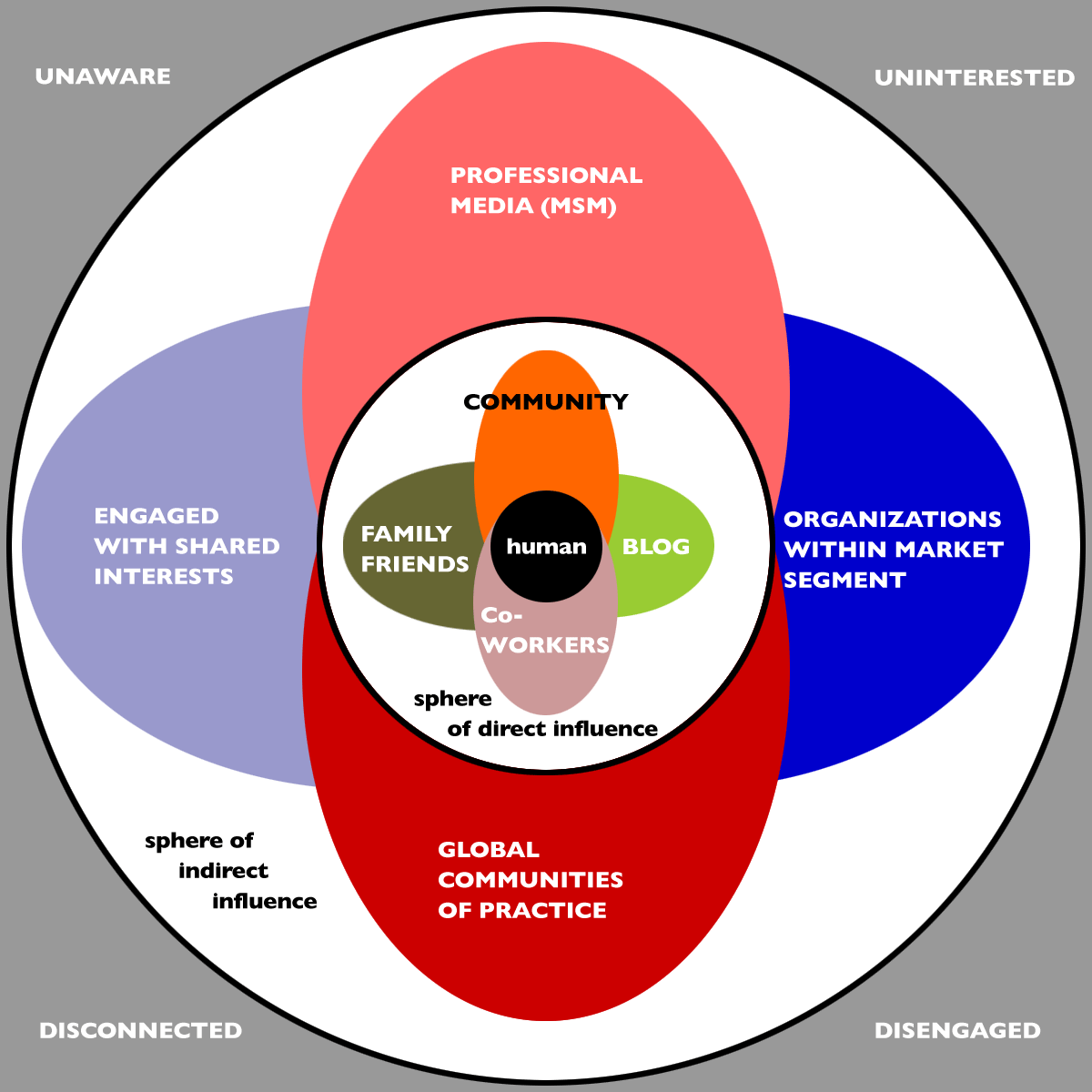
    There are many different perspectives to put on online social networking and it is important to know where one is coming from when talking about social networking and youth. The perspective(s) one has will be very different whether one is a parent with a teenage daughter on MySpace, a marketing executive interested in the target group “14 to 20,” a journalist looking for the next big news story on young people and new media, a youngster using a social networking site as part of everyday life or a researcher investigating how young people are using social networking sites.

    35Perspectives on Online Social Networking provides a different (broader) exposition of online networking. Here we have an excellent overview that helps me to see the matrix of inter-relationships between sectors or groups. That, after all, is what our real world is – and online virtual interactions are no different. Don’t let me forget that.

    So that was what WOW2 was a bit about – educators in one countryexploring education ‘downunder’. I have to thank the WOW2 team for the fabulous opportunity to take part in the WOW2 EdTechTalk recently. It was pretty cool chatting to my aussie mates Graham Wegner and Jo McLeay. But I also ‘met’ Jason Hando, who (rather surprisingly) is in Sydney, doing great things as well. No excuses for us not keeping in touch are there?

    Actually I think that what Sheryl wrote in Virtual Communities as a Canvas of Educational Reform is a ‘must read’ for school leadership teams working on capacity building and educational reform. She says:

    The way I see it, social networking tools have the potential to bring enormous leverage to teachers at relatively little cost — intellectual leverage, social leverage, media leverage, and most important, political leverage. And while most of us reading this post can name educators across the globe that are using these tools as windows from their classrooms to share ideas and develop their own personal learning environments, the sad truth is that most aren’t. The burning question in most of our minds is how can we accelerate the adoption and full integration of 21st Century teaching and learning strategies in schools today?

    Creating virtual communities that function effectively within and beyond our schools IS a significant challenge.

    Our system of schools has been actively exploring these options in 2007 (fabulous!) – and we are definitely learning from the experience. We began the year by formally launching a blogging strategy. Unfortunately we didn’t address some of the important questions that Sheryll raised, and as a result our first effort at system-wide blogging ‘came a cropper’. Well, not totally, but it was no surprise really as some of the vital ingredients of social collaboration were missed starting with the first important point – who is blogging and why?

    The best blogs are social – and we missed that point – and are platforms where discussion blooms. Blogs in this context of collaboration can’t be the stuff of soapbox but must be the stuff of open-ended conversation – and that means writing as well as commenting.

    I like the fact that we continue to try to figure out what sort of virtual communities will work for us. We’re game for the challenge, and won’t let disappointment stop us from pursuing educational innovation and reform.

    Now we have a new strategy to experiment with. The start of Term 3 saw the official launch of the ‘Learning Common’ blog – open to all teachers to write, comment, collaborate, and share the ups and downs of teaching life. We have merged a number of blogs into one, and opened up the option to be a writer to anyone in any school. Will this work?

    Richard McManus covers some important things about blogging within the context of virtual communities asking Is Blogging Dead? Gosh, we are just starting with blogging, so I don’t think our teachers will be abandoning our new blog for something else. But, Richard says

    It’s hard to get discussions going on a blog, but the blogs that at least attempt it and actually write for their readers — these blogs are the most compelling in my view.

    I agree that this is at the heart of the matter. Let’s hope we can make the blog compelling reading – a place that people really want to be to share their ideas. So let’s see what happens. We’re pretty keen on blogging, and many of us blog!!!

    We just haven’t cracked the whole virtual community thing yet, but I think we’ll get there.

    It’s all about spheres of influence. This graphic says a lot, and is easily adapted to provide us the guidelines for successful blogging – that builds capacity as part of our educational reform!

    WikiMindMap is a tool to browse Wiki content easily and efficiently, inspired by the mindmap technique.

    Wiki pages in large public wiki’s, such as wikipedia, have become rich and complex documents. Thus, it is not always straight forward to find the information you are really looking for. This tool aims to support users to get a good structured and easy understandable overview of the topic you are looking for.

    First month of development for this tool – which is nice. I particularly like visual techniques for presenting information to students as part of demonstrating research techniques. Several languages available – be sure to choose the right one for your needs. This visual technique allows you to drill down and refine your ideas as you go.

    Two searches for Web 2.0 and Web 3.0 provided the following really interesting entry screens – which pick up the key launch points for investigation on each of these two broad topics.  It’s  also possible to hyperlink these screen shots directly to the search query – once again this is useful when presenting information to students and for pointing them to a specific search focus for research and learning.

    web-30.jpg

    web20.jpg

    Create + Learn + Broadcast = L3RN

    A very impressive Web 2.0 presence from Seattle Public Schools who have clearly got a great lead on integration of social networking into their learning frameworks!

    Know as L3RN – Learning equals creating, learning and broadcasting, A visit to their fantastic portal is a must. School libraries have their own area for News, tips, resources, and help from Seattle Schools’ libraries.

    The portal has browse, video, audio, docs and channels in its suite. Fantastic.

    Thanks to Awapuni for ‘links for you’ through Del.ici.ous!

    [Cross-posted from: iLibrarian because it is too important to only post in one place!]