Tag your world – share with Stickybits

What next you ask?  How about Stickybits!! With Stickybits we are now able to attach digital content to real life objects, and share this content with anyone else who accesses our Stickybits  barcodes.
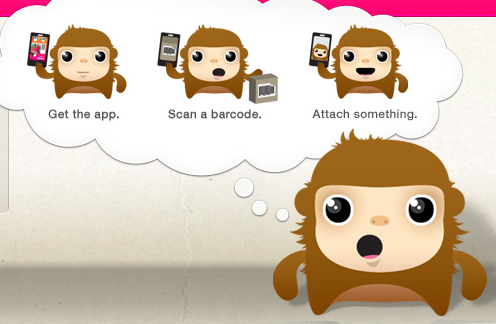
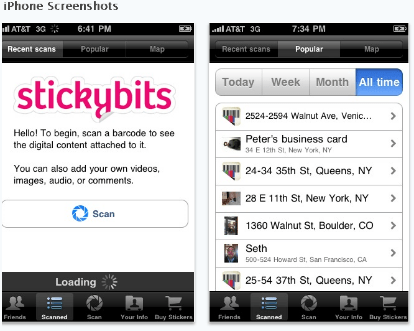
The current phase of social media is all about location-based applications, such as Foursquare, Gowalla and Brightkite, to name a few. By downloading the Stickybits mobile application on an iPhone, users can scan the barcode and which provides the  videos, photos and text which have been added, which are referred to as “bits.”

Anyone that scans the barcode, can see the bits loaded from other users and also add their own content. Stickybits barcode locations can be identified on a map provided in the application and are tracked on the Stickybits website.

I think there are things we could do with this for professional or fun things, as well as develop ideas for school.

You can attach photos, videos, music, pdfs, and more to a barcode.

It is possible to print out your own barcodes, order some snazzy ones from Zazzle, or attach ‘bits’ to existing barcodes.

Here is where it could get interesting for schools – we already have barcodes on objects – now we could attach information goodies to items that are being used for reading, learning, playing, enjoying.  Would we?  This is definitely a whole new idea to explore.

Would you use Sticky Bits?  What would you attach to your barcode?

TechCrunch has a bit to say too:

Every place and object in the world has a secret past: who lived there, who passed by, who touched it. The secret lives of objects are filled with such details. If only you could make them talk. But what if you could give any physical object a story simply by sticking a barcode on it and appending a message to that barcode?

The barcode in a greeting card , for instance, could trigger a video message from the sender. One on a box of medical supplies could inventory what is inside. A business card with a code on it could link to a resume or LinkedIn profile. Museums and theme parks could use them for audio tours and maps. Local merchants could use the barcodes to track deliveries or place them in their storefront windows to distribute digital coupons and offers to passersby.
To get more ideas keep an eye on the StickiWiki, and please do let me know what you try.
Laura Gainor will be utilizing stickybits as a travel journal as she ventures to Disney World with her family from April 16 – 19, 2010 and also bring along stickybit stickers to attach to different real world objects

Laura Gainor used  stickybits as a travel journal for a Disney World trip with her family from April 16 – 19, 2010!

Vodpod videos no longer available.

Climbing up the social ladder …

Two and a half years ago Social Technographics presented a visual analysis of social technology behaviour. Despite the rapid pace of technology adoption, the rungs on the ladder have shown steady growth, with some (like Joiners) growing faster than others (like Creators). In an update –  Social Technographics: Conversationalists get onto the ladder – which includes not just Twitter users, but also people who update social network status to converse (since this activity in Facebook is actually more prevalent than tweeting).

Where do you fit on the ladder?

Social Techno Ladder Mark 2

Another Great Twitter Guide

Twitter can be confusing at best, and downright intimidating to many newcomers.

This guide should give you the basics you need to get more out of Twitter, whether you use it for your business or personal life.

This Twitter Guide covers Twitter basics, terminology, etiquette, tools, twitter clients to use on your computer, other Twitter services, finding friends, using lists, communication, promotion, and more. Additional links to read are also included and combined will provide all the information you need to learn about or use Twitter effectively.

Posted via web from Library Cloud

Not just Twitter and Facebook ~ it’s a Poken!

Get the pokenPulse combination Poken device and USB Flash drive. Click for details.As John explains in his post on Integrating Social Media and Reality, we live in two separate, parallel worlds, with one foot in each. There’s the online world of text, email, online shopping, Internet search, Twitter, Facebook and LinkedIn. Then there’s the real world of food, shelter, family, friends, and work. The two intersect, but they’re not tied together in any robust way. Well, at least until now.

Enter Poken! a device you might keep on a lanyard around your neck or clipped to your jacket, backpack, or bag. Need to exchange information or keep up-to-date with a colleague? If you both have a Poken you can touch the hands of the Poken together and they’ll sense each other’s presence. After a wireless exchange of links, both hands will pulsate with a green glow to announce the successful transfer of information. The magic happens when the Poken is connected online to your personalized online portal.

Way better than a business card ~ amazing social networking! Is this new? Or have I been living under a rock?

Vodpod videos no longer available.

more about “Poken Explained on Vimeo“, posted with vodpod

Don’t Miss These Twitter and Facebook Guides

Whether you are teaching a class, helping a friend or just looking for information for yourself these guides from Mashable are a great resource.

The Facebook Guide topics include:

  • Facebook 101: The Basics
  • Managing Your Facebook Wall
  • Using Facebook for Business
  • How to become a fan of Mashable
  • Using Facebook Applications
  • Facebook 305:Advanced Topics

Twitter Guide topics include:

  • Twitter 101 – The Basics
  • Building Your Twitter Community
  • Twitter for Business
  • Twitter Guide Book To Go: PDF Download and Slideshow
  • Sharing on Twitter
  • Managing Your Twitter Stream

Get your horizons boxed in!

Ever collected boxed sets of your favourite authors, movies and the like ~ to keep and remember?

I’m predicting that 2010 will be a year of amazing shifts, consolidating the innovations that Web 2.0 introduced. Educators always like to study how, what, where, when and why…so go on over now and collect your boxed sets of the Horizon Project Reports put out since 2004 by NMC.

Your  own ‘boxed set’ of Horizon Reports as a single pf:
http://www.nmc.org/pdf/horizon-reports-set.pdf (2.5 Mb PDF)

Collectors Edition which also includes the 2008 and 2009 Australia-New Zealand Editions, the 2009 K12 Edition, and the 2009 Economic Development Edition!
http://www.nmc.org/pdf/horizon-reports-all.pdf (4.6 Mb PDF)

Look for the news on January 19, 2010 when they will add to both collections, the newest edition– the 2010 Horizon Report– which will be released at the EDUCAUSE ELI Annual Conference in Austin, Texas.

Grab the Wordle for the reports too if you like!

Wordle: Horizon Reports 2004-2009

What Matters Now

Seth Godin writes about marketing, the spread of ideas and managing both customers and employees with respect. If you’re not familiar with his books, check them out here.

Seth’s newest ebook What Matters Now is a compilation (or is it a collaboration) of ideas and actions happening around the world.

Seth explains:

We want to shake things up. More than seventy extraordinary authors and thinkers contributed to this ebook. It’s designed to make you sit up and think, to change your new year’s resolutions, to foster some difficult conversations with your team.

Over 70 authors pitched in, and it’s now free to download here, or on Scribd.  Some great ideas to grab for education too!

Did you know that last year 1.2 million books were loaned out in developing countries through Room to Read?

Take one of the pages, and use it as a discussion starter with your students, or your next faculty meeting.

Teaching Privacy in a 2.0 World

[clearspring_widget title=”Animoto.com” wid=”46928cc51133af17″ pid=”4b24168b205436d3″ width=”432″ height=”240″ domain=”widgets.clearspring.com”]

….with thanks to a tweet from Michael Stephens @mstephens7

Teachers done and dusted?

A meeting today reminded me of the chasm surrounding general understanding of what is going on in the new media world of our youth.  Here we are with teachers still ‘learning’ how to do basic things, while the kids have stampeded right on into the 21st century.

Tipping Point Labs has some interesting insights into Tumblr, Twitter and The Tweeters,Tumblrists and Technogeeks using them. Tumblr  is seen as being a more sophisticated version of Twitter with much more room for valuable content and interaction between users.

Now I don’t know about you – but these are old tools of trade for me and many of those in my personal learning network.  Definitly not tools of trade for the majority of those I work with and interact with on a daily basis.

I dropped by the Facebook profile of my very sociable teenage niece.  What I saw was a breadcrumb trail to some new shifts in what her friendship groups were up to. Seems the kids are starting to ‘swarm’ to places like twitter and tumblr. Facebook, Myspace, Beebo and MSN are no longer enough.

This backs up the odd comments I got at school today from some random kids – “you’re not on twitter are you miss?”

I exchanged a few messages with her – and then she actually discovered who I was!

She described my presence as ‘awkward’ – naturally!  I promptly bid my farewells and assured her that I would not ‘follow’ her on Twitter.

Have you checked out lately what your students are doing online?

Horizon Report – K12 at last!

The Horizon Report 2009 K-12 is here!  Naturally I’m thrilled to bits, for professional and personal reasons.

Firstly, because the Horizon reports, that have been released since 2004 and which have provided critical information for educators about emerging technologies and their impact on  society and education – has now released its first report for K-12.  Horizon.K12 focuses on emerging technologies for elementary and secondary learning institutions.

Secondly, I was so lucky to be included on the Advisory Panel of the K-12 Report. Just being part of the process was amazing – but seeing such a breadth of information, and engaging in the process of filtering was an education in itself.  Much material was covered, as we read, filtered and sifted priorities – we’ve seen what didn’t make it into the report – so maybe we got to know what might come next 🙂

While there are many local factors affecting the practice of education, there are also issues that transcend regional boundaries, questions we all face in K-12 education, and it was with these in mind that this K12 report was created. The hope is that the report is useful to educators worldwide, and the international composition of the Advisory Board reflects the care with which a global perspective was assembled.

Information on all the Horizon Reports may be found, and downloaded, at
http://www.nmc.org/horizon.  The Horizon K-12 Report may be downloaded here.