Vodpod videos no longer available.
more about “Web Search Strategies in Plain English“, posted with vodpod

Vodpod videos no longer available.
 Resistance to change is an organizational reality … a frustrating reality that scares the pants off me if I stop and reflect too long on the implications of this for schooling today. I have been lucky in my own professional learning journey – which might explain my passion for change and innovation. I have been to great conferences, made wonderful friends around the world, and can connect with the best as well as the up-and-coming innovators via my social networks. I’ve had dinner at various times with people like Stephen Heppell, John Connell, Kathryn Greenhill, Andrew Hiskens, Marco Torres and Will Richardson; lunch with Ewan McIntosh and any number of cups of tea and coffee with many many more.
At the end of the day it’s not who you eat with that counts! As Dean so aptly explains in his poster No1 (in a 30 day challenge), there is no glory, no change and no achievement in pure grandstanding. To me it has always been about collaborating, and trying to inspire others around me to take up a new learning challenge. Often they forge on ahead and leave me well behind, which is awesome.
Yeah but! is the theme of another of Dean’s posters, and should be printed out an plastered in a few staff rooms around the country 🙂 It’s true – Professional Development; Capacity; Digital Citizenship; Organisation; Sustainability; 21st century skills: – you can wait….but the kids can’t!!!!
So no amount of fine dinners, or friendly conversations matters a fig if we aren’t working in a supportive workplace that promotes diversity in thinking and innovation in practice. A voice in the wilderness is not a good model for innovation and change within the whole school. So 5 men and Jude have formed a team to get some significant thinking and doing underway.
Actually, the 5 “men in black” and myself spent an amazing two days in Melbourne, attending the launch of PLP followed by visits to schools the following day. This was indeed an outstanding beginning for us. The program put together by Will and Sheryl, and hosted by Jenny, was of course full of tactics for easing into the exploration of our proposed journey of change. Thank you for a wonderful start!
I can confidently say that I think I’m pretty ‘eased’ into Web 2.0 and social networking, and learning approaches for students. But it’s the team that is going to act as the force for change in ideas and innovation at our school…building capacity by strengthening knowledge and understanding of how to teach with technology in ways that are not 20th century.
 We also visited three schools, and learned a great deal. Scotch College showed us that professional development is about personalised learning, mentoring, and co-ordination of change.
PLC showed us the incredible value of an integrated Web 2.0 approach. Cloud computing is driving the world, and should be driving what we do in education. Communication, collaboration, and full utilisation of digital environments is essential
Coburg Senior Secondary High School put it all into context with smart thinking and smart learning. The school works on open plan design which incorporates learning commons rather than classrooms. This design and the corporate feel of the school, help create a more university like adult learning where teachers and student learners develop their skills and understandings in a cooperative and supportive manner that has high visibility and high expectations of achievement.
Now our hearts are on fire, and our learning will be intense, but change is definitely underway! Anthony (man in black at the back!) acted straight away first chance! and grabbed the usual boring assessment task that all schools have, with text, text and more text, followed by even more text that spells out the outcomes of learning, and turned it into a student-friendly task. The result is this and this.
Some students spotted my copy, and demanded to know which class was getting that to do! There were loud groans when they found out it was not for their class. The kids said “More teachers should do this!”
Given half a chance they would have started on the challenge straight away – and that’s what passionate learning is all about, isn’t it?
So who’s the learning leader then?
WE ARE!!!!!! YOU ARE!!!!!
PS. Don’t you love the idea at Coburg of projecting school images on the landing of the stairway to the second floor!
 I haven’t had much time to write in the long winter term – but there’s a good reason! I work at a fantastic school with terrific teachers and equally fantastic leadership, all of whom do not shy away from addressing learning challenges – albeit in a timely and appropriate manner.
So TWO really exciting things are happening within my scope during the remainder of the year.
The first revolves around the library learning spaces at ‘Joeys’. The Brother Liguouri Resources Centre was built with an amazing vision that still holds true – the facilities work! and the services are great. It’s just the physical environment that needs an overhaul. So I am involved in great planning with our architect, and we expect to undertake the refurbishment starting late November, early December. Woot!

The second revolves around our trip to Melbourne next week for the official launch of the Australian cohort of the international Powerful Learning Practice program being run Sheryl Nussbaum Beach and Will Richardson.
Powerful Learning Practice offers a unique opportunity for educators to participate in a long-term, job-embedded professional development program that immerses them in 21st Century learning environments. The PLP model is currently enabling hundreds of educators around the country to experience the transformative potential of social Web tools to build global learning communities and re-envision their own personal learning practice.
PLP’s learning cohorts are led by internationally recognized voices and practitioners in the field of educational technology.
I love working with Will, and can’t wait to begin to work with Sheryl too on a regular basis in this program.
We have a great team from school which includes our adventurous Director of Teaching and Learning; my explorer buddies Gary Molloy and Anthony Rooskie (explorers of Wiimote in our Classrooms); and two new teachers (from English and Social Sciences) ready to jump right into this wonderful experience. We will be a strong team.
In addition I am excited to be one of 10 educational leaders called 21st Century Fellows within the Program, which will allow me to work with schools around the world and expand my own knowledge and understanding of an integrated approach to 21st century learning. The Fellows serve as facilitators of online professional development activities and can be “go to” folks if the teams have questions or need help!
For more information, visit the International PLP Wiki.

 Term break means a time to relax, a time to reflect, and a time to regroup! It is also inescapably time to stop and reflect on professionalism. My head has to stop spinning and my mind has to stop being excited on the one hand, or screaming with frustration on the other.
Like many others in my personal learning network, I am passionate about the changes in the learning environments of our students – at least the possibilities if not always the actualities. I’ve been blogging about this and the information frameworks, tools, concepts, and activities since May 2006. Yes, I know that’s not long, but it’s longer than some and long enough now to know when I am hearing or reading rubbish!!
Doug Johnson in Continuum’s End said
It seems to me that that the continuum between reactionary educators who still find overhead projectors a cutting edge tool and progressive educators who seem to master each tool and philosophy du jour is stretching ever longer every year. As a classroom teacher in the 70s and 80s, we all taught pretty much the same way, with the same sets of tools.
The question of importance to me is not the mastery of tools, but the underlying processes that are important. This is the rub – there are those who, rightly or wrongly, are amongst the elite in terms of commentary or influence on directions in education, who it seems to me have become what my own family constantly remind me not to be…..they are ‘clique-bags’.
“Those” clique-bags are the smart ones – not me, not you – but people who make decisions on our behalf.
Finally I have had enough of the clique and rhetoric!
I’m churning my way through a ton of books on digital schooling, digital kids, 21st century society etc etc.
And its always the same – rattle out the cliches, dismiss everything about the past, bang on about the digital generation and bingo you have 21st century learning frameworks.
Don’t get me wrong – it’s not that I don’t agree with some of the key elements – I wouldn’t be a blogger if I didn’t have my headspace in the 21st century – but please slap me with a cold fish if I ever start saying the following:
In many ways, schools as we have all experienced them, are offspring of the industrial age. So powerfully influential were industrial processes and their effects on all aspects of society, that schooling was actually modeled on these processes, designed to meet the needs of a particular society in a particular point in history……..G. Whitby in “Leading a Digital School: Principles and Practice” ed Mal Lee and Michael Gaffney
What has happened with cliques is that educationalists have been ranting about ‘industrial age’ schooling, related to the economic and communication environments that shaped society in the 19th and 20th centuries. So with the globalisation of world economies and the emergence of the flat classroom concepts, the thought leaders have adopted the ‘industrial schooling’ argument as the reason for wholesale deconstruction of education structures across schools or systems.
I would suggest that we not forget the history of education in society. Unique combination of technological, cultural and economic factors led to the Industrial Revolution and a spinnoff in this era was the eventual emergence of the right to education for all. The much criticized ‘industrial age’ of schooling of the 20th century was in fact the endpoint of an age of great achievement where education was sought after and available for every child in western society. It was an age of great sacrifice, of economic battles for the right to either secular or religious education, it was an era that carried forward the ideals of knowledge first cemented by the Greek philosophers, and valued throughout history and the transitions wrought by the age of the printing press and beyond.
The ‘industrial age’ of schooling was the pinnacle of many achievements. My children’s grandfather rode a horse to school, had no electricity or running water at his home, yet without basic technology or the accouterments so urgently demanded for all our students, was able to learn so much that made him the thinking man he is today, who can hold his own and challenge the ideals and deep knowledge of his geeky young grand kids.
It was a major achievement to be able to educate all young members of our society. In third world countries, this right is still being won! It is not technology or web 2.0 or fancy new ways of arranging staff and learning spaces that makes the real difference. It is what we say, how we say it, and how we support deep knowledge that makes it possible for our students become good social, ethical and moral citizens of the world.
No more cliques please. Rather, acknowledge the value of past efforts, and build on them to create future opportunities – which incorporate the demands that our 21st century makes on us. If I go back to John’s post The Continuum’s End – I’d venture that the continuum between reactionary and progressive education spans many centuries.
Unfortunately there are some amongst us that are so poorly read themselves that they can’t see how silly it is to tout 20th century ‘industrial age schooling’ as the reason for educational change. Oh but they are probably the same people who run your education system, or institution and are good at verbose cliques to justify their actions.
Yes, there’s a lot that needs to change about schooling. Let’s focus on the facts to get there. Cliches are born of ignorance – that’s all. Focus on the revolution not the rhetoric!
People beyond Australia will be interested to catch the news item “Phone a friend in exams”.
A SYDNEY girls’ school is redefining the concept of cheating by allowing students to “phone a friend” and use the internet and i-Pods during exams. Presbyterian Ladies’ College at Croydon is giving the assessment method a trial run with year 9 English students and plans to expand it to all subjects by the end of the year.
This is part of a pilot study to examine potential change in the ways in which the Higher School Certificate (HSC is the final pulic examination for all students in New South Wales) might be run.
Read more about it from Chris in The Truth is Out There.

 Like all good things, the finest are not always found where you would expect them. The behemouth trade display at NECC mainly gave me a headache rather than inspiration – except for a couple of quiet finds that were buried amongst the usual widgets, gizmos and latest emperor’s new clothes of IT.
So after some delay I am looking back over some of those quiet discoveries.
Today I created my test account for Haiku Learning Management System. Now I am not an advocate of the usual wall-garden variety of LMS being a denizen of Web 2.0 cloud computing 🙂 I understand the reason why schools go down that path. I have yet to see one that equates with the approach that LAMS (Learning Activity Management System) takes – i.e. supporting the pedagogical side of learning, rather than just the organisation and presentation of a learning materials. LAMS provides teachers with a highly intuitive visual authoring environment for creating sequences of learning activities that make you THINK about your pedagogy. But that’s another story!
However, if you must have something, then chose wisely and don’t look for 20th century solutions – focus on the current and future learning platform that IS the web.
This is why the Haiku LMS has instant appeal. It is as easy to use as any blog, wiki, ning etc tool you are currently playing with. It does what a good LMS needs to do – allows you to create classes, drop boxes, add attachements – whatever. Choose your own templates for a fun look too!
Absolutely everything that you might want is there. If is isn’t – use the embedd code box to add the latest. I remember them saying at the NECC stand that as soon as a good tool becomes available they will grab the API and add it to their Web 2.0 kit. Looking at the full set I found all the popular Web 2.0 tools, and some I wasn’t so familiar with and am now off to explore
This is the BEST of cloud computing I have seen for a school-based LMS yet. The power of this is amazing and wonderful – and just what we should all be doing.
I would love for this to be used at my school.
 Google ’s answer to the Wikipedia encyclopedia, Google Knol (short for Knowledge), launched earlier this week.
Knol is a unit of knowledge! or so the logo proclaims. In fact, Knol is a collection of authoritative articles, written by a community of experts and as such Google Knol is positioning itself in direct competition to Wikipedia.
Knol is looking for authors (either singularly or in groups) willing to put their names behind their content on a wide of range of topics, “from scientific concepts, to medical information, from geographical and historical, to entertainment, from product information, to how-to-fix-it instructions.” Google will not edit the content in any way, but, like Wikipedia, readers will have access to community tools that will allow them to submit comments, questions, edits, and additional content — in addition to being able to rate or write a review of a knol.
In addition, Knol authors can share in the revenue generated from the Google Adsense ads on their subject pages.
I’ve read quite a few reviews, reports and comments about Knol.

It’s still in its infancy as a project, so issues about content and quality are still being fixed. However, my favourite take on Knol comes from Richard Gale, who (after giving Knol a drubbing) discusses some positive thoughts about Knol.
In particular he brings into play a discussion about tacit and explicit knowledge.
Huge amounts of information are collected inside a person’s head or on their computer. And it is not accessible to anyone else. Getting this tacit information out, making it explicit so that others can use it, is an important goal of many Web 2.0 tools.
By providing singular authorship, knols allow a more ego-driven approach for making the information explicit than Wikipedia does.
That is, Wikipedia also provides a means for moving tacit information into the explicit realm. But, there is no real sense of authorship, nothing to really plant a flag and say I did this, I am providing this to the world.
Finding ways to transform tacit information into explicit are crucial in today’s world. Wikis can do this. Blogs can do this. And so can knols. Knols will not replace other approaches. They provide a new path for the transformation to occur.
A danger point? – Knols can move us away from an open-source environment to a digital form of the ‘authoritative’ texts that we bought so frantically to support 20th century learning. Knols are about digitizing our global knowledge base and adding value to their interpretation and delivery of knowledge – by paying out some money. That’s publishing – online!
George Seimens (f Knowing Knowledge fame) says:
Google is essentially stating that individual ownership of articles is important. How will knols be listed in Google searches? Will they receive better search returns than Wikipedia articles? A part of me would like to dislike this service (how much more of our soul must we give up to Google?). But the idea is well conceived.
Digital Inspiration provides a Quick Start Guide.
Resources on the site are quite scarce now, as to be expected. But I am watching this development because I see furture e-texts staring me in the face. The anonimity of wikipeidia is its strength and its weakness. I’m tipping that plenty of teachers will love Knol as the content expands.
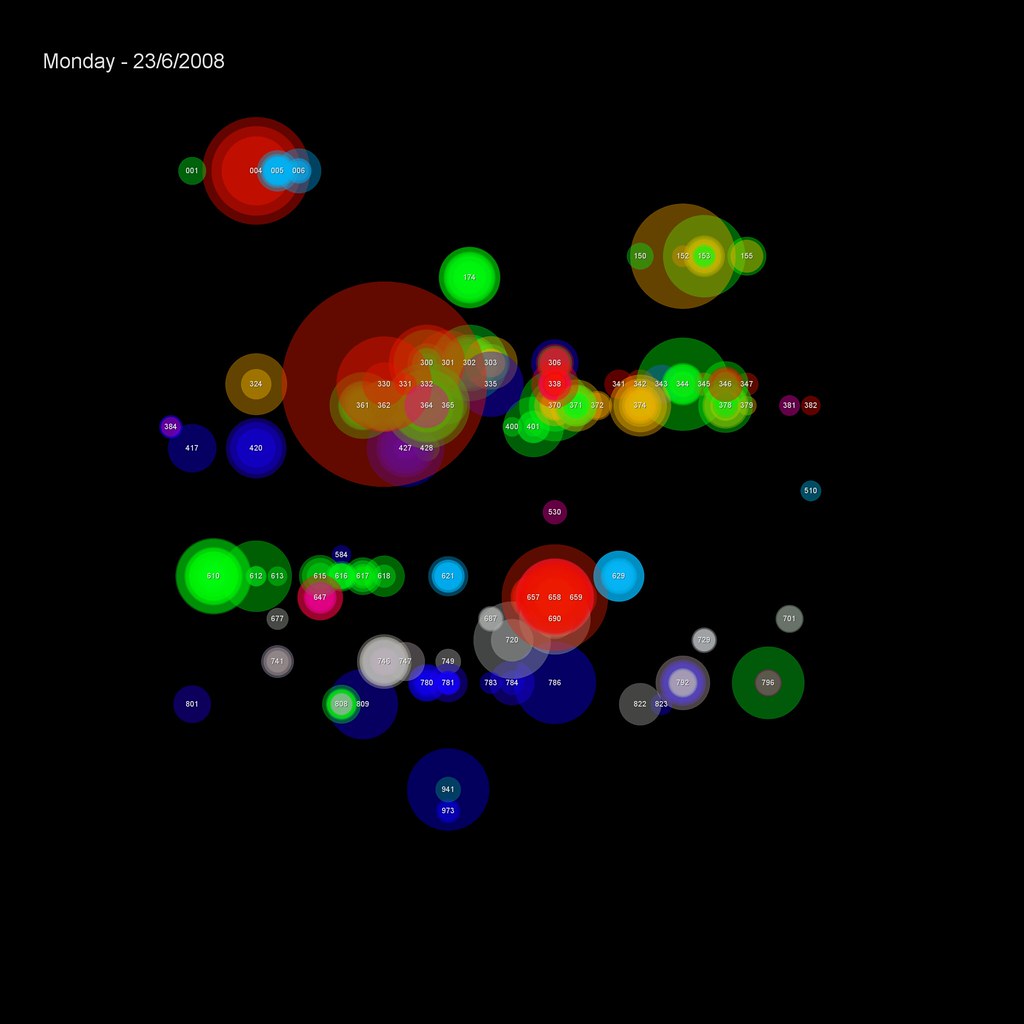
Dewey Bubble!
Check out this cool data visualization of book borrowings! Click here to see an enlarged version of circulation statistics displayed as Dewey Blobs 🙂
The transactions are placed on a 32×32 grid based on their Dewey classification (000-999). Each transaction is shown as a semi-transparent circle with two attributes:
1) colour — based on the School the student making the transaction studies in
2) size — based on the popularity of the book (the larger the circle, the more times it’s been borrowed before)
From Dewey Blobs at Dave Pattern’s “self-plagiarism is style”.

Information Matrix
At my recent visit to NECC, accompanied by my participation in Remixing for Library 2.5 I mentioned a great interface being promoted here in Australia called LibX. Roy Tennant recently posted a list of library-related APIs that library developers may find useful.
What’s an API exactly you ask? Application Program Interfaces (APIs) are structured methods for one software application to communicate with another. APIs allow programs to interoperate and share data and services in a standard way.
This is why you can embedd videos in your blog, or create a feed of your blog to appear in FaceBook – its about creating Mashups. Check out ZDnets video What is a Mashup?
Only APIs that are deemed to be generally useful are listed by Roy. However, almost any library catalog will have a search API (e.g., Z39.50) and may have others as well depending on the vendor and product. Contact Roy if you have a great API to add to the list.
Some great examples:
You see, THIS is the future of information services – Interoperability and flexibility of interfaces.
A very good reason to have a library system that allows you to get involved with API enhancements.
 Have been saying for some time now that our online experiences are going to become more and more 3D. Yes, we need to explore all the options – which is why we are looking at Teen Second life as a co-curricular learning experience for our students ‘in world’ at Skoolaborate. Another option for our Year 7 students will be Quest Atlantis. But kids will get into anything that is going, so I am going to watch this closely!
Like the beginnings of the web, when we first learnt about ‘www’ searching, and visual interfaces, it is time for us now to turn our educators thoughts towards emerging 3D environments. No, we can’t put it off any longer! There are many options of course, but the most recent entry into this from Google Labs (for PC only at this stage) is Google Lively.
Second Life requires users to download and install a separate “client” software package that taps into the online world. Lively also requires a download and installation–Windows only for now–but then people can use Internet Explorer or Firefox to enter the virtual world.
Integration with the ordinary Internet takes several forms. For one thing, you can pipe in content hosted elsewhere on the Internet, including photos or videos. For another, you can embed your Lively area into your blog or, using widgets Google has written, on MySpace and Facebook Web pages. And you can e-mail your friends a normal Web address to get them to join. You can set up you own online spaces–rooms, grassy meadows, desert islands, and you can change the clothing or form of your avatar. And of course you can chat, do backflips, or whatever takes your fancy. Check out the rooms, apparel and accessories at the product catalogue. Read more about it from Ars Technicha (the art of technology).
Guardian Tech says:
At the moment, Lively doesn’t support user-generated content, so you’re stuck with whatever is available in the Google catalogue (click the “Shop for more” button),,,,,it’s another step in Google’s plan to achieve world domination…..
There are already a couple of systems like this around, such as Pelican Crossing, SceneCaster, Imvu, Meez and RocketOn (still in a closed alpha). But Google, like Microsoft, can use its market power to get Lively in front of a lot more eyeballs.
So, is this an important part of Google’s mission to “organize the world’s information”? Or is it just a cheap knock-off that will be binned by Christmas?
This is definitley another 3D thing to check out. Truth is, if it is a Google product, students will grab it and play with it, as they did with Sketch-up and Maps. Watch out world!
 judyoconnell.com