Strategic directions for school libraries

Perhaps one of the most challenging conversations to have in libraries and learning communities as we move towards 2013 is the arrival of RDA.  Yes, here is a new acronym that needs to be embedded in our thinking. 2013 will be a year of living dangerously when RDA arrives. Don’t know about RDA yet?  Then it’s time to get excited, and up-to-date!

As we  close off 2012  many school librarians are busy with their annual stocktake (at least those who haven’t adopted a rolling model of collection maintenance). These same librarians and their staff are perhaps oblivious of the exciting developments that are taking place that will impact on how we manage collections and how we support curriculum in the years to come.

For my money, this is where the rubber hits the ground.  Its where the need for proper professionals in schools becomes more important than ever.   Here we have innovation happening under our very (information professional) noses – yet we have staff in school library senior positions who have no qualifications in the field or who have not done any further academic training to keep up with the changes needed to manage collections in the digital world that is the 21st century.  The next few years are going to be very exciting and challenging making it doubly vital that school leadership understand the importance of having  well-qualified teacher librarians and school librarians leading information services in schools.

These very issues were highlighted at the recent SCIS ASKS Forum held in Melbourne recently. How will education libraries best serve their communities in 2015? Support for the new Australian curriculum makes it imperative that we include emerging technologies and global understanding of information organization in the knowledge matrix that we support. It’s no longer about organizing those container of information that’s important – it’s the connections and access pathways and interpersonal learning experiences that a good school library can facilitate.  It is a teacher librarian’s job to empower students and teachers information access needs, and to manage systems that support this.   We are very lucky in Australia that  Education Services Australia, and the Schools Catalogue Information Service have their eye on this for us.

School library systems, media systems, LMS systems etc need to become the 24/7 structured access point for meaning connections. Here we have the key issue in that our multiple systems need to draw on as well as contribute to a knowledge matrix – one that connects to the various information repositories beyond our schools as well.

Old Questions: New Answers

How can this be done? Is there a vision for this? Enter the search and access power that is driven by Web 3.0 developments and the semantic web.  What’s different about school libraries now is that collections are really no longer about Dewey, or silo catalogue systems. In a world of API and open data, libraries ( particularly school libraries) are faced with a significant conceptual challenge.  Tim Berners-Lee introduced linked data in 2006 and unleashed the future! In 2007 the joint steering committee for Resource Description and Access said that RDA

would be a new standard for resource description for the digital world.

The point of it all is to provide a consistent, flexible and extensible framework for both the technical and content description of all types of resources and all types of content – everywhere, anywhere, always!  When search engine collaboration in 2011 added schema.org, we knew that the future was here. Traditional library data has had its day – and this century we are all about linked data ontologies that facilitate computer communications and  interaction for the benefit of human knowledge.

There is so much to learn, and so much to deploy. Essentially we need to create a new roadmap of open access and interoperability, to allow RDA new standards in schools to take us out of the confines of traditional library services, and to engage with the Semantic web.

Metadata has been changing everything, and information professionals have been leading these developments, mindful of  the semantic web and linked data.  There is a lot to discover and learn about.  If you are a teacher librarian, please make this part of your professional learning agenda for 2013. We are on the web and of the web, and our opportunities to improve the information and knowledge matrix in schools is fantastic – if we know how!

Visit SCIS Asks Forum, and check out the information from the Forum –   even add to the discussion via the survey forms.

Thanks to SCIS for allowing me to kick-start the day with some provocative ideas about Strategic Directions for School Libraries.

Image: cc licensed ( BY ) flickr photo shared by Serge Melki

Hands on the future – spotting Web 3.0.

I recently returned from an outstanding conference in our region, hosted in Singapore by the International School Library Network. I have not had the opportunity to previously attend this conference, but with nearly 300 delegates  and 46 workshop presenters the Hands on Literacy  2012 conference was certainly a success. I was there to present the Keynote to round up the conference day, and I hope that Preparing our Students for Web 3.0 Learning did that in some small way.

But first we started with school library tours the day before, visiting all the various libraries at  Tanglin Trust School, the Singapore American School, and the United World College of South East Asia. What wonderful ideas and new design ideas were captured in each of these schools! Sofa seats with bookend designs, book-swap bowl,  painted designs on chairs, the most gorgeous story corners, the cleverest display and promotion ideas, and so much more. If you ever have the time to join a conference in the future, and take the tour you won’t regret it!

My favourite was the huge sign outside the entrance to SAS – asking for contributions to the annual year book.  Cool huh? Particularly since I hear that some students spend a lot of time on Instagram, even in preference to Facebook.

Learn and learn and then learn some more – I think that was perhaps the underlying message throughout the conference. Hands on literacy took many shapes and forms, and the challenges were equally met by enthusiasm and a willingness to share. Joyce Valenza set the day perfectly with a bucket-load of challenges, so even before anyone hit the workshops their heads were spinning.

My message is really that today’s novelty is tomorrows norm, whether we like it or not. And tomorrows norm is going to take a shape and direction that many have not even considered, even thought the shift is already taking place before our very eyes.

Our personal information age may well have been launched in 1993  when the Mosaic 1.0 browser made the World Wide Web available for contribution and participation by anyone with access to the Internet.  It was a revolution. The future possibilities are likely to be just as different to those initial experiences – so are we ready prepared? Now in the “Internet of Things” anything imaginable is capable of being connected to the network, be come intelligent offering almost endless possibilities in human/technology interaction. Information and learning are at another cross-roads, and I like to think that teachers and teacher librarians are going to meet these developments with their eyes wide open.

Today we are surrounded by interfaces for discovery.  What do we want from technology? How can we create better experiences?  Our new networked society is going to fundamentally change the way we innovate, collaborate, produce, govern and sustain. Come with me on the journey. Now!

Image: Faces cc licensed ( BY SA ) flickr photo shared by heyjudegallery

Badges for learning!

Slowly, ever so slowly, the number of times I come across ‘BADGES’ in relation to learning is on the rise.  Sometimes this is in relation to open accreditation (think higher education) or it might be in relation to classrooms, and gaming approaches to learning motivation. Alternatively, it just might be in relation to social networks (foursquare!) and our passion for collecting badges for ‘check in’ or similar.

Open Badge systems provide many and varied opportunities for representation, not the least of which is uniqueness. Open Badge systems are more than a series of simple documents indicating learning.Think of it as a rich and varied representation of journeys, experiences and learned processes.

Possibly the most prominent one to emerge across sectors is Mozilla’s Open Badges, launched September 2011, that provide any organization the basic building blocks they need to offer badges in a standard, interoperable manner.

A number of tertiary institutions have adopted this approach to learning motivation and accreditation. Badge-powered learning at Purdue University is very comprehensive!

Now, Passport, a new classroom app created by Purdue University, allows instructors and advisers to give students digital badges to indicate mastery of skills. The application uses Mozilla’s Open Badge infrastructure and is available for use by instructors at any institution. Passport provides a platform for anyone who wants to deliver learning credentials. From creation of the challenge to creating the actual badge image itself, and then a way to display earned badges, it’s all built into the platform. A comprehensive explanation and information is available at the post: Digital Badges show student’s skills along with a degree.

If you are working in a school, there is no need to feel left out of the opportunity to integrate badges. ClassBadges is a free, online tool where teachers can award badges for student accomplishments. Through your teacher account, you can award badges customized for your classroom or school. Why not let your students can get involved in creating and managing their badges?

I have a feeling that badges for lifelong learning are an important new development to watch, adopt, and enjoy!

Image: Badges cc licensed ( BY NC SA ) flickr photo shared by Leo Reynolds

ABC Splash working the waves

ABC Splash is a new education website for Australia, packed with 100s of videos, audio clips and games. Everything is totally free to watch and play at home and in school. in a nutshell ABC Splash has teamed up with Education Services Australia to link hundreds of new learning resources directly to the Australian Curriculum. Look out for cutting-edge games, virtual worlds and immersive digital experiences.

The site features information for Early Primary, Upper Primary, Secondary, Parents and Teachers. It’s new and it’s bound to be fabulous, so bookmark it today and start using the services in your classroom, or to support your school community.

It’s also cool to see friends included on the site – we’re making our own ‘celebrity splash’. 🙂

Dean Groom and Grand Theft Childhood.
Darcy Moore and From Primary to High School.
Judy O’Connell and Rules of Engagement in the Digital Age
Jenny Luca and Personal Learning Networks

Thanks to Annabel Astbury (Head of Digital Education, ABC Innovation) for the opportunity!

From Annabel : Welcome to ABC Splash!

Augmented realities in learning – hype for now?

I don’t have enough time for thinking these days – which is  not a very good thing.This thinking beyond ourselves is what the game of learning is all about, and how we do this is how we augment the true cognitive capacities of our minds, regardless of what technology-enhanced sphere that thinking takes us into.

I see so much happening in school and higher education that is encouraging – not the least being the passion that individual ‘teachers’ as learners bring to the daily interaction of augmenting the cognitive interactions of many  minds.

This is what makes learning special.We’ve had this extraordinary trajectory happening as lead speakers ‘bag out’ the industrial model of schooling, introducing ‘new’ ideas, tools, or learning designs. Everything in the past was NOT all bad – if it was we would still be in caves!

Oh I do not dispute the need for change, but I do dispute the passion with which educators get onto the latest bandwagon. First it was the internet, then it was the ICT imperative, then it was computers, then it was laptops, then it was BYOD and mobile devices – like any of this was a curative for poor thinking, poor inspiration, poor learning.

So for me today it’s the MOOC hype. While the MOOC hype continues to grow, lets not confuse mass attendance, choice, access to instructors outside our physical domains, or online platforms for informal courses as being ‘new’. Society has always had answers to the ‘informal’ learning needs of groups of people, and at times these spaces merge into more structured or formal forms of learning. Socrates challenged his listeners – so do MOOCs – if they have a ‘socrates’ equivalent to spike the thinking. But that’s not the only thing that is needed to add depth to knowledge. We have to work with the experts somewhere along the way. We have to undertake research to test ideas, look for answers, find new questions.

So I see this ‘hype’ as really an extension of ways that we augment our learning capabilities.I know that ‘augmented reality’ is used to mean something different – but is it really any different?  Whether the augmentation takes place purely in our minds, as we overlay one idea upon another, or whether the augmentation takes place as we overlay a tech-inspired 3G delivered bit of information/ideas on a local view of things – the question remains – what are we learning? what is it’s deep value? how will this scaffold thinking? Will I want to seek out more?

To be honest, it’s going to take a long time before MOOC, tech, or any hybrid can replace years of cognitive engagement with a field or discipline. MOOCing will not change the world, but thinking has and does. What we should be discussing is how we work with information and knowledge to build the capacity of our society to reach the right answers, generation after generation, in order to further the endeavours of mankind. This is why I get angry when thought leaders simply dismiss the industrial model of schooling – without first acknowledging the valuable elements that were there which we need to retrieve. Building upon foundations is a stronger metaphor for me than burning Rome. We wouldn’t be able to do what we can today if it was all bad!  Thank you Tim Berners-Lee for putting the human need ahead of your pocket!

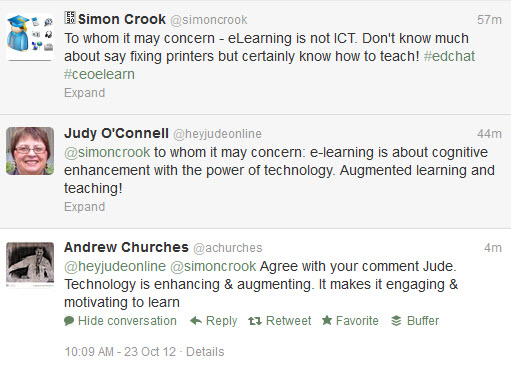
This is where technology fits in – not BYOD or ipads or pulling down the walls for massive sized classrooms for free play with technology.   When technology makes it possible to communicate swiftly, search and acquire information and research effectively,  leverage computational thinking, and come up with better ideas or answers – then we are making sense of ICT, e-learning, technology, or whatever you want to call it.

MOOCs are just the new water cooler.  PLANE and augmented PD initiatives are just the new staff room for peer coaching. Face 2 Face conferences and online gatherings are all great ways to inspire and connect. Augmented reality and virtual worlds are new interfaces for encouraging growth and personal cognitive development. Kids understand this – that’s why they rush into Minecraft!

None of them replaces quality and depth in discipline learning.We’re committed to learning. Let’s not pretend that dedicated teaching is lessened by lack of access to technology. Let’s not pretend that poor teaching is ameliorated by tech.  Until I can plug a USB directly into your mind, it’s the cognitive wheels that need to turn. I can inspire you by drawing in the sand, or giving you a book that takes you to new ideas. Or I can give you an App.

No more hype for me. Sorry for the rant – this interaction with inspirational friends is what got me thinking!

Brain Gain and Marc Prensky

I’ve just put down my review copy of Brian Gain by Marc Prensky, after flipping through the pages once again. Reading it has been timely, given the changes that are taking place in our education environment here in Australia ~ national curriculum, NBN (!), laptop programs, iPad rollouts and  Bring Your Own Device initiatives.

There has been a significant shift in the way we think, work, and talk about technology. There has also been a lot of development in the ways that we can adapt and adopt technology to enhance our personal and professional lives. So while we discuss curriculum, we need books that are provocative and force us to run a final launch countdown to be sure that we really are ready to work with technology in a changing world.

The Australian curriculum as presented by ACARA acknowledges the interdisiplinary role of ICT by defining it as a general capability. For those of us grappling with the integration of computing and technologies, the changes and challenges can so easily take us out of our comfort zone and into new spaces for the creation and development of learning and knowledge encounters. As we are exploiting the capabilities of digital technology, we are discovering that digital technology is more than a tool for creativity, communication, information organization and retrieval.

Technology in a networked world is expanding our physical minds and changing our human horizons.
Enter Marc Prensky and Brain Gain – a broad and conversational discussion about the potential of technology to improve, extend, enhance and amplify the human mind. Marc canvasses the expected territory of the social impacts of technology, rejecting the warnings of those who suggest technology is making us stupid, or slowing down the ability of our students to think.

Because of the rapid advances in technology, notions of what is possible and, more importantly, ‘wise’ in many situation  are undergoing profound change.

Our students have to learn differently, and develop their knowledge differently.

Today’s wisdom is that its far better to learn how to acquire new information.

Throughout the book there is much discussion about ‘humanity’ and the needs of a burgeoning knowledge society to think with and through technology. The book is not a scholarly tome – rather it IS a very accessible and engaging read that covers every angle, and entices the reader into a deeper understanding of our future prospects as being interwoven with technology to deepen human knowledge and creativity.

The book is really all about cultivating digital wisdom in a technology amplified world. There are trade offs. There are pointers for professionals who are looking to understand the breadth of potential of technology. There are sweeping statements too.

However, you can’t go past this book for a riveting read, accessible to the most technophobic teachers or administrators. In setting out to read this book I would have liked to think I learned nothing. In fact I learned a lot, as the book moves from the expected to the implications of a  symbiotic combination of the human brain and technology.

I learned that it is important to be excited by ideas. I learned that collaboration is more important than ever. I learned that our technology past is not ‘old’ or irrelevant – but that our new technologies are simply escalating the rate at which we can think and develop.

I learned that technology is providing us with new pathways for thinking never before possible, and that this synergy with technology is considered by some to potentially change humanity in a ‘evolutionary’ way.

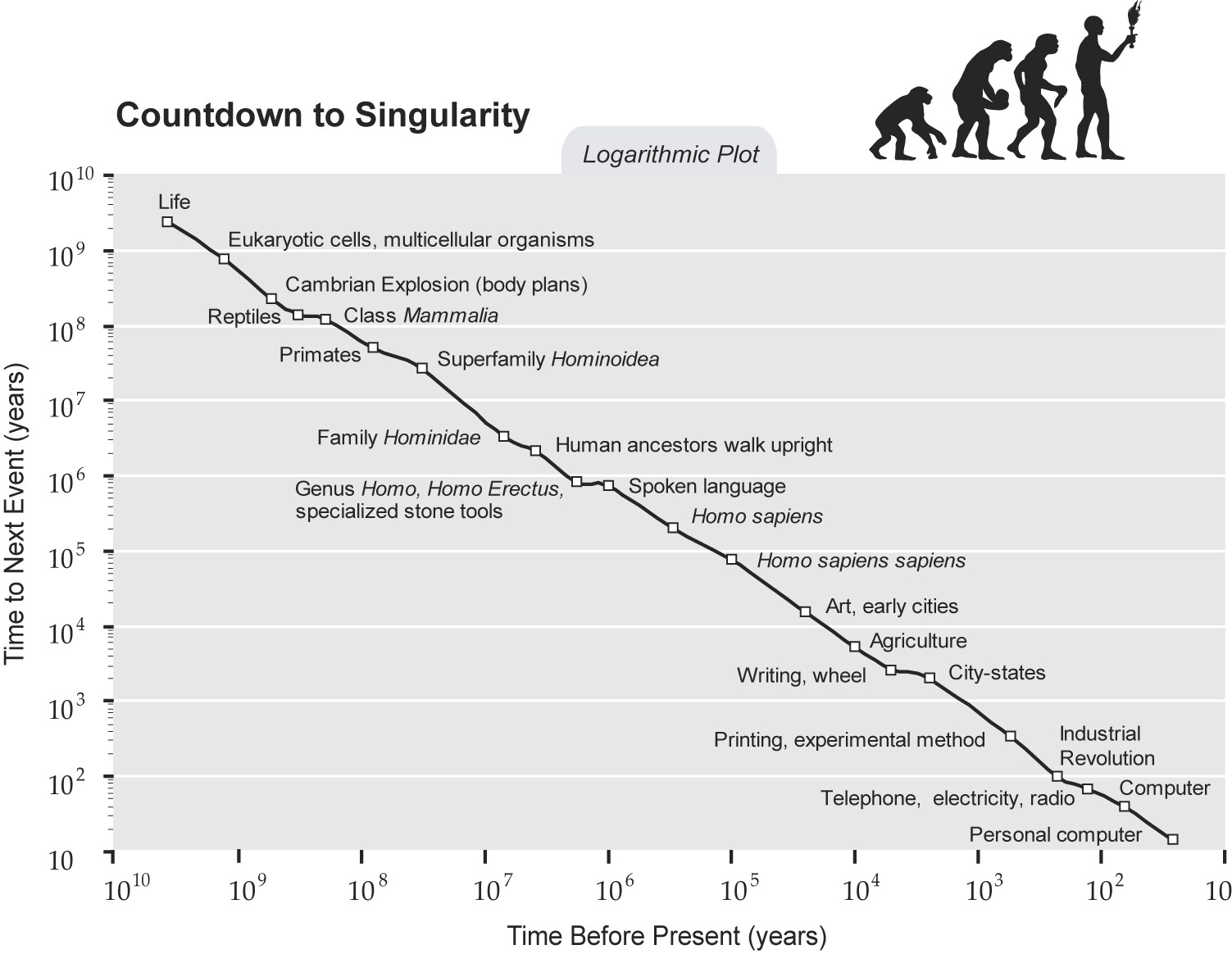
Not only does Marc present us with the positive and negative potential of technology (which we must think about daily in our teaching and learning), but he also introduced me to the Countdown to Singularity.

In the last chapter on the coming Singularity, I read about “the moment, not very far off… when our technology will become as powerful, and even more powerful than our human brains.”  This is when humans will transcend biology. Referencing theories from science fiction writers and futurists (including Ray Kurzweil), this ending seems an odd, speculative conclusion in an otherwise reasonable, practical book.

Get your hands on a copy if you can, and decide for yourself where technology and the quest for digital wisdom will take us.

Image: Reprogramming your inner child cc licensed ( BY ) flickr photo shared by Keoni Cabral

Constant personalisation yesterday, today and tomorrow.

No matter where we look these days, the idea of personalized information streams continue to be supported by new tools, or new ways of working with existing tools – and all linked to our mobile devices in some way.  For example, where-ever I am,  I’m constantly adding items to my public Facebook feed, which ( I have to admit) has remained a constant as any number of other tools have come and gone. I need my tools to interrelate – all the time – easily, and quickly!

What interests me is the amazing uptake of ScoopIT. I was an early adopter myself, but have now taken a different view of the value of the tool – driven by Pinterest. Yes, I’m losing interest in ScoopIT – and here’s why.

I’m not interested in using the ‘built-in’ curation tool that Scoopit offers – it’s just not good enough at sourcing the professional feeds I want.

I’m not interested in having to use a browser-add on – as I just may not be at my computer to Scoop!

In case you haven’t noticed, a Facebook page looks pretty much the same as a ScoopIT page – so guess what – now I am favouring Facebook to do what ScoopIT has been doing!  e.g. Digital Citizenship in Schools vs Digital Citizenship in Schools.

BUT the ScoopIT ecosystem gets so much more traction!  Despite that, I am (like others) now getting really bored with ScoopIT links in Twitter, or Facebook.  When I click on a recommended link I prefer to go directly to the sources.  So there is the dilemma – to Scoop or to FaceBook?  I wonder what you think?

I also became jaded with ScoopIT  me when it insisted on a monthly package upgrade to be able to stream my content to multiple Scoops. Even ScoopIT education wants a monthly payment.  After some emails to try and explain that schools and educational institutions do prefer an annual fee for payment, nothing was put on offer. #FAIL

The other interesting change is the lack of ScoopIT buttons on mainstream pages.  You can Tweet, FB, G+, LinkedIn or Pin –  but you can’t Scoop!  #FAIL

So while I ramble on, the real reason for writing this post is to reflect on  just how much content organisation and curation keeps shifting. Yesterday, today, and tomorrow are fluid places of relentless change.

Thinking about tomorrow?

Check out the new eBook feature enabled in Wikipedia.

We’re happy to announce that a new EPUB export feature has been enabled on English Wikipedia. You can use it to collate your personal collection of Wikipedia articles and generate free ebooks. These can be read on a broad range of devices, like mobile phones, tablets and e-ink based e-book readers.

This is a whole new ball-game for educators. Consider the option of getting students  (Secondary or graduate) to write content for Wikipedia, and publish it as their assessment if it is worthwhile? Consider the teacher or lecturer producing content that is related to a particular discipline and distributing it via this eBook feature – puts a whole new twist on open source publishing! Consider putting your learning materials into Wikipedia and weaving it together to package a knowledge element or topic of investigation?  I think this is a real ‘watch this space’ moment once again.

There’s an explanation and explanatory video at Animals in Space. Basic – but you get the idea. Is this the start of a new shift in information delivery spearheaded by Wikipedia?  I hope so, in the sense that we need to have information from many sources and repositories, but in the first instance we may simply have to plug into Wikipedia with our content. For example, I am toying with the idea of some new ways to assess ‘collection development’ for an Master’s level subject. Prompted by the media release from Wikipedia about the eBook feature, I scanned relevant resources and came up sharply against the lack of good material. Given that Wikipedia is highly searched information source on generalist information  I began to see writing material for Wikipedia as being far more authentic and worthwhile than writing an essay. Still written, but suddenly, with the option for an audience, multimedia content and hyperlinks the learning experience takes on a new focus.  More thinking on this, but I’m tipping that I won’t be the only teacher who begins to see new uses for Wikipedia.

Another tool that caught my eye today was Media2Go. Badged as a new reading experience, it’s just another way of ‘packaging’ what you want.  I’m never that keen on such tools, and (as I mentioned) I’m ‘over’ browser buttons (having lost count of ones used and ditched as media changed)! While I understand that business or corporate users of such tools may have a focussed area of reading, in education we do need to keep open and flexible.

But still worth a try, as its concept has some exciting possibilities. As they explain, the key aims are:

1. Cut out the noise
Bookmarks, saved articles, feeds –we’ve got all those on our browsers too, but how often do you really go back and read all the content you’ve saved? Right at the point of reading, you should be able to see topics that pique your interest and pull content on those topics instantly and without having to sift through tons of articles.

2. YOUR world. YOUR opinion.
We strongly think that we CAN NOT, CAN NOT become a society of homogenized opinions. It’s YOUR world and YOU should have a say in where you get your content from.

Maybe this IS tomorrow?

Creativity and knowledge in Science

The 46th Anniversary  of StarTrek on Saturday co-coincided with the Science Teachers Association NSW annual conference.  Perfect really!  The Google Doodles were fabulous. (Even better, there is a video of it all. If you are a fan, you will want to play it over and over again.)

I got to play with the Google Doodles while I waited to present a Keynote that used the theme of Science Fiction to talk about learning and teaching in a digital era. Science Fiction has been part of my life since primary school after being booted out of the children’s library in Albury and sent off to the ‘adult’ library – because there was nothing left for me to read!  My first book borrowed from the adult library (yes, it was a different building then) was an Isaac Asimov book –  and the rest, as they say, is history. While I never quite made it to become the astrophysicist of my dreams, nor did I pursue science at tertiary level, my personal interest (and my bookcase) shows my interest in real science and science fiction!

It’s this imaginative and expansive capacity of science fiction to relate to and extend science that I particularly wanted to draw upon. I also wanted to show how the changes taking place mean that a good science teacher must connect adroitly in social media environments, must know how to search for information effectively, and must know how to share knowledge in and beyond the classroom.

I met some fab teachers, and loved the opportunity to think
‘science’ for a day. It was great to meet up with @teachercolin, and to make some new science twitter friends too.

So one and all – Resistance is Futile!  I hope you enjoyed the presentation.

Wolfram Alpha and Facebook Personal Analytics

Wolfram|Alpha, the world’s first and only computational knowledge engine, uses its expert-level knowledge and algorithms to answer questions, generate reports, and do analysis across thousands of domains.

New to Wolfram|Alpha? Take a tour » 

There’s also an offer for K-12 educators and students to try out a WolframAlpha Pro account.  With Wolfram|Alpha Pro, you can compute with your own data. Just input numeric or tabular data right in your browser, and Pro will automatically analyze it—effortlessly handling not just pure numbers, but also dates, places, strings, and more.

But wait – now there’s Facebook!

According to TechCrunch

a new feature today that allows you to quickly get an overview of all your data on Facebook. The new report, says Wolfram CEO Stephen Wolfram, expands Wolfram Alpha’s “powers of analysis to give you all sorts of personal analytics.” The company plans to expand these reports with new features over time, but they already give you a pretty deep look at your Facebook habits.

LifeHacker explains

all you need to do is head to Wolfram Alpha’s home page and type in “Facebook Report”. After connecting it to your Facebook and granting it a rather large number of permissions, Wolfram Alpha will break down everything about your Facebook activity into 60 different sections of charts, graphs, and other analyses—like a cluster map of your friends and relationships, everywhere you’ve checked in, what days you’re most active on the site, a cloud of your most-used words, and even the weather from the day you were born. It’s incredibly interesting, super geeky, and downright scary.

Scary indeed – but not so much. This is not new – it’s just a development.

ThinkUp has allowed analysis of any Facebook account. ThinkUp is a free, open source web application that captures all your activity on social networks like Twitter, Facebook and Google+. One of the best ways to learn about ThinkUp is to see it in action.

Your Facebook Report

Your Wolfram|Alpha report will include the more obvious things such as:

  • Which Facebook apps do you use the most?
  • Who comments the most on your posts?

What you first see is only the tip of the iceberg. Change parameters, expands results, and click the More buttons to drill down into deeper layers of computation and analysis.You can even click the name of a friend to run the full page analysis on that friend’s shared Facebook data.

OK. Thanks to the report I now know that Seymour Papert is my oldest ‘friend’, and that many more of my friends lie about their age! Jeff A is 79 and he mostly uploads pictures to his Facebook Account.

Not surprisingly the report also confirms what I knew to be my personal preferences for Facebook  – I use Facebook mainly for sharing!

If all this has convinced you never to touch Facebook – think again!

Whether you like it or not Helmond and Gerlitz (2012) suggest that  the Facebook Like economy is here as part of the reworked fabric of the web  – and the only way to avoid it is never to go online, and never to visit a page with a Facebook link.  That means no more reading the news online, shopping, or browsing websites.Even before we join Facebook, visits to any site with a Facebook icon are being tracked because of the The Open Graph Protocol  introduced in 2009 into Facebook’s infrastructure to code and govern social activities and relations outside the Facebook membership platform.

Meanwhile, through the act of liking Facebook users are validating and linking content on the web, an act previously exclusive to webmasters and establishing what may be considered an emerging Like economy.

To be honest, I am not concerned about this dataflow. It’s here to stay. Refusing to participate is the equivalent of refusing to drive a car to get somewhere –  because it’s mechanical and doesn’t have four legs!

The pervasive nature of the web simply reminds me of the importantance of considering what I do, share and discuss online.  It reminds me that as educators we need (more than ever) to understand this reworked fabric of the 90s web, and understand how best to capitalize on it, learn with it, share with it, and make it possible for our students (young and old) be high calibre participants in their online world.

Remix culture as a creative and professional habit

Yesterday the Charles Sturt University ICT Community of Practice had one of it’s regular afternoon forums, campus-wide, in meeting spaces, and via online conferencing. It’s a great way to bring people together from various faculties and disciplines. The focus in on sharing – not quite a PechaKucha, but close to it with just 10 minutes to share a few nuggets of gold!

As one of the invited presenters, my focus was on creativity and the use of images. This is based on the fact that I want teachers to understand remix culture (when it comes to images); use of creative commons and various sources of free images; image attribution; and visual presentation for blogging and creating presentations. With the 10-minute presentation I also included one of the regular updates that I provided my teacher/students in the Digital Citizenship in Schools subject to help springboard ideas.

The trick of course is to engage teachers from all ends of the spectrum of ICT prowess. So for the newbies, an introduction to flickr and other CC image sources is a must. For the geeks an introduction to tools like Alan Levines wonderful FlickrCC Image Attribution Helper is a must!

A lovely lecturer in Veterinary Science contacted me later to let me know she was excited by the ideas and would be weaving what she has leaned into her work. How cool is that? To be able to share across disciplines in this way is future learning methinks!

Understanding remix culture as a creative and professional habit IS  about understanding creativity and copyright!

Image: cc licensed ( BY NC SA ) flickr photo shared by A. Diez Herrero