Learning Spaces and School Libraries

This time last year I was involved in a planning day with a large number of schools and their staff, on the matter of  21st Century School Libraries Learning Learning.  There is so much to think about in the design or re-design of such facilities no matter what the budget.

Here is another presentation that piqued my interest, with relevance to school libraries.

‘Impressive new buildings are, on their own, NO GUARANTEE that improved learning will be achieved; although they may be useful in marketing terms, by helping brand an institution’.

“teaching and learning should drive design, rather than vice-versa”

Take a look as there are  some good points to take away for your own deliberations…..

The future of digital diversity

Think digital – it’s  a ‘doing’ technology.  Trends from PewInternet Research Centre indicate that teens are digital denizens.

While the research is not Australia, it points the way to the behaviours or our own teens, and signals a need for some major shifts in thinking about learning and teaching contexts.   The interactivity of the web allows students to move very quickly from one application to another – remixing, remaking and montaging ‘content’.  Learning is promoted most effectively when students are making, creating, building, simulating, hypothesizing – all desirable higher-order thinking activities.

So, give these figures some thought!

Augmented Reality – it’s literacy!

While I’m really interested in all sorts of technology possibilities, as a person responsible for a huge library facility and resource centre I passionately believe that the first and most important ‘augmented reality’ option for children and youth are found in books, magazine, graphic novels and more.

Good books. Good literature. Good augmented reality!!  Through books you can experience so many possibilities, so many  passions and emotions, so much history, exciting mystery, and more.

This week has been a big one for us on the ‘augmented reality’ front!

As our visiting speaker Paul MacDonald from The Children’s Bookshop said to our Year 7 students: “A good book should leave you slightly exhausted at the end. You live several lives while reading it”.

Paul challenged the boys for an hour with many exciting ideas, and reasons to get into ‘what’s hot’!  He even got into quiz mode to capture every single boy – the prize?  A Cherub beanie!  You’ve never seen such a sea of hands desperate to answer a question about books and authors!  Heaps of boys charged over to the library after getting out of the dining room at lunch time – and queued to grab or reserve the books that Paul had been enticing them with.

Patrick Ness

We also had a fabulous visit from Patrick Ness, who spoke to Year 9.  Talk about mischievous but exciting! He also sat down for a literary lunch discussion with our Extension English students. Patrick was just fantastic at pitching the literacy message to active adolescents.

Oh, and don’t forget the magic of buying your own signed copy of an author’s book!

For me – the first and best form of augmented reality – guaranteed to impact on every aspect of a students learning future – is reading and more reading.  More important than any other technology tool in the whole world!

The Digital and Literacy World of Young Children

A new report from the Pearson Foundation examines how digital media is affecting early literacy around the globe.

How is digital media changing the way young children learn? Could the way young children learn be evolving to meet a new, dynamic digital media format?

Authors Jay Blanchard, a professor at Arizona State University, and Terry Moore ask these and other questions in their new report: “The Digital World of Young Children: Emergent Literacy” (PDF), out this week from the Pearson Foundation.

The white paper was released at the annual Consortium for School Networking (CoSN) International Symposium.

Blanchard and Moore conclude “developmental milestones are changing as today’s children approach learning and literacy in new ways, not thought possible in the past. “

The paper is worth a read, especially for understanding our current context around the  emergent literacy needs of primary-aged students.

(via Spotlight on Digital Media and Learning)

A new look to your Second Life

Second Life Viewer 2, now in beta, is the next generation of Second Life viewers that makes it easy to explore and socialize in Second Life with a familiar, browser-like experience, enhanced search, and fully integrated web-based media capabilities. Test Drive Second Life Viewer 2, Now in Beta by downloading here.

Did you know what’s happening to the Internet?

This is another official update to the original “Shift Happens” video. This completely new September 2009 version includes facts and statistics focusing on the changing media landscape, including convergence and technology, and was developed in partnership with The Economist.

Thanks to Wes Fryer for the tip-off in his post Can you Imagine So Much Global Sharing?  My answer is – I never could, even though I’m an avid reader of SciFi. Dreaming and doing are quite different things!

Also in the same post – a peek at the state of the Internet. 

2010 is one amazing year!

Vodpod videos no longer available.

more about “JESS3 / The State of The Internet“, posted with vodpod

Tsunami – in the classroom?

I wonder how many classrooms in Australia will spend time this week talking about, reviewing and learning about the impact of earthquakes and tsunami  on countries and people?

This weekend saw the earthquake in Chile and the tsunami it created affecting many parts of the world.  The Chilean president declared a state of catastrophe after a deadly quake of magnitude 8.8. Subsequently warnings of tidal waves were issued in 53 other countries.

In the Guardian’s Report Chile Earthquake: Pacific nations brace for Tsunami we have a good lead article to set the scene for discussion.

The Tsunami raced across the Pacific and threatened Hawaii as it rushed toward the U.S. West Coast and hundreds of islands from the bottom of the planet to the top. Sirens blared in Hawaii to alert residents to the potential waves. As the waves expected arrival drew near, roads into tourist-heavy Waikiki were closed off.  Police patrolled main roads, telling tourists to get off the streets.

It’s not new – social media has a well established co-reporting global events!

But do your teachers know this?  Do they know powerful social media is in providing information and synchronous coverage of event?

Did they pick up the links they need via Twitter? of Facebook? or other social networking site?

Perhaps they already have the Associated News App on their iPhone (find it in the App store)  and were aware of events that way? or via another mobile App?  or heard it on the news?

Did they send out a message (text? IM?) to their geography students to alert them to the CBS News Stream via Ustream so they could experience live some of these events – even if only for a few minutes?

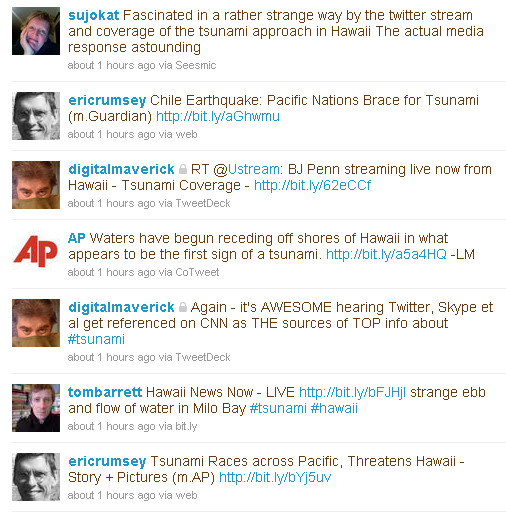
Not only were the media doing live reports online, as well as on TV, but people in the streets were contributing picture and live phone feeds and images to contribute to the pooling of information.

Twitter was buzzing.

Don’t forget to check out Diigo and Delicious during the week to find more links from other  ‘connected’ teachers.  

From a student’s point of view – social media tools allow them to experience these  incidents live and hear the authentic experiences of people observing the event.

By Monday there will be plenty of online media sites that will have stories, videos, etc to use for class review. But none of that is as good as experiencing a live report! How many teachers will be ready to immerse their students in learning with the very tools that students love to use?

Here’s someone ready to incorporate this type of learning into their uni classes – Magnitude vs Intensity in Chile. Learning can be amazing.

Larry Ferlazzo provides The Best Sites to Learn about the Earthquake in Chile (& possible Tsunami).

Go on teachers – give it a try!!  Here’s a great map of Estimated Tsunami arrival times to get you talking.

The picture below shows the live CBS News UStream.

Library of the Future in Plain English

(via Tame the Web)

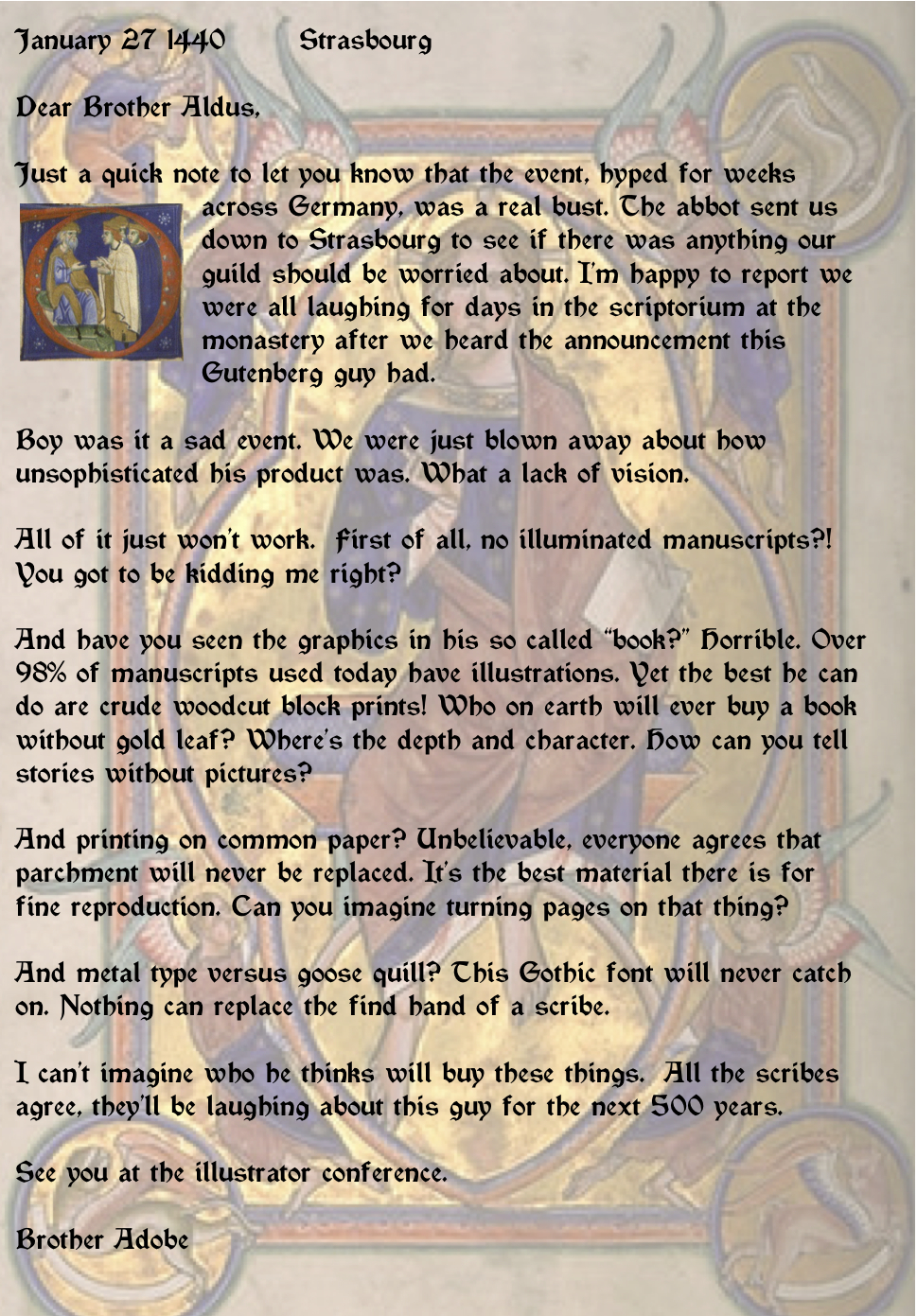
Printing on common paper? Unbelievable!

(via Memo From the Monastery)

Flat Classroom Project: Fresh start in a new world

The brilliant work by Julie Lindsay (Beijing, China) and Vicki Davis (Westwood Schools, Georgia, USA) continues in The Flat Classroom Project 2010-1 which is now is well under way for 2010.

The Flat Classroom™ Project is a global collaborative project that joins together middle and senior high school students. This project is part of the emerging tend in internationally-aware schools to embrace a holistic and constructivist educational approach to work collaboratively with others around the world.

One of the main goals of the project is to ‘flatten’ or lower the classroom walls so that instead of each class working isolated and alone, 2 or more classes are joined virtually to become one large classroom. This is done through the Internet using Web 2.0 tools such as Wikispaces and Ning.

The Project uses Web 2.0 tools to make communication and interaction between students and teachers from all participating classrooms easier. The topics studied and discussed are real-world scenarios based on ‘The World is Flat‘ by Thomas Friedman.

I was honoured to be invited to present the Keynote, ‘Pandora’s Box: Fresh Start in a New World’ for FCP10-1. This time there are  over 200 students from 10 classrooms across 6 different countries.

Here are some guiding questions to get them thinking about how to respond and start a discussion or foster an existing discussion:

  1. Is global collaboration using emerging technologies a pandora’s box? Why?
  2. How can we best prepare the ’17 year old Internet/connected world’ to mature and grow into ‘adulthood’?
  3. How has the flat world impacted on you as a teenager? as a teacher?
  4. What place do immersive worlds and virtual realities have in education?