Virtual communities as a canvas of Educational Reform

Some recent online reads have prompted me to write about learning within our ‘shape-shifting’ technologically driven world. If you are new to blogs and online tools, let me tell you that there is a lot happening – but don’t let that put you off getting involved.

There are many different perspectives to put on online social networking and it is important to know where one is coming from when talking about social networking and youth. The perspective(s) one has will be very different whether one is a parent with a teenage daughter on MySpace, a marketing executive interested in the target group “14 to 20,” a journalist looking for the next big news story on young people and new media, a youngster using a social networking site as part of everyday life or a researcher investigating how young people are using social networking sites.

35Perspectives on Online Social Networking provides a different (broader) exposition of online networking. Here we have an excellent overview that helps me to see the matrix of inter-relationships between sectors or groups. That, after all, is what our real world is – and online virtual interactions are no different. Don’t let me forget that.

So that was what WOW2 was a bit about – educators in one countryexploring education ‘downunder’. I have to thank the WOW2 team for the fabulous opportunity to take part in the WOW2 EdTechTalk recently. It was pretty cool chatting to my aussie mates Graham Wegner and Jo McLeay. But I also ‘met’ Jason Hando, who (rather surprisingly) is in Sydney, doing great things as well. No excuses for us not keeping in touch are there?

Actually I think that what Sheryl wrote in Virtual Communities as a Canvas of Educational Reform is a ‘must read’ for school leadership teams working on capacity building and educational reform. She says:

The way I see it, social networking tools have the potential to bring enormous leverage to teachers at relatively little cost — intellectual leverage, social leverage, media leverage, and most important, political leverage. And while most of us reading this post can name educators across the globe that are using these tools as windows from their classrooms to share ideas and develop their own personal learning environments, the sad truth is that most aren’t. The burning question in most of our minds is how can we accelerate the adoption and full integration of 21st Century teaching and learning strategies in schools today?

Creating virtual communities that function effectively within and beyond our schools IS a significant challenge.

Our system of schools has been actively exploring these options in 2007 (fabulous!) – and we are definitely learning from the experience. We began the year by formally launching a blogging strategy. Unfortunately we didn’t address some of the important questions that Sheryll raised, and as a result our first effort at system-wide blogging ‘came a cropper’. Well, not totally, but it was no surprise really as some of the vital ingredients of social collaboration were missed starting with the first important point – who is blogging and why?

The best blogs are social – and we missed that point – and are platforms where discussion blooms. Blogs in this context of collaboration can’t be the stuff of soapbox but must be the stuff of open-ended conversation – and that means writing as well as commenting.

I like the fact that we continue to try to figure out what sort of virtual communities will work for us. We’re game for the challenge, and won’t let disappointment stop us from pursuing educational innovation and reform.

Now we have a new strategy to experiment with. The start of Term 3 saw the official launch of the ‘Learning Common’ blog – open to all teachers to write, comment, collaborate, and share the ups and downs of teaching life. We have merged a number of blogs into one, and opened up the option to be a writer to anyone in any school. Will this work?

Richard McManus covers some important things about blogging within the context of virtual communities asking Is Blogging Dead? Gosh, we are just starting with blogging, so I don’t think our teachers will be abandoning our new blog for something else. But, Richard says

It’s hard to get discussions going on a blog, but the blogs that at least attempt it and actually write for their readers — these blogs are the most compelling in my view.

I agree that this is at the heart of the matter. Let’s hope we can make the blog compelling reading – a place that people really want to be to share their ideas. So let’s see what happens. We’re pretty keen on blogging, and many of us blog!!!

We just haven’t cracked the whole virtual community thing yet, but I think we’ll get there.

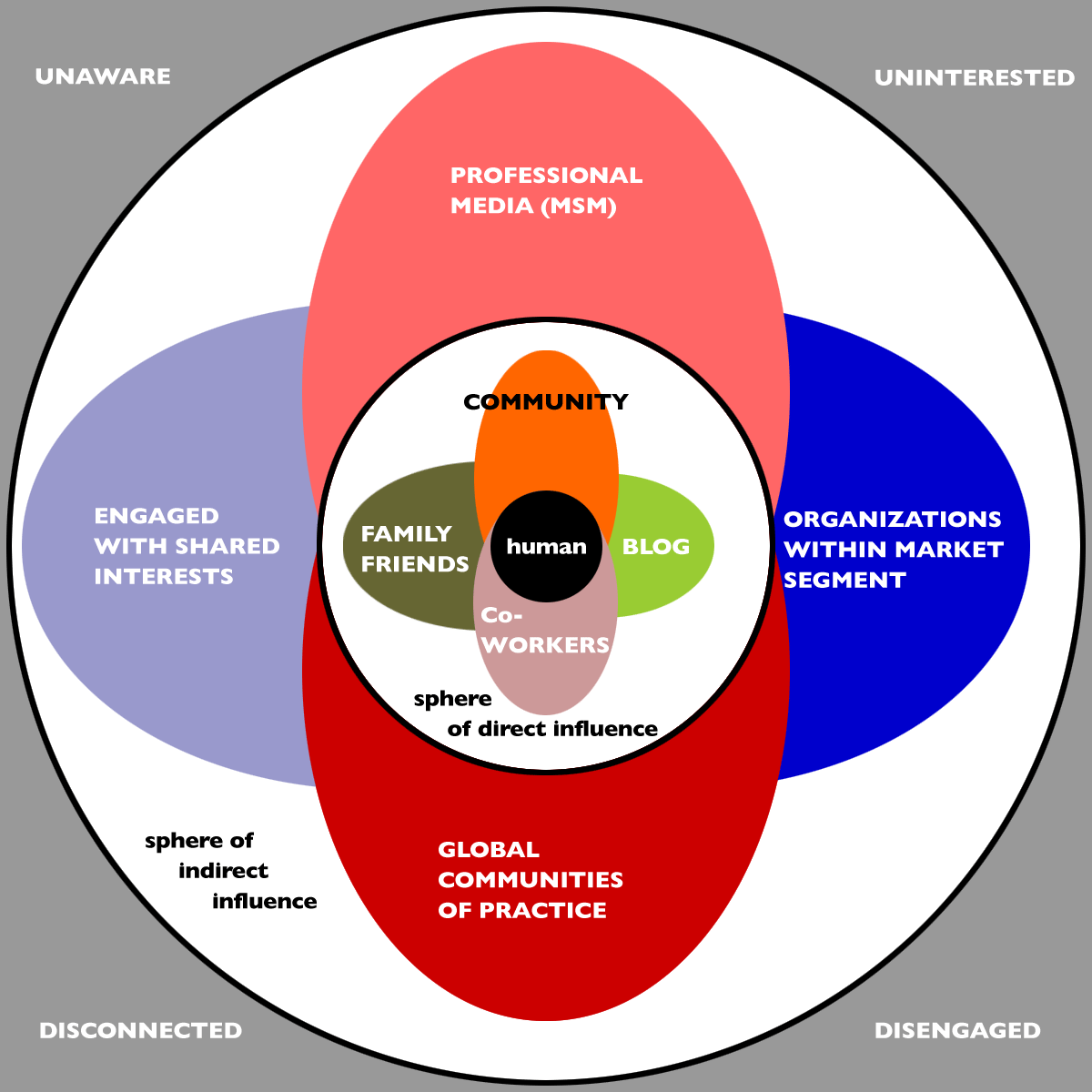
It’s all about spheres of influence. This graphic says a lot, and is easily adapted to provide us the guidelines for successful blogging – that builds capacity as part of our educational reform!
Sydney twitter meetup – be there!

twitter.jpg

For all you twitter fans or “would-be” twitterati! based in Sydney – you need to know that we have a
Sydney Twitter Meetup on Wednesday 25 July at 6.00 pm.

Pier 26 Bar
Pier 26, Aquarium Wharf, Wheat Rd, Darling Harbour
Sydney, New South Wales

More details at Upcoming.

Twitter has created quite a buzz for itself in the first quarter of this year- managing to combine the ease of Instant Messaging and SMS with the reach and scope of social networking services. So what’s all the buzz about?

Twitter: A beginners guide will give you all the information you need, and fill you in on this social networking phenomenon. I don’t think everyone is ready for Twitter – but I have found it a real boon for keeping in touch.

I don’t have a public profile – as I only really want to twitter with people involved with education. All up I have 65 friends – leading educators from around the world as well as in Australia – more than I could hope to keep in touch with using ‘traditional’ methods of communication like email!

“heyjudeonline” (me) is not online all the time – but when I link in I can quickly catch up. I also have the option of sending messages directly to my ‘friends’. I like the zany personal touch that twittering allows. It might be a passing fad – but twittering is part of the evolving shape of online communication – so for now I tweet! I do this online at twitter, or within FaceBook.  There is a Sydney Twitter Meetup in Facebook!  I’ll have to get myself invited 🙂

I don’t use my mobile to tweet – but I will certainly turn it on for the Sydney twitter meetup!

Why don’t you come and join me?

Next WOW2 show – now that’s WOW!!

Thanks to a post by Chrissy (Teaching Sagittarian) I have been prompted to mention the next WOW2.0 broadcasting through Worldbridges and EdTechTalk, which takes placeTuesday nights at 9 p.m. EST. (Which is Wednesday morning at 11 a.m. Sydney time).

WOW2 is for all who are using the tools of the internet whether it be in a classroom setting, leading seminars, authoring books, maintaining blogs or wikis, or just enjoying the tools of the internet in an educational and exciting way.

This week’s show features four Australian educators:
Graham Wegner
– Teaching Generation Z – Judy O’Connell (me!)- Jo McLeay – The Open Classroom – and Jason Hando – Clever Learning. Vicki Davis, fantastic ‘coolcatteacher’, writes a little more about it, while Jo McLeay does some preliminary thinking getting ready for the exciting event! We also get pulled in on the NECC2007 blogs feed – now that is something!

We will be talking about Education 2.0 in Australia – things that are happening, tools that are being used, integration and more – and especially what needs to change to make things keep moving right along!

Women of Web 2.0 (WOW2) is brought to you by Cheryl Oakes, Jennifer Wagner, Sharon Peters, & Vicki Davis, four women who not only love using the tools of the Internet but also love sharing the tools with others.

Their mission is to provide a professional voice in educational Web 2.0 discussions. Conversations coming from the WOW2 network will move across gender, race, and country lines and display the beautiful diversity of the internet kaleidoscope. WOW2 are advocates for professional ethics, emerging technologies, collaborative projects, quality best practices research, and teaching students critical thinking skills.

Join WOW2 some time soon 🙂

Easy Peasy Rich Media – Voice Thread

I’m not even going to attempt to give my own review of this tool!

What I am going to suggest is that you read Alan Levine’s excellent evaluation of VoiceThread at his post Easy Peasy Rich Media – Voice Thread.  Thanks Alan for the ‘heads up’ on this at Twitter 🙂

From its site:

A VoiceThread is an online media album that allows people to make comments, either audio or text, and share them with anyone they wish. A VoiceThread allows an entire group’s story to be told and collected in one place.

WHAT a podcasting toolbox!

OK, who can keep up with the good stuff coming out of Mashable these days!

If you don’t already subscribe – you should give it a go. I find the email option invaluable, as the truth is that I don’t always get to read all the stuff in my RSS feeds. Don’t miss out – subscribe to Mashable today!

So now Mashable has given us another great list:  the Podcasting Toolbox: 70+ Podcasting tools and resources. Thanks Mashable 🙂

WHAT a photography toolbox!

Photos are everywhere on the web. From sharing with friends, to editing, printing, buying, selling, searching, remixing and free hosting, we’ve lined up a plethora of resources for photo fiends.

Following up from my post about What a Video Toolbox, here is one I should have included on photography – once again from the Mashable team.

90+ Online Photography Tools and Resources


Social networking in plain English

CEC (NSW) Forum, 2007

Another year, another CEC Forum 😉 How time flies!

Nevertheless many educators gathered together on the first day of the school holidays to attend the ICT Forum organised by the Catholic Education Commission NSW.

As promised my presentation for the session, introducing the concept of social bookmarking, is provided below.

A detailed list of links are provided for you at my ‘social bookmarking’ TAG at Del.icio.us Heyjude.

You may like to use this delicious_setup.pdf from David Warlick to help yourself or your colleagues set up a Del.icio.us account.

For a detailed presentation that covers all the key aspects of managing and using your Del.icio.us account I highly recommend the one below put together by Michael Sauers.

Just start your viewing after the TechSupport page.

Web 2.0 stuff I’ve used


Doug Belshaw has a great post on Web 2.0 stuff he’s used, or plans to use, in his role as a teacher of History and ICT.

I’d like to see what YOU would consider your required list for teaching YOUR particular curriculum areas.

Tell me, or write your own post, and link it back here. 🙂

There are so many possibilities that I think it is important to create your own favourite ‘Web 2.0 toolkit’ – no gimmickry allowed!


WikiMindMap is a tool to browse Wiki content easily and efficiently, inspired by the mindmap technique.

Wiki pages in large public wiki’s, such as wikipedia, have become rich and complex documents. Thus, it is not always straight forward to find the information you are really looking for. This tool aims to support users to get a good structured and easy understandable overview of the topic you are looking for.

First month of development for this tool – which is nice. I particularly like visual techniques for presenting information to students as part of demonstrating research techniques. Several languages available – be sure to choose the right one for your needs. This visual technique allows you to drill down and refine your ideas as you go.

Two searches for Web 2.0 and Web 3.0 provided the following really interesting entry screens – which pick up the key launch points for investigation on each of these two broad topics.  It’s  also possible to hyperlink these screen shots directly to the search query – once again this is useful when presenting information to students and for pointing them to a specific search focus for research and learning.

web-30.jpg

web20.jpg