2007 – a year of wonder – come to the party!

Just a few days till Christmas and not much more till the end of another academic year and actual year!! How different it is for us in the latter climes of the globe…..concluding everthing in time for Christmas. We are frenetic just at the time when my edublogging colleagues in opposite latitudes are hitting their academic stride – watch those blog feeds and gasp at the volume of conversations in all sorts of multi-threaded spaces.

I love ending the year with the wonderful Edublog Awards. Being caught up in changes myself I haven’t had time to properly thank all the wonderful people involved for hosting such a great fun event again. Thanks everyone! Special thanks to all those who took the time to nominate, vote, and read lots of ‘new to them’ blogs, and come to the celebration fun party ‘in world’ on the island of Jokaydia.

Luckily my friends haven’t been as slow of the mark. Thanks! Super congrats to award winner of best Library/Librarian blog A Library By Any Other Name, Vaughn Branom. Oooh, and I’m thrilled to see that the winner of Best Individual Blog is ScienceRoll, Berci Meskó, from Hungary. I like to follow the Hungarian blogosphere a little via my young librarian blogging friend Ádám Paszternák and his K-12 Webzine.

Kathryn Greenhill lists the winners and also tell us

Interspersed with the award announcements were Dave Cormier’s list of the Top 10 Educational Stories of 2007 . This was an international list – but number one was an Australian. A sixteen year old Australian, Tom Wood, who cracked the Federal Government’s internet filter within 30 minutes of it being released.

If you want to subscribe to all the winners with just one click, Andy Powell from Eduserv has created an OPML file of 2007 Edublog winners’ feeds .

Stephen Downes has contributed to this wonderful end-of-year extravaganza by posting Not the Edublog Award Winners.

His list is intended to shine some light on some people who really deserve some praise and wider notice – his personal ‘honourable mention’ category. Read this list too because Stephen has highlighted some fabulous people, services, tools and initiatives !!

That the blogosphere and all other social networking sites has grown is not in question. What is in question as we charge to the end of the year is what exactly will take prime place amongst our educational collaborative tools and what will just merge into pop culture.

For now I rely on the twitterverse to help me track the ebb and flow. Yesterday I woke up to find the twitterverse all agog about GoogleTalk IM with or without a gmail account, with the downloaded application or with the web only interface. My twitter ‘ever questioning’ friend Chris Betcher asks

betch2.jpg

I also rely on my conversations ‘in world’ as I catch up with my education colleagues from around the world while exploring the metaverse of SecondLife, where I attend conferences, talks, presentations and more, and where I have had the chance to collaborate with international colleagues, some of whom I first met recently at the Edublog awards ceremony.

How lovely to have lots of cute avatars come up to me and say Hi! thanks for your blog! I read you blog all the time… and I’m from Spain, Texas, and more.

So one of my special thankyou greetings for 2007 HAS to go to Jo Kay and Sean Fitzgerald for all their work in Second Life in Education. I wouldn’t be ‘in world’ without them 🙂

Do drop by Jokaydia some time. You might come across me there chatting with friends as I am a resident on Jo’s island at Heyjude Hall.

Better still, come and celebrate some Christmas cheer at the Jokaydian Christmas Party.

Join us for some dancing and socialising on the Island of jokaydia as we celebrate the festive season AND delivery of our new sim! (Yes, Jokadia is growing, and 2008 is going to be a great year!)

Where: http://slurl.com/secondlife/jokaydia/113/150/23

Time: Saturday 22 December @ 6pm (Australian Time)
Friday 21 December @ 11pm (Second Life Time)
For more info IM jokay Wollongong

This long post has to conclude with a BIG THANK YOU to all the wonderful teachers and professional colleagues I have worked with during the last two years at the Catholic Education Office. You all know you are grand! and the work you will continue to do will be groundbreaking, despite the ‘top heavy’ constraints and rules that are beginning to emerge in some areas of the organisation. Keep in touch, and we will continue to work subversively to challenge, change, and make a real difference to the kids.

As for me? I’m moving onto a very exciting new role at St Joseph’s College, Hunters Hill here in Sydney, as Head of Library and Information Services. This is a fabulous school, part of the strong Marist network of schools around the world, with a long tradition of excellence in education here in Australia. I am excited at the honour and opportunity to work with teachers and students at the school – where I will be able to take innovation and educational change in new directions for library and Web 2.0 learning.

So on that note…it’s time for me to go and poke a few friends on Facebook, just for Christmas fun.

poke.jpg

I am taking a long holiday break this summer…as I haven’t had a holiday since the middle of 2006!

Happy Christmas and best wishes for a fantastic 2008!

  • Photo: Christmas in Love

    Students 2.0 – fantastic initiative!

    I hope you’ll find it as exciting as I do. This new initiative from Clay (thanks for sharing the Delicious ranking success with us in Twitter) has the potential to create fairly seismic effects, over time, in the edublogosphere – by elevating student edubloggers!

    The students ask us to

    Check out this post by Clay Burell, the teacher who sponsored our collaborative, world-wide project, for ideas on how to spread the word.

    Students 2.0 looks like being the first of its kind! Grand stuff indeed….. and the site design is just fabulous. Go visit!

    Administered, designed, edited, and written by a global mix of students of varying ages, interests, voices, and points of view, Students 2.0 will feature content written by both staff writers and guest contributors. From Hawaii and Washington, from St. Louis and Chicago, from Vermont, New York, Scotland, Korea, and other points on the globe, these writings will be united in one central aspect: quality student writing, full-voiced and engaging, about education.
    The moment for a student-centered edublogosphere has come. The staff at Students 2.0 invite their adult partners in education to treat their posts as they treat all others: as serious writing, as invitations to their readers to listen, reflect, agree, disagree, extend ideas – and above all, to create new possibilities, understandings, and insights in education.

    PageFlakes – teacher edition!

    Another addition to the suit of Web 2.0 tools customized with advantages for K-12 educators. We’ve already got Wikispaces, VoiceThreads, WetPaint Wiki, and Ning.

    pageflakes.jpg

    Another tool I regularly promote is PageFlakes , which now has PageFlakes Teacher Edition – with a nice specialist education focus.

    This is Cool! if it remains open for sharing – no strings attached.

    I did a search amongst the repository and found some nice PageCasts, e.g. Middle School Literacy and Harry Potter Feeds, as example. There is a huge long list of Flakes (widgets) you can add to customise your PageCast..

    The Pageflakes team explains:

    You can customize this page by adding and deleting Flakes (Widgets). Click the yellow button at the top right corner to:

    • browse the Educational Gallery
    • change the layout
    • customize your theme
    • share and publish your page

    By default, all your pages are private. To publish a page or to share it with your colleagues please click on “Make Pagecast”. Of course you can have as many pages (tabs) as you want.

    Why not setup a private page to start with? And when you’re ready, you may create a public Pagecast (check out our Pagecast Gallery) or a group Pagecast (shared page) for you and your colleagues – great for sharing notes, news and documents.

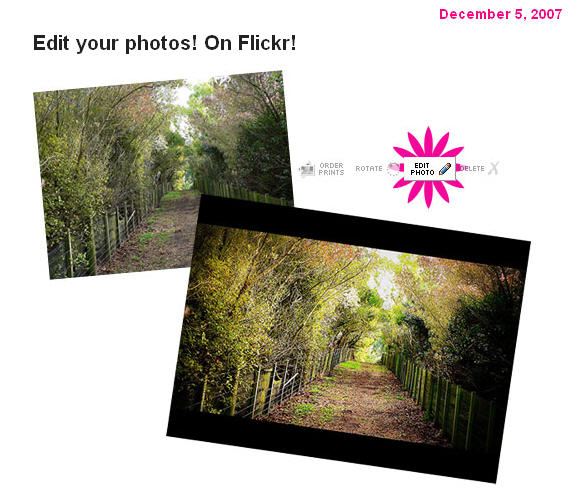
  • Wow! Edit your photos on Flickr

    Picnik’s awesome photo editing tools are now only a click away. If you’ve ever wanted to deal with the dreaded red eye or crop a photo just so, click on the new “edit photo” icon located above one of your photos and get started.

    The Picnik/Flickr collaboration works similarly to other 3rd party services who’ve built additional tools on top of the Flickr API: You’ll need to pass through the step of giving the Picnik service permission to edit and save your photos… It’s a little bit like you’re “installing” Picnik on your Flickr account, but with nothing to download.

    I rather like having access to this – especially when I am not always working on my own computer with my own suite of favourite tools. It’s all about being able to work quickly, efficiently, and ‘on the fly’ whenever and wherever – isn’t it?

    Rock on Web 2.0!

    picknik.jpg

  • Blogs in plain English

    Digital Natives explain!

    What is a digital native? How does the generational divide impact the legal, societal, and educational realms?

    Great questions being answered – or at least explored in depth – through the research lead up to publication of a new book. There is some tremendously helpful feedback on the draft v.0.9 of the forthcoming book Born Digital (Basic Books, German translation with Hanser) from tertiary students at Harvard and St. Gallen Law School, which is very worth while reading.

    Discussing Born Digital with European Students, gives insights into Digital Natives ideas about the opportunities, challenges, and most promising approaches in digital technologies when asked three discussion questions:

    First, what do you think is the greatest opportunity for Digital Natives when it comes to digital technologies? Second, what are you most concerned about when thinking about the future of the Internet? Third, what approach – generically speaking – seems best suited to address the challenges you’ve identified?

    Join them in the discussion if you like, or check out their project wiki , their new DN blog, follow them on Twitter, or join their Facebook group.

    Here are the student’s thoughts in brief:

    Greatest opportunities:

    • Democratizing effect of the net: DN can build their own businesses without huge upfront investments (Rene, Switzerland)
    • ICT enables networking among people across boundaries (Catrine, Switzerland)
    • Encourages communication among DNs (Pierre-Antoine, France)
    • Increased availability of all kind of information, allows fast development and sharing ideas among DNs (Jonas, Germany)
    • Availability of information, DN can go online and find everything they’re looking for; this shapes, e.g., the way DNs do research; as a result, world becomes a smaller place, more common denominators in terms of shared knowledge and culture (Melinda, Switzerland)
    • Efficiency gains in all areas, including speed of access, spread of ideas, … (Eugene, Singapore)

    Greatest challenges, long-term:

    • Problem of losing one’s identity – losing cultural identity in the sea of diversity (Eugene, Singapore)
    • Dependency on technology and helplessness when not having the technology available; DNs are becoming dependent on technology and lose ability to differentiate b/w reality and virtuality; other key challenge: bullying (Melinda, Switzerland)
    • Who will get access to the digital world – only the wealthy kids in the West or others, too? Digital divide as a key problem (Jonas, Germany)
    • Addiction: DNs are always online and depend so much on Internet that it maz lead to addictive behavior (Pierre-Antoine, France)
    • DNs can’t distinguish between offline and online world, they can’t keep, e.g. online and offline identities separate (Catrine, Switzerland)
    • Notion of friendship changes; DNs might forget about their friends in the immediate neighborhood and focus solely on the virtual (Rene, Switzerland)

    Most promising approaches:

    • Teach digital natives how to use social networks and communicate with each other; law, in general, is not a good mode of regulation in cyberspace (Rene, Switzerland)
    • Technology may often provide a solution in response to a technologically-created problem like, e.g., privacy intrusion (Catrine, Switzerland)
    • Don’t regulate too much, otherwise people won’t feel responsible anymore; education is key, help people to understand that it’s their own responsibility (Pierre-Antoine, France)
    • The laws that are currently in place suffice (except in special circumstances); learning is key, but who shall be the teacher (since today’s teachers are not DNs)? (Jonas, Germany)
    • Generic legal rules are often not the right tool, problems change too fast; instead, kids need general understanding of how to handle technology; goal could be to strengthen their personality in the offline world so that they can transfer their confidence, but also skills to the online world (Melinda, Switzerland)
    • Technology will most likely help DNs to solve many of the problems we face today; education is the basis, but focus needs to be on the question how to put education from theory into practice (Eugene, Singapore)

    From the blog Law and Information: obtaining a better understanding of the information society and law’s role in it.

    Technology-rich learning spaces

    Recently I had the opportunity to both attend and take part in the 2nd International LAMS conference with my own presentation on School libraries for 21st century learning.

    What I found particularly exciting was the opportunity to learn something about the design considerations for planning new libraries, the innovations in furniture and fittings, the re-conceptualization of learning priorities, the understanding of learning needs, and much more.

    Thanks to the presentation by Maxine Brodie, Maquarie University Librarian, I have a number of very useful leads to add to my personal knowledge-base about learning and libraries in 21C.

    Two of particular interest are:

    1. Scott Bennett from North America and the Library Space Planning site.
    2. Joint Information Systems Council (JISC) from the United Kingdom and their Planning and Designing Technology-Rich Learning Spaces

    A wealth of information, case studies, research, photo evidence etc is available at each site. Even just trawling the JISC Flickr photos provides inspiration, before getting into more detail!

    Some key questions were offered for our consideration – from Scott Bennet – which can equally be applied to school libraries as to tertiary settings since we all understand that:

    Space designs that acknowledge the social dimension of . . . learning behaviors and that enable students to manage socializing in ways that are positive for learning are likely to encourage more time on task and more productive studying, and thereby yield a better return on the investment in physical learning spaces.

    Question 1.

    What is it about the learning that will happen in this space that compels us to build a bricks and mortar learning space rather than rely on a virtual one?

    Question 2.

    How might this space be designed to encourage students to spend more time studying and studying more productively?

    Question 3.

    For what position on the spectrum from isolated study to collaborative study should this learning space be designed?

    Question 4.

    How will claims to authority over knowledge be managed by the design of this space? What will this space affirm about the nature of knowledge?

    Question 5.

    Should this space be designed to encourage student/teacher exchanges outside the classroom?

    Question 6.

    How might this space enrich educational experiences?

    There are many insights to these questions to be learned from the two resources, as well as from collaborative discussions about these issues amongst us all.

    The key for me is the Planning Context – this context will drive the creation of new 21C Library/Resource centres.

    Our facilities will

    …….need to move from being collection-centred to being learner-centred

    ……in order to support research, learning and personal development in a new networked environment.

    Bennett, S. (2007) ‘First questions for designing higher education learning spaces’ Journal of Academic Librarianship (33)1, pp. 14-26.

    Photos: JISC InfoNet’s photostream

  • Introduction to Second Life – Edublog awards

    I’d like to share this great overview of Second Life from Jo Kay and Sean Fitzgerald once again, and recommend their wiki Second Life in Education. Both Jokaydia Island and the wiki have been nominated for an Edublog award.

    I have joined Jokaydia in this great Second Life adventure – how else can I develop my understandings so as to nurture the learning opportunities for my students in classroom and library learning environments? 🙂

    Thanks to Jo and Sean for their great mentorship in this field!

    Introduction to Second Life

  • Here comes everybody!

    The grand thing about Web 2.0 and social networking is the opportunities for both serendipity and synergy in the process of networking and collaboration.

    Today I read with interest Beth Kanter’s (from Cambodia) notes about building your network strategically. Beth is writing an article and threw some thinking up on her Facebook notes. She starts by saying that

    Doing “outreach” or adding new friends to your network is a critical part of the work flow. To reap the benefits a using a social networking, you need to build your network, although as some experts say it is a matter of quality, not quantity. You want to avoid random outreach, but remember since outreach can be open-ended and there are opportunities for distractions. Remember to know when to stop.

    While Beth is looking at marketing in the non-profit sector her comments were of interest to educators – Vicki Davis (Southern Georgia, our coolcatteacher!) added a note saying

    In school we tell everyone,”Never add a friend of a friend, only add people you know,” and many of us are building our network in this way. Aren’t kids who add friends of a friend learning valuable networking skills? It is important to remember this, but also that we are creating a vast disconnect between what we tell students and what is going to make them successful in the future!

    So here we had just one of our many dilemmas in education being effectively highlighted and discussed, right in a social networking space, accessible only amongst ‘friends’.

    It didn’t stop there. I also had a message from Ken Carroll (Shanghai & Dublin) about the launch of his new blog Ken Carroll on Learning. Here we have Ken, and astute businessman, doing exactly as Beth advises – using friends networks to reflect and share, manage and promote.

    I am pleased that Ken shared his new blog link with me, because he has some highly relevant issues for consideration by educators. (Consider adding Ken Carroll on Learning to your RSS reader.)

    His post Here Comes Everybody touches on so many issues related to learning – information sharing, communication, gathering, discussion, utilisation etc etc. Yes, Ken, we have all been learning more, faster than we could 5 years ago….that is, if we are immersed in Web 2.0 tools and communication opportunities. As he puts it

    every individual now has a voice in the Big Conversation…. the participative web goes way beyond just high-speed access to information. It also enables us to form learning networks that include people, conversations, and information. This is a crucial development that we need to understand.

    Like Ken, I also connect with people on my network through blogs, social networks, email, instant messaging and more.

    This is what I want to share with my teachers. This is what I want to empower in the learning opportunities for my students. This is what future learning is all about.

    Photo: Casa Batllo, My Social Network