Be yourself – stand out with edutagger

Remember when Del.ici.ous and other social bookmarking sites were new….. and hardly anybody knew what they were let alone used them? Remember when we discovered Digg?

Well here’s your chance to see something else new with great potential, which is designed specially for K-12 teachers. Edutagger is in its early days (not much there yet) so will depend on us, the online educators of the world, to build up its capacity to store and promote the best resources we can find and share with each other. Think Delicious tagging + Digg and you’ll have an understanding of what it might do.

Blending the use of categories and tags, Edutagger it is an online organisational space for sharing and pooling our resources. Could this be the breakthrough that we have all been looking for?

I recommend that you take a look, create an account, and add some links. Before you know it we could build a critically useful collection for us all.

Edutagger still sports Google ads – like other online tools before it, Edutagger relies on this to get started. Don’t let that stop you exploring and contributing to Edutagger.

For me the other great thing is that this product is made by an aussie, who works in one of our schools in Melbourne, Australia. Email chatting with Edutagger’s creator today I discovered that he was a wee bit busy preparing a video presentation for parents! Nice touch..someone who ‘gets’ education!

Our busy life never stops does it? So let’s share the load and ‘be happy’!

Photo: Be yourself

Update: Information provided by email by Mark Schuman, from his school in Melbourne. Mark supports and trains staff in the use of e-Learning technologies and has become known as “Mr Moodle” – his name is around the Moodle forums a fair bit. Thanks to Stephen Downes for ‘picking me up’ on not providing information about Mark (blame late-night blogging!). Stephen provides a profile and some comments about the tool.

Google docs … at it again!

googledocs.jpg

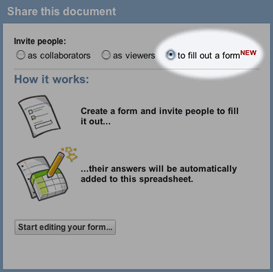
From Arthus on Twitter came the news that Google Docs now brings us forms!

Create a form in a Google Docs spreadsheet and send it out to anyone with an email address. They won’t need to sign in, and they can respond directly from the email message or from an automatically generated web page. Creating the form is easy: start with a spreadsheet to get the form, or start by creating the form and you’ll get the spreadsheet automatically.

Responses are automatically added to your spreadsheet!

  • Creativity on the cheap with WiiMote

    In a few weeks a new member of staff will join the Resource Centre team at St Josephs. Amongst other things Joan Denahy has been working with Web 2.0 tools with her staff, so I’m looking forward to her joining the team. Andy, Simon and Richard, members of the Resource Centre team, spent some time this week exploring Web 2.0 tools with me. This post is really for you 🙂

    You’ll enjoy this one, on WiiMote, not new, but lots of fun! … which also reminds me – my friend Dean Groom should be building this for us to see!

    Digital natives and their reading

    The Guardian provides an interesting analysis of the National Endowment for the Arts study, called To Read Or Not To Read, which chronicles in exhaustive statistical detail the waning of literary culture and its dire consequences for American society.

    To Read or Not To Read expands the investigation of the NEA’s landmark 2004 report, Reading at Risk. While that report focused mainly on literary reading trends, To Read or Not To Read looks at all varieties of reading, including fiction and nonfiction genres in various formats such as books, magazines, newspapers, and online reading. Whereas the earlier report assessed reading among adults age 18 and older, To Read or Not To Read analyzes reading trends for youth and adults, and readers of various education levels. To Read or Not To Read is unique for its consideration of reading habits alongside other behaviors and related outcomes including academic achievement, employment, and community involvement.

    No need to throw our hands up in despair. It seems that Google-gen kids who have grown up spending their leisure time on computers rather than slouched in from of the TV are the least violent, the most politically engaged and the most entrepreneurial since the dawn of the television era.

    Actually the whole ‘statistical number-crunching’ about literacy, reading and books is nicely challenged in this Guardian article by writer Steven Johnson (author of Everything Bad Is Good For You: How Today’s Popular Culture Is Actually Making Us Smarter and The Ghost Map).

    My favourite bit:

    And of course we are writing more, and writing in public for strangers: novel readers may have declined by 10%, but the number of bloggers has gone from zero to 25 million. Simply excising screen-based reading from the study altogether is like doing a literacy survey circa 1500 and only counting the amount of time people spent reading scrolls.

    Photo: The Guardian, Vaultboy
  • Tweeting and twhirling

    Do you tweet on Twitter?

    Then you might like to Twhirl as well.

    There are many little tools you can use for your Twitter conversations, but my twitter client choice for now is Twhirl. Are teachers twittering? You bet. Check out the first Twitter Mashup from sujokat (Sue Tap).

    Looks good doesn’t it? Functionality is excellent.

    twhirl.jpg
  • Information and knowledge alert!

    There is a bit of a thing happening with Campus Editions. First I learnt about Edublogs Campus, a nice new offering…. and then rather belatedly I  heard about Firefox Campus Edition.

    The Firefox campus edition comes pre-installed with StumbleUpon (for discovering websites, photos and videos), FoxyTunes (lets you control almost any media player and find lyrics, covers, videos, bios and much more with a click right from your browser) and Zotero (for clipping web notes and to help you collect, manage, and cite your research sources.

    Providing this tool will make it imperative for us that students have good information and critical literacy skills to navigate successfully in this environment in order to think deeply, creatively and fairly rather than plagiarising or operating outside a creative commons approach to online media.

    It’s marketed as being everything you need for a well-rounded College Life!

    According to Mashable

    It’s probably fair to say this is a marketing drive to get Firefox installed on student laptops before they head back to school.

    I wonder, did anyone actually install this on their student machines? I like to be quite choosy about the Firefox addons I use – some of which are great. I think I would prefer to apply the same approach to customizing student delivered web browsers.

  • That’s my mouse…

    ……is a neat new entry into a teacher’s toolkit – if you’re brave enough to give it an experimental go!

    ThatsMyMouse allows people to passively interact. Just by navigating through a web-page you can interact with the people on it. Since it’s written in JavaScript (and supports all major browsers) it works for 95+% of visitors after a website places a single line of JavaScript on their page. You can see, talk and interact with anyone who browses to the same page as you.

    Mashable also wrote about this simple but brilliant gimmick that they dubbed a Social Browsing Widget.

    Playing around with it after an alert by Alec Couros on Twitter, I thought that it could be used as a good focus point for discussing a topic on a web page, or even webpage design.

    Contribute to the discussion of the tool for Alec at ThatsMyMouse. Alec’s captured text transcript will help you discover more.

    The way it could be used is governed by the comment field, which you position with your mouse after writing the text. The comments don’t stay on screen for long, so it’s not about marking up a page with comments, but rather having a fun tool – perhaps online with other classes – to throw some ideas around and generate discussion.

    Try this out on your wiki some time soon 🙂

  • A Whole New Mind – Pink style

    6.00 am on Saturday morning, and at last it was my turn to join one of the classes for live blogging A Whole New Mind with students from Arapahoe High School.

    Some weeks ago Karl Fisch (you’ll remember his Did You Know 2.0? video) put out a call for people to participate in ‘live blogging’ over a series of weeks, and you can see the timetable of these events at AWNMLiveBlogging. Luckily for me I could make the Period 6 timeslot on a few of the dates.

    I’ve just completed my first session with these fabulous students. The record of just this one class group is at Smith 9H07-08.

    What I can’t capture here was the opportunity to hear the fishbowl discussion technique in action. Using MeBeam, a web-based video chat tool, I heard every fabulous word of discussion, along with my fellow bloggers Christian Long and Gary Stager.

    Yet another wonderful way to add flexibility and creativity to learning as a multimodal conversation.

    Photo: 油姬

    Network fatigue and the remixable web

    That’s what it’s all about …. lets keep an eye on these developments!

    The DataPortability technical blueprint uses OpenID to provide decentralized identity. OpenID 2.0 Attribute Exchange (AX) is utilised for discovery of user service details. XRDS/YADIS are utilised to provide the details of the various services a user employs.

    As users, our identity, photos, videos and other forms of personal data should be discoverable by, and shared between our chosen (and trusted) tools or vendors. We need a DHCP for Identity. A distributed File System for data. The technologies already exist, we simply need a complete reference design to put the pieces together.

  • Breakdown of social networking

    Its the weekend and time to relax. So here I am surfing the Net – and what do I find?

    Imagine this scenario – what would happen to our social networking endeavors if we all lost connection to the Internet? Some of you may have been following Afterworld, the first television series to be made available on mobile phones and the web simultaneously (each of the 130 episodes is just over two minutes long). This animated sci-fi series tells the story of life on earth after an inexplicable global event which renders technology useless.

    More than 95% of international telephone and data traffic travels via undersea cables. So sometimes there is an accident! What does happen when something goes wrong?

    Passport reports:

    The Arabist, an anonymous blogger based in Egypt, sarcastically predicts “complete social breakdown” when people find themselves unable to update Facebook every few minutes. Here’s hoping it doesn’t come to that. Internet users from Cairo to Calcutta are either without the Web or their service is operating at a fraction of its normal capacity.

    The culprit? A ship off the coast of Alexandria, Egypt, dragged its anchor and snagged two major underwater telecommunications cables. Unfortunately for Internet addicts in Egypt, Saudi Arabia, Qatar, the United Arab Emirates, Kuwait, Bahrain, Pakistan, and India, the SeaMeWe-4 and FLAG Europe-Asia cables, which carry the majority of Internet service between Western Europe and the Middle East and South Asia, were the ones cut.

    Unfortunately for Internet addicts in Egypt, Saudi Arabia, Qatar, the United Arab Emirates, Kuwait, Bahrain, Pakistan, and India, the SeaMeWe-4 and FLAG Europe-Asia cables, which carry the majority of Internet service between Western Europe and the Middle East and South Asia, were the ones cut.

    It’s happened before, and will happen again. Passport explains that it’s unclear when normal service could be restored to the affected countries. I wonder how blogger Julie Lindsay is managing in Doha? and if she still has steady access.

    Oh, I see she is in Prague ……  and busy blogging about the ECIS conference! I recommend a visit to the slides of her presentation on Personal Learning Networks. She captures the key points beautifully.

    Below: damaged cable networks

  • .