
Teaching is Dead – Long live learning
Reply

Knowledge is changing. It develops faster, it changes more quickly, and it is more central to organizational success than in any other time in history.
 Our schools, universities, corporations, and non-profit organizations, need to adapt. We need to change the spaces and structures of our society to align with the new context and characteristics of knowledge.
Knowing Knowledge book site – and email request page
Knowing Knowlege available in pdf format
Knowing Knowledge – .pdf Files for the book Knowing Knowledge:
Color images are also available on flickr: Knowing Knowledge Photoset
…and if you are interested, you can contribute to the wiki and correct the errors of my ways: Knowing Knowledge Wiki
Robert Cailliau, co-developer of the WWW, acted as Provocateur for Session 1. His aim was to explore emerging trends in a connected world and to delve into concepts of knowledge explosion and the ability of an individual’s brain.
I enjoyed listening to his session, in particular his ‘take’ on ideas and issues that have significant relevance to our work in education. He has, of course, an in-depth and longstanding understanding of ICT and ‘informatics’.
He asked
How will people cope with the world as it might be a decade from now, if that means ever more informatics and ever more ‘intertwinglings?
Interestingly he focused on science as a research tool, and the relationship between science and common sense. He suggests that the use of common sense in daily life is the norm, but the scientific approach focuses on observation of facts, formulation of hypothesis, predictions, hypothesis etc. He also recommends that scientific methods should be the basic tool for all thinking. We should use scientific methods and common sense in all subject matter, not just in science classes – BECAUSE – thinking is very ‘effort-full’.
However, Robert seemed to focus on science research as an empirical tool and did not include qualitative research processes, evidence-based practice, and evaluation as a process approach of change. Measurement tools of social research can enable thinking and conversation in order to create deeper understanding of our actions and our learning endeavors.
Robert reminded us that knowledge is increasingly becoming more difficult for the average brain to understand – things we know that the average person cannot grasp – e.g. quantum mechanics. There are things that cannot easily be explained, discussed, etc
Overall the audience was following his words closely – and his reference to SecondLife and other tools from a Web 2.0 environment was good to hear. However, his ‘take’ on SecondLife was rather skewed I thought. OK, only a few hands went up to the question ‘who has an avatar in second life’. Robert said that people go into interactive virtual worlds in SecondLife because
He then asked
Will education cope with people who are increasingly disinterested in the real world?
Oh dear – a very bad representation of the potential of SecondLife environments, and no recognition of the valuable education uses for which SecondLife is already being used.
So finally, because we will have to save the planet…keep learning and developing…we can only do this with
Real knowledge, good tools, and good leadership
I am attending the Global Summit 06, hosted by Education.au, and reporting and reflecting on sessions over the course of the next two days.
The conference program has a telling quote from Marchall McLUhan which sets the framework for the Summit discussions. I’ll share it with you here:
Our Age of Anxiety is, in great part, the result of trying to do today’s jobs with yesterday’s tools”.
A great quote, and good setting for the Global Summit.
Our first Keynote address was delivered by Keynote: Andrew Cappie-Wood, Director General NSW Department of Education. He reminded us that education is about engaging young minds in stimulating curriculum, amongst other things to develop decent, thoughtful, resourceful students. He also highlighted that the intent and the use of ICT isn’t different across the different states of Australia – but that there is a tendency for comparison and competition. Bragging rights!! Are a common problem as people show ‘how good we are’.
 Since ICT is just part of the competitive advantage Andrew said ‘lets hear the brag!’ We heard about email for students across the state, and ‘leveraging the size to engage in ‘efficient’ procurement and system architecture’.
There are many key drivers for the system for ICT to deliver quality education to everyone everywhere.
Imperatives in action are:
Change is expotential – and technological changes are providing challenges for safe working environments. The example was YouTube, and the question was asked as to what we do to effectively respond and adapt to challenging technologies. There are superb opportunities, and many factors that will influence our adoption. There is no future for us without ICT in an increasingly global world.
How can ICT improve our educational outcomes? I would have liked to hear Andrew go beyond the generalized summary of ICT potential and infrastructure developments and get closer to the social networking imperatives of Web 2.0 beyond a brief mention of change with a YouTube example in the last minutes of the address.
It’s possible that today, more than any day ever, has shown me the power of Web 2.0 to be the catalyst for change and motivation in education. The fact that blogging has lead to an opportunity for face-to-face dialogue with John Connell, Learning Futures Strategist from LT in Scotland is amazing! Thank you John for taking the time out in your short Aussie stay to chat with some of us downunder.
I sound like an excited teenager – and I guess in the world of blogging that is what I am 🙂 John Connell has been leading educators in Scotland for many years through his work with SSDN, and now in his new role, continues to explore the potential of school-based learning.
So the opportunity to listen to John as he shared stories and insights with a small (select) group of my colleagues in Catholic Education in Parramatta was exceptional – and I know that such opportunities to talk with people with vision and experience is greatly appreciated.
 Bloggers of the world really were united – as Al Upton from Glenelg in South Australia joined us to listen to John – again, as a result of our blogging and communications that result from this!
The interesting thing was the ease with which two bloggers, from very different walks of life, could be so easily bound together by the common passion of delivering educational opportunities to students that harness the potential of technology in new ways, incorporating Web 2.0 as platform thinking.
I hope to have a podcast available of John’s presentation available, once I get back to work after attending the Global Summit where I have a feeling we will all be engaging in some very good professional conversations – and possibly knock the socks off the world with the resulting ideas that are generated!! If schooling is indeed struggling to find relevance in today’s world, then it is almost certain that solutions that emerge will do so due to as a result of the activism of bloggers and Web 2.0 aficiondos.
Now, about six degrees of seperation?
 John talked about Whitby, the place from which Captain Cook sailed to reach Botany Bay. John travelled out to Australia to speak with us at Parramatta, where Greg Whitby is now our Executive Director. Greg dropped in for a short while to listen to John, and will attend the GENIE meeting with John on Tuesday. Al Upton comes from Glenelg, and I live in Glenelg place.
Bloggers of the world unite!
ASCD SmartBrief Reports:
Google courting teachers with new tech resource
Google for Educators, a new Web site launched yesterday, offers guides and lesson plans detailing creative ways to use Blogger, Google Maps, Google Earth and nine other Google applications in the classroom. The site also offers links to a training academy that will allow teachers to become “Google certified.” Silicon.com (10/12)
Google says:
Google recognizes the central role that teachers play in breaking down the barriers between people and information, and we support educators who work each day to empower their students and expand the frontiers of human knowledge. This website is one of the ways we’re working to bolster that support and explore how Google and educators can work together.
The whole thrust is about ideas for using technology to innovate in the classroom. The Google Generation certainly deserves teachers who can think differently about the use of technology. But this list of tools smacks of the usual ‘tech tool’ approach – classrooms with more ‘bells and whistles’. Given the Google purchase of YouTube, the possibility is there that Google tools might actually reflect Web 2.0 think?
On the other hand, the list is a tantalising one to throw before teachers who are starting out, if only because Google has become such a ‘staple’ friend of teachers and students alike.
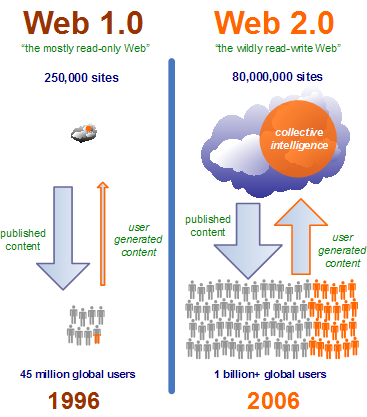
Let’s not forget the strength of the Read/Write web as demonstrated by this graphic from popoever.
Web 2.0 is about collaboration and remix, and syndication of data in such a way that anyone, anywhere can use use the results.
Web 2.0 does not lock the reader/writer into rigid technology actions — it intentionally forfeits that control in favor of much greater returns.
Let’s hope that Google remembers that! What I am particularly interested in is the concept of ‘expanding the frontiers of human knowledge’. Web 2.0 alone will not do this, nor even come close to facilitating this. Web 2.0 is a new environment, with new options, new possibilities, new dimensions to human cognitive engagement.
However, I see little evidence yet of Web 2.0 moving beyond into serious investigation of the semantic web and the new spaces for thinking deeply by extracting deep information! Web 2.0 Google tools for educators doesn’t address this at all – not even remotely.
Knowledge Strategy for school libraries
Who is going to guide educators in understanding cognitive information strucutures of the mind, of virtual and physical resources and new ways of interaction in a Web 2.0 environment. The technology evangelists in schools believe they have the answer!! Google the world, use wikipedia, and scrap the school library for a virtual information locker! Nuts! Or more frighteningly a solution as rigid and dangerous as ‘book burning’.
A hundred years before the advent of Hitler, the German-Jewish poet, Heinrich Heine, had declared: “Wherever books are burned, human beings are destined to be burned too.”
On the night of May 10, 1933, an event unseen in Europe since the Middle Ages occurred as German students from universities once regarded as among the finest in the world, gathered in Berlin to burn books.
In the new era of Web 2.0, school principals and technology evangelists are attacking school libraries by ‘burning’ the books – rather than doing to libraries exactly what we have to do to class rooms …… Change change change change…. and learn from the leading digital repositories in the world that are using technology to preserve literature, movies, images, etc. I hate lots of school libraries, the way that they are run, the way they look, the way school leaders ‘abuse’ their potential in the schooling of our students. But the solution is not to close their doors, but to initiate a reform as comprehensive as the one that needs to take place in our classrooms.
What does our Knowledge Strategy need to become? I’m thinking about it! Are you?

While some of my colleagues are at the Australian Computers in Education conference in Cairns, I am catching up on another batch of marking for Charles Sturt University before flying out to HongKong for a very well earned rest. When I get back it will almost be time for the Global Summit, where I hope to see a few of my fellow bloggers.
John Connell will join us at Catholic Education, before the Global Summit, ‘in conversation’ and to inspire us with his work in Scotland. Might have a podcast to share afterwards if John is happy with the idea. If you haven’t dipped into John’s blog, I highly recommend it. I have no idea how one person can think and write so much, but be assured that you will be challenged by the diversity of his posts.
I’ve been doing some writing for the office in the last couple of weeks, teasing out ideas around future directions and our learning agenda. One concept that has tested thinking for a few people has been around the whole issue of learning management systems (LMS) and virtual learning environments (VLE). Funnily enough some of my colleagues get stuck on debating semantics and how to describe systems that we are rolling out for our schools. As if describing the system will somehow make it more worthwhile or more relevant?
In fact, what we should be focussing on is the Web 2.0 world of our students and their personal learning environments (PLE). Remember, its a combo-world. In Macca’s sales speak – we are constantly ‘upsizing’ and offering ‘fries with that’ because we have to!
Today we can deliver TO student expectations beyond the LMS and VLE that have emerged in recent times as the answer to learning for a 21st century technology world.
The emergence of Web 2.0 and social software moves us beyond the use of integrated LMS or VLE to social networking and education immersed in the future world of our students. No use debating which LMS to buy, or what a VLE is! Understand MySpace and you will understand the shape, meaning, value, future directions of student learning.
In fact, any discussion of the educational value of LME or VLE, and the integration or separation of social software must must be grounded in new ‘MySpace pedagogy’ and must include a genuine understanding by educators of the Web 2.0 world of our net-savvy students.
I suggest that we need a combination of a number of tools: a management system, personal tools and social networks. Our integrated solution requires this personal learning environment, because the very nature of what our students do and how they use online spaces extends their learning beyond the classroom and the present …. right into the future …. for life and for lifelong learning.
In fact, ‘Web 2.0 as platform’ is the natural implementation and platform for 21st century learning.
It’s time to dream the impossible dream and leap beyond the context of our current understandings.
Flexibility and personalisation are at the core of our re-purposing of education. If students think about the internet as a virtual locker, backpack and notebook, then we must create flexible learning environments which support the use of multipe resource tools, including Web 2.0.
If we do this, then we will have a learning framework that is Web 2.0, 24/7, global, contextual, personalised, real, physical, virtual, and visceral.
We’ll help our students be passionate about their personalised learning!
Now, off to HongKong 🙂

Joseph, a senior maths and IT teacher writing at Computers & 21CEduk8n left a nice comment on my podomatic site about my podcast.
Thanks for the feedback! 🙂
But better still, Joseph followed it up with a great post on podomatic Podomatic = Podmail and the unique options possible with podmail. Now, that’s creative, distributive, digital learning!
Well worth a read.
Extraordinary as it may seem, we are living through a significant part of world history, as startling as the changes heralded by the invention of the Gutenberg press.

Whether of not you need convincing that radical times are upon us, you can’t afford to miss exploring Imagining the Internet. Here you will find past, present and future; voices, predictions, visionaries and kids; as an ongoing record and dialogue of developments. Best fun of all is reading theVox Populi – crazy and thought-provoking!
The debate and developments around MySpace continues. Mashable reports on MySpace alliance with Seventeen as well as the development of the MySpace Guardian toolbar.
Seventeen has a Saftey Guide for Parents available for download.
We are working hard to stay in touch with Internet developments, and help our teachers and school community work effectively with the developing internet and Web 2.0 tools.
At a technology forum earlier in the year I was invited to talk about Web 2.0 and the shape of learning for our Google kids. Though not sophisiticated you might like to view/listen to the presentation. Thanks to Stephen Abram for sharing some slides for the presentation.

Following up from my post on Social Networking Explained
…..it is good to find that my group of schools will be encouraged to take a more postive approach to the value and purposes of social networking right down to flexible use of MySpace.
Back on Tuesday 17 May at a K-12 School Library network meeting, Jan and myself raised the matter of MySpace and tried to encourage people at the meeting to take a positive view of the opportunities that MySpace represents. My post MySpace and School Libraries resulted in some feedback to me from some teacher librarians saying that they had changed their view of MySpace and were now looking at how to develop a better approach.
So of course this recent post by Jane’s E-Learning Pick of the Day on Zapr reminded me of the highly flexible possibilities that MySpace or similar offer.
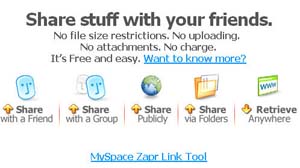 Easy communication and transfer of information is what MySpace is all about. Zapr includes a MySpace Zapr Link Tool . Zapr lets you create links to any files on your PC. Then you can send these links to friends (via email or IM) and they can get the files directly from your computer via their browser.
Is this important. You bet! Jan at Delaney College explains that students are using MySpace for storing their learning ideas and learning resources. They are bamboozled when they get to school and suddenly can’t access their own work, their own files, and continue right on with the learning from where they left off the night before.
You might like to add Jan’s del.icio.us to your network, or Jan’s del.icio.us work with teachers to your network. Thanks to Jan for sharing her enthusiasm.
 judyoconnell.com