About Judy O'Connell

Educator, learner, blogger, librarian, technology girl, author and consultant. Transforming education and libraries. Innovation for life.

The Knowledge Tree

The Knowledge Tree enables the sharing of research and innovation in global e-learning practice.

Edition 11: The Knowledge Tree Goes Communal , looks at what it means to be in community on the Web, that is, examining what is community or communion, the structures being used to create Web communities, the types of communities that are emerging, the processes used to facilitate online communities, the relationships being formed within Web communities and the uses of Web communities in education.
Nancy White of Full Circle and Associates in Seattle, United States of America, is featured in this edition with her article titled of ‘Blogs and Community: launching a new paradigm for online community?’. Nancy has long been a leader in the field of online community facilitation and online community development.

You can join Nancy through ‘live conversation’ in a live Elluminate session on Tuesday 26 September at 2.00pm AEST (Monday 25 September in US). This ‘live conversation’ represents a great opportunity to dialogue with Nancy before she conducts her national speaking tour around Australia from 7 – 27 October.

You can enter this session with Nancy an hour before the scheduled 2.00pm start.

Shifting technologies

So back to the idea of the telephone or the printing press as change agents. A post from Stephen’s Lighthouse on The Primary Web Device provides some growth figures on mobile phone consumer technology.

He quotes from The Register 

The cellular industry took 20 years to reach one billion connections, three years to reach two billion connections and is on target to reach its third billion in a period of just over two years,” Wireless Intelligence director Martin Garner said. “Worldwide growth is currently running at over 40m new connections per month – the highest volume of growth the market has ever seen,” he added. According to Garner, most of the current growth is coming from emerging markets with low levels of penetration, rather than from mature regions such as Europe.

Stephen covers some cool ideas in what this means for libraries. Bit different to our schools where mobile phones are usually seen as something to be locked away or banned.

His last two questions are the best. Are we preparing for new software and device modalities? Are we in K-12 prepared for the largest generation in history – with phones attached?

Frankly we have hardly begun to think this through. Will the next 12 months see a bit of a shakedown in some schools? I have had a secondhand report today that one of my Teacher Librarians is preparing to embark on a metamorphisis of her library, and in addition to reconfigurine learning spaces she will add mobile devices into the library device pool. Excellent. Let the experiments and lateral thinking begin!

What we are doing is creating a learning community. We do this by using Web 2.0 tools and a social constructivist approach to learning. Jo McLeay asked How do we know that blogs and podcasts improve student learning? The comments are well worth a read, as they show that it is learning in a Web 2.0 community that works, not technology as tool – which is what Web 1.0 was all about and which is where many of our teachers are still.

John Connell pointed to Don’s Blog and and his comments about his son’s Study Blog. His son Lewis’ learning community extended beyond his school leading to be a very productive learning experience.

Lewis received his first comment on a blog post yesterday from someone in Dublin, Ireland, in connection with a post he had put up about Proportional Representation. It’s made a real impact as he now realises there are people out there are reading what he writes. It also helped him to better understand what he is studying.

David Warlik got this feedback from his teachers about Why Kids Blog:

Even when they’re out sick, students work on their blogs.

Carol Barsotti

I’ve got 6th graders coming in during their lunch and after school to add articles to their blog and to respond to their classmates’ articles

Al Gonzalez

My students are floored when, as they say, “some random person from Texas commented on my blog!!” The students are getting real world experience with writing.

Brian McLaughlin

Why would my students want to write on paper for their teacher to see, when they could write on their blog for the whole world to see.

Kathy Cassidy

In fifteen years of teaching, I have never seen anything come along even CLOSE to motivating students to write – like blogging does.

Mark Ahlness

Our learning spaces need to get into mobile technology, mobile computing and social software to engage with the students in their world. From where teachers stand it is all about new literacies and new ways of communicating and negotiating content and meaning.

So back to that mobile phone. Take a read of Smith’s Ninth Grade Blog and To Cell Phone or Not to Cell Phone.

So today I tried something new…I had the kids turn on their cell phones and ring in their answers.

Did you guess what the students had to say about the incorporation of mobile phones into their learning experience?

Ways of learning need to change, and I like to think that the required pace of change is oh so! neatly highlighted by the growth in mobile phone connections.

Metamorphisis of libraries & learning spaces

For some time I have been reading and thinking about the much-needed metamorphisis of school libraries in order to create a fully integrated information and literature learning environment for our kids that is in keeping with our Web 2.0 world. As I have 77 school libraries to think about, the idea of creating that metaphosis is ridiculously exciting and even more ridiculously challenging!

We have significant changes taking place in the various media that drive our social communications – in a range of digital ways. Overall ours is no longer an analogue world, though books in print retain their core place in literacy acquisition and leisure reading. What are your ideas about the changes that are rushing up on us? Whatever you think, I share this comment from an essay on Dead Media from the Sydney Alumni magazine:

The next question is whether these changes are analogous to the invention of the telephone, which changed us a great deal, or the invention of the printing press, which changed everything.

For my schools I have reflected on the need to restructure learning spaces and incorporate a whole-school approach to the traditional library.

The Learning Commons

The Learning Commons has been recognized internationally as an innovative approach in bringing together services that support students in their learning. In the tertiary sector academic institutions/libraries are responding to these same trends worldwide by rapidly developing “learning commons” or “information commons” – areas which are new on-site facilities designed to provide higher levels of technology (hardware and software), access to content (digital and print), and support for users working to access and develop information resources. While some learning commons facilities are in newly constructed buildings, most are renovations within existing or expanded library spaces.

The aim of a Learning Commons is to provide a physical environment which addresses the profound changes affecting how we teach and learn and which complements the evolving integrated, virtual/online teaching and learning environment of Web 2.0, advanced technologies, and Social Networking of the web.

We need to look for new ideas and new ways of working with literacy, information literacy, and digital fluency for teaching and learning. Whether it’s blogs or wikis or RSS, all roads now point to a social network that is collaborative and social in nature. Teaching and learning needs to change just because we have expansive access to a wide variety of ideas, can find and receive information in a way never before possible, and create and share at a global level with transparent ease.

In a newly designed or liberally re-organized and structured school, students can choose to learn in the Learning Common on workstations, on their own laptops or PDAs, connecting to the Internet and Learning Common online resources via wireless connectivity. Learning commons subsets can also exist in other places in the school – depending on how flexible learning spaces are developed.

An integrated approach to Library and Learning Commons

  • reading materials for pleasure or study
  • information retrieval and critical analysis support
  • learning activities
  • social activites
  • academic writing guidance
  • special education learning support
  • information technology support
  • multimedia design centre with Kinko-style production services
  • traditional bibliographic services
  • social networking services
  • 24/7 learning
  • supporting creativity not productivity


A Learning Commons approach ensures a student-centred focus where school structures and technology exist as metacognitive tools, thereby helping learners and their mentors to understand better the processes of learning.

A metamorphosis of the Library into a Learning Commons allows us to include new or different types of spaces, features and services. I see the ‘Learning Commons’ as an approach that will provide an innovative environment to students and staff for accessing educational facilities and engaging in the creative experience of learning.


A framework to think about for Services and Structures

  • ICT and HELPDESK integration and management through Learning Commons
  • Technology integration as part of literacy, information literacy and curriculum and driven by curriculum leaders
  • Integration of new and emerging technologies such as Smart phones, tablets, PDA, podcasting, and active use of social software (wiki, blogs, flickr, RSS information distribution).
  • Provision of literacy and learning support
  • Fiction Collection for provision of resources for reading for pleasure and improvement
  • Online digital respository of materials and resources
  • Provision of audiobooks on iPods etc
  • Provision of a digital design studio facilities for multimedia and print output.

If you have some ideas or success stories, or good articles on the topic, I would love to know more.


Streaming media

I agree with Stephen Abram’s of Stephen’s Lighthouse….streaming media is definitely breaking out 😉 The Good, the Bad and the Ugly are definitely out there!

My workplace has yet to step into the streaming media phase – but we will be doing this with a rush and with considerable (learners!) enthusiasm very soon as we transform the lansdcape of our personalised learning environment. Stephen’s questions are important ones for us to consider right now.
Stephen says:

If it doesn’t already, your employer will be creating, licensing, storing and offering education, training, meeting, and communication events to its employees, partners and clients and maybe even the general public. Whether these are called streaming media, webcasts, e-learning, webinars, podcasts, Video On Demand, VODcasts, or whatever, we, as information professionals, should be ready. How do you use them? How are they acquired and what rights are licensed? How are they indexed, archived and made accessible? Can they be put into the OPAC and/or intranet? How are they preserved and stored? Can their contents be searched? Are there better formats and what are the trends? What recommendations should we be making for our companies intranet, Blackberries, browser plug-ins, etc.? There are plenty of questions!

From Islands in the Stream, Infotech Column, Information Outlook, July 2006 issue

Creative Commons and Second Life

Apologies for cross-posting – but this is too cool not to share 🙂

Creative Commons – this is important for educators. Creative Commons and Second Life combo – gives us an amazing digital event.

From the Creative Commons blog:

Mark your calenders: On Thursday, September 14 at 5PM (SL/Pacific), PopSci.com and Creative Commons will be hosting a special concert in Second Life featuring Jonathan Coulton as well as popular Second Life musicians Melvin Took, Kourosh Eusebio, Etherian Kamaboko, and Slim Warrior. From Jonathan Coulton’s blog:

I will be playing live from a secure, undisclosed location in the real world, but you will see my handsome avatar onstage at a venue called Menorca in the Second Life universe. You can also listen to the concert via a number of streaming type websites … The whole concert, audio and video, will be Creative Commons licensed, so feel free to record it.

More information is available on this wiki. We’ll post more information on the CC blog as soon as it becomes available.

Building an education strategy for metadata

On quite a different note, but nevertheless favourite topic of debate for me…well not debate really as teachers and educators don’t think about this…is a metadata focus.

I was diverted back to this track by a post from the Really Strategies Blog and a planned focus group meeting in New York City on the knowledge and usage of industry standards and metadata.

Now, as an information professional, metadata means a lot to me! But for the average educator reading this blog, take it from me – without metadata our learning management systems, our knowledge management structures, and almost everything we are building up in our online world is dependent on GOOD metadata.

What is metadata? Well, it is information about any resource either physical or digital, and enables management and organisation of information. Metadata is used to facilitate discovery and retrieval of information; enables data interchange; separates content, structure, presentation and behaviour; provides the opportunity to enrich information about resources; and ensures persistence in resources. In other words, as information is stockpiled, you get to be able to find it!

This isn’t the place to go into details, but standards for metadata are available from a number of sources, and are important as they allow consistency, help to establish authority and allow ease of access for users (that’s us! 🙂 )

Some very important global standards are in operation, and include Dublin Core Metadata Initiative (which includes an education set) and Learning Object Metadata from IEEE. A good example of the practical, vital and valuable application of metadata in Australian education is demonstrated by EDNA (Education Network Australia). This organisation recognised early on the essential role of metadata.

The EdNA Metadata Standard is based on the internationally recognised Dublin Core Metadata Element Set (DCMES) and is consistent with the Australian Government Locator Service (AGLS). The work of maintaining the EdNA Metadata Standard is conducted by the EdNA Metadata Standard Working Group which reports to the AICTEC Standards Sub-Committee and the education.au limited Board.

The problem is that school systems, and individual schools implementing knowledge management initiatives or learning management systems haven’t (on the whole) caught up with the priority of metadata. It’s a vital component of good Web 2.0 implementation of collaborative learning cultures.

At the end of 2005 I had the good fortune to work on a project (for a national online digital media delivery system used by Australian schools) developing a complete metadata set for the company. I guess I have a bit of an idea of what’s involved.

So I would love to be a fly on the wall and hear what the meeting in New York comes up with in discussion on how publishers are using metadata in their digital asset and content management workflows well as for enhancing content for reuse and product development.

However, some of the key points for discussion at that meeting have significant relevance for schools and learning or content management systems now and in the future. Here are some of them I’ve adapted for schools:

  • How will schools achieve sophisticated search today – or plan for it in the future?
  • Is there a way to easily share information with other schools or sectors?
  • What does an education enterprise metadata strategy actually mean in a practical sense? What is the value to schools and organisations that have one?
  • How will schools manage their digital rights in this environment?
  • Are schools achieving success with Digital Asset Management and content management systems and/ what are the critical success factors?
  • Is automating RSS or other types of syndication feeds an imperative?

Come on education – wake up to metadata, content management workflows, content reuse and information dissemination.

Literacy and learning

This morning I have gone back to an article I wrote -seemingly before the dawn of time – well, before the dawn of the internet as we know it, and Web 2.0. I said that we need to examine literacy directly in relation to thinking, and as a tool for learning and the creation of meaning. In other words ‘meaning’ is an aspect of literacy. It is both context and content specific, and is with regard to something, some aspect of knowledge and experience.

To quote myself correctly this time:

Literacy has a specific cognitive dimension, and is a powerful enabling mechanism for thinking and learning. Through the skills of literacy, conscious and deliberate exploitations of text are possible, so facilitating a more abstract, reflexive stance towards information and the processing of meaning.

The problem is of course that since I wrote this much has changed and there are a plethora of ‘literacies’ that are discussed – sometimes in isolation from what I think of as the core concepts of literacy. This is to the detriment of the essential and fundamental purpose of literacy – creating, developing, understanding and sharing meaning!

I really liked the thoughts expressed by Ulises A. Mejias (discussed by Will Richardson and James Farmer) on Social Literacies.

The word literacy is used loosely these days to define all sorts of competences (viz. visual literacy, musical literacy, computer literacy, and so on). Here, I am using Kress’ more exact definition: literacy as the “term which refers to (the knowledge of) the use of the resource of writing” (2003, p. 24). This definition makes it possible to separate literacy from other resources (such as speech), as well as other ‘metaphorical extensions’ of the concept (such as musical literacy, cultural literacy, etc.).

He discusses wiki which make social literacy apparent by allowing us to witness the evolution of text in time, an evolution that reflects the decisions not of a single individual, but of a community.

Thank you! The powers unleased through the invention of printing have enabled thinking… by sharing. For me the fact that we can do this sharing simultaneously and online is not so revolutionary as evolutionary – particularly if we remember that our Web 2.0 literacy is “as the continuation of the struggle that began when Guttenberg released free speech first in our tradition”.

So I don’t totally agree that Wikis engender a new form of literacy: a social literacy. New framework? Yes. But what we are seeing is the actualisation of the full possibility of our literacy potential which began with Guttenberg and which was essentially about social communication as well as information dissemination. Having said that, the social literacy of Web 2.0 tools IS creating a renaissance in our time that will be reflected in creative changes as dramatic as the original Renaissance.

Anyway, to top it all off, I have to express my thanks to Stephen Downes for his post Things you really need to learn. While I’m rambling about literacy and the way it underpins everything! Stephen has given us yet another throught-provoking read that digs into learning.

He switches us over to consider in a deep way what literacy is about: description, arguement, explanation and definition. Yes, these emerge from core literacy and can translate to any context or environment we choose – and as you develop your literacy you are in fact doing what Stephen describes as creating ‘patterns of connectivity’ in your brain ………and enhancing what I understand as the capacity for cognition and metacognition.

This capacity for cognition and metacognition is for me the purpose and value of literacy acquisition, development, and extension in old and new contexts.

Library 2.0 meme

Thanks to Jan (awapuni) in my del.icio.us network for alerting me to this very useful Library 2.0 meme from bonariabiancu that presents another (better!) view of the ideas that I put into my Library 2.0 matrix in the last post.

Puts people at the centre of a very socially-networked library, with full flexibility in access to ideas and information – and of course my ‘bee in a bonnet’ thing of reading for fun and relaxation. Interestingly neither of us has made a point of including that in our graphical represenations of Library 2.0!

Back to the drawing board for me. In the meantime, here is the Library 2.0 meme map.

Library 2.0 meme

Music inspires Library 2.0 Matrix

I have been listening to a lot of music in the last week, as a way of clearing my mind, and helping focus some ideas that are simmering below the surface. Here’s how music helped me think about a Library 2.0 Matrix………

One old favourite that I had to come back to was Bach’s Double Violin Concerto in C Minor. You can pick it up at uTube just to refresh your mind. This particular performance is not the traditional rendition which provides synergy to my thinking….this is how….

The performance includes a number of greats in classical music performance, and some youngsters as well. I know from my brief skirmish as Manager of the Western Youth Symphony Orchestra that this can be performed with gusto and excellence by youth, as well as masters. In a Web 2.0 world this completely reflects the flexibility of social networking, of flexible approaches to learning, of master and novice working together to create great synergy in creativity in performance.

Likewise the double violin concerto – the way the music unfolds and has two strong roles for each violin, symbolises the complexity and contrapuntal beauty of this music – just the same way that there is an complex and beautiful relationship between literacy and information literacy that underpins the social network world.

There have been many developments in modelling of various literacy models (ditital, social, economic etc). While I have my favourites I need to restate what is somehow being lost in the emerging ‘Web 2.0 as platform’ discussions.

Literacy is a key enabling mechanism for information literacy, creativity, knowledge creation and human communications.

Being able to read, and to think more deeply due to the ideas that we have contact with through reading has made the developments possible in our Western and Eastern civilisations. Ideas are found in written works – wherever and in whatever format they may be. Our kids need to have the opportunities to read, and develop a love of reading for pleasure as well as purpose. Our heart and soul must be found in the creative endeavours of our society – art, music, writing, design, innovation.

So we need to reflect carefully on the new synergy in the opportunities that we have before us. Why am I saying all this? I’m churning ideas about the future of school libraries. Literacy remains a prime and fundamental purpose. Web 2.0 tools and techniques coupled with the trademark ‘social networking’ provides the framework for knowing ‘what’s next’ for organisational frameworks for school libraries in Web 2.0.

It is no longer a matter of guesswork, as we now have enough information about possible futures to blend and shape our new Library 2.0 future.

Chris Harris says:

In its 2.0 incarnation, the digitally re-shifted school library must transcend the physical space to bring services and programming to every student and teacher throughout the school wherever learning is taking place with teacher librarians interacting more directly with students as well as their teacher peers in new spaces.

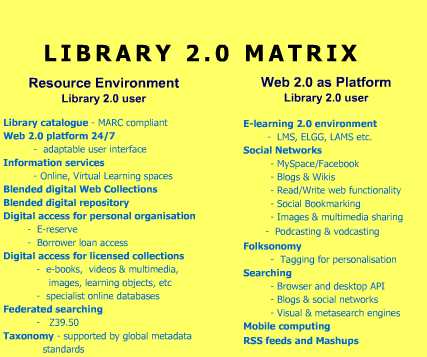
As part of my thinking about Library 2.0 frameworks I put together the Library 2.0 Matrix.

Library 2.0 Matrix

library20matrix.jpg

Web 2.0 as platform

Vision is one thing, but getting down to it and doing what’s needed to unite 32 local authorities to create a fully authenticated national learning community is quite another!

The latest podcast from John Connell says it all! In addition to describing the growth of the Scottish Schools Digital Network and its next phase of implementation through GLOW, we are given an execellent overview of social software, purposeful learning, current technology developments and future capabilities of “Web as platform”.

….the time will come sooner or later where all I will need to be fully productive will be a number of browsers, possibily just one, the device interface itself will simply be the browser.

Tracking the seemingly daily developments in web apps it is easy to see this ‘future’ rushing towards us. However, John’s observation that Web as platform will contribute most to closing the digital divide is of particular interest and worth hanging out for.

With bandwidth and infrastructre costs, coupled with problems of distance, Australian school communities will be real winners in this new environment. But for now Australian school systems struggle with delivering standards that match the SSDN and GLOW developments. While individual schools have faced the challenges head on, and systems have done various things in different parts of the county (some very effective), the country as a whole will find it very difficult to match the Scottish initiatives for quite some time.

This podcast is well worth a listen!