About Judy O'Connell

Educator, learner, blogger, librarian, technology girl, author and consultant. Transforming education and libraries. Innovation for life.

Library 2.0 and Books of the World

Due to the google-ification of the world's collection of books, we are going to find ourselves in a very different space in terms of books and reading some time in the not so distant future. No, I don't advocate getting rid of books – there is something very portable, tactile, personal and relevant about an actual copy of a book. But we do need to think beyond book too.

Changes in the book-landscape come together in a series of recent posts and messages that are related to books.

Will Richardson's post about his book Blogs, Wikis, Podcasts and Other Powerful Web Tools for Classrooms (love that book!) is worth reading just to see what he is cogitating. What will he do about his next book?

Then we have Michael Stephen's message about the iPod program at St Joseph County Public Library.

" The library will begin offering downloadable audiobooks on iPods beginning Fall 2006! Bring in your own iPod or check out one of the library-owned iPods. We’ll download bestselling audiobook titles from the iTunes Music Store for use on your MP3 player, laptop, or in your car."

Last but not least from InfoBlog we have Michael Cart talking about the future of books. The 15-minute podcast looks at the New York Times Magazine article from May 14 entitled, "What Will Happen to Books?"

His unique perspective as an author and librarian brings an even-handed perspective to the controversy surrounding the "google-ification" of books and what impact this may (will) have on our current ideas of intellectual property.

Some food for thought!

Social software and learning

A quick post from the Information Literacy Weblog alerts us to an interesting report from Future Lab:Social software and learning. FutureLab stands apart for the level of innovation in their work in education.

This paper is one of the best papers I have read about social software and learning. The issues raised are significant, and grounded in the understanding that there is "a shift in the nature of knowledge and how knowledge is being created and organised." There are "new ways of working, living and learning outside of school. We see the emergence of new forms of interaction mediated by technology." As is to be expected from FutureLab, the paper is comprehensive, easy to follow, and for those new to the ideas, the paper provides explanations of the terms, commentary, useful links & references.

back to homepage

Link to FutureLab and the publication here.

Wikia looks like happening

Gil Penchina, previously eBay’s Vice President and GM of International, is now the CEO of new startup Wikia.

Wikia is the for profit sister site of Wikipedia. Where Wikipedia focuses on verifiable facts, Wikia is all about opinions – travel guides, political opinions, whatever.

See? Social networks are everywhere!

Learning is essentially a social activity

I am not keeping up with the things I want to communicate and discuss with my colleagues, and it will get further behind as I head to the UK and Portugal to engage with colleagues involved with school libraries from around the world. However, just this fact of going and working with people – hands on – to explore new options and to savour old options reminds me that learning is essentially a social activity. We learn when we enjoy. We learn when our minds are challenged and piqued with curiosity. We learn when we laugh. We learn when we feel a sense of success and accomplishment.

We do all these things in all sorts of places. I will do this when I meet with my international colleagues – and continue to do this when I communicate and share with them via webspaces, skype, and any social networks I can get my hands on to.

To learn is to engage and develop as a person within and as part of our social framework. Ultimately, it's not just about skills and competencies in isolation, but about skills and competencies within the greater context of our global society. The reality is that the web environments of social networks are very empowering when utilised to develop ideas, share resources, hone knowledge and empower creativity.
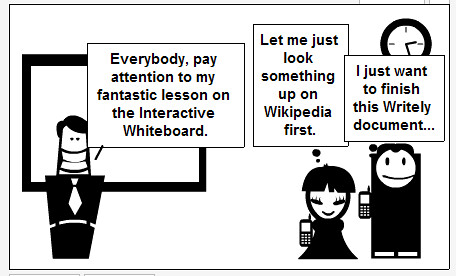
What is it about the social institution that is 'school' that doesn't quite work for our students? What are we doing to support learner groups to connect in virtual environments – a natural extension of life for 'millenials'. How do we create a learning framework that is real, physical, virtual – even visceral? How can we help our students NEED to learn?

Information fluency is understood by our students, engaged with as a natural choice, and unfortunatley seen as something other than what they are expected to do/enjoy/learn/create at school. As educators we are beginning to discuss these issues. Great! Some have grabbed these issues by the throat and have been working with them for months, and even years. Overall though, as a educators, we are just waking to the urgency of social networking. We have to talk about this.

A recent message from Stephen Abram, SirsiDynix Vice President of Innovation, really weighs in on these issues, and provides a list of social websites that he talks about. In particular he tries to focus on what libraries can learn from MySpace. You can it read it here in the SirsiDynix OneSource monthly e-Newsletter. Actually, many of the papers he writes are great food for thought.You can access other issues and subscribe here. I have Stephen's Lighthouse blog in my blogroll.

Social Software and Web 2.0

Today I had fun working with a small group of teachers, in a workshop simply called  "Introduction to Blogging". This was intended to help people think about, and be confident enough to go back to school and get involved with blogging.

It's great to see teachers and teacher librarians volunteering to
come and learn these things!  With this training, and with those
who have already got their blogs under way, I am seeing a wave of interest in blogging and other social software.  After my presentation at the last large network meeting, I am finding others with whom I can talk about blogs, news feeds, tagging, flickr, de.lic.ious etc. 

Nice to know we have begun  thinking about and working with social software – and started to do new things. In this context I would highly recommend the article by Brian Alexander that appeared in Educause Review  Web 2.0: a New Wave of Innovation for Teaching and Learning?  Vol. 41, no. 2 (March/April 2006): 32–44.  You can read this online here or download the pdf file. Though written for the Higher Education sector, the article provides a comprehensive overview of social software and Web 2.0, and asks some challenging questions about the implications of these developments for education.

"The term is audacious: Web 2.0. It assumes a certain interpretation of Web history, including enough progress in certain directions to trigger a succession. The label casts the reader back to Sir Tim Berners-Lee’s unleashing of the World Wide Web concept a little more than a decade ago, then asks: What forms of the Web have developed and become accepted enough that we can conceive of a transition to new ones?"

Grab this article and check out the other issues for more treasure.  

Its just an “Interactive Whiteboard”!

I've had some experience with interactive whiteboards both in the classroom and for professional development. I know that there are plenty of teachers who are taking this technology 'on board' (excuse the pun) and finding very good uses when working with students. Many more teachers are still hankering for a 'piece of the action'.

Nice – but not enough. I have had reservations about the whole 'enthusiasm' thing. It is great to have good technologies to work with. I know the benefits. But lets keep the whiteboards in perspective. It is critical that we do not take Whiteboards as THE solution for providing engaging technology learning experiences for students. It's as if the Whiteboard is THE solution. Big sigh of relief – we are keeping up with new technologies!!

In my view it was just one bump on the rollercoaster ride of our teaching and learning journey. I don't want to dampen the enthusiasm, but I do want it kept in perspective.

So it was great to read the post from New Zealander Leigh Blackall, where he picked up the long reflective piece from Australian educator Graham Wegner . As Leigh says, the graphic sums it up – for me too! But better still, read the whole of Graham's reflection here. Graham is responsible for IWB implementation at his school, but as he explains, he is not a blind advocate.

More on the Learner as Network

If you haven't found it already, then you need to read the post and comments on this topic at Weblogg-ed. Read Will Richardson's post here.

Getting Social – Creating an effective adoption strategy

For local blog learners, this post from Ewan McIntosh is worth a look:

If you have a suggestion or success story of implementing social software (blogs, wikis, podcasts) in your area or institution please do share it on the wiki.

Check out the wiki – but better still, add edublogs.com to your regular reading list. If you need information on issues, approaches, ideas, or changing directions and opportunities with social software, and you want to know what the leaders in the field are doing – you can't do better than the Scots on this one!

I've also had some conversations with teacher librarians in recent days about MySpace and Bebo, and what they are saying to their students who are spending time on these social spaces at school. Questions are asked about 'what' students are doing, and with whom they are interacting. One reply was 'I have been to a lot of schools and I like to stay in touch with my friends'.

" In school, though, in a classroom there is far less choice as to whom you connect to, so groups perhaps reflect more diverse types of person. But is it education's job to wade in here and try to help students better decide how they use their social space, what information to share, how to use it to learn?"

Read the rest of Ewan's comment here.

The Learner as Network

A post on Will Richardson's webblogg-ed brings home the critical issues central to the whole debate about 'futures' in education. The learner has always been considered central to the education enterprise, and in a constructivist sense the learner is the creator, shaper, and manager of learning experiences. Translate that into the world of ICT, and you get education being 'delivered' with different IT tools, exploring new and/or different ways to allow students to engage with ideas for the creation of new personal knowledge.

Sound good? Many schools think so, and in some cases are appointing people into a position that might be a Director of e-learning (or similar). e-learning what? how?

What then about the socially networked world of our students? Aren't they busy e-learning without any help from their teachers?

Will comments on how far we need to go:

" We are still about control, not sharing. We are still about distribution, not aggregation. We are still about closed content rather than open. We are static, not fluid. The idea that each of our students can play a relevant, meaningful, important role in the context of these networks is still so foreign to the people who run schools. And yet, more and more, they are creating their own networks, sharing, aggregating, evolving to the disdain of the traditional model of schooling that is becoming more and more irrelevant.

Read the full post here. My concern is that educators need to understand (if not adopt) the ways of networking that permiate the lives of students. Also,what we need in our schools or educational institutions is someone who can 'direct innovation'. This is vital to ensure that a true blend of tools, techniques, processes, and thinking strategies can happen. Who can bring a broad curriculum understanding to integration of ICT and social networks, as well as promote and develop literacy for reading and relaxation as well as communication (essential for metacognition and learning), plus embed knowledge techniques for information search, analysis and sythesis? If the position criteria are any guide – what we now need is a Director of Innovation. This is not an IT leader, or teaching & learning leader, or curriculum leader, or information services leader. This is new, and this is important!

We can no longer afford a silo mentality. We need a genuine innovator to remix a new learning framework for our students – within a school that is remixed in shape and style to accommodate "the learner as network".

Social Internet = Web 2.0

At an inservice some weeks ago, a group of us shared ideas about changes in the digital envirnoment of our students that is impacting on their lives – and which must be understood by educators if we are to adapt our teaching to include more collaborative tools.

Our introduction to Web 2.0 was designed to alert our teachers to a different web world – well beyond the comfortable world of websites and smart searching of the internet. We provided this summary sheet of these ideas to encourage them to do a bit of looking. I admit, we could have created a Lense in Squidoo – maybe next time!

Web 2.0 is an 'hot topic' in the blogosphere – but is not yet a hot topic in your average school. Just today I came across yet another forum being promoted amongst our schools –Learning in an Online World.

Quite correctly the promo considers many changes that have occurred since 2000, and states that "Major challenges still exist. Continued collaboration and sharing and best practice is crucial to achieve our shared vision of all schools confidently using ICT in their everyday practices to improve learning and teaching."

This forum will certainly showcase some interesting things – because so many teachers and schools still have a lot to learn about the potential of Web 1.0 technologies. However, as far as I can see there is nothing Web 2.0 about the Forum. There is no obvious reflection on the digital world of our students, nor the use of Web 2.0 technologies for social networks, and supporting teaching and learning. Of course, these concepts may emerge within presentations.

Somehow I think that much is being missed in a forum which is discussing learning in an online world. While some very important things will be covered, there is just so much more to consider than learning management systems (MyInternet), electronic whiteboards, video editing, learning objects, Kahootz, ipods, wikki versus Britannica (ho hum! I wonder how up-to-date this presentation is?). The focus is very much on tools to use, rather than ways of thinking and operating in a socially networked world.