Participatory networking – an eye on Twitter and Jottit!

I’ve enjoyed my week at the NavCon2K7 conference, where I am pleased to see that we some workshops showing people how to engage in participatory networking – cool tools for cool news and professional interactions.

It was a real buzz to find that Heyjude was being used as part of a demonstration workshop about setting up iGoogle. So nice to meet people who read and enjoy this blog, or share in the Heyjude del.icio.us network. It was great that Leigh showed folks how to get into Facebook – because it has already expanded the conversation spaces amongst my colleagues.

But it’s what I learned from Lenva that excited me – a new strategy for ‘working’ a conference to share and collaborate! Here’s the story……

Amongst other things, I used Twitter to tell my professional network a bit about what was going on at the conference. Because I mentioned Twitter in question time (posing a question to Leigh from the twitterati, as well as from myself) Lenva discovered me and we became ‘friends’.

Lenva and I both posted links and comments to Twitter while Adam Lefstein was presenting his Keynote address. Lenva Shearing is a Principal who passionate about learning. Some of Lenva’s school team were attending the Ulearn conference in NewZealand at the same time – so the twitter conversation between them was showing up in my Twitter feed. She was actually participating in what was happening in NZ, while they were participating in what was happening in Sydney…….and I was becoming a bit of an observer. 🙂

But here’s the best tip of all. Lenva and other colleagues were taking notes (as lots of us were). The difference? Forget scribbling with a pen, writing a word document, or composing a blog post. Their notes were immediately shareable with each other via twitter or their blogs using Jottit.

Check out Lenva Shearing and her notes from Adam Lefstein and others (which she posted up on Twitter almost as soon as sessions were over) and Allanah’s Note page which she was using to share her Ulearn conference experiences. Ewan McIntosh and Leigh Blackhall would be proud of them all! Right? Now if only I had been at the Ulearn conference amongst such a buzz.

As for Lenva? – what a fantastic Principal – leading, doing, and engaging everyone – participatory networking bringing life to 21st century rhetoric.

Image: Mon Oeil
  • K12 Online – the conference is coming!

    The 2nd annual K12 Online virtual conference is just about a month away. The 2007 conference is scheduled to be held over two weeks, October 15-19 and October 22-26 of 2007, and will include a preconference keynote during the week of October 8.

    The conference theme is “Playing with Boundaries.”

    Make sure you attend, or attend the conference archive. The event is completely free. Important thinkers and dreamers and practitioners will present. Connect yourself with their visions of how our schools are evolving, how learning is changing.

    The presenters this year have been invited to create short, online videos (published to a website like YouTube or TeacherTube) which will give attendees a better idea of what their presentation will address. These videos provide a fabulous way of deciding which presenters to listen to first! Check the blog out now, and you’ll be in for a treat!

    Stay in touch with the lead-up to the conference by following the K12 Online conference blog, and enjoy!

  • Google docs in Plain English

  • Cool class project

    I’m really enjoying reading The Thinking Stick at the moment, mainly because Jeff pushes the boundaries non-stop. I love these thoughts from I don’t want to integrate it, I want to embed it.

    What I want..is technology to be embedded into the classroom. Into the learning environment. I am tired of trying to integrate it into a process, a classroom, or a curriculum that was never made to integrate technology to begin with.No, what I want is to start at the very bottom and embed technology tools, skills, and standards into lessons, our classrooms, and our outcomes……What if we truly acted like technology was just part of us, part of education, part of educating students today. What if we start embedding it and stopped integrating it?

    Jeff models this every day for us. What about this coll class project – Teen Tek.

    Perhaps you have some teens who would enjoy this too. Or perhaps you can adapt this idea for your own students in some way.

  • Want to collaborate?

    From the Skoolaborate project comes another useful tool for planning and collaboration.

    Check out FlashMeeting – the simple meeting tool that works in a web browser.

    Westley advises that the interface can be learnt in seconds and is incredibly intuitive. Basically you get to see all your friends faces as they connect, you can text each other in a common window and one person at a time can speak. Should they say something that requires your comment you can ‘put your hand up’ (indicated by an hand sign) and when that person stops speaking you will pop up on screen and have your say. Really it does this and so much more but I will let you explore – Just take it from me, there is nothing better.

    Seems like a good option when you need to move beyond Skype conference – but don’t want to dip into more robust (or pricey) products.

    But wait! there’s more….from Jeff at The Thinking Stick who has written about WizIQ in WizIQ and a twitter experiment.

    Jeff gives a full run-down of the program, and I am pleased to see that it includes video, whiteboard, file uploads, and the capacity to record sessions. While Jeff lists some negatives, it certainly goes well beyond the capabilities of FlashMeeting.

    The thing is, of course, to choose the appropriate tool for the task. 🙂

    Now, go test…..

  • Top 100 tools for learning 2007

    Jane’s E-Learning Pick of the Day is a ‘must read‘ to add to your RSS feeds.

    She gathered people’s favourite Top Ten Tools for Learning from 100 educators around the globe. Over 400 different tools were named in total, but the final list was created in order of popularity. The top 100 tools received 3 or more (positive) mentions. The results can be seen here in a neat comparison table with links to sites providing the tools.

    It’s a great resource for anyone looking at their knowledge working environment and wondering where to improve.

    Choose several different tools to get things done in your knowledge working landscape – tools for gathering, processing, networking, sharing, and scheduling because Learning is a Conversation and learning (not schooling) is our context.

    Photo credit: Sweet reality, sweet fantasy
  • Classroom 2.0 review and Second Life

    How can I resist sharing Dean Groom’s reflection on his Classroom 2.0 experiences in his Term 3 Reflection Time. It’s a ripper read.

    He talks about the changes his students have experienced, and changes in his own style of professional learning.

    The way to look for these is from your peers outward. I kind of see each of the people I’ve connected with (or aligned myself with) as a a little whirlpool, each sucking in information and experience. I now look at the whirlpools first. Before I looked at Google.

    I’m happy to be part of his whirlpool!

    Dean is a member of the Parramatta Learnscope Team – who are engaged in a project with NSW Learnscope.

    At a workshop today he shared his experiences with us – he’s ‘upgraded’ his classroom, developed a Web 2.0 toolkit, and learned to move more effectively into the student’s learning mindset.

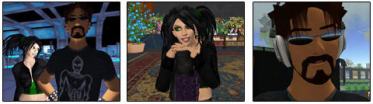
    Guest of the afternoon was Sean FitzGerald, who talked to the group about Second Life. Jo Kay and Sean do a lot of fabulous work with Second Life in Education.

    jo_sean.jpg

    Sean went so far as to mention machinima and it’s place in this brave new world.

    Machinima is perhaps the extension of this newer wave in education. Digital movies made in online virtual worlds seem to be ‘the next big thing’ in youth created content these days.

    For the uninitiated, machinima (muh-sheen-eh-mah) is filmmaking within a real-time, 3D virtual environment, often using 3D video-game technologies.

    Machinima extends far beyond media creatives and youth though…With ‘Machinima for Dummies’ hot off the press, the first European Machinima Festival kicking off in October, and YouTube screening of the Global Kids’ year-long machinima project A Child’s War.

    The video is based on research done by the youth about the situation of child soldiers in Uganda and the upcoming trial at the International Criminal Court.

    You can watch their earlier piece about digital media and youth here and read the youth leaders blogs here.

    3-D platforms like Teen Second Life (13-17 year olds) open up new ways of learning, identity exploration, behavioral experimentation and self-expression without stumbling into dicey terrain ‘outside the grid’ in SL’s larger virtual world.  This makes initiatives  such as Skoolaborate possible.


    Hello to all the students :-)

    OK, I have to admit, this is spooky.

    I am sure that Will, or Ewan, or Michael or Sue are used to using their blogs (or having their blogs used) as part of a program of study at various university or other graduate education courses.

    However in the last 6 months I have noticed the odd link to course programs etc. in the backlinks to Heyjude. Amazing I thought! Even more amazing when a friend forwarded a copy of their uni assignment to me – a review of HeyJude 🙂

    But in the last few months things have been getting busier, and recently there has been a bit more of a flurry.

    So R U in ED2203?

    I’ve read some of your work, and seen the interesting Web 2.0 tools that you are being asked to investigate and discuss. It’s great to see Web 2.0 getting into uni programs. But I am wondering how much depth is being applied? Who teaches you ‘power’ use of Web 2.0 tools?

    I’m alluding here to what I think is the same problem that we face helping our teachers in schools learn about Web 2.0. In the beginning it is always just the basics – and often I find that that is where many teachers seem to stay – missing the full potential for supporting learning, because they can’t get there themselves, and their is no-one to guide them.

    What we need is a TeachMeet07 of our very own to “Learn something new, be amazed, amused and enthused”. The Scottish model seems a great one.

    Who can take up this challenge?

    “Unlearning” and the future of education

    In my workplace we are undergoing a sort of major change as the leadership work to shape a new direction for the learning frameworks in our schools. I’m pretty keen on seeing these changes. Recently, at a two-day workshop, we heard some great stories from three schoosl – Unlimited Paenga Tawhiti, Summerland Primary School, and North Loburn School, all in New Zealand. Nice one Vince, Luke and Mike! Personally I would like to hear more from Australian schools, and Australian teachers. I know we have some fabulous innovation going on right here in Sydney……..but?

    Never mind – the global collaborative to the rescue (no business flights required)

    A post in the social networking site Classroom 2.0 lead me to the Map of Future Forces Affecting Education from the KnowledgeWorks Foundation and Institute for the Future 2006-2016. Check it out or grab the pdf, and then think about what you’ve seen on the map and discuss it with colleagues.

    Will Richardson wrote recently about The Steep “Unlearning Curve”, and lists 10 things we need to unlearn to make ‘future’ schooling come to life. What Will talks about resonates with us all who are trying to create a shift in the way schooling happens. It IS about seeing the possibilities.

    The “aha” moments in life delight us. We suddenly gain an insight, experience a profound joy, or realize something important for the first time. That’s learning! That’s why we have to push further into the future of learning than our NZ colleagues took us recently.

    How far and fast we can go is picked up right here in Sydney by Westley and his MLC girls, busy building Skoolaborate in TeenSecondLife.

    This for me is real innovation, and leaves our NZ colleagues for dead. Me? I wish!

    BlogDay 2007 from Downunder

    Today it is BlogDay!! an event to foster more connections between bloggers and a way to get to know other bloggers with other interests from other countries.

    Thinking about the global context, I thought to myself “if there is only one blog from the whole world that I am allowed to read for the next 12 months what would I choose?”.

    Without hesitation, my choice was John Connell, because he keeps me in touch with a diversity of things – culture, history, society, philosophy, technology, news, ideas, creativity, and just good fun. Thanks John.

    However, since I blog downunder right here in Sydney Town, I’ve decided to highlight 5 blogs (so hard to choose!!!) from Australia rather than other countries, to promote our emerging culture, point of view, and attitude in the global conversation, and to say ‘thanks’ the the aussie bloggers that I have added to my reading list this year!

    Drop by (if you haven’t already) and enjoy the read.

    Sue Waters at Mobile Technology in TAFE has done a stunning job promoting mobile technologies, e-learning and m-learning tools and strategies, is always investigating new and challenging ways of incorporating Web 2.0 into the education experience.

    John Pearce at My Other Blog teaches in a primary school in Victoria, but his work draws on the global conversation to drive his thinking and practice in his own school. As John says, the whole Web 2.0 scene is moving so rapidly it is only via that web itself that you can hope to keep up.

    Melinda Phillips at The Parramatta Learnscope Team blogs with a special purpose – to challenge her project team to explore Web 2.0 for professional learning and teaching in a ’21st century’ way. Great guidance and good reading. Melinda is a great person to work with 🙂

    Chris Betcher at Betchablog teaches in a school in Sydney, does great professional development sessions, and runs From the Virtual Classroom podcasts which are a bit of a hit.

    Cindy Barnsley at Thinking 2.0 teaches in country Australia and dreams (and writes) about technology to enhance students’ learning, with a focus on blogs, wikis and digital storytelling. I love her quote that drives her blog:

    The illiterate of the 21st century will not be those who cannot read and write, but those who cannot learn, unlearn, and relearn.” Alvin Toffler

    There are MANY blogs in Australia and the world that we all love dearly. I couldn’t survive professionally without them. THANK YOU 🙂

    Technorati Tags: