New twist on ‘digital’ (library) books!

book_atm.03.jpgSomehow I missed this in the media – An ATM for Books from CNN Money. We’ve had various ways of getting books printed and into our hot little hands ready for the next comfortable read. But I bet it will be a while before we see Australian libraries have one of these ‘little beauties’.

The Espresso – a $50,000 vending machine with a conceivably infinite library – is nearly consumer-ready and will debut in ten to 25 libraries and bookstores in 2007. The New York Public Library is scheduled to receive its machine in February. The machine can print, align, mill, glue and bind two books simultaneously in less than seven minutes, including full-color laminated covers.

For me, this is the perfect blend between the new and the old.

However, that’s not all there is to the developments in the ‘digitisation’ of books.

THE BRITISH LIBRARYThe British Library has also been hard at it in the Turning the Pages 2.0 project! Turning the Pages 2.0™ allows you to ‘virtually’ turn the pages of the library’s most precious books. You can magnify details, read or listen to expert commentary on each page, and store or share your own notes.

Clive Izard, Head of Creative Services at the British Library explains how itcliveizard.jpg works in a small video clip. The value of digitisation that makes books accessible for reading AND research cannot be ignored – particularly when the technology is shared beyond the application of rare books.

How this compares with Google’s digitisation project, I don’t know. Perhaps someone can provide more information on that.

Work like this reminds me why I like the British Library ……… and I’m pleased that I have my own borrower card! Shame it expires in July and that I can’t be there to renew it!

Libraries on the Pillars of Web 2.0

From Information Today:

FEATURE
Building a Library Web Site on the Pillars of Web 2.0
by Karen A. Coombs

Web 2.0 is often defined by the technologies that are part of it: social software, Weblogs, linklogs, folksonomies, wikis, podcasts, RSS feeds, and Web services. Because of this, some see Web 2.0 as merely hype. However, if you examine the technologies to see what they have in common a pattern emerges. “Web 2.0” is transforming the Web into a space that allows anyone to create and share information online—a space for collaboration, conversation, and interaction; a space that is highly dynamic, flexible, and adaptable.

Further discussion and reading led me to design six pillars of Web 2.0 that we wanted to use as the foundation for rebuilding our library Web site. These six pillars are as follows:

1. Radical decentralization
2. Small pieces loosely joined
3. Perpetual beta
4. Remixable content
5. User as contributor
6. Rich user experience

This paper is an interesting analysis of the Web 2.0 thinking in the re-design of the University of Houston libraries.

I like how they have Subject Blogs.

The [library] world is flat – too!

We have a central library catalogue (SirsiDynix Unicorn) serving 77 schools K-12 plus some specialist libraries, which allows for individualisation and sharing of information – we can search our own library or all libraries across all our schools as well as the specialised support libraries.

Unicorn’s architecture makes it easy to change databases and to implement new functionality. We have ‘content enrichment’ – book jackets, reviews, teacher notes and more also added to our basic catalogue. We could extend our services to include electronic packets (learning objects) and electronic files, provide federated searching of our resources, which includes an excellent range of subscription databases such as Britannica and EBSCO.

We could launch an enterprise portal solution, or implement any number of excellent options that SirsiDynix offers to revolutionise access to digital knowledge resources, as well as bibliographic resources.

At this stage, we have not rolled out the really effective enhancements that makes this system of delivery revolutionary…….. information anywhere, anytime.

We ‘stand out‘ in the school library sector in Australia for having implemented this system – yet we are hindered in making further developments because ………the potential of the innovation goes unrecognised! Urrrrggghhhh – so frustrating! Such Web 1.0 thinking. So yesterday!

The Information Network for Ohio Schools has done much of this, and is worth exploring to see some of the possible ways of supporting learning and teaching across schools.

I am delighted that at least a public library in Australia is leading the way in Web 2.0 using the same platform as our own (Unicorn), though obviously for a much smaller group of libraries.

The SirsiDynix WebSeminar “Hopping into Library 2.0: Experiencing Lifelong Learning” will be presented by Christine Mackenzie —Chief Executive Officer, Yarra Plenty Regional Library, in Melbourne, Australia. She will talk about why they decided to implement Learning 2.0 and how this has equipped them to get bold in their thinking about social networking. They’ll discuss 4 themes for their Library worker 2.0 staff development program in 2007 – getting information, enabling learning, creating content and celebrating culture; and how they are encouraging an environment of lifelong learning within the organization. Grab the podcast if you can’t join in the conversation. Of course there is also an excellent Yarra Plenty Library Blog, currently promoting great summer reading.

Singapore National Library shows an interesting MashUp with BookJetty. Some nice Web 2.0 enhancements, and a curious blend with Amazon. Can’t borrow the book? I guess you can buy it! My test searches provided pretty interesting results – in some cases, only providing Amazon information. Port the same search across to WorldCat – and get a very comprehensive result – all the information leads you could want for collection development, research sources, or unusual collections. Why not put the WorldCat search box on your site?

In terms of nice innovation, I love what MIT libraries have done! MIT Libraries now have RSS feeds for new additions to their catalogue.

Of course, they have lots of other nice things too, but RSS feeds for new resources is a cool Web 2.0 touch for keeping informed!

Technorati Tags: , , , , , ,

The value of knowledge!

I spent today, Saturday, at The Kings School, working closely with professional colleagues from the School Library Association of NSW, doing some strategic planning for 2007 and beyond.

ASLANSW Planning DayOne way or other we covered a lot of ‘territory’, driven by our need to respond to the constantly changing landscape of learning of students, and the needs of ‘school 2.0’. Admitedly we didn’t actually use that term all day, but School 2.0 was actually what was pushing the strategic planning. Amongst other things, the results of our planning saw professional development initiatives for 2007 that have a strong digital and Web 2.0 focus, alongside literature and learning.

We spent a lot of time talking about ‘knowledge’ – including knowledge access, knowledge creation, learning networks and connective knowledge. Knowledge will underpin our future thinking and planning and I am planning on writing a paper on this topic in the coming months, and plan to deliver a presentation early in 2007 on a ‘knowledge commons’ as the new direction for blended learning – merging school libraries further into the main knowledge work of a school. We need knowledge specialists to support knowledge processing (finding, thinking, creating), not librarians shelving books or recording videos.

After the action research I undertook this year in 5 schools on digital learning I am as convinced as ever that teachers and students can benefit from a ‘knowledge expert’ at the school. (The results of this research will be published in 2007).
In addition, we will be responding to the NSW Board of Studies HSC: All My Own Work program that is designed to strengthen the capacity of HSC students to follow the principles and practices of good scholarship, including understanding and valuing ethical practices related to locating and using information as part of their HSC program.

The program has been developed as part of the NSW Government’s Respect and Responsibility strategy and complements other approaches such as brochures for teachers, students and parents and strengthened student and teacher declarations for the HSC. The HSC: All My Own Work program is integrated with other NSW syllabuses and programs. The program is designed to be delivered flexibly as self-paced learning modules, and is now available online for schools, for online delivery, and quiz completion. We will be running workshops in Sydney in term 1, and hope to repeat these in country areas later in the year.

Great day everyone!

Learning! New approaches, new spaces, new tools

Recently we held a 1-day mini-conference looking at the issue of learning – in new spaces with new tools. Our keynote speaker, Leanne Cameron from the Teacher Education Program Instructional Technology Centre, Macquarie University , presented some thought-provoking ideas about kids learning, and the changes they have made in adapting to the learning modes of digitally native tertiary students. Changing Learning space design, incorporating digital tools, and a 24/7 approach to learning was what it was all about. Of particular interest was the physical changes of classroom environments and resulting assessment tools – e.g. use of chat as an assessment tool.

Even just one example shows the changes possible if we use web 2.0 tools in a blended way to support learning.

For instance, running chat discussions and learning frameworks via the LAMS system, offered innovative opportunities.

..three chat sessions of the prescribed readings accounted for 20% of the total marks (and will be lifted to 25% in 2006); authoring of a LAMS sequence was compulsory, but marked only as pass or fail, with an accompanying analysis and reflection of the pedagogical design worth 35%.over a topic allows remote access, and for the teacher leader, provides a ‘transcript’ of conversations far more powerful than the usual groupwork method – particularly when tied to assessment processes.

Discussion about the changes needed in creating a Library 2.0 environment was the natural extension of these changes being noted in student learning needs.

In the blogosphere these conversations are being had all the time. I recently picked up the Conversation about the Future of Libraries from David Warlick – check out the podcast and circulate it to your colleagues. We need to keep this conversation happening.

Leanne also showed us the future automated system at Macquarie uni library for storage and delivery of books. Remember the old stacks that postgrads used to use? Catch the concept at Sonoma University Automated Retrieval System. The retrieval system provides quick access to an additional 750,000 items housed in a three-story, computer-managed shelving system located within the library building.

So where does that leave us with information management? and access to knowledge repositories? and building wise connections from what we read online or off, and as we engage with others?

On this topic I was much taken by Dave Pollard’s Adding Meaning and Value to Information. Let’s take it from another angle – the real world rather than the school world that educators seem to live in – though not our digitally native kids!

He shows us a great table exploring how we make what is written down more meaningful, more valuable. Whether online or off, this is what it is about isn’t it? He then draws an example of the cognitive and metacognitive pathway of that process.

Finally he says:

The great challenge in this task is enlightening management — the majority of executives still seem to see IT as a means to disintermediate information and get rid of the Information Professional role entirely. It has been my experience that no one in the modern organization is as under-utilized and under-appreciated as the information professional.

OK – can you hear the highly relevant echos of this sentiment in our schools?

Web 2.0 to Library 2.0 – the next publication

PART 1

Earlier in the year Part 1 of a two-part series of papers was published with the title Engaging the Google Generation through Web 2.0. This article was just a small effort on my part aimed at introducing teachers and teacher librarians to the world of Web 2.0. It has worked quite well for introducing newcomers to Web 2.0. I have seen copies of it with highlighter pen marking key concepts and places to visit. I have had people come to workshops and sessions with their well-thumbed article ready to learn more.
Part 2

Now Part 2 has arrived Engaging the Google Generation through Library 2.0. Perhaps it has something to offer you as well.

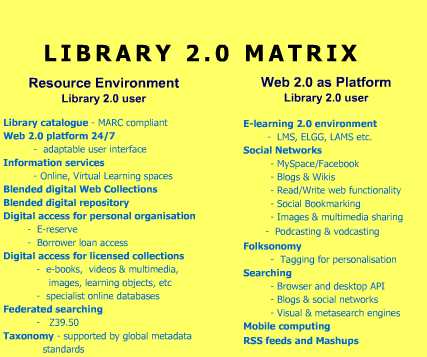
I was not as happy with this paper, but writing it inspired the Library 2.0 Matrix. I will have to update my Matrix on Flickr now to reflect the version presented in the article. The pace of change means that anything we read these days needs to be sifted and sorted for ideas – so I guess it’s your turn to sift right now 🙂

There are points in the article which are not correct. The editorial addition of the SCIS (Schools Cataloguing and Information Service) website review is confusing and misleading. I suspect that the writers of the review of the Second Life Library 2.0 blogspot didn’t quite understand what they were writing about. The blog is now at InfoIsland, and is a great place to get an overview of the action in SecondLife even if you don’t yet want to go into the 3D world.
Delany Library’s Delicious account is a good example of how one of our teacher- librarian is making use of the social bookmarking site to hook teachers and students into Web 2.0, as well an ensuring currency and relevancy of her library services. But it is not a ‘blog’! Sorry.

Anyway, you might find something of interest in the article, or you may like to circulate it between friends or colleagues. Enjoy!

Shifting technologies

So back to the idea of the telephone or the printing press as change agents. A post from Stephen’s Lighthouse on The Primary Web Device provides some growth figures on mobile phone consumer technology.

He quotes from The Register 

The cellular industry took 20 years to reach one billion connections, three years to reach two billion connections and is on target to reach its third billion in a period of just over two years,” Wireless Intelligence director Martin Garner said. “Worldwide growth is currently running at over 40m new connections per month – the highest volume of growth the market has ever seen,” he added. According to Garner, most of the current growth is coming from emerging markets with low levels of penetration, rather than from mature regions such as Europe.

Stephen covers some cool ideas in what this means for libraries. Bit different to our schools where mobile phones are usually seen as something to be locked away or banned.

His last two questions are the best. Are we preparing for new software and device modalities? Are we in K-12 prepared for the largest generation in history – with phones attached?

Frankly we have hardly begun to think this through. Will the next 12 months see a bit of a shakedown in some schools? I have had a secondhand report today that one of my Teacher Librarians is preparing to embark on a metamorphisis of her library, and in addition to reconfigurine learning spaces she will add mobile devices into the library device pool. Excellent. Let the experiments and lateral thinking begin!

What we are doing is creating a learning community. We do this by using Web 2.0 tools and a social constructivist approach to learning. Jo McLeay asked How do we know that blogs and podcasts improve student learning? The comments are well worth a read, as they show that it is learning in a Web 2.0 community that works, not technology as tool – which is what Web 1.0 was all about and which is where many of our teachers are still.

John Connell pointed to Don’s Blog and and his comments about his son’s Study Blog. His son Lewis’ learning community extended beyond his school leading to be a very productive learning experience.

Lewis received his first comment on a blog post yesterday from someone in Dublin, Ireland, in connection with a post he had put up about Proportional Representation. It’s made a real impact as he now realises there are people out there are reading what he writes. It also helped him to better understand what he is studying.

David Warlik got this feedback from his teachers about Why Kids Blog:

Even when they’re out sick, students work on their blogs.

Carol Barsotti

I’ve got 6th graders coming in during their lunch and after school to add articles to their blog and to respond to their classmates’ articles

Al Gonzalez

My students are floored when, as they say, “some random person from Texas commented on my blog!!” The students are getting real world experience with writing.

Brian McLaughlin

Why would my students want to write on paper for their teacher to see, when they could write on their blog for the whole world to see.

Kathy Cassidy

In fifteen years of teaching, I have never seen anything come along even CLOSE to motivating students to write – like blogging does.

Mark Ahlness

Our learning spaces need to get into mobile technology, mobile computing and social software to engage with the students in their world. From where teachers stand it is all about new literacies and new ways of communicating and negotiating content and meaning.

So back to that mobile phone. Take a read of Smith’s Ninth Grade Blog and To Cell Phone or Not to Cell Phone.

So today I tried something new…I had the kids turn on their cell phones and ring in their answers.

Did you guess what the students had to say about the incorporation of mobile phones into their learning experience?

Ways of learning need to change, and I like to think that the required pace of change is oh so! neatly highlighted by the growth in mobile phone connections.

Metamorphisis of libraries & learning spaces

For some time I have been reading and thinking about the much-needed metamorphisis of school libraries in order to create a fully integrated information and literature learning environment for our kids that is in keeping with our Web 2.0 world. As I have 77 school libraries to think about, the idea of creating that metaphosis is ridiculously exciting and even more ridiculously challenging!

We have significant changes taking place in the various media that drive our social communications – in a range of digital ways. Overall ours is no longer an analogue world, though books in print retain their core place in literacy acquisition and leisure reading. What are your ideas about the changes that are rushing up on us? Whatever you think, I share this comment from an essay on Dead Media from the Sydney Alumni magazine:

The next question is whether these changes are analogous to the invention of the telephone, which changed us a great deal, or the invention of the printing press, which changed everything.

For my schools I have reflected on the need to restructure learning spaces and incorporate a whole-school approach to the traditional library.

The Learning Commons

The Learning Commons has been recognized internationally as an innovative approach in bringing together services that support students in their learning. In the tertiary sector academic institutions/libraries are responding to these same trends worldwide by rapidly developing “learning commons” or “information commons” – areas which are new on-site facilities designed to provide higher levels of technology (hardware and software), access to content (digital and print), and support for users working to access and develop information resources. While some learning commons facilities are in newly constructed buildings, most are renovations within existing or expanded library spaces.

The aim of a Learning Commons is to provide a physical environment which addresses the profound changes affecting how we teach and learn and which complements the evolving integrated, virtual/online teaching and learning environment of Web 2.0, advanced technologies, and Social Networking of the web.

We need to look for new ideas and new ways of working with literacy, information literacy, and digital fluency for teaching and learning. Whether it’s blogs or wikis or RSS, all roads now point to a social network that is collaborative and social in nature. Teaching and learning needs to change just because we have expansive access to a wide variety of ideas, can find and receive information in a way never before possible, and create and share at a global level with transparent ease.

In a newly designed or liberally re-organized and structured school, students can choose to learn in the Learning Common on workstations, on their own laptops or PDAs, connecting to the Internet and Learning Common online resources via wireless connectivity. Learning commons subsets can also exist in other places in the school – depending on how flexible learning spaces are developed.

An integrated approach to Library and Learning Commons

  • reading materials for pleasure or study
  • information retrieval and critical analysis support
  • learning activities
  • social activites
  • academic writing guidance
  • special education learning support
  • information technology support
  • multimedia design centre with Kinko-style production services
  • traditional bibliographic services
  • social networking services
  • 24/7 learning
  • supporting creativity not productivity


A Learning Commons approach ensures a student-centred focus where school structures and technology exist as metacognitive tools, thereby helping learners and their mentors to understand better the processes of learning.

A metamorphosis of the Library into a Learning Commons allows us to include new or different types of spaces, features and services. I see the ‘Learning Commons’ as an approach that will provide an innovative environment to students and staff for accessing educational facilities and engaging in the creative experience of learning.


A framework to think about for Services and Structures

  • ICT and HELPDESK integration and management through Learning Commons
  • Technology integration as part of literacy, information literacy and curriculum and driven by curriculum leaders
  • Integration of new and emerging technologies such as Smart phones, tablets, PDA, podcasting, and active use of social software (wiki, blogs, flickr, RSS information distribution).
  • Provision of literacy and learning support
  • Fiction Collection for provision of resources for reading for pleasure and improvement
  • Online digital respository of materials and resources
  • Provision of audiobooks on iPods etc
  • Provision of a digital design studio facilities for multimedia and print output.

If you have some ideas or success stories, or good articles on the topic, I would love to know more.


Library 2.0 meme

Thanks to Jan (awapuni) in my del.icio.us network for alerting me to this very useful Library 2.0 meme from bonariabiancu that presents another (better!) view of the ideas that I put into my Library 2.0 matrix in the last post.

Puts people at the centre of a very socially-networked library, with full flexibility in access to ideas and information – and of course my ‘bee in a bonnet’ thing of reading for fun and relaxation. Interestingly neither of us has made a point of including that in our graphical represenations of Library 2.0!

Back to the drawing board for me. In the meantime, here is the Library 2.0 meme map.

Library 2.0 meme

Music inspires Library 2.0 Matrix

I have been listening to a lot of music in the last week, as a way of clearing my mind, and helping focus some ideas that are simmering below the surface. Here’s how music helped me think about a Library 2.0 Matrix………

One old favourite that I had to come back to was Bach’s Double Violin Concerto in C Minor. You can pick it up at uTube just to refresh your mind. This particular performance is not the traditional rendition which provides synergy to my thinking….this is how….

The performance includes a number of greats in classical music performance, and some youngsters as well. I know from my brief skirmish as Manager of the Western Youth Symphony Orchestra that this can be performed with gusto and excellence by youth, as well as masters. In a Web 2.0 world this completely reflects the flexibility of social networking, of flexible approaches to learning, of master and novice working together to create great synergy in creativity in performance.

Likewise the double violin concerto – the way the music unfolds and has two strong roles for each violin, symbolises the complexity and contrapuntal beauty of this music – just the same way that there is an complex and beautiful relationship between literacy and information literacy that underpins the social network world.

There have been many developments in modelling of various literacy models (ditital, social, economic etc). While I have my favourites I need to restate what is somehow being lost in the emerging ‘Web 2.0 as platform’ discussions.

Literacy is a key enabling mechanism for information literacy, creativity, knowledge creation and human communications.

Being able to read, and to think more deeply due to the ideas that we have contact with through reading has made the developments possible in our Western and Eastern civilisations. Ideas are found in written works – wherever and in whatever format they may be. Our kids need to have the opportunities to read, and develop a love of reading for pleasure as well as purpose. Our heart and soul must be found in the creative endeavours of our society – art, music, writing, design, innovation.

So we need to reflect carefully on the new synergy in the opportunities that we have before us. Why am I saying all this? I’m churning ideas about the future of school libraries. Literacy remains a prime and fundamental purpose. Web 2.0 tools and techniques coupled with the trademark ‘social networking’ provides the framework for knowing ‘what’s next’ for organisational frameworks for school libraries in Web 2.0.

It is no longer a matter of guesswork, as we now have enough information about possible futures to blend and shape our new Library 2.0 future.

Chris Harris says:

In its 2.0 incarnation, the digitally re-shifted school library must transcend the physical space to bring services and programming to every student and teacher throughout the school wherever learning is taking place with teacher librarians interacting more directly with students as well as their teacher peers in new spaces.

As part of my thinking about Library 2.0 frameworks I put together the Library 2.0 Matrix.

Library 2.0 Matrix

library20matrix.jpg