
Drawing on a huge collection of book reveiws from around the world, the Critical Compendium represents a great mashup – and a nice idea to emulate for your library! or just use it as it is 🙂
Very Library 2.0!

Drawing on a huge collection of book reveiws from around the world, the Critical Compendium represents a great mashup – and a nice idea to emulate for your library! or just use it as it is 🙂
Very Library 2.0!
Thanks to Media Cafe Polska for alerting me to a neat New Widget Its My News – that thinking laterally, could be an interesting addition to various school blogs, media studies units, literacy units etc.
You can easily select from among 50,000 media sources – newspapers, magazines, blogs, TV and radio, and more – and build your ItsMyNews page, which updates automatically for you, all day, every day. We’ve collected news from all the popular topics in every format: text, photo, sound, and video.
Krzysztof has a good set from ItsMyNews on display at his post on the topic, and has inserted some in the sidebar of his blog. He was also online in Twitter as I was writing this post – BUT I can’t read polish. What a pity!

You’ll find me as heyjudeonline in Twitter or Judy O’Connell
in Facebook.
 We’ve been doing a bit of a ’roundup of possibilities’ in our school libraries, and some of our Teacher Librarians and Technology Co-ordinators have become keen to expand this aspect of their digital services within their schools. For those who are on the same path, I thought I would highlight one of the excellent series of Technology Reports from ALA TechSource.
Author Tom Peters explains that his issue of Library Technology Reports (Jan/Feb 2007), Digital Audio Book Services through Libraries “examines in some depth digital audiobook services that can be purchased or leased. It also looks briefly at a few free online digital audiobook sources.”
I have purchased some of these Library Technology Reports – which for us in Australia are very expensive – and they are absolutely excellent 🙂
However, the good folk at ALA kindly make digital copies available for viewing and download.
View (and then save) your pdf copy here.
 ….. or so Librarian Chick insists. You might like to drop over to the Librarian Chick wiki – where you will find a big compilation of all kinds of resources.
I am particularly interested in the Books and Audio Books section, because many of our school libraries are looking for good ways of integrating digital and audio book resources.

We can play hide and seek as much as we like – but we can’t hide from the real issues of equity and access for long. So of course, that friendly travelling Scot, John Connell, who sees so much of the diversity of opportunity, raised a very important point about access to information, literature and cultural repositories in his post World Library 2.0?
My work with the International Association of School Librarianship has brought me close to this type of problem – albeit not actually personally, but through our work in the organisation supporting libraries the world over. How different is a school library that is actually carried around on the back of a donkey, and then displayed with genuine excitement for all, by putting the books into pockets hanging off a long rope strung between two trees.?
 Sadly I was not able to re-nominate for my Executive position, as the cost of attending the international conference was beyond my personal budget this year. The conference will be in Taipei, Taiwan 16-20 July on the theme Cyberspace, D-World, E-Learning:Giving Libraries and Schools the Cutting Edge.
I have spent many years working closely with IASL, and want to acknowlege the encouragement I have received from my school Principals since the late 90s in supporting my involvement with IASL, as the work brought me in touch with the joys and hardships of students and teachers around the world, as well as keeping me abeast of the trends and developments in international librarianship.
I’ve met lots of special people along the way. Gosh, how else would I have been able to have dinner with Stephen Heppell, or lunch with Ross Todd? How else would I have learned how to make a book resource out of single piece of paper, or got a set of decorative reindeer bells from Iceland? The opportunities to develop my own learning, or to be engaged in research and learning of others (e.g.on the editorial board of School Libraries Worldwide) have been pretty good. I finish my active involvement with IASL in July and wish the incoming Vice-President good luck and happy learning 🙂
But I digress……… Back to equity and access. I’m not sure that the ‘googlification’ of the world is the answer, but I do agree that digital solutions will help … so long as there is access, and the opportunity to print, view, or store resources.
The whole thing is a bit loopy really, and solutions hinge on a world that is ‘free and accessible’ – another take on ‘Web 2.0 as platform’.
So some other observations I want to share:
You’ve got to see it to learn it! is a great post from the Infinite Thinking Machine about using digital cameras and Picassa (one of my favourite tools). I regularly recommend free tools to teachers – and wonder why more isn’t being done to promote the diversity and flexibility possible by using tools like these. You can download Picasa for free for Windows and now for Linux. Mac users can use iPhoto in place of Picasa. Google even provides a plug-in for iPhoto that allows Mac users to take advantage of the popular Picasa Web Albums feature to share their photos on line for free. This is a great way to share images of student work, presentations, or field trips with parents using public or private online albums (with permission of course).
My recent visit back to BookYards:Library to the World shows me that there is much more on offer, and that the site is expanding all the time. I suggest you take a look, as it is shaping up as an interesting source for e-books, education links, informatiopn
However, what intrigued me more was the recent post from the Bookyards blog, about Free Books. Did you know that:
…….. there are dozens of websites in Eastern Europe that freely offer tens of thousands of recently published books by popular Western writers in Word, PDF, and/or any other format that a reader may want to browse through. Greylib has been online since 2003. They are a Russian blog that discusses recently published works. But while the site is in Russian, it is easy to locate, browse, and download the hundreds of popular English books (670 at present count) that are in their library. This is done by going to their listing of available English books for downloading….. and selecting your choice of authors from the bottom of the page.
Yes, it is that whole issue of access – and the burning matter of copyright or Creative Commons licencing. It’s so easy to be liberal!
Like the great picture above! I know that it is listed as not being free to copy – but the tehcnology lets me anyway. I’ve often hear people say that it doesn’t matter. I wonder what you think? For me it is about what you claim you do, create or produce yourself – plus I can’t help trying to follow the law.
So I used this photo to make the point that I can beg, borrow or steal if I want to – as many people do. As the image was created by dads on a flickr-hunt, I am hoping that they understand the point I am making – and that I am not out to seek credit or profit from their great little flick. But then I also wonder how many people realise that the default setting on Flickr is for all rights reserved. Would more people share if they knew how?
Photo credit to A Knight who says Ni
 Revish is a book review community site which is to be launched on Friday 30th March 2007.
If you love reading and sharing your reading experiences you’re in the right place!
Revish lets you:
For more information, listen to Dan Champion founder of Revish in the Talking with Talis podcast about Revish, and how Revish differs from other book sites such as Shelfari and LibraryThing .
Listen Now | Download MP3 [17 mins, 4 Mb]
During the conversation, they refer to the following resources:
 Somehow I missed this in the media – An ATM for Books from CNN Money. We’ve had various ways of getting books printed and into our hot little hands ready for the next comfortable read. But I bet it will be a while before we see Australian libraries have one of these ‘little beauties’.
The Espresso – a $50,000 vending machine with a conceivably infinite library – is nearly consumer-ready and will debut in ten to 25 libraries and bookstores in 2007. The New York Public Library is scheduled to receive its machine in February. The machine can print, align, mill, glue and bind two books simultaneously in less than seven minutes, including full-color laminated covers.
For me, this is the perfect blend between the new and the old.
However, that’s not all there is to the developments in the ‘digitisation’ of books.
 The British Library has also been hard at it in the Turning the Pages 2.0 project! Turning the Pages 2.0™ allows you to ‘virtually’ turn the pages of the library’s most precious books. You can magnify details, read or listen to expert commentary on each page, and store or share your own notes.
Clive Izard, Head of Creative Services at the British Library explains how it works in a small video clip. The value of digitisation that makes books accessible for reading AND research cannot be ignored – particularly when the technology is shared beyond the application of rare books.
How this compares with Google’s digitisation project, I don’t know. Perhaps someone can provide more information on that.
Work like this reminds me why I like the British Library ……… and I’m pleased that I have my own borrower card! Shame it expires in July and that I can’t be there to renew it!
This morning I have gone back to an article I wrote -seemingly before the dawn of time – well, before the dawn of the internet as we know it, and Web 2.0. I said that we need to examine literacy directly in relation to thinking, and as a tool for learning and the creation of meaning. In other words ‘meaning’ is an aspect of literacy. It is both context and content specific, and is with regard to something, some aspect of knowledge and experience.
To quote myself correctly this time:
Literacy has a specific cognitive dimension, and is a powerful enabling mechanism for thinking and learning. Through the skills of literacy, conscious and deliberate exploitations of text are possible, so facilitating a more abstract, reflexive stance towards information and the processing of meaning.
The problem is of course that since I wrote this much has changed and there are a plethora of ‘literacies’ that are discussed – sometimes in isolation from what I think of as the core concepts of literacy. This is to the detriment of the essential and fundamental purpose of literacy – creating, developing, understanding and sharing meaning!
I really liked the thoughts expressed by Ulises A. Mejias (discussed by Will Richardson and James Farmer) on Social Literacies.
The word literacy is used loosely these days to define all sorts of competences (viz. visual literacy, musical literacy, computer literacy, and so on). Here, I am using Kress’ more exact definition: literacy as the “term which refers to (the knowledge of) the use of the resource of writing” (2003, p. 24). This definition makes it possible to separate literacy from other resources (such as speech), as well as other ‘metaphorical extensions’ of the concept (such as musical literacy, cultural literacy, etc.).
He discusses wiki which make social literacy apparent by allowing us to witness the evolution of text in time, an evolution that reflects the decisions not of a single individual, but of a community.
Thank you! The powers unleased through the invention of printing have enabled thinking… by sharing. For me the fact that we can do this sharing simultaneously and online is not so revolutionary as evolutionary – particularly if we remember that our Web 2.0 literacy is “as the continuation of the struggle that began when Guttenberg released free speech first in our tradition”.
So I don’t totally agree that Wikis engender a new form of literacy: a social literacy. New framework? Yes. But what we are seeing is the actualisation of the full possibility of our literacy potential which began with Guttenberg and which was essentially about social communication as well as information dissemination. Having said that, the social literacy of Web 2.0 tools IS creating a renaissance in our time that will be reflected in creative changes as dramatic as the original Renaissance.
Anyway, to top it all off, I have to express my thanks to Stephen Downes for his post Things you really need to learn. While I’m rambling about literacy and the way it underpins everything! Stephen has given us yet another throught-provoking read that digs into learning.
He switches us over to consider in a deep way what literacy is about: description, arguement, explanation and definition. Yes, these emerge from core literacy and can translate to any context or environment we choose – and as you develop your literacy you are in fact doing what Stephen describes as creating ‘patterns of connectivity’ in your brain ………and enhancing what I understand as the capacity for cognition and metacognition.
This capacity for cognition and metacognition is for me the purpose and value of literacy acquisition, development, and extension in old and new contexts.
I have been listening to a lot of music in the last week, as a way of clearing my mind, and helping focus some ideas that are simmering below the surface. Here’s how music helped me think about a Library 2.0 Matrix………
One old favourite that I had to come back to was Bach’s Double Violin Concerto in C Minor. You can pick it up at uTube just to refresh your mind. This particular performance is not the traditional rendition which provides synergy to my thinking….this is how….
The performance includes a number of greats in classical music performance, and some youngsters as well. I know from my brief skirmish as Manager of the Western Youth Symphony Orchestra that this can be performed with gusto and excellence by youth, as well as masters. In a Web 2.0 world this completely reflects the flexibility of social networking, of flexible approaches to learning, of master and novice working together to create great synergy in creativity in performance.
Likewise the double violin concerto – the way the music unfolds and has two strong roles for each violin, symbolises the complexity and contrapuntal beauty of this music – just the same way that there is an complex and beautiful relationship between literacy and information literacy that underpins the social network world.
There have been many developments in modelling of various literacy models (ditital, social, economic etc). While I have my favourites I need to restate what is somehow being lost in the emerging ‘Web 2.0 as platform’ discussions.
Literacy is a key enabling mechanism for information literacy, creativity, knowledge creation and human communications.
Being able to read, and to think more deeply due to the ideas that we have contact with through reading has made the developments possible in our Western and Eastern civilisations. Ideas are found in written works – wherever and in whatever format they may be. Our kids need to have the opportunities to read, and develop a love of reading for pleasure as well as purpose. Our heart and soul must be found in the creative endeavours of our society – art, music, writing, design, innovation.
So we need to reflect carefully on the new synergy in the opportunities that we have before us. Why am I saying all this? I’m churning ideas about the future of school libraries. Literacy remains a prime and fundamental purpose. Web 2.0 tools and techniques coupled with the trademark ‘social networking’ provides the framework for knowing ‘what’s next’ for organisational frameworks for school libraries in Web 2.0.
It is no longer a matter of guesswork, as we now have enough information about possible futures to blend and shape our new Library 2.0 future.
Chris Harris says:
In its 2.0 incarnation, the digitally re-shifted school library must transcend the physical space to bring services and programming to every student and teacher throughout the school wherever learning is taking place with teacher librarians interacting more directly with students as well as their teacher peers in new spaces.
As part of my thinking about Library 2.0 frameworks I put together the Library 2.0 Matrix.
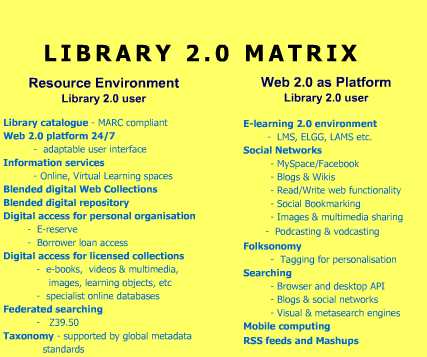

One to watch, from Stephen Abram: Google has finally launched it’s MS Office competitive threat today:
You can read more at Information Week.
Google this week will launch Google Apps for Your Domain, a software bundle aimed at small and midsize companies. The free, ad-supported package combines Google’s E-mail, calendar, and instant messaging with Web site creation software. It will be hosted in Google’s data center, branded with customers’ domain names, and packaged with management tools for IT pros.That’s the first step. Later this year, Google plans to add its Writely word processor and Google Spreadsheets to the suite, build online collaboration features that work across its applications, and market the whole package to large companies for a fee. Google will include IT-friendly features such as APIs, directory-server integration, guaranteed performance levels, and telephone tech support.”
GRRRR – would this explain why my Google desktop has suddenly been giving me merry hell on different machines? Reconfigurations and ‘big work’ at Google datacentre? I gave up and uninstalled it from two of my boxes!
Google’s work in digitising the worlds books in the Google Book Search project is also one to think about in terms of Library 2.0. Finally some inside information is provided by ACRLblog:
Today the Chronicle of Higher Education offers an article (by Scott Carlson) that will give academic librarians a bit more insight into that relationship by providing a link to the actual contract between Google and the University of California Library System. The contract was obtained in response to an open-records request from The Chronicle.According to Carlson’s report:
“the university will provide at least 2.5 million volumes to Google for scanning, starting with 600 books a day and ratcheting up over time to 3,000 volumes a day. Materials pulled for scanning will be back on the shelves of their libraries within 15 days.”
By anyone’s standards that is a heck of a lot of books being digitized each day.
This whole concept of a digitized library is an important one to think about. I am all in favour of an online world and digital access everything. But I am also all in favour of using “real” books to develop and promote reading. I see a great place for good books in good digital libraries. I don’t mind if those books are also in digital form, or on ipods, or in braille – it is having alternative choices that are tactile, couch friendly and sometimes NOT digital that is so important.
The magic of a shared story, kids in happy piles on the library floor relaxed and in a haven away from the stresses of life – that’s a nice, wonderful, important, vital library experience. The magic of senior students reading, discussing, testing, taunting, challenging authors as they discuss plot, purpose, values etc irreplaceable. Or do we envisage sitting on a digital couch in SecondLife, reading a digital book, which we got from a digital source? No, we need to keep some hold on reality while we work with technology.
Literacy and good reading are at the heart of civilisation and culture, and while we continue to digitise we should never dismiss or destroy our books and our libraries.
That’s what repressive and distructive regimes have done. Learn from history: Let’s not digitise and then burn our books!
 judyoconnell.com