ClaimID for OpenID

ClaimID is the free way manage your online identity with OpenID.

No, I haven’t used it, but Michael Habib has! Michael belongs to that wonderful group of new graduates who are going to change the shape of libraries, so it makes sense that he already has a ClaimID.

Michael says: I use ClaimID to manage my online identity. ClaimID is a tool for collecting and annotating links related to me. Mathias Fischer says: ClaimID allows me to present my profile on the net.

Thanks to DoubleSlash for providing a Slideshare that outlines the relationship between OpenID and ClaimID.  Perhaps you will lay your claim?

ClaimID and Open ID raises further issues beyond the last post on OpenID, in relation to   learning, identity, authorship and attribution. This is clearly a developing field – and one that I imagine will intersect (and converge) with copyright and creative commons managment of online materials.  One to watch for the future.

Technorati Tags: , , ,

OpenID – Web [3.0] connections

As we move towards the Semantic Web world of Web 3.0, the question of online identity takes on another dimension. This is the matter of ‘single sign-on’ – something that we are just getting instituted across the network of all our 80 schools. Nice when organisations finally get that sorted.

But what about the Web platform? A feature article from April online journal Ariadne covers OpenID and the ability for a person to have ‘single sign-on’ across multiple OpenID-enabled services.

OpenID: Decentralised Single Sign-on for the Web takes a brief look at OpenID and asks what relevance it has to e-learning.

Proponents of Learning 2.0 and Personal Learning Environments argue that we are going to see far greater use of ‘informal’ Web 2.0 services as part of the delivery of learning in our ‘formal’ learning institutions (schools, colleges, universities, etc.). If we accept this argument, then the use of OpenID is likely to become increasingly important to our learners.

Our learners are likely to want an online identity (or several online identities) that span the different phases of their education and that span the individual institutions within any particular phase.

Technorati Tags: , ,

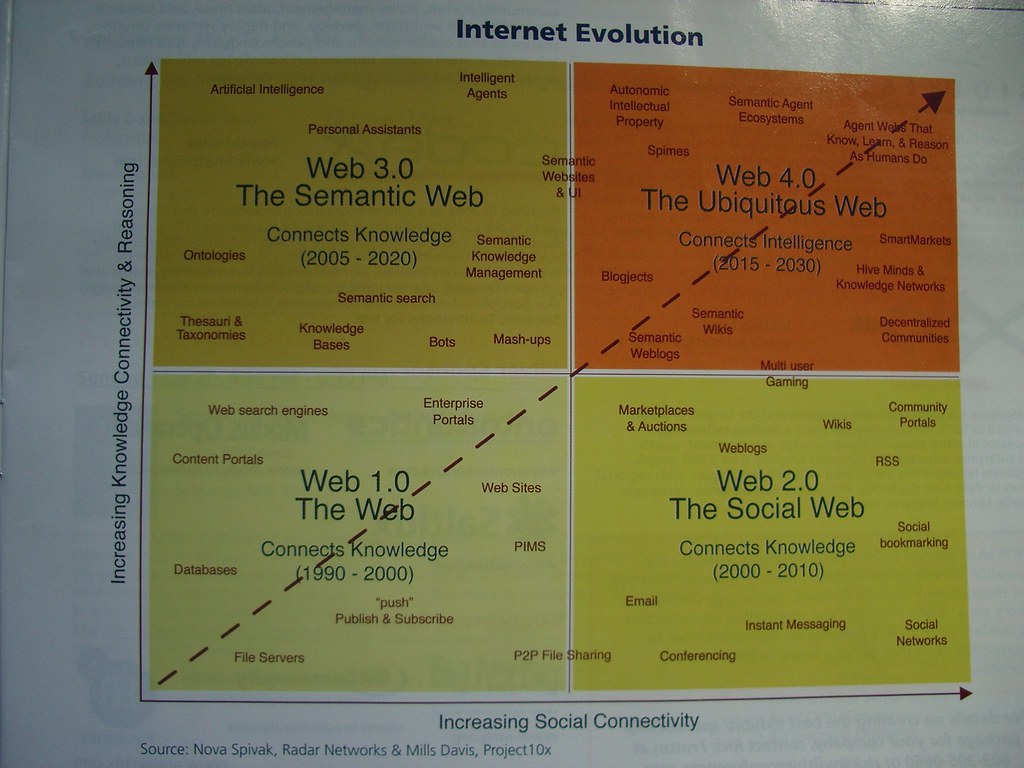
Thinking about Web 3.0…with IEEE Internet Computing

For a long time now I have been thinking about Web 3.0 – not to join the hype, but to better understand the potential of web developments that will effectively merge thinking in disparate fields.

Unlike some of my colleagues, my thinking (and my blog) bounces between two distinctive fields or disciplines – education and pedagogy vs technology and information science. I think I am lucky, because too often I see the errors of thinking that some educators (and leaders) perpetuate in the guise of keeping up with the (21st century learning) Jones!

google.jpgWeb 3.0 is getting some blogosphere air-space – and about time too. Adaptive hypermedia research has been around for many years, nicely juxtaposed against developments in search alogorithms and enhancements with various serach engines. A dawn of a new era? Certainly not according to Jean-Noel Jeanneney in his book Google and the Myth of Universal Knowledge. Google’s digitisation project has provided a healthy jolt to our complacency, and the assumption that digital initatives = fantastic developments. Here is the true rub of machine generated, folksonomy driven hierachies where virtual information is being brewed in a global cauldron.

In my view, we should be less interested in the utopian dream of exhaustiveness than in aspiring to the richest, the most intelligent, the best orgainzed, the most accessible of all possible selections. …Jean-Noel Jeanneney

It is time to focus on the cultural and knowledge aspects of Web 2.0 as it moves to Web 3.0, if for no other reason than this digitisation of our society provides challenges and opportunities for equality or repression like never before.

For this discovery of yours will create forgetfulness in the learner’s souls, because they will not use their memories; they will trust to the external written characters and not remember themselves…….PLATO, Paedrus, translated by Benjamin Jowett

Phil Midwinter asks Is Google a Semantic Search Engine, and goes on to explain that Google is using semantic technology, though it is not yet a fully fledged semantic search engine. He is more optimistic about developments.

There are barriers that Google needs to overcome… is it capable of becoming fully semantic without modifying it’s index too drastically; can Google continue to keep the results simple and navigable for its varied user base? Most importantly, does Google intend to become a fully semantic search engine and to do so within a timescale that won’t damage their position and reputation? I like to think that although the dragon is sleeping, that doesn’t mean it’s not dreaming!

A business-oriented write-up, which nevertheless has important considerations for the educator/information professional. The key thing is that there appears to be a convergence in thinking around the fact that “semantics” will form the backbone of what might be dubbed “Web 3.0”. The Wikipedia entry on Web 3.0 talks of leveraging semantic web for 3-dimensional collaboration…even as far as to point to this as being on the evolutionary path to artificial intelligence! (the stuff of many SciFi stories)

However, what we are really needing to examine closely, is the rise of the API culture – as this is transforming what it is we can seek or serve our knowledge-seeking selves!

Read/Write Web to the rescue! Another excellent write-up from Alex Iskold on Web 3.0: When Web Sites Become Web Services. Well, I suggest that we need to do a lot of reading and learning about folksonomy and taxonomy … and more. Let’s say, more posts for another day.

BUT what we do know already is that the Semantic Web efforts are providing an approach to constructing flexible, intelligent information systems – and it is the synergies between ubiquity and semantics that are exciting, and in which we should expect to see significant future work.

Read more about this in Embracing “Web 3.0” in IEEE Internet Computing.


Technorati Tags: , , , , ,

The Horizon Project – they’re at it again!

I want to thank Julie Lindsay, Vicki Davis and others involved in the Horizon Project for once again showing us the exciting benefits of a global e-learning experience. Aren’t these students just awesome?

Like the award-winning Flat Classroom Project (2006), this new project involves students, this time 60 students in five countries, working together to look into the future of education based upon the Horizon Project Report 2007 Edition by the New Media Consortium and Educause (pdf).

The key trends identified in the Horizon Report which will be explored by the students are:

This project (using Wikispaces, Delicious, Slideshare, Ning, Twitter, Meebo, YouTube and many other online tools) is a ‘trip to the future’ where students will envision, create, and discuss what this future will look like withothers around the world. Through their work on the wiki, the students will be researching and experiencing web 2.0 enabled learning in a global community.

Student work will be assessed against three criteria related to the objectives of the Horizon Project.

  • To understand, analyze and evaluate the trends highlighted in the Horizon Report 2007based on key ideas and areas of impact.
  • To create a project wiki page that details this investigation and synthesis of the material.
  • To use Web 2.0 tools to facilitate collaboration as well as creation.

The comprehensive rubric is worth reading. They also made use of ISTE technology standards NETS.S (revised) for ‘What students should know and be able to do to learn effectively and live productively in an increasingly digital world’.Explore the Horizon Project, the Teachers’s Page and the Students Page.

The students come from USA, Austria, Bangladesh, Australia and China.

I have been invited to join the group as a member of the Expert Review Panel, supporting and reviewing the section on Social Networking. I expect to learn a great deal from these wonderful educators!

Vicki Davis, from Camilla, Georgia, has a beaut introduction to The Horizon Project available at Ning.

Julie Lindsay, from Dhaka, Bangladesh, (who is an aussie) has put a nice introduction to the project on Youtube. Horizon Project Introduction.

Technorati Tags:

A bit of domain chaos – feed facts!

domainchaos.jpgToday I launched my new domain, to which this blog now points. All seems to be working just fine, though if you have problems picking up my feed you might like to pick up the new feed.

I am not sure how Bloglines will resolve the old vs new feed! And I also don’t know what will happen to the embedded YouTube videos- as I can’t get onto Youtube right now (is this our network or a Youtube problem?). My blog no longer shows the embedded videos, so I will try and resolve this problem – or at least point the post to the previously embedded goodie.

In a way, this post is also a test to see what happens with the domain name changes via wordpress. Currently I can’t preview the post, so I am assuming that some resolution issues still exist. Sigh!

Bloglines Technorati Profile

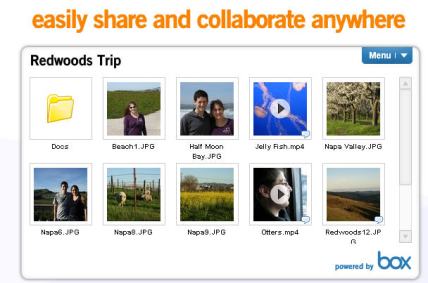
Easily Share and Collaborate Anywhere! Nice one!

box.jpgI don’t usually blog about tech tools – but this is one that I must mention from my favourite Box.net folk.

Check out the live demo to get the full measure.

Simple, elegant sharing

The Box Widget lets you share documents, photos, audio, video and more on any website or blog with a single line of code.

Professional, secure collaboration

With a Box Professional account, you can invite others to upload directly into the widget or add password-protection for more security.

boxshare.jpg

🙂

Design, Technology & Information Architecture

Information design in Web 2.0 is simple, it is social, and it embraces alternate forms of navigation….. The design of today’s Web applications is being led by a principle of simplicity….. There has emerged on the Web a trend towards socializing things which are not inherently social such as books, photos, videos, and text such as news articles, papers, and posts….. In addition to websites which socialize media and applications, there are websites which are social for social’s sake. These websites are all about connecting people and building community. They are the social networking websites such as the MySpace, Gather, Facebook, and Ning networks.

A comprehensive post from Ellysa Kroski over at Infotangle, based on her upcoming conference presentation Computers in Libraries 2007 conference on Monday, April 16th.

The video below from ZDnet, which covers Mashups, provides another part of the story – an explanation of the extensive influence of APIs in creating the flexibility of Web 2.0.

[‘Caught’ on Library20.ning, with a full post at InfoTangle.]

What is a Mash-up

Book Reviews: Revish has arrived!

Revish is a book review community site which is to be launched on Friday 30th March 2007.

If you love reading and sharing your reading experiences you’re in the right place!

Revish lets you:

  • Write reviews of any books you read
  • Maintain a reading list and share it with friends
  • Keep a reading journal – look back and see what you were reading at any time
  • Read reviews by other Revish members
  • Create and participate in groups, to discuss books, reading or anything else
  • Use our API and widgets to include your Revish content on your blog or website
  • Receive books with Revish Connect (coming soon)

For more information, listen to Dan Champion founder of Revish in the Talking with Talis podcast about Revish, and how Revish differs from other book sites such as Shelfari and LibraryThing .

Listen Now | Download MP3 [17 mins, 4 Mb]

During the conversation, they refer to the following resources:

[Dan Champion talks with Talis about Revish]

Forcast of Worldwide Information Growth

The Expanding Digital Universe: A Forecast of Worldwide Information Growth Through 2010 IDC white paper—Sponsored by EMC “The incredible growth of the digital universe means more than simply the fact that as individuals we will be facing information explosion on an unprecedented scale. It has implications for organizations concerning privacy, security, intellectual property protection, content management, technology adoption, information management, and data centre architecture.”

The implications to be absorbed by education are important.

You can download the complete whitepaper and/or the Executive Summary from The Expanding Digital Universe

[Via Jane’s E-learning Pick of the Day]

TeacherTube – video in education

Check out TeacherTube. If you want to find out what’s going on in the TeacherTube community, then jump straight across to the TeacherTube blog launched in March. TeacherTube is the YouTube of educators, and recently it launched a channel for student-created videos. You can find loads of resources that have been uploaded by teachers from around the world. techtips.jpg

For instance, the TechTips ScreenCast Episode 5: Collaborative Research provides information on how Del.icio.us social bookmarking has been used for a student research project. The result is a website aggregating the research results of the very best websites on Mesopotamia that students had found, with descriptive phrases added to each bookmarked site.

From Jodie at TeacherTube:

Thanks go out to TeacherTube community member Anne Bubnic (http://abubnic.blogspot.com/) for pointing us to the current research. The following article references are posted on the The California Technology Assistance Project (CTAP) Region IV math project site:

Scientific Research Indicates that Using Video in the Classroom Improves Learning http://www.libraryvideo.com/articles/article18.asp

Using Video in the Classroom – There is substantial research promoting the use of video in the classroom as a dynamic resource for supporting curricula. http://www.libraryvideo.com/articles/article13.asp

Video Goes to School – a 3-part series at http://www.eschoolnews.com/news/showStory.cfm?ArticleID=5597

KQED – using video effectively – http://www.kqed.org/topics/education/educators/videoclassroom/effective.jsp

Why It Works – a series of papers & research studies from United Streaming. http://www.unitedstreaming.com/home/why.cfm?id=3

The research confirms the power of video in teaching and learning. But TeacherTube users, we want to hear specific examples of how you are using video. Please share your success stories!