Sputtr – or Spluttr!

Could have been great for the students! as Sputtr is a very clever multi-search engine.

We gave it a go, when some students came asking for assistance with their current research topics.

Afterwards we also looked at the options it has for creating a customized search page by including some of my favourite search tools, as well as allowing us to choose from a variety of Web 2.0 zones – anything from Youtube to twitter to DeviantARt to WorldCat and heaps more.

Sputtr incorporates websearch, images, video, audio/music, maps, blogs, blogsearch, news, bookmarks, social networks, people search, reference, country information, and more.

Ah, so it’s great isn’t it?

Yes, it is.

But I CAN’T recommend it for use by my students because it has the naughty button which leads to a paid ‘love’ service. What a damned shame. After a good start I spluttered to a halt.

I miss my friends, my conversations

New job, new challenges! Yikes!

My post Core knowledge and creativity for learning 2.0 has generated a bit of discussion – amongst my old friends with whom it is easy to have robust pedagogical conversations about learning in a Web 2.0 world. Read those conversations and you can see how we changed in a couple of years in our own thinking and our own classroom practice. Our students have been the winners.

Michael suggests that I am ‘biting my tongue’. 🙂 You might be right about that! Michael, like all my professional friends and colleagues in the Parramatta Diocese, knows how passionate I am about changing the learning opportunities for our students – bringing our classroom practice in alignment with their Web 2.0 world.

So now I miss my teaching friends a lot – because I have no-one with me yet with whom I can have these challenging pedagogical discussions. You know how it is – back to base one, only it’s worse when you have learnt so much with your friends, and you KNOW that things have to change, and change significantly.

At the end of the day, though, it’s deep knowledge and deep thinking that drives learning – Web 2.0 or otherwise. Engagement, even the engagement of Web 2.0, is only relevant where it promotes and commits our students to being reflective, critical thinkers, able to find and use information effectively and ethically, and able to absorb common and core knowledge in order to build and contribute to human knowledge and understanding. You engage learners in a Web 2.0 world by recognizing their multimodal way of thinking and being – not for the sake of the Web 2.0 gimmick but for the sake of attracting and absorbing the interest of our young learners. Deep thinking has always been around – from Socrates to the 21st century. It’s how we get to encourage deep thinking that has radically changed in our multimedia/multimodal world

Stay with me my old friends, as we continue our fantastic transformation as teachers in a 2.0 world. Come with me my new friends, join me on a glorious journey of rediscovery – because I think that’s what it is…rediscovering deep learning, connected learning, reflective learning, and much more – so much more!

It’s not just about the HSC any more. It’s about powering our students into their global futures in ways that none of us teachers ever experienced as learners. These kids, they’re so lucky – if only we’ll let them fly!

Let’s not forget – we talk about Web 2.0 as if its still something new. These kids – they ARE Web 2.0.

Photos: Valentine’s Day Sucks, Even though things could be better, Our schools are flat

The Future of Reputation

Thanks to Grainne Connole who posted the following link to Del.icio.us – yes, Grainne is in my network!

THE FUTURE OF REPUTATION:
GOSSIP, RUMOR, AND PRIVACY ON THE INTERNET

by Daniel J. Solove
Yale University Press (2007)


The full text of The Future of Reputation is now available online for free. Click on the links below to download PDFs of each chapter. The front matter to the book is at the beginning of each chapter.

If you’re using this book for a book discussion group or for an academic class, click here for discussion questions.


Sense and order in Web 2.0 – and some!

For many joining the world of Web 2.0 is still a new adventure, and for those of us working with these new adventurers it is important to be able to step back and start at the beginning. But it is also a wee bit magical to push forward, and look back on your own adventure – and be amazed at the change.

It was Del.ici.ous that did it for me!! To be so liberated by a single tool never ceases to amaze me – perhaps the most powerful personal web tool of all! For my money it remains the most important one to introduce to all teachers as a way of transforming or shifting their technology use from Web 1.0 to Web 2.0.
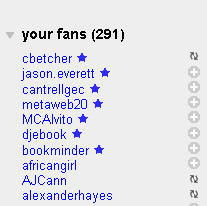
fans.jpgAlso, the power of the network cannot be underestimated!

I currently have 145 people in my network, and 291 fans – some of them very new as indicated by the star. Sometimes I know who they are (hi Chris!) and other times I don’t.

However, there comes a time when you KNOW that you’re no longer a newbie!! You know the way it is ….. you check your Network, and see great bookmarks that others have added. And then you smile, because you added those a LONG time ago. So information comes around, goes around, and gets shared at all different points of the sequence of people’s personal learning journey in Web 2.0.

Del.icio.us still powers the web for me, though how I use it hasn’t much changed since I started social bookmarking 18 months ago. In fact, I hadn’t come across much else new in the world of Del.icio.us until today.

Research Buzz reported Del.icio.us Spy, and I took a look.

deliciousspy.jpg

That blew my socks off!! Del.icio.us Spy, at http://www.ajaxonomy.com/deliciousspy/ , shows you bookmarks as they’re being added to del.icio.us, along with a screen shot and occasionally a little context.

If you don’t want to see every last bookmark being added, you can also filter by tag. If you happen to choose a tag that doesn’t get updated very often, you can have the site play a sound for you every time it updates. And finally, there’s a pause button if you see some links that you want to investigate before they scroll off the screen.

Oh, and as the links fly onto the screen, you can simply hit the Save for Later button, and then chill out and browse through the links you’ve saved – though you need to do this before the end of your session.

I found some cool stuff that I added to my Del.icio.us account – thus adding to the world pool of ever growing links. What a very different Web 2.0 world it is 🙂


Meme – Passion Quilt

Oh no!! here comes another meme 🙂

Thanks to Joyce Valenza and Dianne Cordell I have been tagged to join in the Passion Quilt meme. Usually I don’t like memes, but this time I couldn’t resist as I will be meeting up with these two fabulous Teacher Librarians at ISTE’s conference in San Antonio later in the year.

So what is my passion? what image will I add to the quilt?  Here ’tis!

Refocus your mind! Recharge your energy! [R]evolution Web 2.0.


My Picture

In this picture simplicity and peace are juxtaposed with Web 2.0 in order to highlight a changing mind or vision in learning. I like the picture because it shows that it is not about the rush of technology that mandates Web 2.0 – rather the mindshift that embraces learning as a multimodal conversation in our Web 2.0 world.
My Passion
I am passionate about lifelong learning, for students of all ages.

You’ve been tagged:
I’m passing this meme on to five like-minded teachers and/or tech savvy librarians:

Frances Manning HFS Conversations Teacher Librarian in Sydney

Jo McLeay The Open Classroom Teacher in Melbourne

Kathryn Greenhill Librarian’s matter Librarian in Perth (Australia)

Ewan McIntosh Edu.blogs.com Teacher consultant in Scotland

John Connell Passionate friend of teachers and librarians. Hails from Scotland, works in the world!!

Meme: Passion Quilt

The rules are simple.
1. Think about what you are passionate about teaching your students.
2. Post a picture from a source like FlickrCC or Flickr Creative Commons or make/take your own that captures what YOU are most passionate about for kids to learn about…and give your picture a short title.
3. Title your blog post “Meme: Passion Quilt” and link back to this blog entry.
4. Include links to 5 folks in your professional learning network or whom you follow on Twitter/Pownce.

Google for newbie Web 2.0 teachers

I like to point out obvious tools to teachers to discover – and challenge their thinking about Web platform tools. So here’s a little reminder to keep an eye out for good Google tools.

Too many teachers know about ‘googling‘, but don’t know enough about what else is worth using for Google tools.

googlemore.jpgSo remember, when you go to do a Google search, look up at the top left-hand corner and discover a few other tools – the magic one to follow is the little word “more“.

Most teachers are already know about images, maps, Gmal…but more?

Yes, there are a few other very useful goodies. But then what about “even more“?

That’s a page that all smart 21C teachers should visit and come to grips with! Not necessarily to use them…but to be aware of what these represent..the required pervasiveness of Web 2.0 tools in our daily educational practice.

Check out Google Notebook, and Google Scholar – if you haven’t already done so. There are many Google tools that deserve attention and discussion. How could we use them? What other ‘brand’ tools might be a better choice? What are the tips for good pedagogical integration?

What you’ll also notice on the full listing page is that sometimes a new tool appears with the label New! right next to it. Google Notebook has that right now.

Did you know that this doesn’t really mean ‘totally new‘ but rather that the tool is no longer in beta phase?

Indeed!

Google Labs are the place where the up-and-coming tools can be found. Checking out Google Labs is a great way for teachers to find out about some of the future trends.

I wanted to highlight this information about Google because Google is everywhere – especially where teachers haven’t moved beyond the “go and do some research on the internet” phase of online instruction.

Google is more than a search tool or email facility. Know what else Google actually is, and then develop a good sense of discernment – so that you can determine whether a Google tool or another tool is the best for your particular learning and teaching need!

That’s a fun series of PD sessions for you to try out?

Hmmm, might do that myself later in the year too 🙂

Core knowledge and creativity for Learning 2.0

Today was interesting! I met two year 11 Chemistry classes and spent a little time opening up the options of choosing a Web 2.0 tool to produce part of their assessment task. These students have by and large been operating in a Web 1.0 world for school learning – but of course are operating in a Web 2.0 world of social networking with the usual MySpace, Facebook or Bebo.
The challenge for them was to think about creativity and the learning process, and if they dared, to step out of their usual comfort zone and into Web 2.0.

Why did we want to do this? Well the issue is this – that critical thinking skills cannot be learned in the abstract. They always pertain to concrete knowledge of subject matter. But by the same token, absorbing and ‘learning’ some concrete subject knowledge does not necessarily lead to critical thinking or creativity. Learning is a delicate pattern of interconnections!

If you sit boys in rows, if you always ask them to write an essay, produce a poster, deliver a talk, or make a powerpoint then without a doubt the capacity for independent learning or flexible collaborative learning that is deeply reflective just ‘ain’t gonna happen’ easily.

It’s true – we threw these boys in the deep end with a big challenge. Sorry boys!

…….. and I watched some of them run right back to safe shores, others forgot how to paddle or swim and splashed and floundered around (hiding their confusion behind boyish bravado), and others got right in and swam to the new shore across the bay. A few quiet ones spent a lot of time exploring the tools, checking the parameters and began to talk about the nature of learning this way.

We’ll be happy if we see a few wikis, maybe a blog or two, or maybe even a voicethread. This was just an experiment. No student will be advantaged or disadvantaged for either choosing or not choosing a Web 2.0 option. All we hoped for was that for some boys – the naturally curious and creative ones – the opportunity to use a Web 2.0 tool just might make the learning experience fundamentally creative, collaborative, and fun!

I’ve added a new TAB to the blog for the students called Student Tools – Let them fly!

So back to the beginning of the lesson.

What DOES this video prompt YOU to think about creativity and learning?

After all, an escalator can never break. It can only become stairs. Have we nullified the capacity of our students to be creative in the very ordinary yet essential daily processes of learning? That’s the message the video gives to me 🙂

Photo: One small piece of machinery

Google docs … at it again!

googledocs.jpg

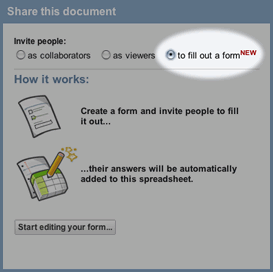
From Arthus on Twitter came the news that Google Docs now brings us forms!

Create a form in a Google Docs spreadsheet and send it out to anyone with an email address. They won’t need to sign in, and they can respond directly from the email message or from an automatically generated web page. Creating the form is easy: start with a spreadsheet to get the form, or start by creating the form and you’ll get the spreadsheet automatically.

Responses are automatically added to your spreadsheet!

  • Breakdown of social networking

    Its the weekend and time to relax. So here I am surfing the Net – and what do I find?

    Imagine this scenario – what would happen to our social networking endeavors if we all lost connection to the Internet? Some of you may have been following Afterworld, the first television series to be made available on mobile phones and the web simultaneously (each of the 130 episodes is just over two minutes long). This animated sci-fi series tells the story of life on earth after an inexplicable global event which renders technology useless.

    More than 95% of international telephone and data traffic travels via undersea cables. So sometimes there is an accident! What does happen when something goes wrong?

    Passport reports:

    The Arabist, an anonymous blogger based in Egypt, sarcastically predicts “complete social breakdown” when people find themselves unable to update Facebook every few minutes. Here’s hoping it doesn’t come to that. Internet users from Cairo to Calcutta are either without the Web or their service is operating at a fraction of its normal capacity.

    The culprit? A ship off the coast of Alexandria, Egypt, dragged its anchor and snagged two major underwater telecommunications cables. Unfortunately for Internet addicts in Egypt, Saudi Arabia, Qatar, the United Arab Emirates, Kuwait, Bahrain, Pakistan, and India, the SeaMeWe-4 and FLAG Europe-Asia cables, which carry the majority of Internet service between Western Europe and the Middle East and South Asia, were the ones cut.

    Unfortunately for Internet addicts in Egypt, Saudi Arabia, Qatar, the United Arab Emirates, Kuwait, Bahrain, Pakistan, and India, the SeaMeWe-4 and FLAG Europe-Asia cables, which carry the majority of Internet service between Western Europe and the Middle East and South Asia, were the ones cut.

    It’s happened before, and will happen again. Passport explains that it’s unclear when normal service could be restored to the affected countries. I wonder how blogger Julie Lindsay is managing in Doha? and if she still has steady access.

    Oh, I see she is in Prague ……  and busy blogging about the ECIS conference! I recommend a visit to the slides of her presentation on Personal Learning Networks. She captures the key points beautifully.

    Below: damaged cable networks

  • .

    Google generation and virtual libraries

    pin.jpgPeople have very different information needs at different points in their lives. People also search for information very differently depending on the knowledge they have of search techniques or the nature of the interface that is being interrogated.

    A new report Information Behaviour of the Researcher of the Future provides a comprehensive analysis of information behaviours, google gen and social networking behaviour, and the implications of this for the information environment and libraries – and includes the challenges we face.

    Is the Google Generation a myth? This new report, which was commissioned by JISC and the British Library, counters the common assumption that the ‘Google Generation’ – young people born or brought up in the Internet age – is the most adept at using the web.

    Lets face it – there is a world of difference between social networking conversations and in-depth information requirements, knowledge building and development. It is in this area that the report explains

    that people are having great difficulties navigating and profiting from the virtual scholarly environment.

    The report provides a strong message for library services, and significantly it also raises the issue of the semantic web – a topic of conversation on Twitter a few days ago.

    The world wide web as we have seen and experienced it so far could be completely revolutionised by the advent of the `semantic web’. A system where, currently, humans express simple searches in everyday language, to order groceries, reserve a library book or look up a railway timetable, could be superseded by a system in which computers become capable of analysing all the data on the web.

    Good Information Architecture will become more and more critical if the semantic web is to deliver information effectively.

    Twitter conversation:

    @heyjudeonline Web design juxtaposed against information design – now there’s a pretty challenge yet basic building blocks for semantic web.

    @Tuna XML mainly as RDF is just lacking in practical application in real world schema (dodges flames)

    @Heyjudeonline real world schema is the real issue isn’t it. Structured approaches and metadata were the first line of attack in web

    @Tuna correct.. the break out of the meta information flow is critical to the webs development beyond a search farm. We can direct and translate and ensure like goes with like or people have the chance to join their like with like

    @heyjudeonline exactly! We know that single data domains with simple keyword tools are rapidly obsolete. Move beyond RDF resource primer