Blogs in plain English
Reply

This is a really nice thought-provoking presentation from Kim Cofino called The 21st Century Educator: Embracing Web 2.0 in your Professional Practice.
I think this presentation is worth highlighting on it’s own.
I won’t be at the conference – but I can almost hear what Kim will be saying about personal learning networks 🙂 Thanks for sharing Kim!

Wetpaint is by far my most favourite wiki software, but I have not promoted it because of the problem of advertising. Now I believe that Wetpaint should be the ‘wiki of choice’ for school staff – it has a great interface, is easy to use, and has all the features you need to make wikis a part of everyday learning online.
To find out more about qualifying to get ads removed and find great tips for creating education wikis, visit: www.wetpaint.com/education. Then follow the instructions to apply for your ad-free wiki.
Go on – create a Wetpaint wiki for your classroom!
 The big news from Ning! is that it is offering Ad-free student networks. This is a real boon.
I like Ning very much for the robust social networking it provides – it’s excellent for good discussion and group sharing, ideal for new users to social networking, and especially good for specific global projects like the Flat Classroom project, or for your own school-based projects or staff space.
But I have been avoiding ‘marketing’ it in my schools because of the advertisments.
Steve Hargadon writes about the new look Ning! – and how current education users can request to have advertising removed. As a member of the FlatClassroom Project, Classroom 2.0, The Global Education Collaborative, Library 2.0, NextGen Teachers, School 2.0, Stop Cyberbullying, Edublogger World, and lots more. I’m not active really, just drop by sometimes – unless the group is project-based such as The Horizon Project and the Flat Classroom Project.
I especially like the way we can use Ning! to introduce groups of new teachers to the world of robust social networking – sharing information, ideas, videos, movies etc, as well as having a personal space to run a bit of a blog (for those who haven’t got time to ‘go it alone’), a way to discuss and ask questions through the forum….and more!
Now it’s time for more people to have a go! Go on, start by joining a group – I have found another that needs my attention – Ning in Education! Time for me to schedule a workshop!
What I would like is a better way of integrating all my groups FaceBook style! API anyone?
This (rather fuzzy) video explores the changes in the way we find, store, create, critique, and share information. This video was created as a conversation starter, and works especially well when brainstorming with people about the near future and the skills needed in order to harness, evaluate, and create information effectively.
Excellent companion piece to the Machine is Us/ing Us.
For our schools it is time to take a well-earned break with the term 3 holidays now underway. So it’s time for me to have a bit of fun on this blog too before I get back to more serious matters….
 Time to talk about wonderful things…boing boing style …. prompted by my lightweight breakfast reading of the Sun Herald (no, not my choice of paper).
An article there about a device that creates plates, bowls and other tableware on demand and recycles them (a Star Treck fan like me recognises this!) , produced as a prototype by MIT led me to comment “I bet they got that from boing boing!”
A little research showed me that Boing Boing listed the story Dishmaker: Printer for Dishes on February 12, which came from Gizmodo, who had linked to this story 12 months earlier at TreeHugger. Well, here’s a video about the earlier prototype…you are looking at the beginning of replicators for us all 🙂
By the way, boingboing is a weblog of cultural curiosities and interesting technologies, and is listed by Technorati as Number two blog in the world, with Engadget, the number one blog in the world, having replaced boing boing at the top.
Boing Boing is a ‘beaut’ blog full of eclectic news!
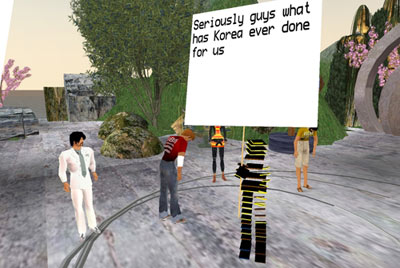 Today I read about a recent “in-world” labor protest that took place in Second Life. The company in question: IBM. The aggrieved: 1850 avatars, including some bananas and triangles. Link.
I discovered a beautiful Gallery of Illustrated Endpapers. What are they? Endpapers are the inside covers and facing pages of books. Today, endpapers are almost always blank. But our more sophisticated forebears made good use of endpapers by adding thematic illustrations to them.

Look at the endpapers here.
I also found out about a Terry Pratchett DiscWorld reading order guide; thought about the Walk to Rivendell challenge; and saw how mobile technology worked for a reporter in Myanmar who had had his camera confiscated.
There’s lots more to read on Boing Boing every day – so add it to your RSS reader! Lots of good ideas to provoke discussions in your classrooms.
Now, settle back and watch another video – Dice Stacking – reported by Boing Boing of course!
Can’t say it better than Stephen Downes.
I want and visualize and aspire toward a system of society and learning where each person is able to rise to his or her fullest potential without social or financial encumberance, where they may express themselves fully and without reservation through art, writing, athletics, invention, or even through their avocations or lifestyle.
Where they are able to form networks of meaningful and rewarding relationships with their peers, with people who share the same interests or hobbies, the same political or religious affiliations – or different interests or affiliations, as the case may be.
From Brandon Hall Research Innovations in Learning Conference, San Jose, September 25, 2007
If you haven’t already done so, add Today’s News in OLDaily to your RSS reads.
On Monday I had the opportunity to provide a short presentation to educators interested in Literacy and Web 2.0. This presentation is just a simple ‘discussion starter’ and a bit of inspiration. We enjoyed ourselves 🙂
I’ve always been curious about the information architecture behind search tools – infrastrucure and alogorithms. As I am not a mathematician or a programmer, some answers can become too complex.
However, I have found a couple of gems about Google. The first takes us back in time to Stanford University and two eager students, Sergey Brin and Larry Page, working on a large-scale prototype search engine. The Anatomy of a Large-Scale Hypertextual Web Search Engine introduced some key ideas that we are now familiar with – but which were revolutionary and which underpin the force of Google today.
We know from The Google Story just how different the Google setup is. David Carr in How Google Works explains:
Google buys, rather than leases, computer equipment for maximum control over its infrastructure. Google chief executive officer Eric Schmidt defended that strategy in a May 31 call with financial analysts. “We believe we get tremendous competitive advantage by essentially building our own infrastructures,” he said.
Google does more than simply buy lots of PC-class servers and stuff them in racks, Schmidt said: “We’re really building what we think of internally as supercomputers.”
Previous search engines had not analyzed links in the systematic way that Google did – all part of the original ideas of the two young researchers. If you’d like more answers to your question, How Does a Google Query Work, provides a few clues.
But Niall Kennedy, a web technologist has also come to my rescue with his post on Google phrase analysis where he explains that a few more details about Google’s possible analysis of page text is available from a recently published patent application by Googler Anna Patterson from June 2006. The application details how a search engine like Google might analyze text phrases, date-based topics, and associate a web page with related topics, even if the specific topic does not appear in the document itself. The 22-page document further emphasizes Google’s current work on “shingle” analysis to discover important phrases and concepts.
He provides a neat Google search diagram for muggles like me!

Listening to Daniel Brusilovsky , just 14, is for sure a reality check for any teachers hesitating to adopt Web 2.0. Daniel works in IT, and has his own blog and podcast show. I love that Daniel talks so favouribly about Twitter – because I picked up the information about this podcast right from a post by Scobleizer on Twitter! Good one Daniel!
[podtech content=http://media1.podtech.net/media/2007/08/PID_012094/Podtech_DanielB.flv&postURL=http://www.podtech.net/home/3757/inspirational-teenager &totalTime=1019000&breadcrumb=ae6a213b3d354fe6b199ef8616abb90c]
 judyoconnell.com