‘What hath God wrought’

Lots of discussion in the blogosphere about the merits or hype associated with Web 2.0. Two particular posts challenge readers to slow down….

Bryan Appelyard writes in the Australian IT with a cautionary view of Web 2.0, suggesting that ultimately Web 2.0 will only be good for us if, somehow, it succeeds in evolving towards an identity-based discourse. All else is mere anarchy.

In the AASL blog heated debated, inspired by Twitter reflections, also indicates that people are in Web 2.0 overload. The pressure is on, particularly with our current API driven expansion of Web applications – as seen at the Museum of Modern betas! or that fascinating Web2.0 Directory.

Never mind.

From that most esteemed institution of American Librianship – the Library of Congress – we now have the Library of Congress Blog, launched today. The very first post links right into the idea of change, change, change – at the heart of Web 2.0.

How did I find out about this? Through Steven Cohen on Twitter of course 🙂

What hath God wrought? The blog leads right into the topic with….

Those were the first words ever transmitted electronically, in 1844, by Samuel Morse. That message and Morse’s invention of the telegraph marked what was undeniably, at the time, the most significant communications revolution since the advent of movable type.

Technorati Tags: , , , , , , ,

Reframing Education for the 21st Century

My friend John Connell has kindly posted the main links covered in his talk to the e-Learning Alliance annual conference.

He quotes my ‘boss’, Greg Whitby, and a host of other good people. I particularly agree with John’s high estimation of the work of Paul Anderson on behalf of the JISC: “What is Web 2.0: Ideas, Technologies and Implications for Education.”

Get yourself a copy. It is a very comprehensive examination of Web 2.0 indeed! I have it sitting on my desk at work, and have been dipping into it with great enthusiasm.

Technorati Tags: , ,

Library Twitter

From Twitter this afternoon, via Stephen Cohen, from Jeff Scott, and on Library2.0. at Ning:::: too amazing for words!

I did it! I was able to take all of the library’s notifications and put them into twitter.

I set up our twitter account at http://twitter.com/cglibrary

Then I dumped all of the library’s rss feeds into http://www.rss2twitter.com

Now everytime the library has an update, a library event, a new book or video, or new newsletter, it goes automatically to twitter. If the content is too long for the message, it automatically creates a tiny url.

Technorati Tags: , , ,

Design, Technology & Information Architecture

Information design in Web 2.0 is simple, it is social, and it embraces alternate forms of navigation….. The design of today’s Web applications is being led by a principle of simplicity….. There has emerged on the Web a trend towards socializing things which are not inherently social such as books, photos, videos, and text such as news articles, papers, and posts….. In addition to websites which socialize media and applications, there are websites which are social for social’s sake. These websites are all about connecting people and building community. They are the social networking websites such as the MySpace, Gather, Facebook, and Ning networks.

A comprehensive post from Ellysa Kroski over at Infotangle, based on her upcoming conference presentation Computers in Libraries 2007 conference on Monday, April 16th.

The video below from ZDnet, which covers Mashups, provides another part of the story – an explanation of the extensive influence of APIs in creating the flexibility of Web 2.0.

[‘Caught’ on Library20.ning, with a full post at InfoTangle.]

What is a Mash-up

Forcast of Worldwide Information Growth

The Expanding Digital Universe: A Forecast of Worldwide Information Growth Through 2010 IDC white paper—Sponsored by EMC “The incredible growth of the digital universe means more than simply the fact that as individuals we will be facing information explosion on an unprecedented scale. It has implications for organizations concerning privacy, security, intellectual property protection, content management, technology adoption, information management, and data centre architecture.”

The implications to be absorbed by education are important.

You can download the complete whitepaper and/or the Executive Summary from The Expanding Digital Universe

[Via Jane’s E-learning Pick of the Day]

SuTree – Social Bookmarking

SuTree calls itself a ‘knowledge community’. Doesn’t quite fit with my understanding of this – which lead me to an interesting bit of reading on Community of Practice on Wikipedia.
However, SuTree says:

We nurture the ultimate tree of knowledge:
the world’s largest index & library of free video/audio
lessons, tutorials, lectures & how-to’s

Our content is handpicked by our users and then
examined by our team/community.

Pulls resources from various places….. which I like. Let’s see how it develops.

Found this nice example:

NetVibes – An Introduction

That 2020 Vision again!

A while back I wrote about 2020 vision, and future directions. I wanted to share two graphics – one for the fun of it, the other for the ideas it raises.

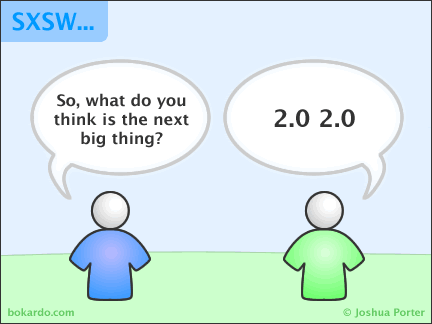
Comic 2.0 2.0


Semantics of Information Connections and Social Connections.


Who’s Watching YOUR Space?


This is a great encapsulation of the OCLC Symposium: How do we operate as educators and information professionals? If you haven’t joined the conversation, or become part of the action, then it really is time to start.

We need to learn how to experience these technologies and put them into practice!

Click on the link to go to YouTube – the owner of the video does not allow this video to be embedded into a blog!

This is the 3-minute version of the most recent OCLC Symposium at ALA Midwinter 2007. More than 400 people attended this discussion of social networking practices and trends on January 19, 2007 in Seattle, Washington. Michael Stephens, Instructor, Graduate School of Library and Information Science at Dominican University and author of Web 2.0 & Libraries: Best Practices for Social Software, was moderator. The expert panel included: Howard Rheingold, a leading thinker on the cultural, social and political implications of communications media and virtual communities; danah boyd, PhD candidate at the School of Information at the University of California, Berkeley and Fellow at the University of Southern California’s Annenberg Center for Communications; and Marc Smith, Senior Research Sociologist, who leads the Community Technologies Group at Microsoft Research. The full video (2:23:19) can be viewed at http://www.oclc.org/index/symposium

Judgement and Web 2.0

At the beginning of the year, Will Richardson commented on his lack of enthusiasm for 2007. The problem seems to be (amongst other things) a lack of progress in relation to changes in classroom pedagogy and Web 2.0-style 21st century learning.

While I sympathise with his frustrations (he IS an evangelist), I also consider that it will only be our evolving understanding of these contexts that will make 21st century learning work.

For example: the debate in 2006 around the value of Wikipedia as a significant online knowledge resource. There were those who insisted that Wikipedia showed the way of the future. There were others who spoke about the significance of this collaborative model. Just a few spoke about problems. While stuck in this debate, the real issue remained untouched – a shift of control!

Where is ‘judgement’, and what are we doing to create learning that promotes ‘judgement’? Learners need to be engaged in activities at a level of deep understanding about why or what they are trying to learn. So what did you tell your students about the value of, and use of, Wikipedia within their learning? Have you praised it’s value?

John Connell, in Fact and Fiction and Wikipedia shared a ‘must read’, salutory experience with Wikipedia from Joe, an authority on John Donne. This is the real Wikipedia – valuable, and invaluable at the same time! Judgement needed at all times – the kind of ‘judgement‘ that is nurtured by information professionals.

All the promotion of Web 2.0-style learning will not change anything really – I guess the source of Will’s ‘down‘ moment – unless we include ‘judgement‘ in the mix. This is where regular Web 2.0 evangelists don’t quite ‘get it’.

What do I mean? I mean the whole idea of searching for information, comparing, contrasting, and synthesising, and engaging deeply, and if needed, slowly in the way that Geetha Narayanan has shown us has great value. I would throw literacy and reading into the mix as well.

But for now, I suggest that Web 2.0 envangelists must consider a more proactive approach to judgement in Web 2.0, built on good searching and sourcing of knowledge components – otherwise we are in danger of building global parochialism!

So…… go and learn more about the Web 2.0 tools of searching. You could start with the Top 100 Alternative Search Engines.

il.jpgGo learn how to motivate and challenge learners by supporting students online and offline in their information-seeking behaviour . Read They Might Be Gurus – a good-humoured account of the strengths and weaknesses of teen researchers and you’ll get my drift.

Then consider how you will foster ‘judgement‘.

Our kids need to think deeply and think well in a Web 2.0 world.

Is the medium the message?

Response to Web 2.0 … The Machine is Us/ing Us

This recent video on YouTube continues the dialogue about the “The Medium is the Message”. It’s important not to be swept up by the ‘hype’ and to continue to focus on the value of the read/write web. I also like the way this video points us towards the future that SecondLife is busy developing. The blend between our various realities is hard for us to grasp………so let’s continue a healthy dialogue around all the issues and possibilities! Will you make the next video? 🙂