This video has great value in explaining not only what the Smithsonian commons has to offer millenials, but also the concepts that drive the learning environment of our students today!
Millenials and the Smithsonian commons
1

This video has great value in explaining not only what the Smithsonian commons has to offer millenials, but also the concepts that drive the learning environment of our students today!

I’m not a keen been when it comes to Windows products, but I know that many organisations (including my school) are built on a Windows platform. Naturally I’ve never been tempted to use Windows Live for blogging, as I’ve been sold on WordPress since I started blogging back in 2006. So it was nice to see that Windows has conceded to WordPress as the better blogging platform.
Good onya! Come on all you live blogers….join me here at WordPress!
As we looked at customers’ blogging needs and what different companies were providing, we were particularly interested in what WordPress.com is doing. They have a host of impressive capabilities – from a scalable platform and leading spam protection, to great personalization and customization. WordPress powers over 8.5% of the web, is used on over 26 million sites, and WordPress.com is seen by over 250 million people every month. Not only that, Automattic is a company filled with great people focused on improving blogging experiences. So rather than having Windows Live invest in a competing blogging service, we decided the best thing we could do for our customers was to give them a great blogging solution through WordPress.com.
If you’re looking for a nice clear explanation of the dynamics and professional value of personal learning networks, then sit back, relax, and enjoy this excellent slide-set from my favourite Unquiet Librarian!

In the old epoch...
Many schools (and organisations responsible for K-12 education) worry about moving to the cloud for their knowledge pathways and learning interactions. But while ‘we’ worry, have we stopped long enough and looked far enough into possibilities in order to gain a better perspective on the scope of the digital [r]evolution around us?
I see this worry as being associated with a number of things:
In such a scenario school libraries wishing to be placed at the centre of innovation in 21st century learning environments are faced with a remarkable challenge. While it could be said that the whole school, or education itself, is facing a challenge, the strategic importance of school libraries in forging new places and new approaches to learning should never be underestimated.

Anytime anywhere
This is as true for the smallest central school in Australia as it is for large learning enterprises such as my own school. I believe we still have a little time up our sleeves simply because the majority of people – from the stake-holders to the senior administrators – do not yet understand the extraordinary opportunities before us. But getting ourselves sorted is getting urgent. And no, the solution isn’t just going to a laptop program. It’s much more than that.
I believe it is time to start digging deeply into the new learning culture that is emerging. I am not talking here about using Web 2.0 tools, or creating content, connections and conversations online, of playing with tech tools on laptops. I know that we are all busy exploring these options, and many teachers are demonstrating that they CAN adopt cloud-based activities to
empower learning, and do know how to challenge their students to develop the best thinking skills possible.

Uncommonly flexible..
What I would like to see is a growing understanding of the shifting base-line of our
technology-enhanced learning environment. From there we can move to develop an adoption strategy for each school that will shape the nature of a learning commons – agile learning spaces in the real sense – i.e. a school and a school library that is both physical and virtual, and which is pervasive, real, and enmeshed in all aspects of student learning. Some are on the way – but many are not! Where do you fit on the spectrum?
It takes time for any enterprise or organisation to adjust to new technologies, and schools are no different in this regard, particularly when K-12 moves to the cloud.
It is easy to
point to the online professional learning networks that many educators participate in as being key to helping share ideas about how to best use these tools in their classroom.
The real-time web in the classroom is here to stay and are busy lowering the proverbial walls of the classroom, giving students access to information that far surpasses the print-bound copies of encyclopedias and periodicals that were once the standard for K-12 research projects. As technology-educator Steven Anderson argues, these technologies
really make the world smaller for our students and show them that they can find the answers they need if we equip them with the tools and resources do to so.
The next step is to create a vision, form and function for your school library that is free from edu-speak conventions (which can become quite stale) and is intuitively accessible to the wider school community. Re-engineer what your library has to offer in whatever ways are possible to you. It is easy to write about whole-scale change, but not so easy when you look at each school and each school library because of the underlying thought changes that have yet to happen.
Give it time – but put KNOWLEDGE at the centre of your thinking rather than ‘library’ and ‘information services’. Knowledge and knowledge creation – globally – is the ticket to the future!
It’s in the context of this thinking that I really enjoyed learning about the Smithsonian Commons project. I haven’t had time until now to catch breath and absorb the implications of this important endeavour.
Michael Edson, Director of Web and Michael Edson, Director of Web and New Media Strategy at Smithsonian Institution, talked about his project, explaining that foundational concept that everyone should have access to the raw materials of knowledge creation – everyone, for any purpose.
The project is a significant one and speaks of an approach or philosophy that should be the motivation for our educational endeavours. It demonstrates a new model of knowledge creation – one that is fast, transparent and open. The spirit and philosophy of this project is one in which they define success as a truly open sandbox that belongs to everybody.
The Smithsonian commons is a project that is just beginning and the goal is to stimulate innovation and creativity and learning through open access to s resources, expertise and communities. In the old epoch institutions like the Smithsonian and like universities were built on the model of enduring wisdom. “we didn’t have to change, we didn’t have to look outside ourselves to strenuously because wisdom endures, wisdom is slow”. In this epoch I think we’ll be measuring our worth, this library will be measuring its worth, the Smithsonian will be measuring its worth in terms of how successful we make people outside our walls. It’s a very different way of thinking. It requires a great deal of institutional humility and generosity. I’m inspired by the work of Kathy Sierra, social web thought leader who said “in the old days the pitch for business was follow me, I’m great. The big opportunity now is follow me or my product because I help make YOU great”.
Watch TWIL #22: Michael Edson (Smithsonian Institution) from Jaap van de Geer on Vimeo.
Be inspired by the idea, and visit the related websites:
Smithsonian Commons – A place to begin – wiki
Smithsonian Commons Prototype – wiki
Smithsonian Commons Prototype – Live
It’s always exciting to read or discover more ideas to support an emerging view – particularly if it is being expressed globally. Following on from my post Hybrid Synergy – the Future of School Libraries, I was pleased to see two things this week that provided me with much food for thought.
Joyce Valenza has an (updated) Manifesto for 21st Century School Librarians published in Voya. In her roundup of indicators of what a 21st century librarian is involved in, she covers
This article is a must-read – and a wonderful ready-made tool for anyone planning directions within their school. Use this article as a springboard for developing an innovative vision and creative response to the learning needs of our students.
If that was not enough, an amazing presentation has also hit the intrawebs – from Lyn Hay at the School of Information Studies at Charles Sturt University. In her presenation you will find a huge amount of information and ideas to stimulate your thinking.
My favourite is the iCentre!
Lyn explains the core business of the iCentre:
I recommend taking time to look through the presentation Converging the Parrallels!
A spectrum of information resources – – – – the library of the future will be coming TO the reader and the researcher.

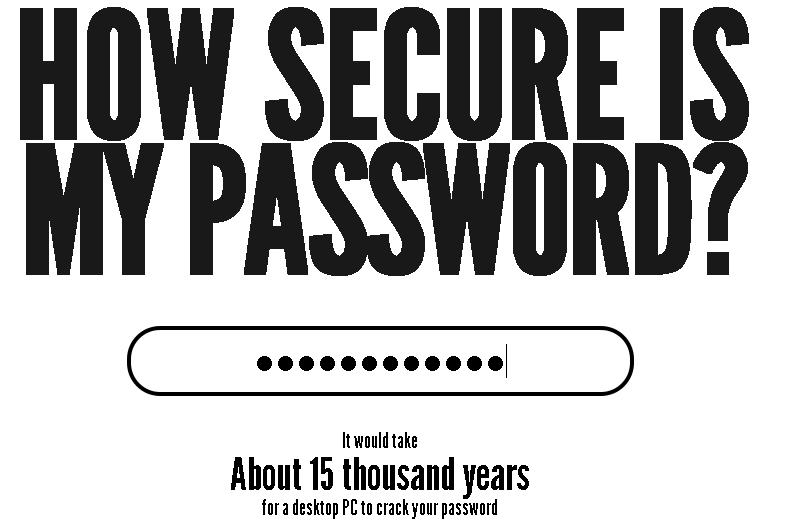
http://howsecureismypassword.net/
Here’s a great tool to demonstrate password strength to staff, students, family and friends. Try out your usual favourites and see how they fair!
I ran some of my trusty passwords through it and found pretty much what I expected.
One regular password I use for sites that I don’t care about much in terms of security came up as taking 13 minutes to crack.
The next regular password I use, which is alphanumeric, rated a score of 2 hours.
My best score ? 15 thousand years for a desktop PC to crack! Nice!
Regrettably my online banking password failed miserably – at 3 minutes!! Ok, back to the password drawing boards for me.
No idea how valid this is. But it’s useful for making people think!
Thanks for the fun tip from Yvonne @southoz

The Resources Centre
School has been busy – and so have I. Not many blog posts – but nevertheless I’ve been busy mulling over the future of school libraries and how they should best be integrated into the education setting that we call “schools”.
Those of us who have been in ‘schools’ for many years remember when schools had no libraries! Now it seems that some forward thinking people prefer to return to elements of schooling that were regarded as outmoded. Get rid of libraries? Forget the role of libraries and teacher librarians? We don’t try and go backwards in other areas of education – so what’s the deal with this myopic view?
I have been busy watching the twitter stream #iwbnet10 where three of my colleagues are listening to some of Australia’s brightest talk about schools, schooling and the digital revolution at the Seventh National Interactive Teaching and Learning Conference.
By all accounts the conference has been brim full of ideas. But what strikes me about this and other conferences, such as ISTE2010 (that I very much enjoyed in Denver earlier this year) is the decided lack of discussion of what I see as an urgent need for a ‘new’ hybrid synergy between learning and libraries. According to Designing for the Future of Learning
the school library remains one of them most symbolic, protected, and expensive ’spaces’ on any campus. But will future designers of school libraries be recreating sacred book spaces of the past or will technology and the ‘consumer’ inspire new design strategies for the future? For many, the library is the literal information bridge to the future.
It is very discouraging indeed to have conference attendees excited by one-eyed presentations of future learning needs. Focussing on the digital revolution and ignoring the pivotal role that a good school library can play is to achieve only a percentage of what is possible – regardless of how good it seems , it’s just not good enough!
When I focus on my role as a teacher librarian, I ask myself a few leading questions:
 Should we be immersed in new media and technology in our hyperlinked library? Definitely.
Should we be working tirelessly to identify what is needed to think in ‘future tense’ and embrace the challenge of keeping ahead? Most certainly.
Should we be leading the conversation about social networking and digital identities? And how!
Should we be discussing the assessment problem in these media environments? But of course!
I have the joy (and tears) of managing a school library that is open each week day from 8 am – 10 pm.
It’s a central hub for collaboration, technology, reading and writing. It’s a place for change and about change. But with all that, it still has a long way to go to achieve a hybrid synergy in our school. No different from most – we are evolving and responding to change!
This is important because in an era of fast facts and short cuts kids have to become VERY literate in multimodal forms.
There are NO short cuts to literacy, and there is no replacement for the love of reading! No amount of gaming, movie making, sport, social networking etc can replace the cognitive gains to be made by allowing our students to become deep readers and deep researchers. Technology has so much to offer in this thirst for deep knowledge and engagement with the ebook [r]evolution! However, technology is not a replacement for reading, researching, and the value that school libraries and school librarians can bring to our multimodal digital century.

Can you read this?
So while you get excited about technology rich schools, and while you focus on immersive and multimodal technology, don’t forget to focus on reading, literacy, information fluency and deep understanding. What we need is a hybrid synergy between teaching, learning, technology, pedagogy, and the services of a school library/information services centre of learning and innovation.
Everything is a matter of degree. We do need to redesign our learning environments to address, leverage and harness the new media technology environment of our schools. We need to start redesigning our school libraries and the work of teacher librarians for these learning environments. We need to adopt learner centred e-teaching. We need to share, co-operate and collaborate because we now have an information ecology that can be open, self-managed, fostered and conducive to knowledge flow between content and connections.
As Michael Wesch explains,
Students need to move from being knowledgeable to being knowledge-able
Please look for ways to create a hybrid synergy in your school or academic institution. In terms of modern information and media skills, our practice demonstrates small, uneven pockets of best practice. We have no textbook for what 21st-century school library practice looks like.
Today I found a school that has grasped the need for hybrid synergy! Not only do they have a school library that is the centre of learning and innovation – they will have in 2011 the perfect vehicle for synergy in 21st century learning by formalising the lead structures within their school.
Check out St Ignatius College, Riverview here in Sydney. They have realigned their library services to create a new hybrid synergy under the direction of the Head of Digital Learning and Information Services, supported by several Digital Learning Facilitators who will teach a subject, work with a faculty, as well as support students reading, learning, and research needs in the library. Of course, with such a commitment to empowering student learning, there are other important roles such as a Library Manager, and library and media technicians.
Oh, but we can’t afford that at our school!
Maybe not – but you cannot afford to do without a library, nor can you afford not to adopt a hybrid synergy that will allow your teacher librarian to take charge of the digital revolution – that is in danger of disenfranchising our students.
Let your students become ‘knowledge-able’ through literacy, reading and information fluency driven by teacher librarian experts embedded in your multimodal learning environments.

Last term the Library Team at Joeys excelled themselves in launching an amazing “Body in the Library” investigative program in collaboration with the Science and English faculties. I promised to share this after talking about it at EduBloggerCon 2010 in Denver. So here are some more of the details!
Boy’s body found in the Resource Centre! Year 8 suspected!
The focus of the project was to facilitate deeper learning in our students by creating an ‘authentic learning’ experience to strengthen writing and literacy skills across the curriculum. In English, students learned about the literary conventions of forensic fiction in their crime novel, Framed, and how to use them to solve a crime. In Science, students learned about how use a variety of scientific methods including analysing dental records, fragments and fibres, fingerprinting, shoeprinting and DNA samples in order to solve a crime.
These skills were then put to the test when boys were asked to solve a ‘body in the library’ type crime which the library team spent weeks preparing!
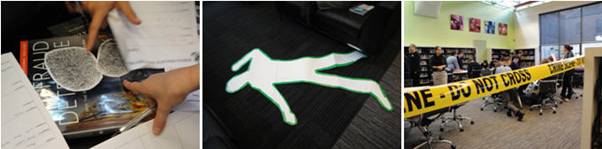
To solve the crime, students viewed the crime scene, looked at photographic evidence, read various ‘official’ forensic and crime reports, watched video-taped evidence of the crime in action; watched interviews of the suspects; read testimonies of different suspects; and analysed many forms of written and physical evidence! Students employed deductive thinking skills, analysed all available evidence and established motives for the suspects in an attempt to determine who committed the crime. Lastly, each student submitted their own police report on the crime and its investigation.
This collaborative activity raised an astounding level of interest from all 150 boys – as well as raising a lot of interest from boys from many other years.
 Here’s a brief overview of the scenario::
A body is found in the library at the end of Period 4 on Tuesday. It is a Year 9 boy who has been hit on the head with a blunt instrument. The body is discovered by Mrs O’Connell in the Fiction area. A coroner’s report puts time of death at recess/Period 3.
The murderer is Mrs Smith. In a fit of rage, she has killed the student for not returning an overdue book. There are two other prime suspects: Mr Smith, the Yr 9 Co-ordinator, who is annoyed by the behaviour of the student, and Jack, the boy’s friend, who had a fight with the victim.
Each boy received a forensic workbook – containing a range of materials for examination such as crime reports, witness statements and a coroners report. In addition the ‘crime scene’ was taped off, with key evidence on display e.g. fingerprints, the location of the body, and places where DNA was found. Photographic evidence included the injury reports (fake bruising and blood on the victim), video footage of the scene of the crime (staged by students and teachers) and also hard hitting interviews. The students were able to go into our two discussion rooms (which have a plasma screen for collaborative work) and view the footage and interviews, and take notes about what they saw and heard.
All this analysis led to some fierce competition to solve the crime, and find the murder weapon – which was hidden amongst the library shelves. You guessed it – a steel bookend (decorated with some fake blood).
If you want to prepare a scenario of your own, here is our YEAR_8_FORENSIC_SCIENCE framework that set up the string of evidence and clues for our project.
A copy of the coronor’s report below will give you an idea of the level of detailed evidence provided for the students to analyse.
The rest you’ll have to create for yourself!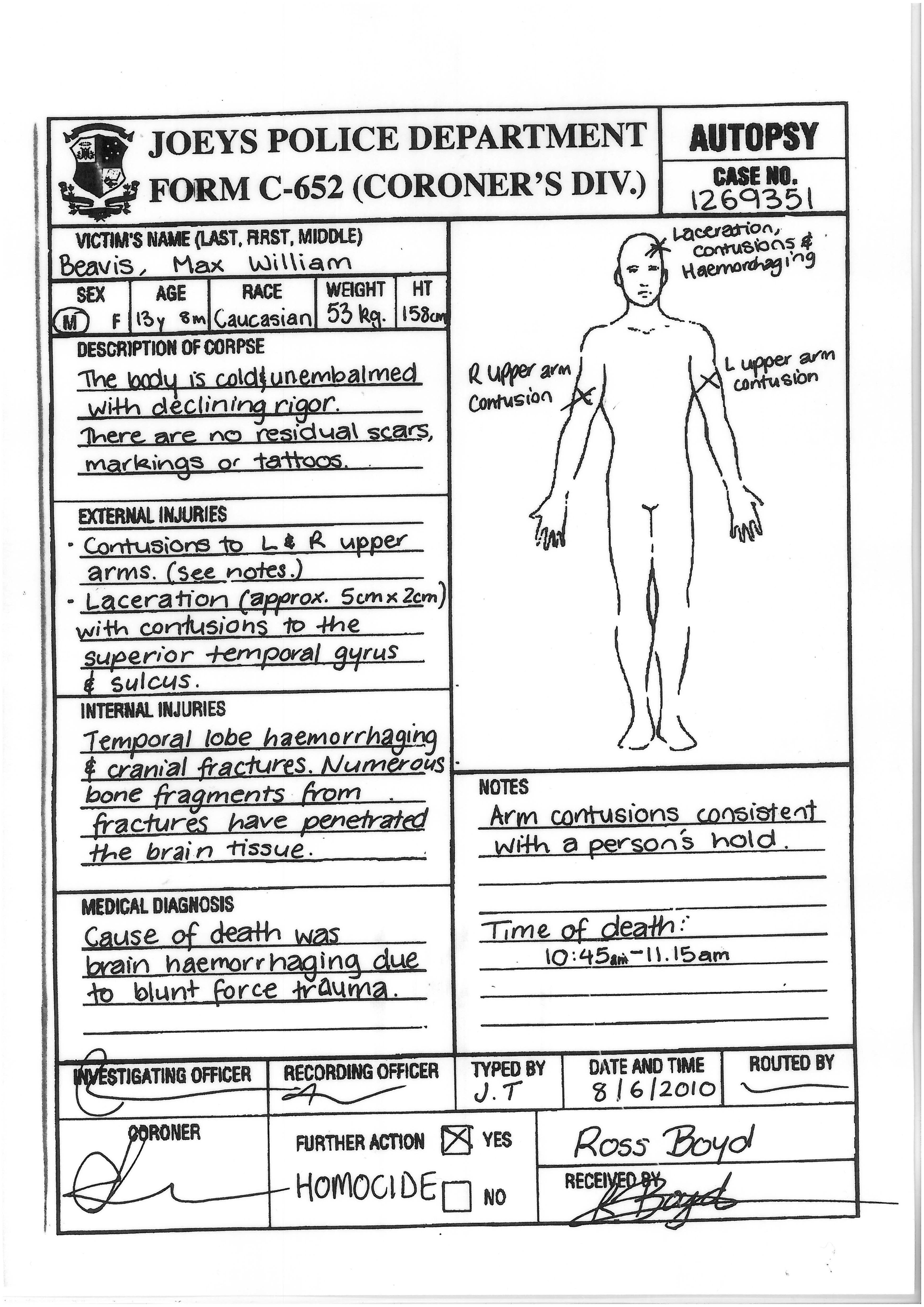 Did I mention I have the best Library Team on the planet? This was just such a fantastic experience!
Google has acquired Metaweb, which indexes things or “entities” in the world.
In a video explaining what they do, Metaweb talks about how the internet is not just words and for search to be the most relevant, it should be able to determine the context of the search term.
Last year PC World authors even called Google’s approach to search “aging” and talked about the search giant’s strategic moves to revamp its algorithms using semantic search.

