Here is a fascinating, entertaining and informative video outlining what the Semantic Web might be, and why it is important.
Vodpod videos no longer available.
more about “Web 3.0 on Vimeo“, posted with vodpod

Here is a fascinating, entertaining and informative video outlining what the Semantic Web might be, and why it is important.
Vodpod videos no longer available.
This is an outstanding presentation from Meredith Farkas, that has much to offer school libraries too!
Here is an example of how one educator used social technology to promote the use of social media for collaboration and learning in his school. Awesome!
Digital Literacy across the Curriculum (pdf), from FutureLab, UK, is a 63-page handbook aimed at educational practitioners and school leaders in both primary and secondary schools who are interested in creative and critical uses of technology in the classroom. The handbook is supported by case studies (pdf) of digital literacy in practice and video case studies.
The handbook aims to introduce educational practitioners to the concepts and contexts of digital literacy and to support them in developing their own practice aimed at fostering the components of digital literacy in classroom subject teaching and in real school settings.
Developing digital literacy is important because it supports young people to be confident and competent in their use of technology in a way that will enable them to develop their subject knowledge by encouraging their curiosity, supporting their creativity, giving them a critical framing for their emerging understandings and allowing them to make discerning use of the increasing number of digital resources available to them. p.10
Developing digital literacy in the classroom can allow students to apply their existing knowledge of creating with digital technology to learning in school and in the process be supported to think more critically and creatively about what it is they are doing. p.24
Fostering creativity in the classroom involves applying elements of creativity to subject knowledge. This can be done in all subjects across the school curriculum. p.25
This is an outstanding document that can be used as an information primer for helping schools develop a whole-school approach – particularly relevant in the current 1:1 laptop scenario in Australia.

What next you ask? How about Stickybits!! With Stickybits we are now able to attach digital content to real life objects, and share this content with anyone else who accesses our Stickybits barcodes.
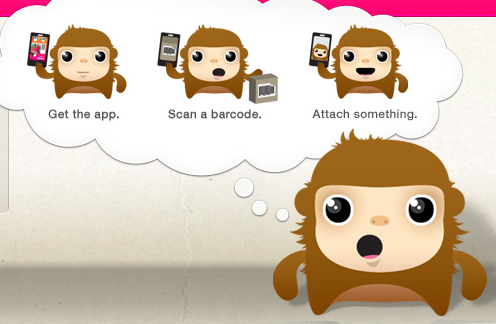
The current phase of social media is all about location-based applications, such as Foursquare, Gowalla and Brightkite, to name a few. By downloading the Stickybits mobile application on an iPhone, users can scan the barcode and which provides the videos, photos and text which have been added, which are referred to as “bits.”
 Anyone that scans the barcode, can see the bits loaded from other users and also add their own content. Stickybits barcode locations can be identified on a map provided in the application and are tracked on the Stickybits website.
I think there are things we could do with this for professional or fun things, as well as develop ideas for school.
You can attach photos, videos, music, pdfs, and more to a barcode.
It is possible to print out your own barcodes, order some snazzy ones from Zazzle, or attach ‘bits’ to existing barcodes.
Here is where it could get interesting for schools – we already have barcodes on objects – now we could attach information goodies to items that are being used for reading, learning, playing, enjoying. Would we? This is definitely a whole new idea to explore.
Would you use Sticky Bits? What would you attach to your barcode?
TechCrunch has a bit to say too:
Every place and object in the world has a secret past: who lived there, who passed by, who touched it. The secret lives of objects are filled with such details. If only you could make them talk. But what if you could give any physical object a story simply by sticking a barcode on it and appending a message to that barcode?
The barcode in a greeting card , for instance, could trigger a video message from the sender. One on a box of medical supplies could inventory what is inside. A business card with a code on it could link to a resume or LinkedIn profile. Museums and theme parks could use them for audio tours and maps. Local merchants could use the barcodes to track deliveries or place them in their storefront windows to distribute digital coupons and offers to passersby.
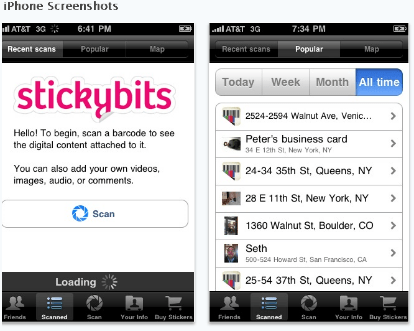
Laura Gainor used stickybits as a travel journal for a Disney World trip with her family from April 16 – 19, 2010!
Vodpod videos no longer available. Web 3.0 or the Semantic Web is the development of the web as data are given meaning (semantics) which enable computers to look up and eventually “reason” in response to user searches. It’s early days yet, but because of that, it’s particularly interesting to delve into these changes to see how the Semantic Web might affect education.
The Semantic Web holds three key features that are of interest to me. The first is the capacity for effective information storage and retrieval. The second is the capacity for computers to augment the learning and information retrieval and processing power of human beings. The third is the resulting capacity to ‘mix and match’ that will extend and expand knowledge and communications capabilities of humans in multiple formats.
The Semantic Web is a vision of information that is immediately understandable by computers, so computers can perform more of the tedious work involved in finding, combining, and acting upon information on the web. As the Semantic Web becomes more of a realization, new technologies will also continue to enhance the learning process making flexibility and adaptability a keystone of learning. The unlimited mashup of dynamic information, all portable and tailored to your preferences will be the vehicle for learning in the future.
Linked Data is powering the web but mostly outside of libraries, so libraries and those that deal with information (educators) need to catch up.
Technology is evolving extremely quickly, and consumers are driving delivery methods – “get it to me on my device”. Live Serials explains:
The information industry is all about helping people to find things and linking students to the resources that they need. We need to rethink how we do this, bringing the information directly to the user, in the format that they want. There should be no need to bounce the user via resolvers and multiple URLs to a site that eventually proclaims “Here it is!”. It should just be delivered.
Education needs to link students to resources and search is only one way of doing this, but an essential way nevertheless.
When a 16-year-old student writes about a new Semantic Search Engine and provides an extensive review of it – at a time when most teachers are even oblivious of the sort of choices that are ‘out there’, I begin to worry for teachers and be excited for our students.
Take the time to read Xavier’s review of Kngine at Kngine: The Smartest Search Engine Ever? which he says
aspires to be the next leader of the Semantic Web or commonly known as Web 3.0. The Washington-based revolutionary Semantic search engine functions similarly to Wolfram Alpha, but much better (based on my personal opinion).
Cool review, cool search engine!

This video aims to contribute to the design and development of visually stunning, fit-for-purpose libraries with learning spaces that support 21st century learning in extended school settings. It shows the contribution an effective library can make to the educational, creative, emotional & reading development of children and young people, and the aspects of design that can enable this.
Where is the one place in the school, where people come together, to share and exchange and swap, but do so with an expectation of academic ambition? It’s the library! Stephen Heppell
The school library is seen as the central space in the school for creativity, imagination and learning to be released.
Features Stephen Heppell with excellent contributions from schools around the UK. A very comprehensive rationale and presentation funded by CILIP School Libraries Group and MLA (Museums Libraries and Archives Council).
Though this video/DVD is not new, it is very relevant as we visit and revisit our future directions.
 While the short form musings of a generation chronicled by Twitter might seem ephemeral, the Library of Congress wants to save them for posterity — and Google wants to let you search them like an archive! We’ve already seen the 140-character status updates on what people are doing turn into a global publishing phenomenon.
Now Twitter messages will be archived permanently by the Library of Congress.
The Twitter archive of all public tweets, starting from its inception in March 2006, will join such august collections such as letters from the Civil War and famous photographs from Great Depression-era works project.
For its part, Google thinks you shouldn’t have to wait to start doing sociological and anthropological research into the Twitter archive — so it’s turning on a feature that lets you choose a point in time and start to “replay” the short-form messages from that point on. Google’s search combines Twitter updates with those from MySpace, Facebook and its own fledgling micro-publishing service Buzz.
The point of all this?
We’re watching the making of digital history – again! You may still have a lot of people to explain Twitter to – now you have an additional reason to make them sit up and take notice.

Wow! I have to say, the claims about Opera Mini – are – pretty genuine! At last, I can browse/jump around websites as fast on my iPhone as I do on my main computer. Plus it has lots of extra features and nice navigation options! Should be very cool on the iPad.
I have added Opera to my bottom navigation bar – bye bye Safari!
If you haven’t already downloaded the App – race on over to the App store and grab your new browser experience.

