We can solve this problem together!

There are many ways we can create learning environments for our students that will help develop their thinking and problem-solving skills. While I spend a lot of time working with technology and Web 2.0, I am fortunate to hear from my colleague, Nicole, about another technology approach – that is beaut for young kids!!!

Welcome to the world of Freddie the Bee-Bot! It is worth reading and absorbing the developing story of Bee-Bots Downunder, as youngsters in our schools engage in collaborative thinking and co-operation about their learning while they program Bee-Bot action.

A Bee Bot is a visually attractive, audible easily handleable programmable floor robot which can be used to support the development of skills in a wide range of areas. It allows learners to give a range of instructions from simple to more complex. It can be used for the development of fine motor skills by using the directional buttons. It can support imaginative play through the use of commercial or school designed covers. It allows learners to demonstrate skills in ways that a traditional approach would not support.

Nicole created a blog to keep a record of the learning these kids are doing. Nicole explains:

The children work collaboratively, and through their own experiences develop and use positional language, problem posing and solving skills and the ability to work co-operatively to achieve a goal. It is important that the students use whatever strategies that are meaningful to them to solve the problem.

Keep an eye on the developing achievements of our Bee-Bot kids at Bee-Bots Downunder. Fantastic work Nicole and team!

That 2020 Vision again!

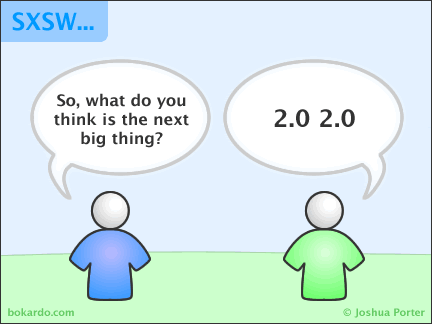
A while back I wrote about 2020 vision, and future directions. I wanted to share two graphics – one for the fun of it, the other for the ideas it raises.

Comic 2.0 2.0


Semantics of Information Connections and Social Connections.


Why the world isn’t flat…..isn’t it?

A few hectic weeks…..and a few frustrations later, I can’t help but reflect on the value of our global dialogue in helping us to ‘push’ our thinking in education. As I have mentioned before, the challenges of bringing an aging teacher workforce into 21st century thinking is sometimes overwhelming. Then good things happen, and I know that we are ‘going to make it’.

I have had quite a number of emails from colleagues who attended the presentation at the State Library on ‘2020 vision’. All have been to indicate how excited they were at what they heard, and what each person has been doing to get some Web 2.0 projects underway. I don’t always get an email – but I see activity in my wordpress hits; I see new delicious accounts setup; and I find new blogs linking to HeyJude.

We learn from each other – with a global reach. Just this morning I ‘skyped’ Carol from Fielding Graduate University…and I thank Web 2.0 tools for making this kind of professional exchange possible. I recommend taking a look at her Learning is Chaotic links. Carol has been doing some interesting research, so why not drop by and provide some feedback. I am hoping to link up with Carol and Fielding later in the year.

I am able to learn so much from classroom practitioners in my schools, in Australia, and around the world (I have some favourites in my Heyjude Blogrolls, and others are at Bibliosphere News; and new blogs are appearing everwhere, my most recent discovery being Principal Laffan’s blog Laffan Out Loud) – but right now I am fascinated by the work that Tom Barret is doing at ICT in my Classroom, and really enjoying watching how our students are Making the Most of Web 2.0 with his help. Tom says:

Our ability to connect has obviously greatly improved since the advent of this 2nd evolutionary web. The walls of all our classrooms have begun to tumble and we look further outward, the earth as they say has become flat.

We have had a ‘shakey’ start to the venture – but it is also part of the learning for our teachers. The enthusiasm is more than tangible – I can vouch for the teacher enthusiasm and commitment as I have skyped with Jamie weekends and up to midnight some nights!! (IM on skype is a great way of working into the wee hours, without disturbing family, plus it allows ‘next-gen’ multitasking, as we worked together to solve technical problems!).

What’s equally interesting is the number of times that Heyjude blog has been included as part of an academic program of study – universities here in Australia, Canada, and USA. I see this as exciting because it shows how the world of education IS flattening out – and even if I feel a bit like a ‘travelling roadshow’ at times, I know that I have to keep going.

Mind you, Web 2.0 is not what is important – what is important is the changing understanding of the learning landscape of our students, as well as our own opportunities for professional learning. I know this because my blog tells me that it is not only subscribers from English-speaking countries who are part of the dialogue.

So during the last week I discovered Adam Paszternak’s FIKSZ blog, and his post  Tíz technológia-alapú áramlatról könyvtárosokna which turned out to be Michael Stephen’s Ten Tech trends for Librarians. Here’s Michael’s take on the translation.

I’ve exchanged some Hungarian and English messages with Adam, and joined his Delicious links, and got some fun feedback on some of my shared links 😉 I am particularly enjoying seeing Web 2.0 developments through another language and culture, and seeing how innovation presents the same challenges and opportunities regardless of where we are.

Finally, this small reflection is really a response to a post from John Connell on Why the World isn’t flat. John points to an article by Pankaj Ghemawat, professor of global strategy at IESE Business School, entitled, Why The World Isn’t Flat, and asks for response.

I don’t claim to even begin to understand global economics – but I do claim to understand that I can’t be an effective educator without globalisation of my education work. Geographical boundaries, cultures and economies clearly do impact on what in happening in a locality – but is the global perspective that is driving the philosophical changes education. It is important to realise that we are in the middle of significant change – and just because of this, it can be to easy to say ‘well that won’t happen’. I don’t agree with Pankay Ghemawat, just because I think he is taking a short view of things. He says:

Of course, given that sentiments in these respects have shifted in the past 10 years or so, there is a fair chance that they may shift yet again in the next decade. The point is, it’s not only possible to turn back the clock on globalization-friendly policies, it’s relatively easy to imagine it happening.

For me he presents a narrow view when translated to education – a view locked to economic dialogue, without recognition of the cultural changes that are also affected, and which also create change (what happened to the cold war?).

The Australian Good Weekend Magazine ran an article on Shi Shengrong, an unassuming Chinese/Australian citizen known as ‘the sun king’ of solar energy fame – who is the richest man in China, and director of SunTech in Wuxi, China. It is the intersection of business with social responsibility that interest him most. He is determined to retain his focus on solar power and help solve the world’s polution problems. When asked about the goal of economic development he responds:

Few people answer that it’s about eating poisonous foods and breathing acidic air. But that’s what will happen unless we change course. We need to ask ourselves these questions. That is the real bottom line.

Yep! The world is flat – it’s just a matter of how we look at the matter, what period of time we look at, and the questions we ask that gives us the real bottom line.

In my presentations I talk about the profound changes that have taken place in learning in my lifetime. Now it is my responsibility to help ensure that the changes taking place for our students, at a much faster rate, will be fantastic.

Who’s Watching YOUR Space?


This is a great encapsulation of the OCLC Symposium: How do we operate as educators and information professionals? If you haven’t joined the conversation, or become part of the action, then it really is time to start.

We need to learn how to experience these technologies and put them into practice!

Click on the link to go to YouTube – the owner of the video does not allow this video to be embedded into a blog!

This is the 3-minute version of the most recent OCLC Symposium at ALA Midwinter 2007. More than 400 people attended this discussion of social networking practices and trends on January 19, 2007 in Seattle, Washington. Michael Stephens, Instructor, Graduate School of Library and Information Science at Dominican University and author of Web 2.0 & Libraries: Best Practices for Social Software, was moderator. The expert panel included: Howard Rheingold, a leading thinker on the cultural, social and political implications of communications media and virtual communities; danah boyd, PhD candidate at the School of Information at the University of California, Berkeley and Fellow at the University of Southern California’s Annenberg Center for Communications; and Marc Smith, Senior Research Sociologist, who leads the Community Technologies Group at Microsoft Research. The full video (2:23:19) can be viewed at http://www.oclc.org/index/symposium

Judgement and Web 2.0

At the beginning of the year, Will Richardson commented on his lack of enthusiasm for 2007. The problem seems to be (amongst other things) a lack of progress in relation to changes in classroom pedagogy and Web 2.0-style 21st century learning.

While I sympathise with his frustrations (he IS an evangelist), I also consider that it will only be our evolving understanding of these contexts that will make 21st century learning work.

For example: the debate in 2006 around the value of Wikipedia as a significant online knowledge resource. There were those who insisted that Wikipedia showed the way of the future. There were others who spoke about the significance of this collaborative model. Just a few spoke about problems. While stuck in this debate, the real issue remained untouched – a shift of control!

Where is ‘judgement’, and what are we doing to create learning that promotes ‘judgement’? Learners need to be engaged in activities at a level of deep understanding about why or what they are trying to learn. So what did you tell your students about the value of, and use of, Wikipedia within their learning? Have you praised it’s value?

John Connell, in Fact and Fiction and Wikipedia shared a ‘must read’, salutory experience with Wikipedia from Joe, an authority on John Donne. This is the real Wikipedia – valuable, and invaluable at the same time! Judgement needed at all times – the kind of ‘judgement‘ that is nurtured by information professionals.

All the promotion of Web 2.0-style learning will not change anything really – I guess the source of Will’s ‘down‘ moment – unless we include ‘judgement‘ in the mix. This is where regular Web 2.0 evangelists don’t quite ‘get it’.

What do I mean? I mean the whole idea of searching for information, comparing, contrasting, and synthesising, and engaging deeply, and if needed, slowly in the way that Geetha Narayanan has shown us has great value. I would throw literacy and reading into the mix as well.

But for now, I suggest that Web 2.0 envangelists must consider a more proactive approach to judgement in Web 2.0, built on good searching and sourcing of knowledge components – otherwise we are in danger of building global parochialism!

So…… go and learn more about the Web 2.0 tools of searching. You could start with the Top 100 Alternative Search Engines.

il.jpgGo learn how to motivate and challenge learners by supporting students online and offline in their information-seeking behaviour . Read They Might Be Gurus – a good-humoured account of the strengths and weaknesses of teen researchers and you’ll get my drift.

Then consider how you will foster ‘judgement‘.

Our kids need to think deeply and think well in a Web 2.0 world.

Is the medium the message?

Response to Web 2.0 … The Machine is Us/ing Us

This recent video on YouTube continues the dialogue about the “The Medium is the Message”. It’s important not to be swept up by the ‘hype’ and to continue to focus on the value of the read/write web. I also like the way this video points us towards the future that SecondLife is busy developing. The blend between our various realities is hard for us to grasp………so let’s continue a healthy dialogue around all the issues and possibilities! Will you make the next video? 🙂

YouTube becomes mainstream media

A lot of talk in education about YouTube has centred around the ‘dangers’ of thisScreen shot Russell Brand on YouTube open-access, user-generated visual content repository. In some places this adds up to “if you can’t control it, then block it”.

So the report from BBC news – BBC Strikes Google-YouTube Deal – puts a new twist on media and news distribution, and shows how Web 2.0 tools are re-aligning the global media & communications industry.

BBC has struck three deals in one with YouTubenon-exclusive and set to run for several years.

  • BBC: One of the BBC’s two entertainment channels will be a “public service” proposition, featuring no advertising.
  • BBC Worldwide: The second entertainment channel will feature self-contained clips – about three to six minutes long – mining popular programmes in the BBC’s archive.
  • BBC News: The news channel, which will be launched later this year, will show about 30 news clips per day.

The BBC’s director of Future Media and Technology, Ashley Highfield, said the deal was “not about distributing content like full-length programmes; YouTube is a promotional vehicle for us”.

Thanks BBC! – what you’ve given us is a promotional tool to counter-act hysteria in some education circles.

Youtube Ban Comic

Music to my ears!

Travel guides on your iPod, music, movies, podcasts, e-books, language programs ….. so many things to carry on our iPods.

BUT if only I had this sort of fun-techno tool to learn my music theory back in my youth!

I love my iPod/s and so I was particularly interested to read about iTheory, from Duke University.

iTheory is a beginning music theory ear-training program for the iPod which allows on-the-go users to practice interval recognition, scale recognition, chord recognition, and perfect pitch. This program is a complex network of over 600 interactive text notes with links to over 200 audio clips. All iPods with the Notes feature – 3rd, 4th, and 5th generation iPods, as well as the iPod mini and iPod nano – are able to use iTheory.

Grab more information and instructions from iTheory and download iTheory Notes and iTheory Sounds. “ya gotta love it”

iTheory

Technologies on the Horizon

The New Media Consortium (NMC) is an international 501(c)3 not-for-profit consortium of nearly 200 leading colleges, universities, museums, corporations, and other learning-focused organizations dedicated to the exploration and use of new media and new technologies.

The consortium serves as a catalyst for the development of new applications of technology to support learning and creative expression, and sponsors programs and activities designed to stimulate innovation, encourage collaboration, and recognize excellence among its member institutions.

The NMC’s Emerging Technologies Initiative focuses on expanding the boundaries of teaching, learning and creative expression by creatively applying new tools in new contexts. The Horizon Project, the centerpiece of this initiative, charts the landscape of emerging technologies and produces the NMC’s annual Horizon Report. Reports have been produced for each year since 2004, and are availale at the Horizon Project Wiki.

The 2007 Horizon Report is now available. The 2007 edition is a collaboration between The New Media Consortium and the EDUCAUSE Learning Initiative (ELI), an EDUCAUSE program. While the report focusses on the tertiary sector, the information is highly relevant to schools.

In the body of the report, each featured technology includes specific examples, but as the horizon moves farther out in time these tend to be more isolated. Their research indicates that each of these six areas will have significant impact on college and university campuses within the next five years.

  1. User-Created Content. It’s all about the audience, and the “audience” is no longer merely listening. User-created content is all around us, from blogs and photostreams to wikibooks and machinima clips.
  2. Social Networking. Social networking may represent a key way to increase student access to and participation in course activities. It is more than just a friends list; truly engaging social networking offers an opportunity to contribute, share, communicate, and collaborate.
  3. Mobile Phones. Mobile phones are fast becoming the gateway to our digital lives.
  4. Virtual Worlds. Customized settings that mirror the real world—or diverge wildly from it—present the chance to collaborate, explore, role-play, and experience other situations in a safe but compelling way. These spaces offer opportunities for education that are almost limitless, bound only by our ability to imagine and create them.
  5. The New Scholarship and Emerging Forms of Publication. The nature and practice of scholarship is changing. New tools and new ways to create, critique, and publish are influencing new and old scholars alike.
  6. Massively Multiplayer Educational Gaming. In the coming years, open-source gaming engines will lower the barrier to entry for developers, and we are likely to see educational titles along with commercial ones.

The report is worth a read!

Delicious Postscript:

To create the 2007 Horizon Report, the 27 members of this year’s Advisory Board engaged in a comprehensive review and analysis of research, articles, papers, and interviews; discussed existing applications, and brainstormed new ones; and
ultimately ranked the items on the list of candidate technologies for their potential relevance to teaching, learning, and creative expression. Most of this work
took place online in 2006, using a variety of tools, including a special wiki site and a set of del.icio.us links dedicated to the project. The del.icio.us tags are listed under the “Further Reading” section of each of the six topic areas, and readers are invited to view not only the resources that were listed in the report, but many others that were used in our research as well.

Readers are further encouraged to add their own examples and readings to these dynamic lists by tagging them for inclusion in each category.

The (local) secret is out!

While attending the professional seminar at the State Library of NSW, I was not only busy with my presentation and workshop – I was also there to receive an award for

innovative and collaborative teaching practices integrating information and communication technologies

The John Lee Memorial Award is sponsored by Charles Sturt University, and is presented annually by the Australian School Library Assocation (NSW) President and a representative of Charles Sturt University. It was fun to meet with Ashley Freeman from CSU (pictured) as I have been a member of his ‘marking team’ in the Master’s program in the last couple of years.

It was a special honour for me to receive this award, as I worked with John Lee (in whose memory this award is made) in my early years as an information professional, being inspired by him to “think big” and to be future focussed at all times.

John, I think your inspiration has paid off!