You smoke! You die!….for literacy.

year-6.jpg Literacy is still the focus for our project work at Good Shepherd this week – today it was Year 6 using Photostory to consolidate their learning about ‘smoking’.

After doing their research from the Cancer Council about the dangers of smoking, Megan asked the students to create a poster representing a key aspect of these dangers for an anti-smoking advertisment campaign. Students created a storyboard for their work, and were then able to record a supporting statement for each poster. Put these together – and bingo! a podcast of their own about the dangers of smoking. This was all ‘first time’ for these students – and the integration of visual, text and audio literacy skills were the bonus learning experience. Love your work Megan 🙂


I think bloggers don’t read….Cult of the Amateur

From the Guardian Unlimited comes a write-up by Tim Dowling about Andrew Keen, the man who says the internet is populated by second-rate amateurs – and that it is swiftly destroying our culture.

Denizens of the cyberswamp? A million monkeys at a million typewriters? Misplaced faith in the integrity of the amateur – the citizen journalist, the self-published author, the mash-up musician?

To my mind Wikipedia is not wise,” says Keen. “It’s dumb. Not necessarily because all its contributors are dumb, but because if you don’t have an editor in charge, and you don’t have singular voices, then the intellectual quality of what the crowd produces is very low.

Dowling says that Keen’s argument strikes a chord with certain professions, particularly librarians, editors and educators  (oh, that’s my group!). Keen’s critics, on the other hand, see him as defending a largely abandoned redoubt: old media, with its outmoded “gatekeepers” and structural hierarchies.

Read the article and catch up with the criticism.

The Book: The Cult of the Amateur, with the no-messing-about subtitle “How Today’s Internet is Killing Our Culture and Assaulting Our Economy”.

Who says….

………..that Twitter isn’t catching on?

Reading Emerging Technology Trends and Diamonds are fuel cells’ best friends. Did you know that researchers have “invented a method to make oxides such as cubic zirconia (zirconium oxide) with extremely small grain sizes, on the order of 15 nanometers. A nanometer is one-billionth of a meter, or the size of a few atoms. At that scale, the crystals conduct electricity very well, through the movement of protons. The material could be used in fuel cells that are based on chemical oxides.”

This is what caught my eye…

There are 180 followers since April 08.

This puts a whole new spin on RSS. I can see the value of joining a twitter feed for ‘breaking news’.

It’s interesting to speculate how twitter might be used in schools? But my speculation drew a pretty big blank – can’t imagine what value it might add right now! Everything I thought of was answered in my mind with another application. You might like to prove me wrong?

What else my schools are doing…besides blogging!

Websites are a powerful information and promotional tool for encouraging enrolments and creating community awareness ……… and ceo.jpgCatholic Education (Parramatta, Sydney) (where I hang out!) is working on the development of a content managed template-based websites for all schools in the Parramatta Diocese that can be customised to suit each school’s personality and needs.

All our schools will have a website that is professionally designed, dynamic and current, easy to manage, but most of all – effective. I have seen some of the work in the pilot schools, and it is ‘right on the button’ web design and effective

The easy-to-use Content Management System (CMS) will allow schools to modify and maintain the content of their website with no fuss and will make updating content, pictures and menus on websites very quick and easy for all staff.

The aim is to reduce/remove duplication of information and processes, and to fully integrate with our central database and intranet which feeds all sites with information allowing for restricted access to “staff only” information. Of course, the first stage will feature all the usual CMS features that makes life easy for school staff – managing text, images, pages and galleries etc. It will also provide RSS feeds to syndicate website content. Cool!

Even cooler will be the additional developments planned further in the rollout – cool stuff like easy upload of audio and video files, Web 2.0 tools (like wikis and podcasting), easy creation of newsletters and automatic delivery of E-News, multi-lingual support, and (not to forget marketing) search engine optimisation and access to website statistics to gauge site effectiveness.

Good one!

.

Facebook – friend or foe?

Facebook has announced that it has hit 30 million active users. Unlike MySpace, Facebook doesn’t pad its numbers with dead accounts: these people log in at least once a month. As you can see by extending the graph below, the number of active users has doubled since the start of the year.

We also have a battle of the DIY networks – for example, Richard McManus tells us that Ning is one that has a higher profile than others described – and this network tool is one that is very popular with teachers.

My problem right now is that I have too many networks! Is this part of why Facebook is taking off? …….. the fact that there are more and more applications that can be plugged into Facebook saving me from acting like a jumping bean?

I’m not yet sold on Facebook – but on the other hand I am pretty tired of skipping from one NIng network to another – and overwhelmed by the fact that I could actually be writing what amounts to a blog on each of my networks. Chills the spine.

I think that Ning is better exploited on specific projects with specific groups and not as a worldwide collaboration platform. But Ning is evolving and fantastic things keep being added. Will we find a Ning IN Facebook eventually, or is there another [r]evolution around the corner? driven by API and widget developments.

We’re told that a major development in the history of widgets occured just this week; the W3C published a draft of the first widget specification. The goal of this effort is to standardize how widgets are scripted, digitally signed, secured, packaged and deployed in a way that is device independent, follows W3C principles, and is as inter-operable as possible with existing market-leading user agents on which widgets are run.

The rise of widgets was caused by several factors including the adoption of RSS, the expansion of the blogosphere, growth of social networks, fashion of self-expression and the democratization of the web at large. I think that “Widgets-R-Us”!!

Read more on the topic at the Evolution of Web Widgets.

Virtual communities as a canvas of Educational Reform

Some recent online reads have prompted me to write about learning within our ‘shape-shifting’ technologically driven world. If you are new to blogs and online tools, let me tell you that there is a lot happening – but don’t let that put you off getting involved.

There are many different perspectives to put on online social networking and it is important to know where one is coming from when talking about social networking and youth. The perspective(s) one has will be very different whether one is a parent with a teenage daughter on MySpace, a marketing executive interested in the target group “14 to 20,” a journalist looking for the next big news story on young people and new media, a youngster using a social networking site as part of everyday life or a researcher investigating how young people are using social networking sites.

35Perspectives on Online Social Networking provides a different (broader) exposition of online networking. Here we have an excellent overview that helps me to see the matrix of inter-relationships between sectors or groups. That, after all, is what our real world is – and online virtual interactions are no different. Don’t let me forget that.

So that was what WOW2 was a bit about – educators in one countryexploring education ‘downunder’. I have to thank the WOW2 team for the fabulous opportunity to take part in the WOW2 EdTechTalk recently. It was pretty cool chatting to my aussie mates Graham Wegner and Jo McLeay. But I also ‘met’ Jason Hando, who (rather surprisingly) is in Sydney, doing great things as well. No excuses for us not keeping in touch are there?

Actually I think that what Sheryl wrote in Virtual Communities as a Canvas of Educational Reform is a ‘must read’ for school leadership teams working on capacity building and educational reform. She says:

The way I see it, social networking tools have the potential to bring enormous leverage to teachers at relatively little cost — intellectual leverage, social leverage, media leverage, and most important, political leverage. And while most of us reading this post can name educators across the globe that are using these tools as windows from their classrooms to share ideas and develop their own personal learning environments, the sad truth is that most aren’t. The burning question in most of our minds is how can we accelerate the adoption and full integration of 21st Century teaching and learning strategies in schools today?

Creating virtual communities that function effectively within and beyond our schools IS a significant challenge.

Our system of schools has been actively exploring these options in 2007 (fabulous!) – and we are definitely learning from the experience. We began the year by formally launching a blogging strategy. Unfortunately we didn’t address some of the important questions that Sheryll raised, and as a result our first effort at system-wide blogging ‘came a cropper’. Well, not totally, but it was no surprise really as some of the vital ingredients of social collaboration were missed starting with the first important point – who is blogging and why?

The best blogs are social – and we missed that point – and are platforms where discussion blooms. Blogs in this context of collaboration can’t be the stuff of soapbox but must be the stuff of open-ended conversation – and that means writing as well as commenting.

I like the fact that we continue to try to figure out what sort of virtual communities will work for us. We’re game for the challenge, and won’t let disappointment stop us from pursuing educational innovation and reform.

Now we have a new strategy to experiment with. The start of Term 3 saw the official launch of the ‘Learning Common’ blog – open to all teachers to write, comment, collaborate, and share the ups and downs of teaching life. We have merged a number of blogs into one, and opened up the option to be a writer to anyone in any school. Will this work?

Richard McManus covers some important things about blogging within the context of virtual communities asking Is Blogging Dead? Gosh, we are just starting with blogging, so I don’t think our teachers will be abandoning our new blog for something else. But, Richard says

It’s hard to get discussions going on a blog, but the blogs that at least attempt it and actually write for their readers — these blogs are the most compelling in my view.

I agree that this is at the heart of the matter. Let’s hope we can make the blog compelling reading – a place that people really want to be to share their ideas. So let’s see what happens. We’re pretty keen on blogging, and many of us blog!!!

We just haven’t cracked the whole virtual community thing yet, but I think we’ll get there.

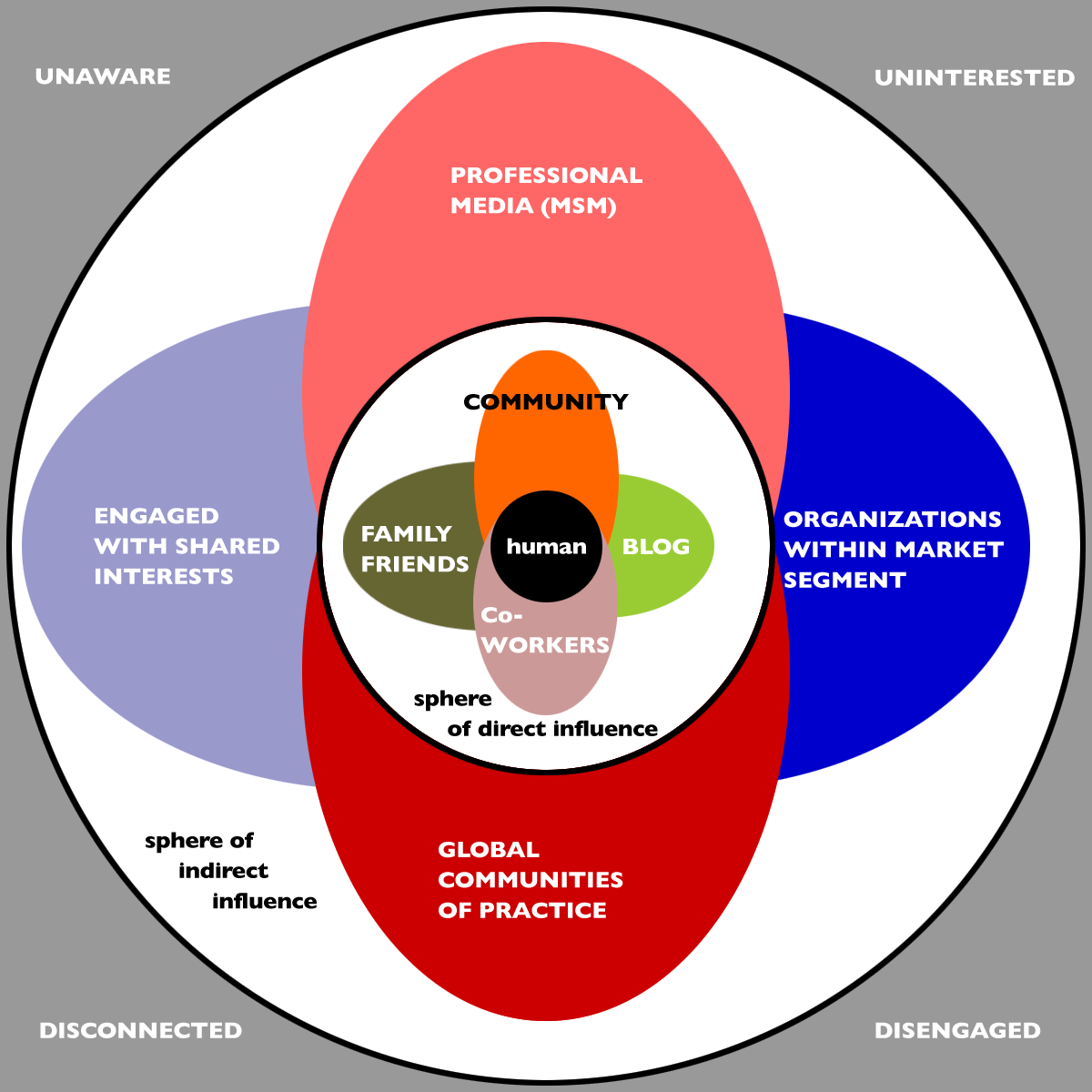
It’s all about spheres of influence. This graphic says a lot, and is easily adapted to provide us the guidelines for successful blogging – that builds capacity as part of our educational reform!

Sydney twitter meetup – be there!

twitter.jpg

For all you twitter fans or “would-be” twitterati! based in Sydney – you need to know that we have a
Sydney Twitter Meetup on Wednesday 25 July at 6.00 pm.

Pier 26 Bar
Pier 26, Aquarium Wharf, Wheat Rd, Darling Harbour
Sydney, New South Wales

More details at Upcoming.

Twitter has created quite a buzz for itself in the first quarter of this year- managing to combine the ease of Instant Messaging and SMS with the reach and scope of social networking services. So what’s all the buzz about?

Twitter: A beginners guide will give you all the information you need, and fill you in on this social networking phenomenon. I don’t think everyone is ready for Twitter – but I have found it a real boon for keeping in touch.

I don’t have a public profile – as I only really want to twitter with people involved with education. All up I have 65 friends – leading educators from around the world as well as in Australia – more than I could hope to keep in touch with using ‘traditional’ methods of communication like email!

“heyjudeonline” (me) is not online all the time – but when I link in I can quickly catch up. I also have the option of sending messages directly to my ‘friends’. I like the zany personal touch that twittering allows. It might be a passing fad – but twittering is part of the evolving shape of online communication – so for now I tweet! I do this online at twitter, or within FaceBook.  There is a Sydney Twitter Meetup in Facebook!  I’ll have to get myself invited 🙂

I don’t use my mobile to tweet – but I will certainly turn it on for the Sydney twitter meetup!

Why don’t you come and join me?

WHAT a podcasting toolbox!

OK, who can keep up with the good stuff coming out of Mashable these days!

If you don’t already subscribe – you should give it a go. I find the email option invaluable, as the truth is that I don’t always get to read all the stuff in my RSS feeds. Don’t miss out – subscribe to Mashable today!

So now Mashable has given us another great list:  the Podcasting Toolbox: 70+ Podcasting tools and resources. Thanks Mashable 🙂

Social networking in plain English

Create + Learn + Broadcast = L3RN

A very impressive Web 2.0 presence from Seattle Public Schools who have clearly got a great lead on integration of social networking into their learning frameworks!

Know as L3RN – Learning equals creating, learning and broadcasting, A visit to their fantastic portal is a must. School libraries have their own area for News, tips, resources, and help from Seattle Schools’ libraries.

The portal has browse, video, audio, docs and channels in its suite. Fantastic.

Thanks to Awapuni for ‘links for you’ through Del.ici.ous!

[Cross-posted from: iLibrarian because it is too important to only post in one place!]