I couldn’t resist sharing this presentation from Sarah Houghton-Jan. You know – you really don’t have to have megabucks to squeeze the best out of interactive web spaces – just a co-operative and flexible IT manager!
Category Archives: Communication Tools
Don’t turn a digital blind eye…

Denver Convention Centre
So here we are – back at school again! After the amazing ISTE2010 conference in Denver Colorado, I can honestly say that I came away packed with inspiration, and refreshed by the multiplicity of exciting approaches being tested and proved for their value in schools around the world.
There were many highlights, but above all, the message came across loud and clear from top to bottom that we need to be proactive and adventurous in digital environments. Don’t guess – collaborate and learn from others! Build academic rigor through excellence in digital innovation.
I was so impressed with the schools that have a solid track record of integration of handheld devices such as the iTouch. They have shown us that it IS possible to have secure networks AND robust learning taking place that transforms opportunities for students. Even more exciting was hearing from those that are also exploring the added advantages that an iPad can bring to flexible learning. Of course, educators also reveled in the opportunity to explore and share Apps for the iPad. ISTE2010 was groundbreaking for me – seeing so many iPads in one place was amazing! Oh yes, the TL Learning Tools Smackdown was a real winner!
It was exciting to hear and see Howard Rheingold in person, in his Crapdetection 101 session. He has so much to offer us in understanding issues around good critical thinking in our digital environments. Take the time to watch his presentation, and then visit ISTEs critical thinking compendium.
So back to school for me and the challenges of digital learning.
Thanks to our Powerful Learning Project initiative, our Digital Citizenship program delivered through a private Ning is once again alive and active with a plethora of curious, clever, colourful and amazing expressions of learning by our Year 7 boys. I know @snbeach will be pleased!

I love watching what happens in the first week! Some boys are really excited (once again) to be working in an environment that to them ‘is like Facebook’ – which makes it cool! Others can’t help but use the Ning environment to ‘shout out’ about topics that are close to their hearts – who should win the next rugby game; should Ricky Ponting be dropped from the cricket team; and personal reflections on home and school. At the same time, boys are able to reflect on the topics being discussed in class, and sometimes amaze me with their insights into their own digital world.
For example:
Cyberbullying is common and mainly occurs because the person on the other side of the screen can’t see how hurt the victim is and they think it’s all a big joke to them. It is one of the largest forms of bullying because it doesn’t have any physical requirements, like conventional bullying does, but can be done by anyone. It is a major problem and is mainly based from social networking sites, not from SMS’ and phone calls because they are too intimate in communication.
One of the most annoying things about cyberbullying is anonymity and not knowing who is bullying you. It also is only effective in large groups so you feel excluded and like everyone is against you, unlike when you know you have friends to support you and back you up. If I experienced cyberbullying I would probably tell a teacher and document all the incidents so that the cyberbullies would get into trouble and hopefully learn a lesson.
Digital Citizenship cannot be ignored. Out of 160 + boys, only a few believe that they have had any help or guidance from parents or teachers in these digital environments. So our digital initiative is being ‘rolled out’ via our English faculty – communicating in digital environments seems a very good reason to adopt this as our own (yes Darcy – I’m an English teacher too, so perhaps rank as a small part of your English Literati set perhaps in some small way?)
Other examples:
This is all well and good that the school’s IT group has put all this time and effort in to making this program but I have a an idea that this is just a trap for cyber bullyers. Because I’m gathering that school has no jurisdiction over our use of Facebook.
Ning is sooo cool, its just like a mini facebook, I can learn soo much from this!!
The important message is that the world is changing really fast and in order to keep up with all the new and exciting things, we also need to no how to use these things in a responsible matter.
Cyberbullying = cowardice!
Very perceptive !
These environments are so important in both social and academic spheres.
Why do some educators continue to turn a digital blind eye?
The world is now a global village
Marshall McLuhan explores the world as a Global Village in 1960 – with extraordinary relevance to our 21st century reality!
Electronic media haven’t wiped out the book. It’s used, read and wanted now more than ever. But the role of the book has changed. It’s no longer alone. It no longer has sole charge of our outlook nor our sensibilities. Of course the trouble is, we act as if we were still solely in the age of the book.
Oh yeah!
Oh my! Twitter makes history for Google search
While the short form musings of a generation chronicled by Twitter might seem ephemeral, the Library of Congress wants to save them for posterity — and Google wants to let you search them like an archive! We’ve already seen the 140-character status updates on what people are doing turn into a global publishing phenomenon.
Now Twitter messages will be archived permanently by the Library of Congress.
The Twitter archive of all public tweets, starting from its inception in March 2006, will join such august collections such as letters from the Civil War and famous photographs from Great Depression-era works project.
For its part, Google thinks you shouldn’t have to wait to start doing sociological and anthropological research into the Twitter archive — so it’s turning on a feature that lets you choose a point in time and start to “replay” the short-form messages from that point on. Google’s search combines Twitter updates with those from MySpace, Facebook and its own fledgling micro-publishing service Buzz.
The point of all this?
We’re watching the making of digital history – again! You may still have a lot of people to explain Twitter to – now you have an additional reason to make them sit up and take notice.
Via Andrew Hiskens on Twitter and Wired.

The Digital and Literacy World of Young Children
A new report from the Pearson Foundation examines how digital media is affecting early literacy around the globe.
How is digital media changing the way young children learn? Could the way young children learn be evolving to meet a new, dynamic digital media format?
Authors Jay Blanchard, a professor at Arizona State University, and Terry Moore ask these and other questions in their new report: “The Digital World of Young Children: Emergent Literacy” (PDF), out this week from the Pearson Foundation.
The white paper was released at the annual Consortium for School Networking (CoSN) International Symposium.
Blanchard and Moore conclude “developmental milestones are changing as today’s children approach learning and literacy in new ways, not thought possible in the past. “
The paper is worth a read, especially for understanding our current context around the emergent literacy needs of primary-aged students.
(via Spotlight on Digital Media and Learning)

Did you know what’s happening to the Internet?
This is another official update to the original “Shift Happens” video. This completely new September 2009 version includes facts and statistics focusing on the changing media landscape, including convergence and technology, and was developed in partnership with The Economist.
Thanks to Wes Fryer for the tip-off in his post Can you Imagine So Much Global Sharing? My answer is – I never could, even though I’m an avid reader of SciFi. Dreaming and doing are quite different things!
Also in the same post – a peek at the state of the Internet.
2010 is one amazing year!
Vodpod videos no longer available.
Tsunami – in the classroom?
I wonder how many classrooms in Australia will spend time this week talking about, reviewing and learning about the impact of earthquakes and tsunami on countries and people?
This weekend saw the earthquake in Chile and the tsunami it created affecting many parts of the world. The Chilean president declared a state of catastrophe after a deadly quake of magnitude 8.8. Subsequently warnings of tidal waves were issued in 53 other countries.
In the Guardian’s Report Chile Earthquake: Pacific nations brace for Tsunami we have a good lead article to set the scene for discussion.
The Tsunami raced across the Pacific and threatened Hawaii as it rushed toward the U.S. West Coast and hundreds of islands from the bottom of the planet to the top. Sirens blared in Hawaii to alert residents to the potential waves. As the waves expected arrival drew near, roads into tourist-heavy Waikiki were closed off. Police patrolled main roads, telling tourists to get off the streets.
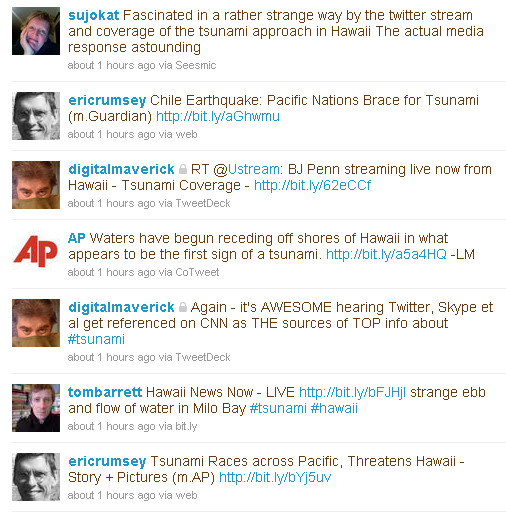
It’s not new – social media has a well established co-reporting global events!
But do your teachers know this? Do they know powerful social media is in providing information and synchronous coverage of event?
Did they pick up the links they need via Twitter? of Facebook? or other social networking site?

Perhaps they already have the Associated News App on their iPhone (find it in the App store) and were aware of events that way? or via another mobile App? or heard it on the news?

Did they send out a message (text? IM?) to their geography students to alert them to the CBS News Stream via Ustream so they could experience live some of these events – even if only for a few minutes?
Not only were the media doing live reports online, as well as on TV, but people in the streets were contributing picture and live phone feeds and images to contribute to the pooling of information.
Twitter was buzzing.

Don’t forget to check out Diigo and Delicious during the week to find more links from other ‘connected’ teachers. 
From a student’s point of view – social media tools allow them to experience these incidents live and hear the authentic experiences of people observing the event.
By Monday there will be plenty of online media sites that will have stories, videos, etc to use for class review. But none of that is as good as experiencing a live report! How many teachers will be ready to immerse their students in learning with the very tools that students love to use?
Here’s someone ready to incorporate this type of learning into their uni classes – Magnitude vs Intensity in Chile. Learning can be amazing.
Larry Ferlazzo provides The Best Sites to Learn about the Earthquake in Chile (& possible Tsunami).
Go on teachers – give it a try!! Here’s a great map of Estimated Tsunami arrival times to get you talking.
The picture below shows the live CBS News UStream.

Open Source ethos
I have been spending a bit of time thinking about The World is Flat by Friedman in preparation for the first Flat Classroom Project in 2010. Amongst other things, I thought about Open Source thinking and flat world communications which I planned to share in the Keynote kick-off.
Well, you now how it is – I just couldn’t share everything I wanted to (lots out in the rough cuts), but the ‘finds’ are still inspirational.
You have to be inspired by the powerhouses of Open Source software and Open Content. There is no doubt in my mind that an ‘Open Source ethos‘ is the best way to collaborate, create, share, and be empowered to inspire future learning.
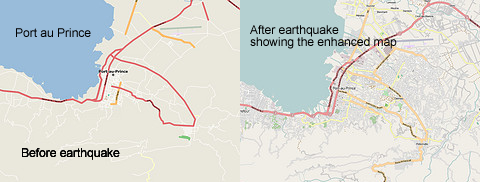
For example, during the crisis in Haiti, the Open Source community did amazing work in Haiti OpenStreetMap to assist aid and rescue workers to do their work and help the relief and reconstruction effort. It was a Flat Classroom Project in action – creating up-to-date maps of Port au Prince. Dozens of mappers and developers were able to lend a hand, coordinating on the OSM Haiti WikiProject.
Thanks to Paul Hamilton, I was inspired by yet another amazing example of the power of work taking place using Open Source Software to help people. The development of the Eyewriter is inspirational. The Eyewriter uses low cost creative technology an free open source software to enable graffiti writers and artists with paralysis to draw using only their eyes.
Vodpod videos no longer available.Climbing up the social ladder …
Two and a half years ago Social Technographics presented a visual analysis of social technology behaviour. Despite the rapid pace of technology adoption, the rungs on the ladder have shown steady growth, with some (like Joiners) growing faster than others (like Creators). In an update – Social Technographics: Conversationalists get onto the ladder – which includes not just Twitter users, but also people who update social network status to converse (since this activity in Facebook is actually more prevalent than tweeting).
Where do you fit on the ladder?

LazyFeed – lazy and productive
I admit to being a web wanderer – lazy random browsing in the topic areas that interest me is wonderful, and it’s amazing what new things you find, what you can enjoy, and what you can learn. My RSS reader is ‘chockers’ – so I can’t just keep adding possible feeds for reading.
Rather belatedly I’ve also discovered LazyFeed. Perfect!
If you are more into tracking stories on a particular subject like technology, music etc rather than tracking specific blogs then LazyFeed could be the tool you need. You just need to sign up and add your favourite topic…. via MUO.
I’ve been using it for a few months now, and just love the flexible way of trawling on my favourite topics. OK, it’s not going to aggregate and store the same way as my RSS reader (Google + Feedly) but it’s going to keep sifting and providing an online reading experience for me any day that I want to drop by!
According to the founder, LazyFeed is like instant messenger for your topics. It’s a tech tool that suits the slow adopters of technology! Got some nice enhancements in January too!
Another recommendation came my way via @RadHertz.
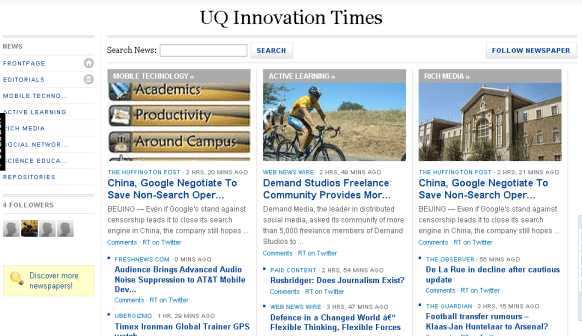
NewsCred lets you launch an online newspaper in minutes. Cool! Read more about this from Louis Gray.
Here’s an example from UQ Innovation Times. Nice :-).