I list Blade Runner as my favourite movie in my Facebook profile. So naturally I am pretty interested in the release of “Blade Runner: The Final Cut” on DVD.
IT’S been 25 years since the release of “Blade Runner,”Ridley Scott’s science fiction cult film turned classic, but only now has his original vision reached the screen.
The film, based on Philip K. Dick’s novel “Do Androids Dream of Electric Sheep?,” takes place in Los Angeles in 2019. It follows a cop named Deckard (played by Harrison Ford) who hunts down androids — or, in the film’s jargon, replicants— that have escaped from their slave cells on outer-space colonies and are trying to blend in back on Earth.
For the new director’s cut, the special-effects footage was digitally scanned at 8,000 lines per frame, four times the resolution of most restorations, and then meticulously retouched. The results look almost 3-D.
The story also takes on some new twists and turns , providing a darker perspective of future society – read more at the New York Times, and be sure to view the FilmFuture clip with Fred Kapplan’s commentary of the future as depicted in Blade Runner.
Likely to be an even more hypnotic and challenging movie! A media studies must!
For our schools it is time to take a well-earned break with the term 3 holidays now underway. So it’s time for me to have a bit of fun on this blog too before I get back to more serious matters….
Time to talk about wonderful things…boing boing style …. prompted by my lightweight breakfast reading of the Sun Herald (no, not my choice of paper).
An article there about a device that creates plates, bowls and other tableware on demand and recycles them (a Star Treck fan like me recognises this!) , produced as a prototype by MIT led me to comment “I bet they got that from boing boing!”
A little research showed me that Boing Boing listed the story Dishmaker: Printer for Dishes on February 12, which came from Gizmodo, who had linked to this story 12 months earlier at TreeHugger. Well, here’s a video about the earlier prototype…you are looking at the beginning of replicators for us all 🙂
By the way, boingboing is a weblog of cultural curiosities and interesting technologies, and is listed by Technorati as Number two blog in the world, with Engadget, the number one blog in the world, having replaced boing boing at the top.
Boing Boing is a ‘beaut’ blog full of eclectic news!
Today I read about a recent “in-world” labor protest that took place in Second Life. The company in question: IBM. The aggrieved: 1850 avatars, including some bananas and triangles. Link.
I discovered a beautiful Gallery of Illustrated Endpapers. What are they? Endpapers are the inside covers and facing pages of books. Today, endpapers are almost always blank. But our more sophisticated forebears made good use of endpapers by adding thematic illustrations to them.
Use Text2Go to transfer information from the web to your iPod, so you can listen to it on the go. Sound like a gimmick? Maybe, but just think about the educational implications of such a tool for our students – anyone who needs audio support to access and enjoy text.
From Melbourne, this software (for a very small cost) could be used to turn free eBooks available at Project Gutenberg into audio books for your library, to loan out on your ipods or mp3 players.
In fact, anything that might be available in digital format could be converted this way. Are there limitations? I don’t know. The idea is a very good one for schools to look into further.
Whether you’re podcasting, making movies, working on music or media projects – then you’ll love this collection of resources from Soundsnap.
While you are at it – join up and contribute – or ask for help on your next problem or project idea from someone on the Forum. A quick browse of the Forum will give you an idea of the range of things possible when working with sound.
She gathered people’s favourite Top Ten Tools for Learning from 100 educators around the globe. Over 400 different tools were named in total, but the final list was created in order of popularity. The top 100 tools received 3 or more (positive) mentions. The results can be seen here in a neat comparison table with links to sites providing the tools.
It’s a great resource for anyone looking at their knowledge working environment and wondering where to improve.
Choose several different tools to get things done in your knowledge working landscape – tools for gathering, processing, networking, sharing, and scheduling because Learning is a Conversation and learning (not schooling) is our context.
Thanks to the ICT Guy’s post about their professional learning day with Scratch – Creating Games with Scratch – I have been reminded to look into this great creative tool.
SCRATCH is a new programming language that makes it easy to create your own interactive stories, animations, games, music, and art — and share your creations on the web.
Scratch is designed to help young people (ages 8 and up) develop 21st century learning skills. As they create Scratch projects, young people learn important mathematical and computational ideas, while also gaining a deeper understanding of the process of design.
Scratch is available free of charge, go to Download, and there are support documents available to get you underway.
Help turn your kids from media consumers into media producers, with their next Scratch project!!
CreateSpace is the new name of Amazon’s on-demand self-publishing service for the super long tail of books, audio CD’s and film DVD/Blue-ray. Products automatically get an ISBN number(a huge draw-card) and are listed on Amazon.com, including “Search Inside” for books. This extends what is on offer, when compared to Lulu and other self-publishing sites.
The National Archives in USA and CreateSpace will be publishing movies from its collection of over 200,000 public domain films, raising some interesting copyright issues i.e. will public domain files ‘go viral’ either online or via home CD copies?
Getting into Google explains that Google is coming out with a new tag called “unavailable_after” which will allow people to tell Google when a particular page will no longer be available for crawling. For instance, if you have a special offer on your site that expires on a particular date, you might want to use the unavailable_after tag to let Google know when to stop indexing it. Or perhaps you write articles that are free for a particular amount of time, but then get moved to a paid-subscription area of your site. Unavailable_after is the tag for you! Pretty neat stuff!
Barry Shwartz reports that Bloglines released a new public beta of their popular web-based RSS reader. The new Bloglines beta is optimized to run well in Internet Explorer 7 and Firefox.
The new beta has several new features including a customizable start page with drag and drop AJAX functionality, three feed viewing options including a “Quick View,” “3-Pane View,” and a “Full View.” New enhanced AJAX drag-and-drop makes feed management and ease, plus a new “Unread System” that makes marking feed items clearer, quicker and easier.
No need to worry, Read/Write Web has a comprehensive review of the new beta Bloglines, plus there is a lot of coverage at Techmeme. You can also read Gary Price’s write up at ResourceShelf.
These three things – nice juxtaposition don’t you think?
84 million dollars would be a nice bonus for anyone – but it seems the government has wasted that amount of funds (again?). Reports are coming in now about the recently released ‘free net filter’ made available to Australian families.
The SMH reports that Tom, a Year 10 student, took about 30 minutes to break through the government’s new filter, released last Tuesday. He can deactivate the filter after several clicks, while making sure the software’s toolbar icon is not deleted. This way his parents would believe that the filter is still working.
Meanwhile another SMH report tells us that staff in the Department of Prime Minister and Cabinet have been editing Wikipedia to remove details that might be damaging to the Government.
Oh dear!
UPDATE from John’s great post The Blush of Power: The Sydney Morning Herald Mashup page has a discussion on How Good Is NetAlert and Boredomistan has a run down on his test run of one of the filters.
I’ve been tracking with some interest the very useful compiliations that Mashable (social networking news site) has been putting together for addicts of anything Web 2.0. I’ve shared a few of them – and now I must share another!

 I’m more and more impressed by the options available to provide good reading and literature options in iPod format.
 I list
  For the new director’s cut, the special-effects footage was digitally scanned at 8,000 lines per frame, four times the resolution of most restorations, and then meticulously retouched. The results look almost 3-D.
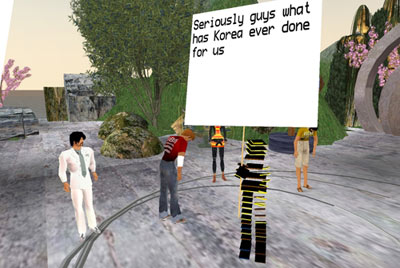 Today I read about a recent “in-world”


 Jane’s E-Learning Pick of the Day

 CreateSpace
 (again?). Reports are coming in now about the recently released ‘free net filter’ made available to Australian families.
 judyoconnell.com