Gaming for learning – and the young

Anshul Samar is a 13-year old founder and CEO of Elementeo, a company operating in the field of education.

Enter the chemical battlefield with Elementeo, a game of chemistry. Two strong wills fighting against each other in a midst of an epic chemical battle, constantly trying to reduce their opponent’s IQ to ZERO. Armed with their arsenal of elements, compounds, and nuclear reactions, these chemists strive to create, combat, and conquer the world!

Teemu Arina says

Isn’t that exiting. One more young CEO who thinks the educational system is not doing an adequate job and decides to fix things himself. Reminds of myself when I was 16 but Anshul beats me by 3 years.

I recommend a read of Tarina, Teemu’s blog. He is partner and CEO at Dicole Oy, a company focusing on understanding the role of social technologies in knowledge work and networked learning in organizations.

Who are you teaching today that is really a CEO in school uniform?

Mobile technology…2020

To tempt you to investigate the Horizon Project, I am going to share this great video by Atif from the International School Dhaka, in Bangladesh. He’s done a great job creating this video to highlight the possible changes and uses of mobile technology in education in the future.

Technorati Tags: , , , ,

Thinking about Web 3.0…with IEEE Internet Computing

For a long time now I have been thinking about Web 3.0 – not to join the hype, but to better understand the potential of web developments that will effectively merge thinking in disparate fields.

Unlike some of my colleagues, my thinking (and my blog) bounces between two distinctive fields or disciplines – education and pedagogy vs technology and information science. I think I am lucky, because too often I see the errors of thinking that some educators (and leaders) perpetuate in the guise of keeping up with the (21st century learning) Jones!

google.jpgWeb 3.0 is getting some blogosphere air-space – and about time too. Adaptive hypermedia research has been around for many years, nicely juxtaposed against developments in search alogorithms and enhancements with various serach engines. A dawn of a new era? Certainly not according to Jean-Noel Jeanneney in his book Google and the Myth of Universal Knowledge. Google’s digitisation project has provided a healthy jolt to our complacency, and the assumption that digital initatives = fantastic developments. Here is the true rub of machine generated, folksonomy driven hierachies where virtual information is being brewed in a global cauldron.

In my view, we should be less interested in the utopian dream of exhaustiveness than in aspiring to the richest, the most intelligent, the best orgainzed, the most accessible of all possible selections. …Jean-Noel Jeanneney

It is time to focus on the cultural and knowledge aspects of Web 2.0 as it moves to Web 3.0, if for no other reason than this digitisation of our society provides challenges and opportunities for equality or repression like never before.

For this discovery of yours will create forgetfulness in the learner’s souls, because they will not use their memories; they will trust to the external written characters and not remember themselves…….PLATO, Paedrus, translated by Benjamin Jowett

Phil Midwinter asks Is Google a Semantic Search Engine, and goes on to explain that Google is using semantic technology, though it is not yet a fully fledged semantic search engine. He is more optimistic about developments.

There are barriers that Google needs to overcome… is it capable of becoming fully semantic without modifying it’s index too drastically; can Google continue to keep the results simple and navigable for its varied user base? Most importantly, does Google intend to become a fully semantic search engine and to do so within a timescale that won’t damage their position and reputation? I like to think that although the dragon is sleeping, that doesn’t mean it’s not dreaming!

A business-oriented write-up, which nevertheless has important considerations for the educator/information professional. The key thing is that there appears to be a convergence in thinking around the fact that “semantics” will form the backbone of what might be dubbed “Web 3.0”. The Wikipedia entry on Web 3.0 talks of leveraging semantic web for 3-dimensional collaboration…even as far as to point to this as being on the evolutionary path to artificial intelligence! (the stuff of many SciFi stories)

However, what we are really needing to examine closely, is the rise of the API culture – as this is transforming what it is we can seek or serve our knowledge-seeking selves!

Read/Write Web to the rescue! Another excellent write-up from Alex Iskold on Web 3.0: When Web Sites Become Web Services. Well, I suggest that we need to do a lot of reading and learning about folksonomy and taxonomy … and more. Let’s say, more posts for another day.

BUT what we do know already is that the Semantic Web efforts are providing an approach to constructing flexible, intelligent information systems – and it is the synergies between ubiquity and semantics that are exciting, and in which we should expect to see significant future work.

Read more about this in Embracing “Web 3.0” in IEEE Internet Computing.


Technorati Tags: , , , , ,

‘What hath God wrought’

Lots of discussion in the blogosphere about the merits or hype associated with Web 2.0. Two particular posts challenge readers to slow down….

Bryan Appelyard writes in the Australian IT with a cautionary view of Web 2.0, suggesting that ultimately Web 2.0 will only be good for us if, somehow, it succeeds in evolving towards an identity-based discourse. All else is mere anarchy.

In the AASL blog heated debated, inspired by Twitter reflections, also indicates that people are in Web 2.0 overload. The pressure is on, particularly with our current API driven expansion of Web applications – as seen at the Museum of Modern betas! or that fascinating Web2.0 Directory.

Never mind.

From that most esteemed institution of American Librianship – the Library of Congress – we now have the Library of Congress Blog, launched today. The very first post links right into the idea of change, change, change – at the heart of Web 2.0.

How did I find out about this? Through Steven Cohen on Twitter of course 🙂

What hath God wrought? The blog leads right into the topic with….

Those were the first words ever transmitted electronically, in 1844, by Samuel Morse. That message and Morse’s invention of the telegraph marked what was undeniably, at the time, the most significant communications revolution since the advent of movable type.

Technorati Tags: , , , , , , ,

Changing scope of social networking

I can’t begin to keep up with the range of social networking options that are available to me – and you! There is no doubt that the scenario put forward by those two canny journalists, Robin and Matt, back in 2005 with EPIC 2014, and EPIC 2015 is just happening and happening…….

I’ve been catching up on Twitter (should you or shouldn’t you?), playing around with Ning! (which needs a good focus to make it work well …. gosh, I belong to too many networks, and so for my money Ning is now too cumbersome for quick networking. However, I believe that a focused activity in Ning is very good for professional networking and project work).

But to go back to EPIC 2015 for a moment…..then take a look at NingVisualisation, and at Twittervision.

This morning Twitter gave me this; showed me Tumblr in action; and got me to explore Picnik. I got a peep into the lives of my professional colleagues who so readily shared their moments of insight with their friends. I am wondering where this is fitting into the learning needs of our students. The Horizon Project might help us work some of this out.

This cartoon catches bit of what is happening now in social networking 🙂

Technorati Tags: , , ,

The Horizon Project – they’re at it again!

I want to thank Julie Lindsay, Vicki Davis and others involved in the Horizon Project for once again showing us the exciting benefits of a global e-learning experience. Aren’t these students just awesome?

Like the award-winning Flat Classroom Project (2006), this new project involves students, this time 60 students in five countries, working together to look into the future of education based upon the Horizon Project Report 2007 Edition by the New Media Consortium and Educause (pdf).

The key trends identified in the Horizon Report which will be explored by the students are:

This project (using Wikispaces, Delicious, Slideshare, Ning, Twitter, Meebo, YouTube and many other online tools) is a ‘trip to the future’ where students will envision, create, and discuss what this future will look like withothers around the world. Through their work on the wiki, the students will be researching and experiencing web 2.0 enabled learning in a global community.

Student work will be assessed against three criteria related to the objectives of the Horizon Project.

  • To understand, analyze and evaluate the trends highlighted in the Horizon Report 2007based on key ideas and areas of impact.
  • To create a project wiki page that details this investigation and synthesis of the material.
  • To use Web 2.0 tools to facilitate collaboration as well as creation.

The comprehensive rubric is worth reading. They also made use of ISTE technology standards NETS.S (revised) for ‘What students should know and be able to do to learn effectively and live productively in an increasingly digital world’.Explore the Horizon Project, the Teachers’s Page and the Students Page.

The students come from USA, Austria, Bangladesh, Australia and China.

I have been invited to join the group as a member of the Expert Review Panel, supporting and reviewing the section on Social Networking. I expect to learn a great deal from these wonderful educators!

Vicki Davis, from Camilla, Georgia, has a beaut introduction to The Horizon Project available at Ning.

Julie Lindsay, from Dhaka, Bangladesh, (who is an aussie) has put a nice introduction to the project on Youtube. Horizon Project Introduction.

Technorati Tags:

Second Life Classroom – Not School, Not Home

Schome Park, in Teen Second Life, is a classroom run by the pupilsI have tried to encourage my ‘system’ colleagues to take 3D virtual worlds seriously – at least to run some pilot projects or join in some 3D initiatives.

Absolutely no success on that for me (blank looks 😦 ), but I am glad to see that not only Australians (e-Leadership team within Learnscope projects), but also educators in the UK ARE taking the future seriously.

The Guardian reports on a pilot project during which around 200 members of NAGTY (The National Association of Gifted and Talented Youth) aged between 13 and 17 will be exploring Teen Second Life.

Plenty of information is available at the Schome Wiki.The Scho-Op on Schome Park

Schome (the education system for the information age) is going to be a new form of educational system designed to overcome the problems within current education systems in order to meet the needs of society and individuals in the 21st century.

Explore Schome and their Second Life Project.

Better still, view Schome Park on Youtube.

Addition from Kerrie Smith: Sites of Interest for Educators in SecondLife .

Also Lindy McKeown, ACCE and ISTE ICT Leader of the Year 2006, is ‘doing’ her PhD on use of 3D learning environments. She has set up Terra Incognita in Second Life as an island for educators. Read more about this from Kerrie in her post Thinking about Second Life, VLEs and other 3D environments.

Forcast of Worldwide Information Growth

The Expanding Digital Universe: A Forecast of Worldwide Information Growth Through 2010 IDC white paper—Sponsored by EMC “The incredible growth of the digital universe means more than simply the fact that as individuals we will be facing information explosion on an unprecedented scale. It has implications for organizations concerning privacy, security, intellectual property protection, content management, technology adoption, information management, and data centre architecture.”

The implications to be absorbed by education are important.

You can download the complete whitepaper and/or the Executive Summary from The Expanding Digital Universe

[Via Jane’s E-learning Pick of the Day]

Have you joined your friends in Ning! yet?

Recently one of my school colleagues, Jan, wrote about Ning on our blog Bibliosphere News – alerting all of a new ‘MySpace-like’ environment that is being explored by educators. As our schools are particularly interested in emerging Web 2.0 tools, she encouraged us to…

Have a look at Steve Hargadon’s School 2.0 social network and see a social network in the making. He’s using Ning, a social network builder, and then look at Bill Drew’s very active Library 2.0 network (includes school libraries but not confined to education).

Certainly Library 2.0 has a great pool of members, (up to 850 the other day) and it will be interesting to see how this develops, and what it offers that is different to blogs and blogging. Like all social networking sites, Ning incorporates flexible ways of communicating and sharing information – easily! I can communicate with my friends, keep track of a number of Ning networks, and use it to create projects of my own.

It is worthwhile checking out Library2.0, Classroom2.0, School2.0 and SecondLife Librarians which is just starting up. There are others too, and (as usual) you can easily find networks of interest via the spiderweb of networks of your friends! (I must say I am not running a seperate blog in each of these – and one of the things I would like is the flexibility to link my blog from each of my networks if I wanted to?)

I really like the use of Ning by the StopCyberbullying network. A beautifully crafted use of Web 2.0 tools to collaborate on this important topic. Great use of Feed Digest to provide the body of content from all the resources that members of the Network have identified as valuable on this topic.

I have already planned to use Ning for a Learnscope project – which will provide the collaborative professional learning environment for teachers involved in VTE Information Technology at Year 11.

LearnScope focuses on work-based staff development. The beauty of LearnScope is that it enables participants to design what, where, when and how their learning will take place during the life of the project (6 months June – November). LearnScope moves beyond traditional expert-centred professional development models to focus on relevant, participant-driven opportunities.

The flexibility of Ning to allow each of the teachers to maintain a blog and share the their own reflections in this environment is a powerful option for this project. In addition, it is easy to share video and photo files, links and other files; embedd other Web 2.0 API such as bookmark tag clouds, clusty search cloud, Google calendar, or whatever; have good threaded discussion in the Forum; have quick comments with chatter……and more! This has got to be a great environment for expert-centred virtual, 21st century professional development.

But as the spruker says  ….  that’s not all!

The one thing I was missing was a wiki…not that it is hard to create and link to a wiki as they have done in Classroom2.0 linking to Classroom 2.0 Wiki.

So the email from BillDrew@Library20.ning (yes, you get an email account as well) was most welcome:

Coming in June, the network will have a wiki component added to it. It is currently in development by Ning programmers. I will add a feature on the main page to spotlight a service or a new tool such as javascripts. Please send me items and ideas for such a feature.

Catch yourself some good movies added to Ning via TeacherTube or FlipShare.

Building an Online Community

Sheep may Safely Graze

Go meet someone new in Ning! today!

That 2020 Vision again!

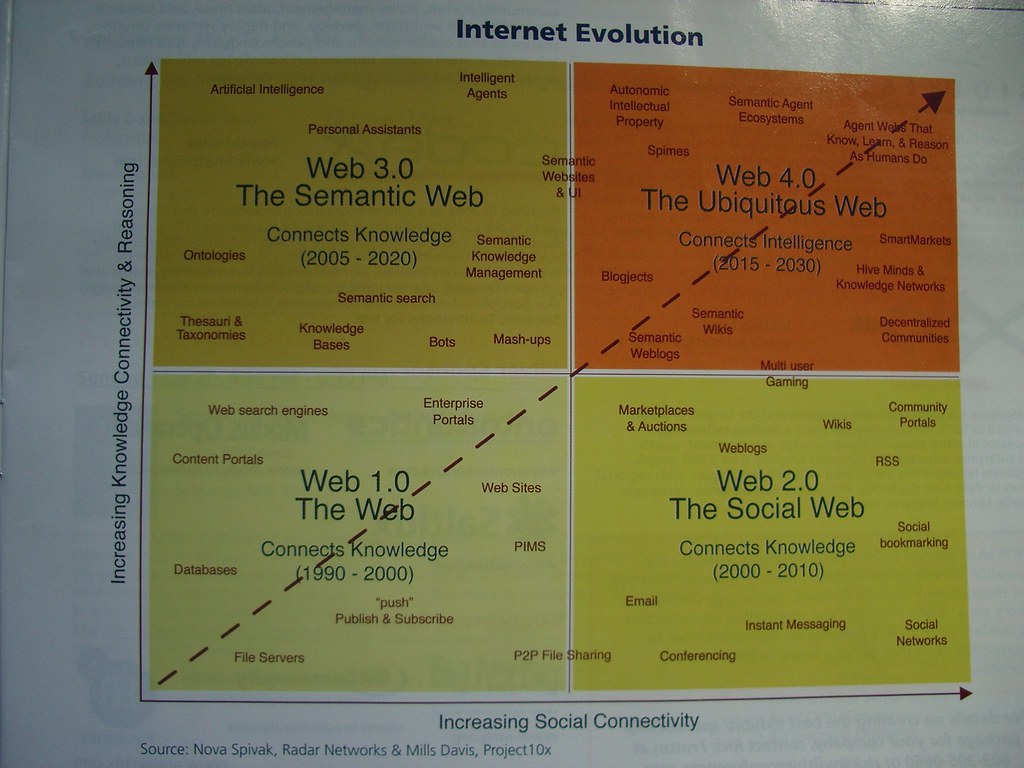
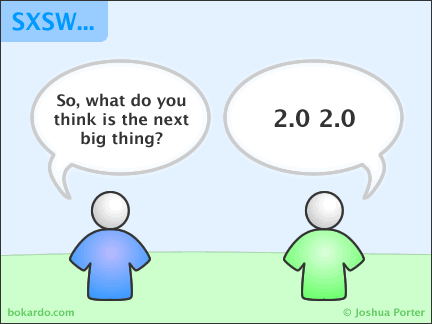
A while back I wrote about 2020 vision, and future directions. I wanted to share two graphics – one for the fun of it, the other for the ideas it raises.

Comic 2.0 2.0


Semantics of Information Connections and Social Connections.