Google – friend or foe?

ASCD SmartBrief Reports:

Google courting teachers with new tech resource
Google for Educators, a new Web site launched yesterday, offers guides and lesson plans detailing creative ways to use Blogger, Google Maps, Google Earth and nine other Google applications in the classroom. The site also offers links to a training academy that will allow teachers to become “Google certified.” Silicon.com (10/12)

Google says:

Google recognizes the central role that teachers play in breaking down the barriers between people and information, and we support educators who work each day to empower their students and expand the frontiers of human knowledge. This website is one of the ways we’re working to bolster that support and explore how Google and educators can work together.

The whole thrust is about ideas for using technology to innovate in the classroom. The Google Generation certainly deserves teachers who can think differently about the use of technology. But this list of tools smacks of the usual ‘tech tool’ approach – classrooms with more ‘bells and whistles’. Given the Google purchase of YouTube, the possibility is there that Google tools might actually reflect Web 2.0 think?
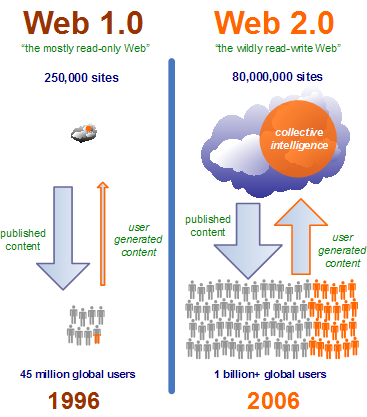
web1web2.png

On the other hand, the list is a tantalising one to throw before teachers who are starting out, if only because Google has become such a ‘staple’ friend of teachers and students alike.

Let’s not forget the strength of the Read/Write web as demonstrated by this graphic from popoever.

Web 2.0 is about collaboration and remix, and syndication of data in such a way that anyone, anywhere can use use the results.

Web 2.0 does not lock the reader/writer into rigid technology actions — it intentionally forfeits that control in favor of much greater returns.

Let’s hope that Google remembers that! What I am particularly interested in is the concept of ‘expanding the frontiers of human knowledge’. Web 2.0 alone will not do this, nor even come close to facilitating this. Web 2.0 is a new environment, with new options, new possibilities, new dimensions to human cognitive engagement.

However, I see little evidence yet of Web 2.0 moving beyond into serious investigation of the semantic web and the new spaces for thinking deeply by extracting deep information! Web 2.0 Google tools for educators doesn’t address this at all – not even remotely.

Knowledge Strategy for school libraries

Who is going to guide educators in understanding cognitive information strucutures of the mind, of virtual and physical resources and new ways of interaction in a Web 2.0 environment. The technology evangelists in schools believe they have the answer!! Google the world, use wikipedia, and scrap the school library for a virtual information locker! Nuts! Or more frighteningly a solution as rigid and dangerous as ‘book burning’.
A hundred years before the advent of Hitler, the German-Jewish poet, Heinrich Heine, had declared: “Wherever books are burned, human beings are destined to be burned too.”

On the night of May 10, 1933, an event unseen in Europe since the Middle Ages occurred as German students from universities once regarded as among the finest in the world, gathered in Berlin to burn books.

In the new era of Web 2.0, school principals and technology evangelists are attacking school libraries by ‘burning’ the books – rather than doing to libraries exactly what we have to do to class rooms …… Change change change change…. and learn from the leading digital repositories in the world that are using technology to preserve literature, movies, images, etc. I hate lots of school libraries, the way that they are run, the way they look, the way school leaders ‘abuse’ their potential in the schooling of our students. But the solution is not to close their doors, but to initiate a reform as comprehensive as the one that needs to take place in our classrooms.

What does our Knowledge Strategy need to become? I’m thinking about it! Are you?


Learning Agenda Web 2.0 style

While some of my colleagues are at the Australian Computers in Education conference in Cairns, I am catching up on another batch of marking for Charles Sturt University before flying out to HongKong for a very well earned rest. When I get back it will almost be time for the Global Summit, where I hope to see a few of my fellow bloggers.

John Connell will join us at Catholic Education, before the Global Summit, ‘in conversation’ and to inspire us with his work in Scotland. Might have a podcast to share afterwards if John is happy with the idea. If you haven’t dipped into John’s blog, I highly recommend it. I have no idea how one person can think and write so much, but be assured that you will be challenged by the diversity of his posts.

I’ve been doing some writing for the office in the last couple of weeks, teasing out ideas around future directions and our learning agenda. One concept that has tested thinking for a few people has been around the whole issue of learning management systems (LMS) and virtual learning environments (VLE). Funnily enough some of my colleagues get stuck on debating semantics and how to describe systems that we are rolling out for our schools. As if describing the system will somehow make it more worthwhile or more relevant?

In fact, what we should be focussing on is the Web 2.0 world of our students and their personal learning environments (PLE). Remember, its a combo-world. In Macca’s sales speak – we are constantly ‘upsizing’ and offering ‘fries with that’ because we have to!

Today we can deliver TO student expectations beyond the LMS and VLE that have emerged in recent times as the answer to learning for a 21st century technology world.

The emergence of Web 2.0 and social software moves us beyond the use of integrated LMS or VLE to social networking and education immersed in the future world of our students. No use debating which LMS to buy, or what a VLE is! Understand MySpace and you will understand the shape, meaning, value, future directions of student learning.

In fact, any discussion of the educational value of LME or VLE, and the integration or separation of social software must must be grounded in new ‘MySpace pedagogy’ and must include a genuine understanding by educators of the Web 2.0 world of our net-savvy students.

I suggest that we need a combination of a number of tools: a management system, personal tools and social networks. Our integrated solution requires this personal learning environment, because the very nature of what our students do and how they use online spaces extends their learning beyond the classroom and the present …. right into the future …. for life and for lifelong learning.

In fact, ‘Web 2.0 as platform’ is the natural implementation and platform for 21st century learning.

It’s time to dream the impossible dream and leap beyond the context of our current understandings.

Flexibility and personalisation are at the core of our re-purposing of education. If students think about the internet as a virtual locker, backpack and notebook, then we must create flexible learning environments which support the use of multipe resource tools, including Web 2.0.

If we do this, then we will have a learning framework that is Web 2.0, 24/7, global, contextual, personalised, real, physical, virtual, and visceral.

We’ll help our students be passionate about their personalised learning!

Now, off to HongKong 🙂

The internet, yesterday, today and tomorrow

Extraordinary as it may seem, we are living through a significant part of world history, as startling as the changes heralded by the invention of the Gutenberg press.

futures

Whether of not you need convincing that radical times are upon us, you can’t afford to miss exploring Imagining the Internet. Here you will find past, present and future; voices, predictions, visionaries and kids; as an ongoing record and dialogue of developments. Best fun of all is reading theVox Populi – crazy and thought-provoking!

The debate and developments around MySpace continues. Mashable reports on MySpace alliance with Seventeen as well as the development of the MySpace Guardian toolbar.

Seventeen has a Saftey Guide for Parents available for download.

We are working hard to stay in touch with Internet developments, and help our teachers and school community work effectively with the developing internet and Web 2.0 tools.

At a technology forum earlier in the year I was invited to talk about Web 2.0 and the shape of learning for our Google kids. Though not sophisiticated you might like to view/listen to the presentation. Thanks to Stephen Abram for sharing some slides for the presentation.

The Knowledge Tree

The Knowledge Tree enables the sharing of research and innovation in global e-learning practice.

Edition 11: The Knowledge Tree Goes Communal , looks at what it means to be in community on the Web, that is, examining what is community or communion, the structures being used to create Web communities, the types of communities that are emerging, the processes used to facilitate online communities, the relationships being formed within Web communities and the uses of Web communities in education.
Nancy White of Full Circle and Associates in Seattle, United States of America, is featured in this edition with her article titled of ‘Blogs and Community: launching a new paradigm for online community?’. Nancy has long been a leader in the field of online community facilitation and online community development.

You can join Nancy through ‘live conversation’ in a live Elluminate session on Tuesday 26 September at 2.00pm AEST (Monday 25 September in US). This ‘live conversation’ represents a great opportunity to dialogue with Nancy before she conducts her national speaking tour around Australia from 7 – 27 October.

You can enter this session with Nancy an hour before the scheduled 2.00pm start.

Building an education strategy for metadata

On quite a different note, but nevertheless favourite topic of debate for me…well not debate really as teachers and educators don’t think about this…is a metadata focus.

I was diverted back to this track by a post from the Really Strategies Blog and a planned focus group meeting in New York City on the knowledge and usage of industry standards and metadata.

Now, as an information professional, metadata means a lot to me! But for the average educator reading this blog, take it from me – without metadata our learning management systems, our knowledge management structures, and almost everything we are building up in our online world is dependent on GOOD metadata.

What is metadata? Well, it is information about any resource either physical or digital, and enables management and organisation of information. Metadata is used to facilitate discovery and retrieval of information; enables data interchange; separates content, structure, presentation and behaviour; provides the opportunity to enrich information about resources; and ensures persistence in resources. In other words, as information is stockpiled, you get to be able to find it!

This isn’t the place to go into details, but standards for metadata are available from a number of sources, and are important as they allow consistency, help to establish authority and allow ease of access for users (that’s us! 🙂 )

Some very important global standards are in operation, and include Dublin Core Metadata Initiative (which includes an education set) and Learning Object Metadata from IEEE. A good example of the practical, vital and valuable application of metadata in Australian education is demonstrated by EDNA (Education Network Australia). This organisation recognised early on the essential role of metadata.

The EdNA Metadata Standard is based on the internationally recognised Dublin Core Metadata Element Set (DCMES) and is consistent with the Australian Government Locator Service (AGLS). The work of maintaining the EdNA Metadata Standard is conducted by the EdNA Metadata Standard Working Group which reports to the AICTEC Standards Sub-Committee and the education.au limited Board.

The problem is that school systems, and individual schools implementing knowledge management initiatives or learning management systems haven’t (on the whole) caught up with the priority of metadata. It’s a vital component of good Web 2.0 implementation of collaborative learning cultures.

At the end of 2005 I had the good fortune to work on a project (for a national online digital media delivery system used by Australian schools) developing a complete metadata set for the company. I guess I have a bit of an idea of what’s involved.

So I would love to be a fly on the wall and hear what the meeting in New York comes up with in discussion on how publishers are using metadata in their digital asset and content management workflows well as for enhancing content for reuse and product development.

However, some of the key points for discussion at that meeting have significant relevance for schools and learning or content management systems now and in the future. Here are some of them I’ve adapted for schools:

  • How will schools achieve sophisticated search today – or plan for it in the future?
  • Is there a way to easily share information with other schools or sectors?
  • What does an education enterprise metadata strategy actually mean in a practical sense? What is the value to schools and organisations that have one?
  • How will schools manage their digital rights in this environment?
  • Are schools achieving success with Digital Asset Management and content management systems and/ what are the critical success factors?
  • Is automating RSS or other types of syndication feeds an imperative?

Come on education – wake up to metadata, content management workflows, content reuse and information dissemination.

Library 2.0 meme

Thanks to Jan (awapuni) in my del.icio.us network for alerting me to this very useful Library 2.0 meme from bonariabiancu that presents another (better!) view of the ideas that I put into my Library 2.0 matrix in the last post.

Puts people at the centre of a very socially-networked library, with full flexibility in access to ideas and information – and of course my ‘bee in a bonnet’ thing of reading for fun and relaxation. Interestingly neither of us has made a point of including that in our graphical represenations of Library 2.0!

Back to the drawing board for me. In the meantime, here is the Library 2.0 meme map.

Library 2.0 meme

Music inspires Library 2.0 Matrix

I have been listening to a lot of music in the last week, as a way of clearing my mind, and helping focus some ideas that are simmering below the surface. Here’s how music helped me think about a Library 2.0 Matrix………

One old favourite that I had to come back to was Bach’s Double Violin Concerto in C Minor. You can pick it up at uTube just to refresh your mind. This particular performance is not the traditional rendition which provides synergy to my thinking….this is how….

The performance includes a number of greats in classical music performance, and some youngsters as well. I know from my brief skirmish as Manager of the Western Youth Symphony Orchestra that this can be performed with gusto and excellence by youth, as well as masters. In a Web 2.0 world this completely reflects the flexibility of social networking, of flexible approaches to learning, of master and novice working together to create great synergy in creativity in performance.

Likewise the double violin concerto – the way the music unfolds and has two strong roles for each violin, symbolises the complexity and contrapuntal beauty of this music – just the same way that there is an complex and beautiful relationship between literacy and information literacy that underpins the social network world.

There have been many developments in modelling of various literacy models (ditital, social, economic etc). While I have my favourites I need to restate what is somehow being lost in the emerging ‘Web 2.0 as platform’ discussions.

Literacy is a key enabling mechanism for information literacy, creativity, knowledge creation and human communications.

Being able to read, and to think more deeply due to the ideas that we have contact with through reading has made the developments possible in our Western and Eastern civilisations. Ideas are found in written works – wherever and in whatever format they may be. Our kids need to have the opportunities to read, and develop a love of reading for pleasure as well as purpose. Our heart and soul must be found in the creative endeavours of our society – art, music, writing, design, innovation.

So we need to reflect carefully on the new synergy in the opportunities that we have before us. Why am I saying all this? I’m churning ideas about the future of school libraries. Literacy remains a prime and fundamental purpose. Web 2.0 tools and techniques coupled with the trademark ‘social networking’ provides the framework for knowing ‘what’s next’ for organisational frameworks for school libraries in Web 2.0.

It is no longer a matter of guesswork, as we now have enough information about possible futures to blend and shape our new Library 2.0 future.

Chris Harris says:

In its 2.0 incarnation, the digitally re-shifted school library must transcend the physical space to bring services and programming to every student and teacher throughout the school wherever learning is taking place with teacher librarians interacting more directly with students as well as their teacher peers in new spaces.

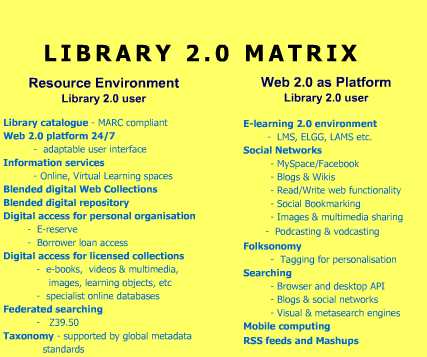
As part of my thinking about Library 2.0 frameworks I put together the Library 2.0 Matrix.

Library 2.0 Matrix

library20matrix.jpg

Web 2.0 as platform

Vision is one thing, but getting down to it and doing what’s needed to unite 32 local authorities to create a fully authenticated national learning community is quite another!

The latest podcast from John Connell says it all! In addition to describing the growth of the Scottish Schools Digital Network and its next phase of implementation through GLOW, we are given an execellent overview of social software, purposeful learning, current technology developments and future capabilities of “Web as platform”.

….the time will come sooner or later where all I will need to be fully productive will be a number of browsers, possibily just one, the device interface itself will simply be the browser.

Tracking the seemingly daily developments in web apps it is easy to see this ‘future’ rushing towards us. However, John’s observation that Web as platform will contribute most to closing the digital divide is of particular interest and worth hanging out for.

With bandwidth and infrastructre costs, coupled with problems of distance, Australian school communities will be real winners in this new environment. But for now Australian school systems struggle with delivering standards that match the SSDN and GLOW developments. While individual schools have faced the challenges head on, and systems have done various things in different parts of the county (some very effective), the country as a whole will find it very difficult to match the Scottish initiatives for quite some time.

This podcast is well worth a listen!

Cut and paste literacy

Reading through some of the Sites of Current Interest to Me from John Connell:the Blog led me to Rough Type and a comment about a paper published about My Space. The paper stands in contrast to the lack of dialogue about MySpace in educational circles. (Partly this is because some schools block access, so by blocking they think that usage goes away; partly it is because they have never heard of MySpace; partly this is because they see MySpace as being irrelevant)

Whether its plagiarism, or creativity, or school intranets, or learning spaces – looking at student behaviours in MySpace is essential if we are to work with the potential of technology and the potential of our kids to create a ‘new future’. Ogh…I know ‘new future’ sounds cliched…but whatever your term for future planning, MySpace and it’s ilk are here and ready to be our advisors and help shape our understandings.

The paper is an indepth analysis of elements of MySpace with important ideas for our understanding of literacy in this Web 2.0 space.

Is illiteracy the new literacy? Berkeley’s Dan Perkel writes, in a paper, Cut and Paste Literacy, on MySpace profiles: “A social perspective of literacy helps show that a part of [the] problem in this framing of copying and pasting as a literacy practice is that it does not neatly fit within common educational practices. From the perspective of the social niche of traditional schooling, to copy and paste is to plagiarize, unless there is careful attribution of sources …

Library 2.0 world of searching

Searching is an essential skill for our Google Generation. Have you noticed the primacy of Google in the minds of students? Have you been told that libraries don’t matter because we have Google? This is not a bad thing really, as we are being forced to consider the complexity of our online world, and the remarkable range and depth of information resources that are available to us.

Thinking about this and developments in libraries I re-read a post written while back at Informancy on the shift in libraries and librarians raised some really interesting issues in the post and comments. Lets just take the issue of searching…

In library and information science precision and recall are two critical elements of the organization and retrieval of information in that they are inversely related. As the rate of recall grows with every addition to the Google database, the level of precision for responses from a Google search falls. Library and information science is about finding ways to increase both of these levels in tandem…that would be the holy grail of searching.

Searching is certainly at the crux of our ongoing debate – and perhaps the area that we need to grapple with most in terms of positioning (school) Library 2.0.

Comment to that post really grabbed my attention..

to me it seems pretty clear that in a net-centric environment, we’re more likely to find our solution to the needle in a haystack with advances in social software technologies tied to intelligent agents. As our folksonomies grow and contextualize information within knowledge seeking and knowledge sharing communities, the value of personalized agents should increase.

Christopher Harris also said

In a recent workshop that involved envisioning libraries 10 years from now, one of the things that stuck out most clearly for me was the need for the library to be the search engine. …. In a virtual library dealing with electronic resources, my avatar can move through rooms that are the facets of the information.

These comments help me to make sense of some ideas that I have put into a paper recently related to Library 2.0. Amongst the usual things I also suggested that future Library 2.0 developments might include

  • Searching of social network repositories alongside federated searching
  • Searching of other search aggregators such as Technorati
  • personalisation of the information research process with a personal library storage space
  • addition of virtual library environments such as Second Life
  • addition of read/write interactivity and Fan Fiction type activities
  • and ultimately ….adaptive hypermedia responsiveness to search strategies, stored information, personal tag structures and subject requirements

What we need is a new Library 2.0 Matrix – that allows us to draw elements from the resource environment of the library/information user and the Web 2.0 environment of the library/inforamtion user. This matrix would allow our schools students to move and be transparently and intuitively in both environments, rather than in two seperate environments – as they now are.

Need to get a good graphic to demonstrate this….sometime.

Here a more good thoughts from elearnspace:

Most of what we call “social network tools” will eventually just be features of existing tools. In very limited ways, this is starting with MS Outlook (and other email/communication tools) – the notification that someone is online, the link to names in address books, etc. are first run attempts at making social networking a part of work…not an activity separate from work