Gaming for learning – and the young

Anshul Samar is a 13-year old founder and CEO of Elementeo, a company operating in the field of education.

Enter the chemical battlefield with Elementeo, a game of chemistry. Two strong wills fighting against each other in a midst of an epic chemical battle, constantly trying to reduce their opponent’s IQ to ZERO. Armed with their arsenal of elements, compounds, and nuclear reactions, these chemists strive to create, combat, and conquer the world!

Teemu Arina says

Isn’t that exiting. One more young CEO who thinks the educational system is not doing an adequate job and decides to fix things himself. Reminds of myself when I was 16 but Anshul beats me by 3 years.

I recommend a read of Tarina, Teemu’s blog. He is partner and CEO at Dicole Oy, a company focusing on understanding the role of social technologies in knowledge work and networked learning in organizations.

Who are you teaching today that is really a CEO in school uniform?

Coming! ready or not!

We can play hide and seek as much as we like – but we can’t hide from the real issues of equity and access for long. So of course, that friendly travelling Scot, John Connell, who sees so much of the diversity of opportunity, raised a very important point about access to information, literature and cultural repositories in his post World Library 2.0?

My work with the International Association of School Librarianship has brought me close to this type of problem – albeit not actually personally, but through our work in the organisation supporting libraries the world over. How different is a school library that is actually carried around on the back of a donkey, and then displayed with genuine excitement for all, by putting the books into pockets hanging off a long rope strung between two trees.?

Sadly I was not able to re-nominate for my Executive position, as the cost of attending the international conference was beyond my personal budget this year. The conference will be in Taipei, Taiwan 16-20 July on the theme Cyberspace, D-World, E-Learning:Giving Libraries and Schools the Cutting Edge.

I have spent many years working closely with IASL, and want to acknowlege the encouragement I have received from my school Principals since the late 90s in supporting my involvement with IASL, as the work brought me in touch with the joys and hardships of students and teachers around the world, as well as keeping me abeast of the trends and developments in international librarianship.

I’ve met lots of special people along the way. Gosh, how else would I have been able to have dinner with Stephen Heppell, or lunch with Ross Todd? How else would I have learned how to make a book resource out of single piece of paper, or got a set of decorative reindeer bells from Iceland? The opportunities to develop my own learning, or to be engaged in research and learning of others (e.g.on the editorial board of School Libraries Worldwide) have been pretty good. I finish my active involvement with IASL in July and wish the incoming Vice-President good luck and happy learning 🙂

But I digress……… Back to equity and access. I’m not sure that the ‘googlification’ of the world is the answer, but I do agree that digital solutions will help … so long as there is access, and the opportunity to print, view, or store resources.

The whole thing is a bit loopy really, and solutions hinge on a world that is ‘free and accessible’ – another take on ‘Web 2.0 as platform’.

So some other observations I want to share:

You’ve got to see it to learn it! is a great post from the Infinite Thinking Machine about using digital cameras and Picassa (one of my favourite tools). I regularly recommend free tools to teachers – and wonder why more isn’t being done to promote the diversity and flexibility possible by using tools like these. You can download Picasa for free for Windows and now for Linux. Mac users can use iPhoto in place of Picasa. Google even provides a plug-in for iPhoto that allows Mac users to take advantage of the popular Picasa Web Albums feature to share their photos on line for free. This is a great way to share images of student work, presentations, or field trips with parents using public or private online albums (with permission of course).

My recent visit back to BookYards:Library to the World shows me that there is much more on offer, and that the site is expanding all the time. I suggest you take a look, as it is shaping up as an interesting source for e-books, education links, informatiopn

However, what intrigued me more was the recent post from the Bookyards blog, about Free Books. Did you know that:

…….. there are dozens of websites in Eastern Europe that freely offer tens of thousands of recently published books by popular Western writers in Word, PDF, and/or any other format that a reader may want to browse through. Greylib has been online since 2003. They are a Russian blog that discusses recently published works. But while the site is in Russian, it is easy to locate, browse, and download the hundreds of popular English books (670 at present count) that are in their library. This is done by going to their listing of available English books for downloading….. and selecting your choice of authors from the bottom of the page.

Yes, it is that whole issue of access – and the burning matter of copyright or Creative Commons licencing. It’s so easy to be liberal!

Like the great picture above! I know that it is listed as not being free to copy – but the tehcnology lets me anyway. I’ve often hear people say that it doesn’t matter. I wonder what you think? For me it is about what you claim you do, create or produce yourself – plus I can’t help trying to follow the law.

So I used this photo to make the point that I can beg, borrow or steal if I want to – as many people do. As the image was created by dads on a flickr-hunt, I am hoping that they understand the point I am making – and that I am not out to seek credit or profit from their great little flick. But then I also wonder how many people realise that the default setting on Flickr is for all rights reserved. Would more people share if they knew how?

Photo credit to A Knight who says Ni

Thinking about Web 3.0…with IEEE Internet Computing

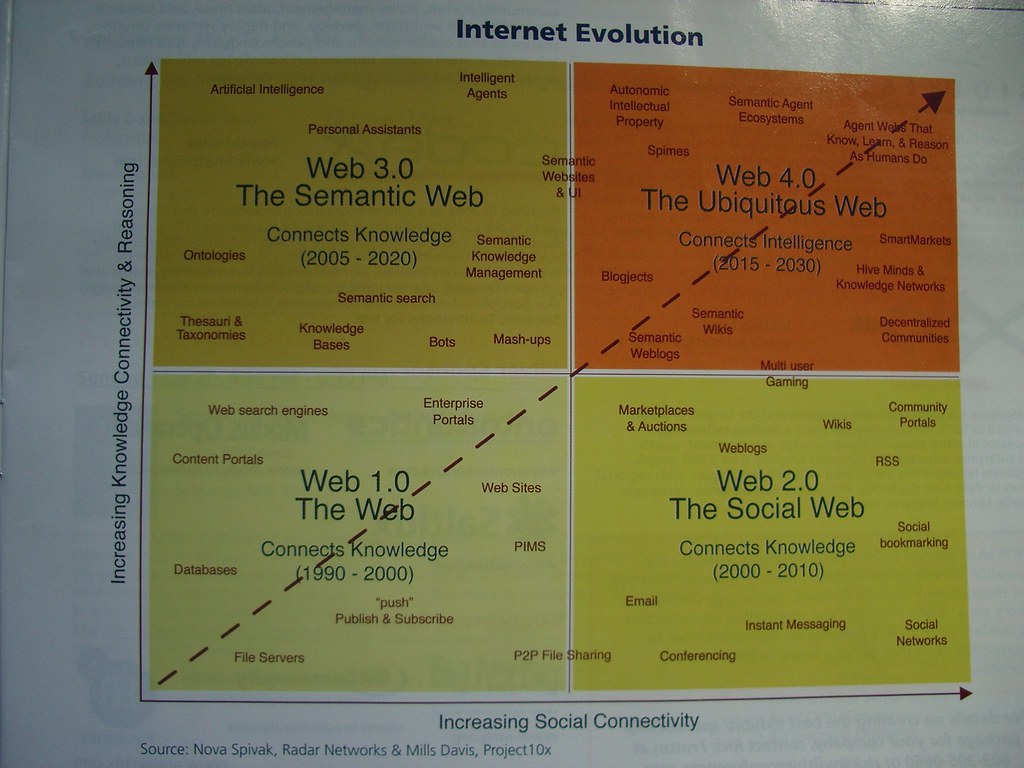
For a long time now I have been thinking about Web 3.0 – not to join the hype, but to better understand the potential of web developments that will effectively merge thinking in disparate fields.

Unlike some of my colleagues, my thinking (and my blog) bounces between two distinctive fields or disciplines – education and pedagogy vs technology and information science. I think I am lucky, because too often I see the errors of thinking that some educators (and leaders) perpetuate in the guise of keeping up with the (21st century learning) Jones!

google.jpgWeb 3.0 is getting some blogosphere air-space – and about time too. Adaptive hypermedia research has been around for many years, nicely juxtaposed against developments in search alogorithms and enhancements with various serach engines. A dawn of a new era? Certainly not according to Jean-Noel Jeanneney in his book Google and the Myth of Universal Knowledge. Google’s digitisation project has provided a healthy jolt to our complacency, and the assumption that digital initatives = fantastic developments. Here is the true rub of machine generated, folksonomy driven hierachies where virtual information is being brewed in a global cauldron.

In my view, we should be less interested in the utopian dream of exhaustiveness than in aspiring to the richest, the most intelligent, the best orgainzed, the most accessible of all possible selections. …Jean-Noel Jeanneney

It is time to focus on the cultural and knowledge aspects of Web 2.0 as it moves to Web 3.0, if for no other reason than this digitisation of our society provides challenges and opportunities for equality or repression like never before.

For this discovery of yours will create forgetfulness in the learner’s souls, because they will not use their memories; they will trust to the external written characters and not remember themselves…….PLATO, Paedrus, translated by Benjamin Jowett

Phil Midwinter asks Is Google a Semantic Search Engine, and goes on to explain that Google is using semantic technology, though it is not yet a fully fledged semantic search engine. He is more optimistic about developments.

There are barriers that Google needs to overcome… is it capable of becoming fully semantic without modifying it’s index too drastically; can Google continue to keep the results simple and navigable for its varied user base? Most importantly, does Google intend to become a fully semantic search engine and to do so within a timescale that won’t damage their position and reputation? I like to think that although the dragon is sleeping, that doesn’t mean it’s not dreaming!

A business-oriented write-up, which nevertheless has important considerations for the educator/information professional. The key thing is that there appears to be a convergence in thinking around the fact that “semantics” will form the backbone of what might be dubbed “Web 3.0”. The Wikipedia entry on Web 3.0 talks of leveraging semantic web for 3-dimensional collaboration…even as far as to point to this as being on the evolutionary path to artificial intelligence! (the stuff of many SciFi stories)

However, what we are really needing to examine closely, is the rise of the API culture – as this is transforming what it is we can seek or serve our knowledge-seeking selves!

Read/Write Web to the rescue! Another excellent write-up from Alex Iskold on Web 3.0: When Web Sites Become Web Services. Well, I suggest that we need to do a lot of reading and learning about folksonomy and taxonomy … and more. Let’s say, more posts for another day.

BUT what we do know already is that the Semantic Web efforts are providing an approach to constructing flexible, intelligent information systems – and it is the synergies between ubiquity and semantics that are exciting, and in which we should expect to see significant future work.

Read more about this in Embracing “Web 3.0” in IEEE Internet Computing.


Technorati Tags: , , , , ,

Capture the 20:20 Vision

We are not alone – not really! The global reach of ideas and subsequent inspiration we can draw from each other is just great! …….. and then the opportunity to share, and be willing to share, is the inspiration of Web 2.0…… communication, conversation, connection, community.

My recent trip to NewZealand gave me a wonderful opportunity to listen and learn from academic, public and school librarians – all involved in education and preservation and promotion of culture.  We all have our own challenges – but it is not surprising when these challenges sound the same “across the ditch” – their expression, not mine 🙂

I had a wonderful visit to Broadgreen Intermediate – their school library is a design inspiration, which houses NewZealand art (on loan from museums), and reflects design and innovation throughout. I wrote more about this here.

Enjoy the snaps of this wonderful library. View slideshow

I was able to talk about the inspiration of global leaders in libraries. My slideshare is a cut-down version of the presentation, which provides the key links to online sites and videos used. There is a slide that features Michael Stephens, a favourite amongst New Zealand blog readers. It’s a great snap of Michael’s online identity!

Links used in the Web 2.0 workshops I ran for Web 2.0 newbies can be found at Workshop Time!

Congratulations to my New Zealand colleagues.

Who’s Watching YOUR Space?


This is a great encapsulation of the OCLC Symposium: How do we operate as educators and information professionals? If you haven’t joined the conversation, or become part of the action, then it really is time to start.

We need to learn how to experience these technologies and put them into practice!

Click on the link to go to YouTube – the owner of the video does not allow this video to be embedded into a blog!

This is the 3-minute version of the most recent OCLC Symposium at ALA Midwinter 2007. More than 400 people attended this discussion of social networking practices and trends on January 19, 2007 in Seattle, Washington. Michael Stephens, Instructor, Graduate School of Library and Information Science at Dominican University and author of Web 2.0 & Libraries: Best Practices for Social Software, was moderator. The expert panel included: Howard Rheingold, a leading thinker on the cultural, social and political implications of communications media and virtual communities; danah boyd, PhD candidate at the School of Information at the University of California, Berkeley and Fellow at the University of Southern California’s Annenberg Center for Communications; and Marc Smith, Senior Research Sociologist, who leads the Community Technologies Group at Microsoft Research. The full video (2:23:19) can be viewed at http://www.oclc.org/index/symposium

Dr Who – and handheld technology

I had reason to visit my friendly general practitioner (doctor) recently, and as usual we had a bit of ‘IT talk’ as part of the consultation. A multi-talented man, Dr W. writes software-programs for medical practitioners. Proud owner of a new Apple Mac at home, his latest project is putting case notes/diagnoses/treatment tutorials onto handheld devices, that trainee doctors will be able to consult as they learn on the rounds.

This put me in mind of the post from CIO blogger Ben Worthen, who wrote about mobile devices in the corporate work environment.

I have partnered with a new site http://www.urFlick.com that will soon launch to provide training material and instructional videos for our industry to people’s mobile devices.
We already allow our sales team to view inventory, place orders, check customer credit and history via their Blackberries. Next is to utilize urFlick.com and have our communication and sales pitches hand delivered to their device.

When I’m in this conversation/reading space, I am frustrated that we haven’t moved more quickly in education (in Australia) to explore just what we could be doing with handheld devices with our students.

Perhaps iPhones in education will push the agenda for us – eventually!

Ben Worthen thinks the iPhone is the single most important thing to happen to CIOs this year, and asks

if the work and the personal parts of your lives are no longer separate why should the devices that you use in those roles be?

I agree. Yes, I know you will tell me that podcasting has had a big push – but somehow this seems just one (almost gimicky) part of an overall need to refocus how we use our technology tools. But that’s a teacher thing. I have a sneaking suspicion that what kids really want is a pocket-sized combo gadget, and teachers had better start pushing the boundaries of our thinking.

In December 2006 FutureLab released a new Handbook , Learning with Handheld Technologies. The Handbook tells us that pedagogical approaches and teaching styles must accommodate a more autonomous learner role for good use of handheld devices. The trouble is the use of handheld technologies in the classroom may present difficulties for those teachers who do not fully understand their potential in a learning and teaching context.

We have much to learn in this area.

Getting back the start of this post…. TV shows like Doctor Who are expected to be available for download later this year after the BBC Trust gave initial approval to the BBC’s on-demand plans. Under the proposals, viewers will be able to watch popular programmes online or download them to a home computer up to a week after they are broadcast.

Apple Conference – Marco Torres

marcos.jpgURGENT! URGENCY! From the heart! from Marco Torres

These senitments encaspsulate the vision and energy that drives his purpose and the acknowledgement of the learning needs of his students. It doesn’t need me to decribe the amazing creativity of his students. His own websites tell the story only too well.

Some ‘one-liners’ that make the point:

“We are arguing about the rearrangement of the deck chairs on the titanic”
Inspired by Einstein … “never memorize anything that you can look up”
“Some of the projects our students have done have changed policy”
“Let the students design their learning and discover their learning needs”

and for us in Australia……..”Los Angeles has more secondary students than Victoria”

We must create the opportunities for students to demonstrate learning – in a multimedia environment.

The importance of a visual, multimedia environment was amply demonstrated by a ‘tactic’ that Marcos has used at conferences.

Hand everyone a small card and ask them to list three major events that have had an impact on their lives. The result from all of these has been that ALL events have been visually recorded ones – and included the following in the top five: ‘man on the moon’, ‘bomb at hiroshima’, ‘image of kids running from naphalam attack in Vietnam’, ‘JFK assassination’, ‘ Challenger explosion’, and ‘Google earth’. This is a really good PD activity!

Better still was Marco’s example of the importance of sound as well. Take a paragraph out of Martin Luther King’s “I have a dream” speech. Which one has the impact? The paragraph or the audio sound that we all know so well. Marco has asked students to change the text version- and it gets to look something like a ‘tag cloud’ style paragraph. This tip is just the kind of thing that design students work with when studying graphics – but still an effective strategy to make a point!

The power of image and the power of sound is what it vital.

Marco quoted Edna Mole: ” Be distinct or be extinct”.

His goal? To develop responsible citizens! and maybe college graduates.

Does your project have wings?

The new world needs creativity. We are connecting kids not machines!

Connect all the pieces: Family, Community, Peers, Personal.

So regardless of the education environment you find yourself in, you have three options. Which will you choose?

QUIT COMPLAIN INNOVATE

Apple Conference – Sydney

Keynote Speaker, Stephanie Hamilton (who joined Apple in 2000 and leaving Austin Independent School District, designing and building 21st century learning environments for 110 schools) and presented the opening session of Apple’s 17th Innovative Technology Schools Conference.

Stephanie provided the ususal inspirational talk that sprang from that important message that we are all trying to communicate to our teachers and school leaders:

  • The only constant in life is….. CHANGE
  • Lifelong learning implies…..CHANGE
  • The road to the 21st century school is paved with ….CHANGE

She addressed all aspects of this change: changing technology; changing learners; and a changing world.

She asked “when you produce a really long document in wordprocessing, do you print it out for proofreading?” A groan of recognition hit us all – yes, we are indeed digital immigrants.

So we are working within a timeshifted world – even out technology tools have radically changed. Kids today have bypassed email, at a time when teachers are just catching up. “Email is so yesterday”! ! Yet how often do we allow students in schools to use IM. Schools still ban mobiles, and “that’s like holding back a tsunami by holding up your hand”!!

How do we take these technologies and make use of them? It is about the difference in the way we learn versus the way technologies are facilitating THEIR learning.

What is their (learning) nature?
Creative, Mobile, Multitasking, Collaborative, Productive

They are prolific writers, but we just don’t know about it, because we don’t move in the spaces they move. They demonstrate these learning characteristics, but we don’t always see it (think MySpace etc) Yet these elements are what a good employer will be looking for, and are checking profiles online as part of the employment process!
They naturally enjoy multi-tasking – today we are more likely to call this ADD. Is this the new normal?
The issue is we need to look at when it works for them, and when it works against them.

Think of there learning as ‘multi-threaded’. We approach them on one dimension, yet they have receptors to take in information on 4 dimensions! We are missing opportunities to communicate with them. Look at the way they can learn – not how we can teach.

Stephanie quoted a figure from the American Library Association: By 2020 information will double every 15 minutes. How long are our teaching periods? What facts will we teach if the information doubles three times in that teaching period!
What a fantastically challenging concept!

For those currently engaged in this discussion via edublogs Stephanie did not actually present anything new, but she did provide an invigorating reminder that there are many aspects of the digital change that we must keep in mind, and provided a few nice points that we can use effectively when encouraging new digital immigrants!

A Final Point……………

Digital Native Learning Infrastructure…..incorporates…. keynote.jpg

          • Knowledge Creation and dissemination
          • Creative exploration
          • Highly collaborative, Interactive and Ad-Hoc
          • Software solutions are expressive
          • User/Student Centric
          • Total Opportunity of Ownership

Digital Identity Mapping

Digital Identity Mapping

Originally uploaded by fredcavazza.

This is a very nice visual image of the shift in our social environment – which now embraces a combination of online tools for every facet of our personal life..

GlobalSummit06 – Seymour Papert

Back to another day, and I am feeling inspired again, because the day started with a few key reflections of the events of yesterday. I felt the strong energy of the group, and the wonderful sense that attendees were genuinely reflecting, cutting and dicing – not just accepting words as received, but using them to further discussion and move in new directions.

Our online link to Dr Seymour Papert was also inspirational for the focus points that he provided us. [Dr. Papert is the inventor of the Logo computer language]

What a great thing to see this leading thinker up on the big screen, and to hear his thoughts flowing in response to questions being presented.

Seymour urged us to move our thinking from HOW to WHAT. Not how students learn and how to teach, but what children learn and what to teach. How can kids learn things in better ways?

As to our how our technology future is looking? Seymour offered four key points:

  1. Every kid must have a computer! It is ridiculous to waste further time to debating this. Every knowledge worker (with the exception of our students) finds that technology is the proper medium for thinking work. If knowledge workers have computers, then why don’t kids!
  2. Shift from HOW to WHAT to learn.
  3. Recognise that it is global forces that drive change in education. Look to the forces in the global scene, rather than relentless educational debate to find the focus for future learning initiatives.
  4. Stop talking to the computer industry, and do not accept their economic agenda to spend more in order to buy bigger and better. We should be setting the pace and saying what we need. The $100 laptop project shows the clout that we can have if we wish to really make a difference.

Through all this Seymour urges us to focus on the fundamentals (not ‘back to basics’) . Now more than ever we need to return to the fundamentals of HARD THINKING – the real issues that are below the surface.

It was great to hear these important concepts articulated by a global leader. Literacy, mathematical thinking, digital thinking ……….. or we could say that literacy remains an enabling mechanism for effective Cognitive and Metacognitive engagement …… hard thinking…… real learning.

People laughed at Seymour Papert in the sixties when he talked about students using computers as intruments for learning and for enhancing creativity. Not any longer!