Cool circulation statistics!

Dewey Bubble!

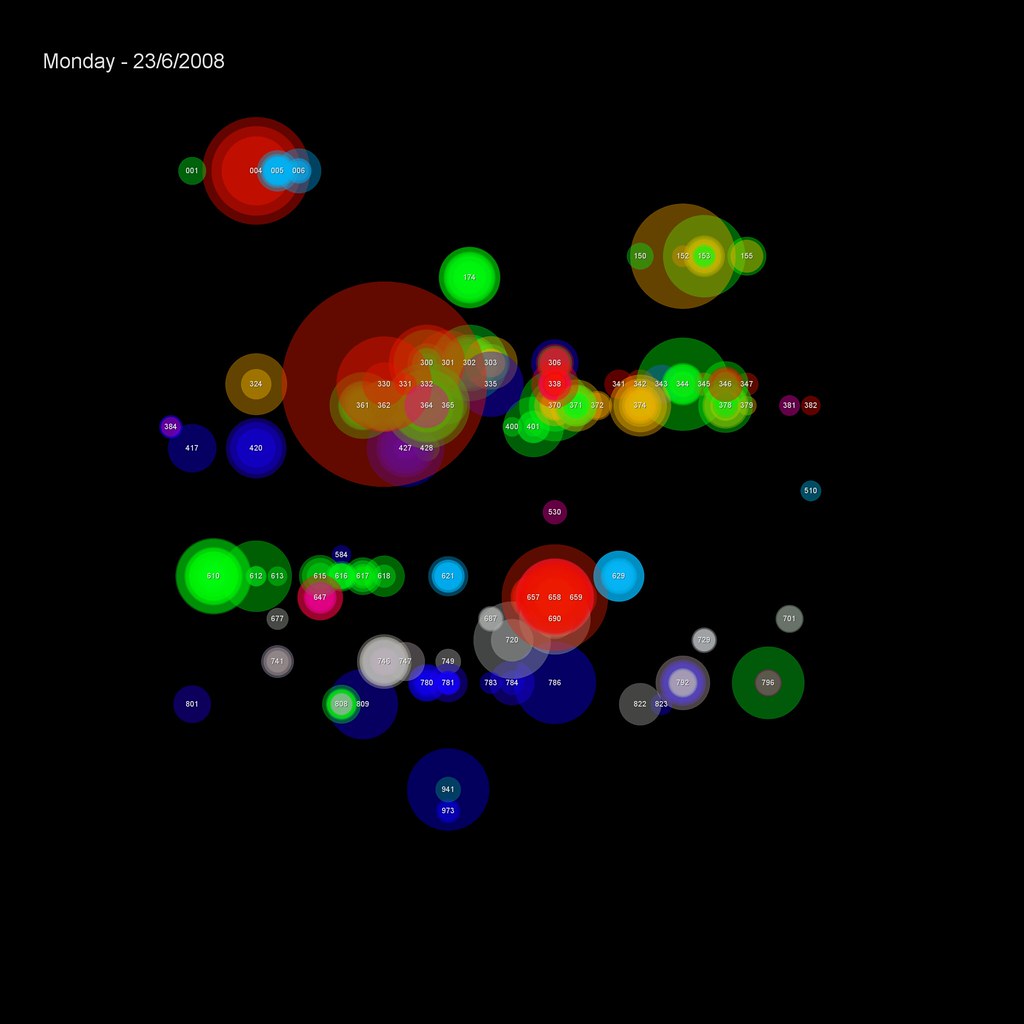
Check out this cool data visualization of book borrowings! Click here to see an enlarged version of circulation statistics displayed as Dewey Blobs 🙂

The transactions are placed on a 32×32 grid based on their Dewey classification (000-999). Each transaction is shown as a semi-transparent circle with two attributes:

1) colour — based on the School the student making the transaction studies in
2) size — based on the popularity of the book (the larger the circle, the more times it’s been borrowed before)

From Dewey Blobs at Dave Pattern’s “self-plagiarism is style”.

Library Program APIs

Information Matrix

At my recent visit to NECC, accompanied by my participation in Remixing for Library 2.5 I mentioned a great interface being promoted here in Australia called LibX. Roy Tennant recently posted a list of library-related APIs that library developers may find useful.

What’s an API exactly you ask? Application Program Interfaces (APIs) are structured methods for one software application to communicate with another. APIs allow programs to interoperate and share data and services in a standard way.

This is why you can embedd videos in your blog, or create a feed of your blog to appear in FaceBook – its about creating Mashups. Check out ZDnets video What is a Mashup?

Only APIs that are deemed to be generally useful are listed by Roy. However, almost any library catalog will have a search API (e.g., Z39.50) and may have others as well depending on the vendor and product. Contact Roy if you have a great API to add to the list.

Some great examples:

  • Google Book Search API – link to items in GBS, and find out about their availability
  • Amazon
  • pewbot (Huddersfield University Library) – “People who borrowed this also borrowed that” service

You see, THIS is the future of information services – Interoperability and flexibility of interfaces.

A very good reason to have a library system that allows you to get involved with API enhancements.

Photo: Favourite tree?

Remixing for Library 2.5

Oh my, what a treat! On Wednesday morning at NECC a bunch of good teacher librarians gathered to present a panel session Feed, Tag, Research: Remixing for Library 2.5. I was the odd one out, having travelled a lot of air miles to attend the session with my colleagues. Between us we covered some key ideas, promotional strategies and a most definite 21st century learning focus.

I want to thank my friends Joyce Valenza, Carolyn Foote, Diane Cordell and Anita Beaman, for the opportunity to join them and provide an Australian view, voice, and focus on some initiatives.

Naturally this keen set of NECC Librarians wiki is there for you to browse!

I did a search for “NECC08”

in Tag Galaxy. Look what I found 🙂

LibX Library Toolbar at NECC08

Here is a video explaining LibX – a great tool that I promoted at NECC in San Antonio.

The LibX Murdoch University Toolbar is a Firefox Browser extension that lets you search the library holdings straight from a toolbar in your browser.

It also embeds little symbols next to the titles of books and journal articles in pages you view on the web. Clicking on these symbols lets you check whether the library has it.

This is awesome and a cool Web 2.0 enhancement for libraries. Enjoy!

Information literacy – and Second Life

If you read this in time – then I recommend attending the a mini-conference focused on Inquiry Based Learning on 26th June in Second Life (the virtual world) from 0.00-05.00 Second Life Time (this is 5-10pm in Sydney, for times in other regions/ countries go to
http://tinyurl.com/6oo4n3).

It is a free event, taking place on Infolit iSchool (Sheffield University’s island in SL, which is focused on Information Literacy and Inquiry Based Learning). The focus of the mini-conference is exploring the nature of Inquiry Based Learning (IBL), and its use in teaching in both Real Life and SL. The mini-conference is aimed at anyone who wants to discuss the potential of IBL, learn more about it and/ or exchange experience: you may be using IBL already (whether in RL teaching or SL teaching) or just be thinking about using it.

Note that delegates can attend one or more of the sessions – you can choose the ones that suit your schedule or interests. It is a SL track for a real life education conference taking place in Sheffield. It includes a “crossover” session interacting with the real life conference: Lyn Parker (a librarian at Sheffield Uni) will be leading that discussion in real life. Anyone who wants to attend in SL should email LTEA2008inSL@gmail.com including their real life and SL names. There is full info on the sessions at

http://networked-inquiry.pbwiki.com/About-LTEA2008-in-Second-Life

(optional extra para) Inquiry Based Learning is basically like problem based learning but more open ended – more like learning through research – and several unis in the UK have a focus on it, hence the RL conference.

From Sheila Webber, Department of Information Studies, University of Sheffield


Blogging – a reflection 3#

Series of posts for the ASLA Online 2008 conference.

On Monday I attended the Christian Teacher Librarians Conference – a really nice bunch of guys an gals working in Christian schools here in New South Wales. I love working with this group because they bring a very special passion and sense of collaboration to their work. Last year I introduced them to Web 20 with my presentation Creative Web 2.0 Learning, and this year I am back to talk about how things have developed in Web 2.0 in the context of running some hands-on workshops. There’s something special about what has happened with this group! As I explained, the slides of the presentation have had quite a big ‘airing’ on blogs and wikis around the world.

So to me this is another dimension of blogging that can’t be overlooked. Not only do we discover, learn, share and encourage each other – but through the conversation of blogs (and wikis) we promote a transformation in the learning opportunities for our students.

During the workshops we *waved to my friends on Twitter, and they *waved back. It’s on twitter that I found the fabulous workshop support wiki 21CTools of Liz Davis – which I shared with the workshop participants (after thanking Liz on Twitter for sharing this resource with us). Twitter is the quick conversation space that tractions the more in-depth conversation of blogging – and it is just one of the many things we talked about as having changed in the blogging and Web 2.0 world in the last 12 months.

I had the chance to sit and listen to Anne Lockwood from Tara Anglican School for Girls, who talked to us all about working with vision and reflecting about the value of our role as Teacher Librarians. Above all, Anne  reminded us just how busy and ‘multi-tasking’ each day of our Teacher Librarian lives are! Anne insisted  that a sense of humour is critical! And through all the fun and hard work she urged us to remember to Focus on Vision – it is so vital to have a ‘big picture.

Anne demonstrated her website to us and talked about transforming our physical and virtual environment as well as our managment procedures. Remember procedures manuals? I love how Anne has visually mapped ‘how to’ sheets rather than the usual procedures manual! Also, reworking your presentation and layout in your physical spaces is essential for us all – do it on a shoestring or with pots of money. Either way, think about your services and change!

Well I can certainly think of many ways to change – but so can all the others in the blogosphere taking part in this conversation about change. The amazing thing is that because of blogging you CAN get a whole new perspective on what’s possible. Starting out is a fabulous adventure – and we all started due to being ‘charged up’ by someone else.

Alisha commented recently that she was inspired by her attendance at the Why2 or Web 2.0 seminar in Sydney with Will Richardson.

After the conference in Sydney, I talked with my principal and even though I work in a primary school, we are opening the door a little to allow our students to use Web 2.0 tools. I created my first blog for My Year 3 class and they love it. This week I am sharing this with my staff and then running some workshops for anyone who would like to start blogging. Feel free to take a look at our blog… it is only in the early stages but the children love it. http://www.bookwrap.edublogs.org/
Thank you to the presenters at The Why 2 of Web 2.0 conference in Sydney for lighting a fire within.

Because of these connections we talk and play continually. A fellow blogger, Dean Groom, leads the way with some very innovative ideas and pedogogical directions at his school. Sharing some links via Skype, I was also able to find and share (what was a great discovery for me) a link for Sue (his Deputy Principal wife) , who was busy thinking of ideas for the students in her primary school. Teacher’s Pet for MS word looked like a very nice enhancement to MS Word and Open Office.

So that’s the thing – it’s not just about blogging – it’s about losing your digital accent!

Will Richardson’s Losing your Digital Accent wiki has the links you need to to dig and then dig even further. We carry an accent just because we were not born ‘hard-wired’ to technology the way the kids are now.

What gets me is the ease that a 3 year old can navigate in Second Life with dad’s avatar – compared to the wooden mode that most adults first adopt.

Don’t lose heart. We are living in one of the most exciting eras in education – so bring anyone you can along with you on the Web 2.0 journey. Find yourself someone nearby and ‘light their fire’!

The How 2 of Web 2.0

It’s 9.00 am and we are all looking forward to our day with Will Richardson! followed by a few good Aussies talking about Australian initiatives. Westley Field will enchant the audience with Skoolaborate; I will do my usual bit; and we’ll hear from Christine Mackenzie about the work at Yarra Pelnty Regional Library in Melbourne. The end of the day will have a panel discussion – which will be streamed to the world at 3.00 pm AEST via Will’s Weblogg-ed TV .

Parallel information universe

Quite a few things today reminded me of the parallel information universe that I live in. This morning a wonderful meeting with mothers at the school – to introduce myself, my new staff and our new vision for learning 21st century style. We talked a little about the MySpace/MSN world of our boys, and how best to deal with pull of technology – sometimes in the wrong direction.

A good question was about plagiarism – what can a mother do to help her son who is cutting and pasting information for an assignment, and playing with fonts, keywords and more to ‘hide’ this capture. My response is always the same – pick your opportunity! The key thing to remember in mentoring our children is to focus on knowledge creation, the discussion of ideas, the veracity of information, and the value of what is being read in helping to understand the topic under study. This means that a parent can ‘let go’ of the process so often promoted, which I suggest is wrong. I’m sure you have heard this said many times…..”put it into your own words” …..which of course is actually a highly complex action.

Much better to let that go. If a task/assessment has been set that really is about making a student learn some facts – then so be it. No different to giving dictation, or asking a student to copy notes from the board. The thing to do is to engage a student reflecting about the value of the material they are ‘copying’. Once a student begins to question, weigh up, challenge, consider and reconsider information and knowledge – then the matter of plagiarism is half way to being solved.

Some of the mums expressed a keen interest in learning more about the online world – safety, online tools, research and more. I have offered to run sessions, course or whatever parents would like to help them in their own understanding about the possibilities of 21st century learning online. By the way, through it all, I emphasized that literacy and reading (in all forms) must underpin the work of myself and the team in the Resource Centre at Joeys.

That was one parallel universe within my daily work at school!

The next parallel universe was revealed late in the afternoon in the foyer of a hotel in Brisbane. A group of us met with Will Richardson to begin to prepare for the Why 2 of Web 2.0 seminar tomorrow (join the ning to take part in the conversation).

Lots of fun discussion about places, people, and events related to leading in a Web 2.0 world. And there it was – the division. School libraries, or libraries in general and teachers and education in general. This is a particular pet hate of mine. We should all be on the same page – or at least on one of the pages in the same volume 🙂 It’s rather like my blogroll – many of the people in one group know nothing of the research, publication, blogs or other initiatives of people in the other group.

A good example? Well I suggest that in Australia schools we all need to know of the work of Will Richardson (education) and Ross Todd (library). Both are world leaders in education. I know that you can think of equally good examples!

In schools there can be no excuse for this. My role is to operate effectively and efficiently as a teacher, a leader of e-learning, Web 2.0 online learning, and teacher librarian. Stop and take a look at your professional practice – and add a bit of knowledge from your teacher or librarian friends – then branch out from your own zone of comfort into other sectors or disciplines. Go on. It’s very worthwhile.

What got me started on this idea of this parallel information universe was prompted by an excellent article with the same title by Mike Eisenberg, which has the by-line “What’s out there and what it means for libraries”.

In a way that’s part of my topic at the seminar tomorrow. But the article itself is an excellent look at Web 2.0 tools, providing strengths, weaknesses, opportunities and threats of a host of tools. This article is a great discussion starter for you.

Journal articles like this remind me of the intensity of change needed – so that parents, teachers, and teacher librarians can actually understand the world of learning as it is becoming, and work together rather than in parallel in forming global blended learning environments.

This is much more than co-operative program planning and teaching by teacher librarians. This is much more than teachers asking the teacher librarians for help and guidance.

What it IS about is creating strong personal professional learning networks that draw information and expertise across sectors, disciplines, and fields of creativity – where Will and Ross know [of] each other, blend their knowledge and research, and can then inspire we teachers and teacher librarians to newer heights 🙂

Time to think out of the square everyone, and stop living in parallel universes.

Photos: 3D cubist kites, 無敵大合照啊

Learning – research, resources, results

It’s been a busy week one way or the other…. We launched our e-learning initiative for the school, and I had the chance to talk for an hour to the whole staff about Web 2.0 and the imperative to adopt flexible approaches to learning online. Much of the material I covered was very introductory, but nevertheless essential to building understanding in order to move forward.

Teachers are no different to students in this regard.

Scaffolding and guidance are requisites for quality learning.

I was delighted to receive a message on Facebook from my colleague Andrew Hiskens, Manager, Learning Services Division, State Library of Victoria about their latest effort to support students and teachers.

I highly recommend a visit to ERGO. This site is fantastic! Andrew says:

Ergo took about 18 months to develop. It was designed to be a tool to assist secondary students in learning to research (hence pared back words, images with rollovers for visual learners and short video clips from writers, historians and scientists). We then coupled that with unique resources form our own collections largely around the history of Melbourne and Victoria.

The site is a practical guide to research, essay writing and studying and shows how to find resources, write great essays and prepare for exams. It also has a huge range of original documents and images.

The idea of the site is to help students make their work the very best it can be! And we know that that means excellent research, writing and study skills.

The site includes:

  • easy to follow guides to research, essay writing and study skills
  • over 500 digitised resources from the State Library’s collections
  • worked examples available at point of need, illustrating bias in primary sources, how to understand an essay question and much more
  • video interviews with prominent authors, historians and artists including Helen Garner and Nobel Laureate, Peter Doherty
  • teacher and student resources with a focus on critical literacy and thinking processes

Thank you State LIbrary of Victoria for supporting students and teachers in Victoria, Australia and beyond!

The future of libraries

From Paul Anderson of Intelligent Content Ltd comes the announcement of the latest JISC report. Understanding metadata – the possibilities, purposes, and functioning in a Library 2.0 world, or even the information architecture world of any online information source, is crucial. If you want to keep up-to-date, or find out what this ‘metadata’ talk is all about, then now is as good a time as any to grab a coffee and start reading.

Metadata for digital libraries: state of the art and future directions

Paul Anderson says:

The Web is having a profound impact on the role and function of libraries. This goes way beyond ‘the demise of the book’, which is, quite frankly, a very simplistic way of looking at things. It’s actually more about having a vision for the future and how you realise that viconscaled250pix.jpgision. For example, one of the problems facing librarians is how to create high quality ‘digital objects’, as they are called. If you think about a book, you might judge its quality in terms of the jacket design or the type of paper used or whether or not you can see guillotine marks on the edge of the pages. You probably wouldn’t think about some of the very obvious quality factors unless they were missing. If you opened a book and, say, the pictures were missing or all the pages were in the wrong order, you’d probably want your money back.

The problem for librarians is that when you are creating things like e-books, you have to think about a different set of ‘quality’ criteria because these digital objects will not be used in the same way that physical books are. They will need to designed so that they can be searched, for example, or delivered as separate pages. For the average library user, accessing information that spans multiple digital sources is increasingly a messy process and for those who are used to search tools such as Google and Yahoo this new and highly fluid environment can be a considerable barrier to accessing information from digital libraries and online collections. What is concerning about this is, unless we are careful, people will increasingly see the search results thrown up by Google, Yahoo etc. as the be-all and end-all of a particular area of interest or subject.