
Will Richardson talks!

Will began his by reflecting on citizen journalism – media, skype, ustreamTV, live tv shows from basements – by kids who are just entering high school. Will is going to take a group of keen teachers and teacher librarians on a wonderfully weaved journey through the read/write web. Retire, and make more by selling ads on your blog than you did in your day job!

Will reflects on the transformation taking place that is as radical a change as that which took place as a result of the invention of the printing press.

Will is providing all the links to his presentation via his wiki http://willrichardson.wikispaces.com/.

Copyright? this discussion is now global. what do we do when content is free, easily copyable, and easily distributable. It’s a different place for business too. http://www.surfthechannel.com/ Pick up any TV show! anything you like. These guys are in Sweden, they don’t run servers – they don’t believe they are doing anything wrong 🙂

The story of Wikinomics is one that we all need to take note of. IBM has 24,000 blogs – they are sharing, collaborating, and being transparent about their jobs. Even governments are changing – there is a pressure for transparency,

But education, by and large, is not changing.

The How 2 of Web 2.0

It’s 9.00 am and we are all looking forward to our day with Will Richardson! followed by a few good Aussies talking about Australian initiatives. Westley Field will enchant the audience with Skoolaborate; I will do my usual bit; and we’ll hear from Christine Mackenzie about the work at Yarra Pelnty Regional Library in Melbourne. The end of the day will have a panel discussion – which will be streamed to the world at 3.00 pm AEST via Will’s Weblogg-ed TV .

Yahoo for Teachers

Something new to try out! Will this be one to watch? Like a Web 2.0 content management system – for your school, between schools, between you colleagues, and just sharing. Will this solve some problems for schools, or just create new ones? Check the Yahoo Teachers info page and register for your own beta invitation.

  • Parallel information universe

    Quite a few things today reminded me of the parallel information universe that I live in. This morning a wonderful meeting with mothers at the school – to introduce myself, my new staff and our new vision for learning 21st century style. We talked a little about the MySpace/MSN world of our boys, and how best to deal with pull of technology – sometimes in the wrong direction.

    A good question was about plagiarism – what can a mother do to help her son who is cutting and pasting information for an assignment, and playing with fonts, keywords and more to ‘hide’ this capture. My response is always the same – pick your opportunity! The key thing to remember in mentoring our children is to focus on knowledge creation, the discussion of ideas, the veracity of information, and the value of what is being read in helping to understand the topic under study. This means that a parent can ‘let go’ of the process so often promoted, which I suggest is wrong. I’m sure you have heard this said many times…..”put it into your own words” …..which of course is actually a highly complex action.

    Much better to let that go. If a task/assessment has been set that really is about making a student learn some facts – then so be it. No different to giving dictation, or asking a student to copy notes from the board. The thing to do is to engage a student reflecting about the value of the material they are ‘copying’. Once a student begins to question, weigh up, challenge, consider and reconsider information and knowledge – then the matter of plagiarism is half way to being solved.

    Some of the mums expressed a keen interest in learning more about the online world – safety, online tools, research and more. I have offered to run sessions, course or whatever parents would like to help them in their own understanding about the possibilities of 21st century learning online. By the way, through it all, I emphasized that literacy and reading (in all forms) must underpin the work of myself and the team in the Resource Centre at Joeys.

    That was one parallel universe within my daily work at school!

    The next parallel universe was revealed late in the afternoon in the foyer of a hotel in Brisbane. A group of us met with Will Richardson to begin to prepare for the Why 2 of Web 2.0 seminar tomorrow (join the ning to take part in the conversation).

    Lots of fun discussion about places, people, and events related to leading in a Web 2.0 world. And there it was – the division. School libraries, or libraries in general and teachers and education in general. This is a particular pet hate of mine. We should all be on the same page – or at least on one of the pages in the same volume 🙂 It’s rather like my blogroll – many of the people in one group know nothing of the research, publication, blogs or other initiatives of people in the other group.

    A good example? Well I suggest that in Australia schools we all need to know of the work of Will Richardson (education) and Ross Todd (library). Both are world leaders in education. I know that you can think of equally good examples!

    In schools there can be no excuse for this. My role is to operate effectively and efficiently as a teacher, a leader of e-learning, Web 2.0 online learning, and teacher librarian. Stop and take a look at your professional practice – and add a bit of knowledge from your teacher or librarian friends – then branch out from your own zone of comfort into other sectors or disciplines. Go on. It’s very worthwhile.

    What got me started on this idea of this parallel information universe was prompted by an excellent article with the same title by Mike Eisenberg, which has the by-line “What’s out there and what it means for libraries”.

    In a way that’s part of my topic at the seminar tomorrow. But the article itself is an excellent look at Web 2.0 tools, providing strengths, weaknesses, opportunities and threats of a host of tools. This article is a great discussion starter for you.

    Journal articles like this remind me of the intensity of change needed – so that parents, teachers, and teacher librarians can actually understand the world of learning as it is becoming, and work together rather than in parallel in forming global blended learning environments.

    This is much more than co-operative program planning and teaching by teacher librarians. This is much more than teachers asking the teacher librarians for help and guidance.

    What it IS about is creating strong personal professional learning networks that draw information and expertise across sectors, disciplines, and fields of creativity – where Will and Ross know [of] each other, blend their knowledge and research, and can then inspire we teachers and teacher librarians to newer heights 🙂

    Time to think out of the square everyone, and stop living in parallel universes.

    Photos: 3D cubist kites, 無敵大合照啊

    Learning – research, resources, results

    It’s been a busy week one way or the other…. We launched our e-learning initiative for the school, and I had the chance to talk for an hour to the whole staff about Web 2.0 and the imperative to adopt flexible approaches to learning online. Much of the material I covered was very introductory, but nevertheless essential to building understanding in order to move forward.

    Teachers are no different to students in this regard.

    Scaffolding and guidance are requisites for quality learning.

    I was delighted to receive a message on Facebook from my colleague Andrew Hiskens, Manager, Learning Services Division, State Library of Victoria about their latest effort to support students and teachers.

    I highly recommend a visit to ERGO. This site is fantastic! Andrew says:

    Ergo took about 18 months to develop. It was designed to be a tool to assist secondary students in learning to research (hence pared back words, images with rollovers for visual learners and short video clips from writers, historians and scientists). We then coupled that with unique resources form our own collections largely around the history of Melbourne and Victoria.

    The site is a practical guide to research, essay writing and studying and shows how to find resources, write great essays and prepare for exams. It also has a huge range of original documents and images.

    The idea of the site is to help students make their work the very best it can be! And we know that that means excellent research, writing and study skills.

    The site includes:

    • easy to follow guides to research, essay writing and study skills
    • over 500 digitised resources from the State Library’s collections
    • worked examples available at point of need, illustrating bias in primary sources, how to understand an essay question and much more
    • video interviews with prominent authors, historians and artists including Helen Garner and Nobel Laureate, Peter Doherty
    • teacher and student resources with a focus on critical literacy and thinking processes

    Thank you State LIbrary of Victoria for supporting students and teachers in Victoria, Australia and beyond!

    Top 100 Tools for Learning Activity

    Between January and March 2008 the Centre for Learning & Performance Technologies(C4LPT) invited learning professionals to share their Top 10 Tools for Learning – both for their own personal learning/productivity as well as for creating learning for others. 155 learning professionals contributed their Top 10 Tools. You can find the links to their individual Top 10 favourite Tools lists at www.c4lpt.co.uk/recommended/
    The Analysis of top 100 Tools  provides plenty of food for thought.

    In total over 460 different tools were named, but from these Top 10 Tools lists we compiled a list of the Top 100 Tools for Learning Spring 2008. 109 Tools were mentioned 3 or more times and an additional 34 tools were mentioned twice.

    The list appears on pages 3-10 of this document and also online at www.c4lpt.co.uk/recommended/top100.html

    I’ve provided a copy of the document (top100s08) to all my staff! Or you may prefer to provide the Summary PDF link.

    Boolify your boolean search strategy

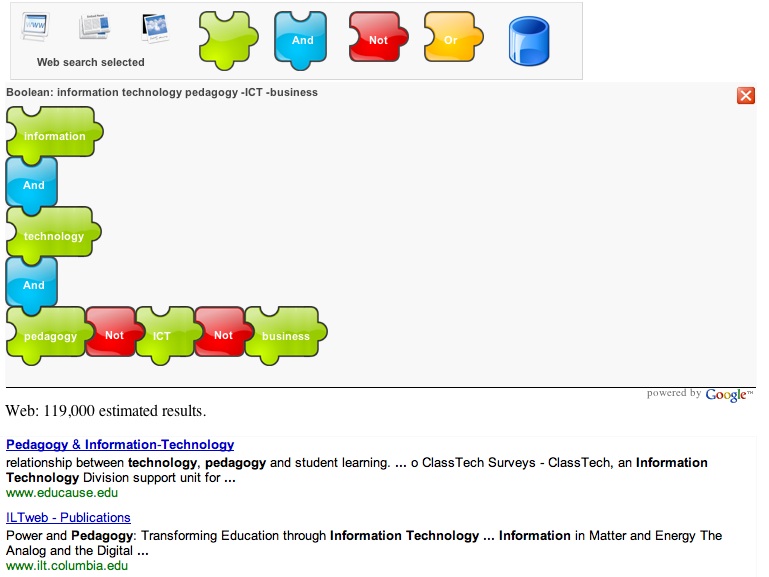
    At last, an opportunity to show kids the impact of boolean searching in a very visual way with this excellent tool from Boolify. Build your search query like a jigsaw puzzle, and see the impact of varying your search strategy.

    Here’s a very interesting way to demonstrate the way boolean searching works, particularly for younger students. Cleverly via Miguel Guhlin.

    Stephen Downes says:

    … I think that this sort of approach to creating queries could be extended a lot – my first thought was that it could function as a generic sentence constructor, which in turn would be really usefuil for language learning and logic. There are also curriculum resources.

    Facebook Chat – more talking!

    Logged into Facebook after coming home from the movies, to discover that my Facebook had acquired a Chat function.

    Yet another thing to think about and integrate into my online communications and organisational tools.

    Actually, I use Facebook quite a bit one way or another – not for the silly game things, but more as a way of quickly staying in touch, and organising meetings, events etc. Using standard email just doesn’t seem to ‘cut it’ for everything anymore.

    Let’s see how it all pans out.

    Facebook says:

    We’ll be rolling this out slowly going forward, but fairly soon you’ll notice our new Chat bar at the bottom of your browser—no installation or assembly required. From this bar you can view your list of online friends and open conversations with any or all of them. There’s no need to setup a “buddy list.” Unlike the Wall or Inbox, the messages are delivered and displayed to your friend as soon as they’re sent, so you should expect a response right away and without any page loading.

    We’re working on pulling other features of the site into the real- time Chat world. Your notifications will now arrive in the Chat bar, and while chatting you’ll see your friend’s Mini-Feed activity thrown into the conversation, as it occurs.

    Chat is by no means a new concept, as instant messaging systems have been around for over a decade. But just as other features on Facebook have allowed friends to communicate more efficiently than before, we hope Facebook Chat will make it easier to connect instantly

    So I’m looking forward to my first chat 🙂 with this new tool.

    April Festival on the Islands of Jokaydia

    Exciting! Jo Kay has announced the April Festival on the Islands of Jokaydia on the 19th and 20th of April!

    It’s a chance for jokaydia Community members and friends to get together to share and support each other…. and of course have some fun!

    Come for a newbie tour!

    Find out about the Virtual Classroom project, featuring the project’s first Educator-in-Residence, Leigh Blackall (SL: Leroy Goalpost) working with Konrad Glogowski (SL: Konrad March) , who is inviting individual educators like Leigh to design and build their ideal learning space for use as either a virtual classroom in Second Life or as a prototype for a real-life classroom.

    Join us for a social event and announcement of the winning entries in the Annual Jokaydia photo competition.

    …..and lots more!

    For full details, check out April Events on the Islands of Jokaydia. Looking forward to seeing lots of my friends there – and to making new ones too!

    Nice!