Open or closed learning for our teachers

You know, it is interesting to see how online social networking and use of tools has developed this year in education. Somehow we seem to be reaching a kind of critical mass (at least in my schools) where Web 2.0 tools are not new in concept, even if they are new in practice.

Sue waters writes a good reflection on ownership and online communities. You may like to add your comments to the debate over there.

It’s what the game is all about in schools – getting ownership from teachers! That is the hardest part of all, and the game plan for increasing ownership is not necessarily clear given the continued emergence of new tools online. It’s in the doing that we discover what is possible – no amount of talking will explain social networking and web 2.0 learning.

What I am amazed at is that I am actually getting calls from school principals asking that I provide some Web 2.0 training to their teachers. What I also know is that this is just an entry point – and that 2 hours of training in blogging will only launch 2 out of 10 people on the journey. But you have to start, and the reality is that some teachers need to have assistance every step of the way because they are digital immigrants, and there is nothing intuitive about web 2.0 for many of them. This is not bad, it is just how it is. Others, of course, need no training – they are the gems in our schools and their praises should be sung far and wide.

I am particularly pleased to see universities introducing e-learning in all its Web 2.0 forms for trainee teachers. I’ve watched some interesting developments this year as students from all sorts of places have ‘studied’ HeyJude. In fact, right now, I’m getting blog hits for ‘the essay’ in one of the courses.

But there is one BIG concern I have about all this, whether in schools, or in degree courses training future teachers.

There is a particular depth to Web 2.0 that takes time, and thought – and training for many – that we are not acknowledging, or providing sufficient support for. Those fantastic educators in my blogroll (especially the teachers) are great examples of those who have ‘done it alone’. Those Principals who blog, and who encourage their teachers to reach out to Web 2.0 as platform are (for me) the real innovators in our schools.

Because we are working with digital natives, the whole idea that we can ask them to show us what to do is also incorrect – peer networking and social networking is not the same thing as learning in a social online environment. That’s our job to figure out!

I would like to see a concerted level of support for my teachers. I would like to see more than experimentation in the training of new teachers. Too much of what we do ‘entry level’ and as such is NOT meeting the needs of our learners. The pace is quickening – for sure. Just because Web 2.0 is “out there” doesn’t mean for a minute that it will move easily and transparently into our classrooms.

If you are not convinced that teachers and students are on a learning journey with Web 2.0, then check out the reflection from Jo McLeay on  Blogging the and now – student and teacher two years ago, and today!  Heck, when Jo was doing this first time around, I hardly even knew that blogs existed. Embarrassing 😦

Check out what Dean has to say about his students who HAVE been blogging. (Dean is a great model and mentor for his students working with current and cutting edge technology) These boy’s blogs helped them to win an IT traineeship amongst fierce competition. Well done fellas!

What we need is a transparent, inspirational, and open strategy…to embed Web 2.0 transformation into learning.

Photos: Open, Closed

Dispatches from Downunder – catching up with Alan

Saturday has an exciting edge to it for me. Alan Levine has finally made it back to Sydney on his travelling tour Australia, which he has been documenting in his flipped version of his blog at CogDogRoo!

Alan is an inspiration to many of us, so if you haven’t added his blog to your RSS feeds, then you’d better catch up now! CogDogBlog is Alan’s place to bark about cool technology, web X.0 hype, weird web sites, photography, and other targets big and small.

This is my chance to say thanks Alan! Thanks mate!

Alan is a pretty important guy really 🙂 as Director, Technology Resources and Member Services of the New Media Consortium (NMC) as well as the Vice President Community and CTO with an international group of colleagues. In Second Life everyone knows he’s a dog (CDB Barkley)!

I met Alan recently ‘in world’ during a NSW Learnscope seminar being hosted on Jokaydia Island (where I have the good fortune to regularly meet educators from Australia to talk the good talk). In fact we had a good gathering at HeyJude Hall last night (that’s my place in Jokaydia and I’m Heyjude Jenns ‘in world’). Thanks to Sue Waters (Ruby Imako) for managing all the introductions! Phew!).

I was so excited by the whole ‘in world’ seminar that I didn’t stop to talk or ask questions. Today its different. A bunch of us are meeting up with Alan for shopping, movie and dinner – somehow I think we’ll all be barking furiously for a piece of the action.

  • Later: From left to right – Angela, Judy, Alan, Westley and Lynnette.
  • YouTube Australia

    Lots of partying, lots of stupid stuff, lots of weird videos about the launch . but hey! the future just keeps rolling on…’cause we now have YouTube Australia, launched on October 23.

    For locally generated and shared videos, this is claimed to help us with our viewing speed – because we won’t have to channel back through the small pipe to the US.

    True? I don’t know. It will be interesting to see how this goes. I just wish we didn’t have such poor bandwith in Australia.

    How will they connect the countries together – like eBay? Yes, you can choose from the dropdown menu to choose the country to search. And yes, you can do a global search too.

    How much stuff is there being stored on all those video servers – can you believe it? Just in time to fill our ipods with more stuff…..

    Photo: iPod 3rd Generation

    “Know How” focus on Flickr

    Don’t usually do this, but I would like to draw your attention to an article in the November issue of Netguide (Australia), which has an excellent ‘how to’ article “Share photos online with Flickr“.

    Very comprehensive, very user friendly guide – great for teachers new to the tool who will easily see the educational connection after reading this clear article.

    Links Flickr to blogging, which is an extra bonus compared to the usual ‘do this and then do that’ kind of guide.

    By the way, Netguide is quite inexpensive to subscribe to – a good recommended read if you are not a ‘techie’ but want to stay in touch with technology!

    More information on Flickr at:

    http://del.icio.us/heyjude/flickr

    http://judyoconnell.wordpress.com/tools/ 

    Digital kids – learning their own way

    Michael Furdyk hit the mark, during the last morning keynote presentation at the ACEL/ASCD conference.

    Here we had (at last!) a clear articulation of the new expectations that are driving the learning characteristics of our students: multiprocessing; multimedia literacy; discovery-based learning; bias towards action; staying connected; zero tolerance for delays; consumer/creator blurring; social networking.

    Michael was supported by his own school to take time off during his school schedule to work on his own company! Would you do this?

    The opportunity for creativity and innovation was central to Michael’s life, starting right there at school. We need to allow students to grab opportunities, connect them with organisations in all fields that will support their keen need to explore and learn – it’s about a positive supportive learning community!

    Michael’s company was instrumental in creating ‘social networking for social good’ at Taking iTGlobal- Inspire, Involve, Inform, providing a window into another world. Using the familiarity of social networking, this site helps students develop an awareness and understanding of global issues and ‘take action’ through projects and collaboration. Explore this – it’s brilliant!

    Photo: Window into another world

    Participatory networking – an eye on Twitter and Jottit!

    I’ve enjoyed my week at the NavCon2K7 conference, where I am pleased to see that we some workshops showing people how to engage in participatory networking – cool tools for cool news and professional interactions.

    It was a real buzz to find that Heyjude was being used as part of a demonstration workshop about setting up iGoogle. So nice to meet people who read and enjoy this blog, or share in the Heyjude del.icio.us network. It was great that Leigh showed folks how to get into Facebook – because it has already expanded the conversation spaces amongst my colleagues.

    But it’s what I learned from Lenva that excited me – a new strategy for ‘working’ a conference to share and collaborate! Here’s the story……

    Amongst other things, I used Twitter to tell my professional network a bit about what was going on at the conference. Because I mentioned Twitter in question time (posing a question to Leigh from the twitterati, as well as from myself) Lenva discovered me and we became ‘friends’.

    Lenva and I both posted links and comments to Twitter while Adam Lefstein was presenting his Keynote address. Lenva Shearing is a Principal who passionate about learning. Some of Lenva’s school team were attending the Ulearn conference in NewZealand at the same time – so the twitter conversation between them was showing up in my Twitter feed. She was actually participating in what was happening in NZ, while they were participating in what was happening in Sydney…….and I was becoming a bit of an observer. 🙂

    But here’s the best tip of all. Lenva and other colleagues were taking notes (as lots of us were). The difference? Forget scribbling with a pen, writing a word document, or composing a blog post. Their notes were immediately shareable with each other via twitter or their blogs using Jottit.

    Check out Lenva Shearing and her notes from Adam Lefstein and others (which she posted up on Twitter almost as soon as sessions were over) and Allanah’s Note page which she was using to share her Ulearn conference experiences. Ewan McIntosh and Leigh Blackhall would be proud of them all! Right? Now if only I had been at the Ulearn conference amongst such a buzz.

    As for Lenva? – what a fantastic Principal – leading, doing, and engaging everyone – participatory networking bringing life to 21st century rhetoric.

    Image: Mon Oeil
  • From text to iPod – in one easy step

    Use Text2Go to transfer information from the web to your iPod, so you can listen to it on the go. Sound like a gimmick? Maybe, but just think about the educational implications of such a tool for our students – anyone who needs audio support to access and enjoy text.

    From Melbourne, this software (for a very small cost) could be used to turn free eBooks available at Project Gutenberg into audio books for your library, to loan out on your ipods or mp3 players.

    In fact, anything that might be available in digital format could be converted this way. Are there limitations? I don’t know. The idea is a very good one for schools to look into further.

    From LifeHacker Australian edition.


    Masters of the metaverse!

    For once I was pretty well stumped for words – that’s because I was able to spend a day seeing leading innovation in education – the future really! Myself and two CEO teachers (members of our Learnscope project), Martin and Dean, travelled to Wollongong to participate in a Second Life event. Dean’s IT trainee also attended online with his own avatar.

    For me, this was a first, and a day I would not have wanted to miss.

    Congratulations to NSW Learnscope for the fabulous regional event Go Virtual 07- Teaching and Learning in Virtual Worlds for VET.

    This was a ‘mixed world’ event – participants in the room, mixing with participants from Australia and around the world – attending the conference in a meeting space prepared specially for the event in Jokaydia. You should teleport to Jo and Sean’s meeting and conference location in Jokaydia, and check out all the fabulous presentations available.

    Of course, we met and heard from the masters of the metaverse Sean FitzGerald and Jo Kay. Their Second Life in Education Wiki is a fabulous resource. What can I say – Wow! 🙂

    We also had a fantastic analysis of SL work from Angela Thomas (aka Anya Ixchel in Second Life) from University of Sydney. Angela teaches English Education at the University of Sydney. Her research interests include digital cultures, new media literacies, multimodal semiotics and digital narratives. Angela has reviewed the event at Go Virtual!


    We heard from the Learnscope e-Learning team – what an awesome job they have been doing. I certainly felt like the poor cousin from the school sector 😦

    Joining us for a panel discussion, we heard from Alan Levine (New Media Consortia). Damn it! I was so gobsmacked by this stage of the day, I didn’t even realise I was hearing from CogDog, fellow blogger, twitter and general blogosphere guru pal. We also heard from Nick Noakes, Centre for Enhanced Learning and Teaching in HongKong.

    Well for once we can grumble. While my schools have no access problems for anything Web 2.0 – Second Life is another thing. We have a few keen teachers ready to begin the exploration of this future form of learning. Let’s face it – it is not that much in the future. A year, two maybe? When we have figures like 15 million, and 20 million in asian countries actively involved in virtual social networking – how can we not begin to research the educational frameworks of virtual worlds?

    I’ve been asking for over 12 months now to have work access and get a project going. Now we have young teachers like Dean who are adept at embracing and making best use of these technolgies. I’m not sure why we aren’t including the metaverse in our conversations about innovation – particularly now that it has been ‘voice activated’.

    Yesterday those ‘in world’ saw and heard exactly the same as those in the conference room in Rydges – that’s because we all engaged via SL – and talked, saw presentations displayed, watched movies that highlighted particular points – and then socialised in that environment. OK – that part is different. I got in trouble for setting off rockets! But Dean gave me a cocktail to calm down. Thanks Dean.

    Dean has already provided us with an opportunity to listen to Sean’s keynote presentation. A bit sketchy, but ideal while we wait for more. Go and listen on TeacherTube – pure gold!

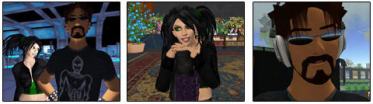
    Dean, Judy and Martin ‘inworld’ are asking “So when do we start?”

  • Visions of the future…..

    There is a wonderful online gallery of illustrations by Villemard from 1910 imagining what life would be like in the year 2000. It’s part of a larger exhibition titled Utopia: The Quest for the Ideal Society in the Western World.

    Check it out here.

    Thanks to the alert from Stephen’s Lighthouse.

  • Classroom 2.0 review and Second Life

    How can I resist sharing Dean Groom’s reflection on his Classroom 2.0 experiences in his Term 3 Reflection Time. It’s a ripper read.

    He talks about the changes his students have experienced, and changes in his own style of professional learning.

    The way to look for these is from your peers outward. I kind of see each of the people I’ve connected with (or aligned myself with) as a a little whirlpool, each sucking in information and experience. I now look at the whirlpools first. Before I looked at Google.

    I’m happy to be part of his whirlpool!

    Dean is a member of the Parramatta Learnscope Team – who are engaged in a project with NSW Learnscope.

    At a workshop today he shared his experiences with us – he’s ‘upgraded’ his classroom, developed a Web 2.0 toolkit, and learned to move more effectively into the student’s learning mindset.

    Guest of the afternoon was Sean FitzGerald, who talked to the group about Second Life. Jo Kay and Sean do a lot of fabulous work with Second Life in Education.

    jo_sean.jpg

    Sean went so far as to mention machinima and it’s place in this brave new world.

    Machinima is perhaps the extension of this newer wave in education. Digital movies made in online virtual worlds seem to be ‘the next big thing’ in youth created content these days.

    For the uninitiated, machinima (muh-sheen-eh-mah) is filmmaking within a real-time, 3D virtual environment, often using 3D video-game technologies.

    Machinima extends far beyond media creatives and youth though…With ‘Machinima for Dummies’ hot off the press, the first European Machinima Festival kicking off in October, and YouTube screening of the Global Kids’ year-long machinima project A Child’s War.

    The video is based on research done by the youth about the situation of child soldiers in Uganda and the upcoming trial at the International Criminal Court.

    You can watch their earlier piece about digital media and youth here and read the youth leaders blogs here.

    3-D platforms like Teen Second Life (13-17 year olds) open up new ways of learning, identity exploration, behavioral experimentation and self-expression without stumbling into dicey terrain ‘outside the grid’ in SL’s larger virtual world.  This makes initiatives  such as Skoolaborate possible.