The Connected Library – get one now!

judysuzette.jpgEarlier this week, our network of teacher librarians were able to spend the day with one of Australia’s leading school library practitioners. Fabulous Suzette Boyd from Scotch College has been an inspiration to many of us during our careers, keeping us grounded on quality services, imaginative enterprises, exciting initiatives, and most important of all – customer focused!

Yes, the kids are what it is all about, and Suzette certainly knows how to manage a school library to achieve the best.

As Victor explained

Suzette was indeed different. I would have liked to have spent an entire day listening to her recount many of the things which she has tried over the years – her ideas are innovative, creative and above all real-world.

During the course of our day we looked at Suzette’s key points:

  • building connections and trust with students
  • communicating with and enlisting the support of all users
  • being positive, upbeat and enthusiastic
  • marketing and promoting the library through an extraordinary array of ideas and activities
  • influencing the Principal
  • becoming the cultural and educational hub of the school.

The best news of all is that Suzette’s inspiration is no longer a secret. She is sharing her vision with us all through her book The Connected Library: A handbook for engaging users.

John Marsden says

The Connected Library is a flight manual for librarians

Marita Thomson says

Slim enough to be manageable in these days of information overload, I found this book affirmed many of my current practices but more importantly inspired me to reach a bit further. There are first all those things I always meant to do but didn’t quite get to and then the more difficult area of taking a few risks. I think what is obvious or correct or a risk will vary from one library to another, but Suzette’s book is an excellent place to find your next project.

In recent times librarians in schools have come to be considered technology experts, curriculum leaders, literature gurus, web masters and providers of on-line information and professional development. They are also expected to be human dynamos, with energy to burn, to have a huge capacity to absorb new information, to have the imagination to deliver exciting new programs, whilst at the same time having the ability to maintain an efficient and relevant library service.

Suzette Boyd believes this is probably still not enough and that the level of engagement with users is the real measure of success!

This book is good reading and very manageable. Go on, order it today, or borrow a copy. Your local public library will probably buy it if you ask.

Let me tell you about Ning! and the new bonus!

The big news from Ning! is that it is offering Ad-free student networks. This is a real boon.

I like Ning very much for the robust social networking it provides – it’s excellent for good discussion and group sharing, ideal for new users to social networking, and especially good for specific global projects like the Flat Classroom project, or for your own school-based projects or staff space.

But I have been avoiding ‘marketing’ it in my schools because of the advertisments.

No longer!

Steve Hargadon writes about the new look Ning! – and how current education users can request to have advertising removed. As a member of the FlatClassroom Project, Classroom 2.0, The Global Education Collaborative, Library 2.0, NextGen Teachers, School 2.0, Stop Cyberbullying, Edublogger World, and lots more. I’m not active really, just drop by sometimes – unless the group is project-based such as The Horizon Project and the Flat Classroom Project.classroom-20.jpg

I especially like the way we can use Ning! to introduce groups of new teachers to the world of robust social networking – sharing information, ideas, videos, movies etc, as well as having a personal space to run a bit of a blog (for those who haven’t got time to ‘go it alone’), a way to discuss and ask questions through the forum….and more!

Now it’s time for more people to have a go! Go on, start by joining a group – I have found another that needs my attention – Ning in Education! Time for me to schedule a workshop!

What I would like is a better way of integrating all my groups FaceBook style! API anyone?

  • Ustream.tv

    ustream.jpgThe twittersphere is full of excitement as more and more ed tech bloggers give UstreamTV a try this week.

    Whether you broadcast live, chat live, or record your show for later, this has some interesting potential for teachers to experiment with in some way. Teachers like Coolcatteacher and Budtheteacher have a Ustream space already.

    A great addition to the professional learning toolkit for global educators.

    A post on Twitter, and there we all were (just before midnight) participating in some cool PD at Where the Dust Settles. Learnt about PollDaddy! Discovered how easy it is to use this tool to effectively share information and have fun!

  • The community will lead – from Stephen Heppell

    The opportunity to hear Stephen Heppell again in a recent Keynote session was a winner for me (albeit via video)! He has long been a leader of learning, inspiring innovators the world over (including my own Director Greg Whitby) to move forward in response to the urgent needs of 21st century learning. I have had the pleasure of seeing Stephen ‘live’ for a conference Keynote for the International Association of School Librarianship in HongKong back in 2005. A rare treat for those of us from Australia.

    Stephen mentions his mobile phone in this Scottish keynote. I remember spending a pleasant evening at the same IASL conference dinner with him….. and I remember a guy full of fun, and down-to-earth enthusiasm. Stephen used his mobile phone to help me do quick calculations during a fund raising auction at the conference dinner, and generally spent heaps of time talking with us about what he can do and what he will be able to do in the future with his phone! I love listening to Stephen 🙂

    Ewan McIntosh alerted us to the keynotes for the Scottish Learning Festival which have been made available now in a version that will play on your video iPod or MP4 player.

    It’s a great way to revisit the rich resource that each keynote address provides. You can right-click (or ctrl-click on a Mac) each of the links below to download these to your computer, and drag them to your iPod or into iTunes:Three of them are of particular interest to me:

    but I want to focus on the last one for now.

    Stephen Heppell explores the consequences of technology and change and reiterates that learning will get better and better, with a transparency in understanding, and with downsizing of schools and schooling. He talks of small schools at the end of each road addressing the personalized learning of students – genuinely responding to what I heard about ‘individuation’ from Yoram Harpaz.

    He explains that the future is ‘massively about teamwork’ and collaboration. It is about stuff that is free, and people reporting, and huge amounts of real-time data helping us make judgments about what we should do and what we shouldn’t do. He asks ‘where are we with real-time data’? What are we doing with our mobile phones? etc. What we need is to allow pupil-centric approaches to learning to take over – technology empowering this all the way.

    For Stephen ‘identity’ and ‘time’ are critical. Real time use of technology is extraordinary and evolving in amazing ways. In this context, doing the job of teaching is spectacularly complex and getting harder every day.One thing that is clear is that Stephen has moved well beyond the notion of system schooling, redesigning schooling, top-down structure etc. He talks about a learning world built from the bottom up.We’re a long way off from what we need – or are we?

    Let Stephen explain.

    Photo: School Bell
  • School leadership – the six secrets of success

    Michael Fullan provided us with pretty important secrets for leadership 🙂

    1. Love your employees as well as your customers – this is essential for productivity.
    2. Connect peers with purpose this is how you give coherence and cohesivenessWe need direction plus flexibility from the centre. The secret glue of cohesion is peer interaction.
    3. Bullying backfiresidentifying ineffectiveness without being punitive or pejorative in your actions.
    4. Learning is the workbe careful – PD is a good way to avoid change! It’s about professional learning not professional development. We shouldn’t learn outside and apply it. It’s the difference between prescription and precision. It doesn’t work to simply make teachers autonomous. Precision means that some things are non-negotiable – and there is no conflict between precision and creativity. It’s the way you gravitate to those things that we know are effective.
    5. Transparency rulesits about results and its about practice.
    6. Systems Learningusing your knowledge while doubting what you know. Using humility while you move forward.

    Photo: Success
  • Digital kids – learning their own way

    Michael Furdyk hit the mark, during the last morning keynote presentation at the ACEL/ASCD conference.

    Here we had (at last!) a clear articulation of the new expectations that are driving the learning characteristics of our students: multiprocessing; multimedia literacy; discovery-based learning; bias towards action; staying connected; zero tolerance for delays; consumer/creator blurring; social networking.

    Michael was supported by his own school to take time off during his school schedule to work on his own company! Would you do this?

    The opportunity for creativity and innovation was central to Michael’s life, starting right there at school. We need to allow students to grab opportunities, connect them with organisations in all fields that will support their keen need to explore and learn – it’s about a positive supportive learning community!

    Michael’s company was instrumental in creating ‘social networking for social good’ at Taking iTGlobal- Inspire, Involve, Inform, providing a window into another world. Using the familiarity of social networking, this site helps students develop an awareness and understanding of global issues and ‘take action’ through projects and collaboration. Explore this – it’s brilliant!

    Photo: Window into another world

    New imagery for schools and schooling

    I am fortunate to be attending the ACEL/ASCD conference in Sydney where I have the good fortune to be able to hear in person from some of the key thinkers in education from around the world.

    I wish I had the time to share the inspiration – but I am busy helping with podcasting and interviews (follow up chats) for ACEL.

    It would be hard to pin down my favourite presentation or workshop. How can we make choices when we are hearing from so many.

    A highlight of day two was a very reflective talk from Peter Senge. He used narrative as a way to help us reflect on the changing shape. You know, it’s not about education any more – its about changing society, and changing the way we support our young people to grow in knowledge, competence, understanding and responsibility for a safe and viable future world.

    John Connell followed with an excellent keynote presentation, which also captured the pervasive media world of our students, and the imperative that we allow creativity to drive change and development. Drop over to John’s highlights of the conference, to see how vital the discussion at this conference really has been.

    The final sessions of the day were a particularly fine opportunity to hear Andy Hargreaves and Michael Fullan debate the future directions in effective school development – where we maximize the capacity of teachers and leaders to create relevant and authentic learning for each of our students.

    A comment at the end from Andy reminded me of one thing that was of interest to me at this conference. Andy reminded us that we don’t know just how the technological and social networking dimensions of our student’s online immersive lives will influence the shape of the education delivery in the coming years.

    Lets not lose sight of this, inbetween the new school structures that we are building. It seems that with the exception of Greg Whitby, John Connell and Westley Field, we have inadequate coverage of Web 2.0 as platform, of social networking, of creativity in the real world of our students.

    I hope that those in senior educational roles do not lose sight of this while they are discussing assessment, ‘effect size’ measures, curriculum mapping management styles, leading learning etc.

    Overall a great conference – yet a starting point only for re-shaping schooling for 21st century learning.

    Lets not forget that that some of the social networking tools that are driving our student’s experiences were developed by young people – out of school, and as an aside to the learning that education seems to be involved with. Lets meet online in these spaces for the next ACEL conference 🙂

    Photo: Valley between buildings.

    Podcasting: A Teaching with Technology White Paper

    Sharing audio and video files on the Web has been possible for most of the last decade. But in the past two years podcasting has exploded onto the scene.

    This paper examines educational podcasting in three realms: the creation and distribution of lecture archives for review, the delivery of supplemental educational materials and content, and assignments requiring students to produce and submit their own podcasts.

    From the Office of Technology for Education and Eberly Center for Teaching Excellence at Carnegie Mellon University, this is a 15 page PDF.

    Podcasting: A Teaching with Technology Whitepaper

    [From: Jane’s E-Learning Pick of the Day]

    Web 2.0…..looking pretty juicy

    juicyweb20.jpg

    Last Friday I spent a full day with teachers from Coffs Harbour and beyond, at a Web 2.0 Workshop. It was a great opportunity to work with teachers from different parts of northern NSW, and to hear from them what was happening in their schools in relation to online learning. It was a very busy day – but these great teachers were not flagging – but calling for follow-up workshops to help continue their learning and sharing of tools and ideas.

    I’ll be back again in Coffs Harbour in a few weeks – this time at an ICT conference, where I’ll do a Keynote and more workshops.

    So to make this learning more flexible for those attending these sessions, and for others that I am working with closer to home, I have put together Judy’s Web 2.0 Notes – which is designed specifically for those new to Web 2.0.


    If you are just beginning your adventure into Web 2.0 e-learning, then this blog is for you!

    These ‘notes’ provide an introduction to the Read/Write web, covering key information, tips, tricks and links to help you enjoy your journey into Web 2.0 e-learning in your school.

    Many thanks to Mary Help of Christians Primary, Sawtell, for hosting the workshop, and for Sharon’s great organisation (and yummy baking)!

    school2.jpg

    Virtual communities as a canvas of Educational Reform

    Some recent online reads have prompted me to write about learning within our ‘shape-shifting’ technologically driven world. If you are new to blogs and online tools, let me tell you that there is a lot happening – but don’t let that put you off getting involved.

    There are many different perspectives to put on online social networking and it is important to know where one is coming from when talking about social networking and youth. The perspective(s) one has will be very different whether one is a parent with a teenage daughter on MySpace, a marketing executive interested in the target group “14 to 20,” a journalist looking for the next big news story on young people and new media, a youngster using a social networking site as part of everyday life or a researcher investigating how young people are using social networking sites.

    35Perspectives on Online Social Networking provides a different (broader) exposition of online networking. Here we have an excellent overview that helps me to see the matrix of inter-relationships between sectors or groups. That, after all, is what our real world is – and online virtual interactions are no different. Don’t let me forget that.

    So that was what WOW2 was a bit about – educators in one countryexploring education ‘downunder’. I have to thank the WOW2 team for the fabulous opportunity to take part in the WOW2 EdTechTalk recently. It was pretty cool chatting to my aussie mates Graham Wegner and Jo McLeay. But I also ‘met’ Jason Hando, who (rather surprisingly) is in Sydney, doing great things as well. No excuses for us not keeping in touch are there?

    Actually I think that what Sheryl wrote in Virtual Communities as a Canvas of Educational Reform is a ‘must read’ for school leadership teams working on capacity building and educational reform. She says:

    The way I see it, social networking tools have the potential to bring enormous leverage to teachers at relatively little cost — intellectual leverage, social leverage, media leverage, and most important, political leverage. And while most of us reading this post can name educators across the globe that are using these tools as windows from their classrooms to share ideas and develop their own personal learning environments, the sad truth is that most aren’t. The burning question in most of our minds is how can we accelerate the adoption and full integration of 21st Century teaching and learning strategies in schools today?

    Creating virtual communities that function effectively within and beyond our schools IS a significant challenge.

    Our system of schools has been actively exploring these options in 2007 (fabulous!) – and we are definitely learning from the experience. We began the year by formally launching a blogging strategy. Unfortunately we didn’t address some of the important questions that Sheryll raised, and as a result our first effort at system-wide blogging ‘came a cropper’. Well, not totally, but it was no surprise really as some of the vital ingredients of social collaboration were missed starting with the first important point – who is blogging and why?

    The best blogs are social – and we missed that point – and are platforms where discussion blooms. Blogs in this context of collaboration can’t be the stuff of soapbox but must be the stuff of open-ended conversation – and that means writing as well as commenting.

    I like the fact that we continue to try to figure out what sort of virtual communities will work for us. We’re game for the challenge, and won’t let disappointment stop us from pursuing educational innovation and reform.

    Now we have a new strategy to experiment with. The start of Term 3 saw the official launch of the ‘Learning Common’ blog – open to all teachers to write, comment, collaborate, and share the ups and downs of teaching life. We have merged a number of blogs into one, and opened up the option to be a writer to anyone in any school. Will this work?

    Richard McManus covers some important things about blogging within the context of virtual communities asking Is Blogging Dead? Gosh, we are just starting with blogging, so I don’t think our teachers will be abandoning our new blog for something else. But, Richard says

    It’s hard to get discussions going on a blog, but the blogs that at least attempt it and actually write for their readers — these blogs are the most compelling in my view.

    I agree that this is at the heart of the matter. Let’s hope we can make the blog compelling reading – a place that people really want to be to share their ideas. So let’s see what happens. We’re pretty keen on blogging, and many of us blog!!!

    We just haven’t cracked the whole virtual community thing yet, but I think we’ll get there.

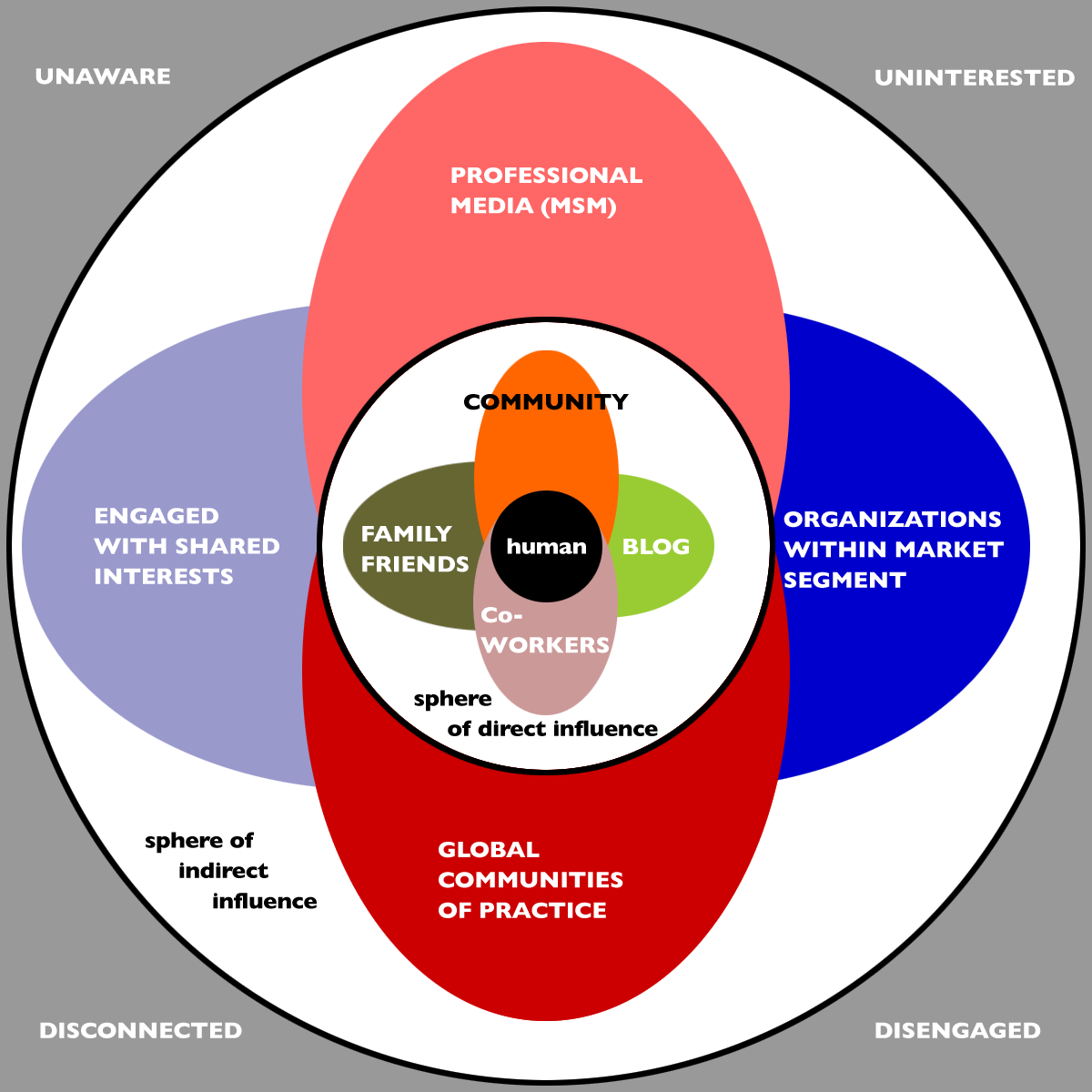
    It’s all about spheres of influence. This graphic says a lot, and is easily adapted to provide us the guidelines for successful blogging – that builds capacity as part of our educational reform!