ICT – responsible use forum

I’m attending an ICT forum on “responsible use” tomorrow, with information from Minter Ellison, National Copyright Unit, and more. I hope to learn something ‘new’.

Fair use, and responsible use online are significant issues, that need solutions for management in schools in developing a culture of ‘fair use’. I am surprised that there seems to be nothing listed on the agenda in relation to Creative Commons – will they mention or cover these newer directions?

Back in August, Andy Carvin wrote about Encouraging student creativity with Creative Commons.

In today’s world, copyright has become a lot more complicated. Ever since the advent of digital recording and the ability to upload large files to the Internet, everyone with Internet access could theoretically become distributors of other people’s content, even without their permission.

Hmm, how does this video below fit with this?

The post on YouTube provides the source of this video from Stanford Law School. Nice. Is it OK for me to capture it this way for the purpose of education? Since their purpose is to promote ‘fair use’, and our purpose in schools is to teach about “fair use” – I imagine that distribution of this video, with acknowledgment, is going to be fine. But I don’t know – and I didn’t ask. Would you? In this case the ‘horse has bolted’, as I found this link via popurls!

How close do we stick with these ideals? The sharing on social sites, such as Flickr, encourages us to ‘do the right thing’ and reference our use of photos, even when willingly shared. However, it is our job to be encouraging students to be familiar with the purpose of Creative Commons licensing, and how this is used in environments beyond the standard copyright laws in our own countries or under international law.

A Fair(y) Use Tale

Technorati Tags: , , ,

Mobile technology…2020

To tempt you to investigate the Horizon Project, I am going to share this great video by Atif from the International School Dhaka, in Bangladesh. He’s done a great job creating this video to highlight the possible changes and uses of mobile technology in education in the future.

Technorati Tags: , , , ,

Digital teaching and multi-tasking via Horizon

I know that many of us are doing it …..joining the digital natives…..but I have just had a really fun hour in the global digital domain doing the following:

  1. judging parts of the Horizon project wiki
  2. judging Horizon project manager videos
  3. listening to a GenTech podcast on copyright and fair use
  4. entering results in the Google docs spreadsheet – right there online for us to share (web 2.0 as platform – remember?)
  5. watching the results drop in from others around the globe
  6. chatting within the Google docs space – using the chat window to collaborate with  colleagues from Melbourne, Dhakka, and Shanghai.

This time, as part of my small role in the Horizon Project, I was specifically looking at the sections on Mobile phones and Massively Multiplayer Educational Gaming.

If you haven’t yet picked up on the tremendous work of the teachers and students involved in this year’s version of the Flat Classroom Project, then take a visit to the Horizon Project Wiki, and see how things are progressing.

ClaimID for OpenID

ClaimID is the free way manage your online identity with OpenID.

No, I haven’t used it, but Michael Habib has! Michael belongs to that wonderful group of new graduates who are going to change the shape of libraries, so it makes sense that he already has a ClaimID.

Michael says: I use ClaimID to manage my online identity. ClaimID is a tool for collecting and annotating links related to me. Mathias Fischer says: ClaimID allows me to present my profile on the net.

Thanks to DoubleSlash for providing a Slideshare that outlines the relationship between OpenID and ClaimID.  Perhaps you will lay your claim?

ClaimID and Open ID raises further issues beyond the last post on OpenID, in relation to   learning, identity, authorship and attribution. This is clearly a developing field – and one that I imagine will intersect (and converge) with copyright and creative commons managment of online materials.  One to watch for the future.

Technorati Tags: , , ,

OpenID – Web [3.0] connections

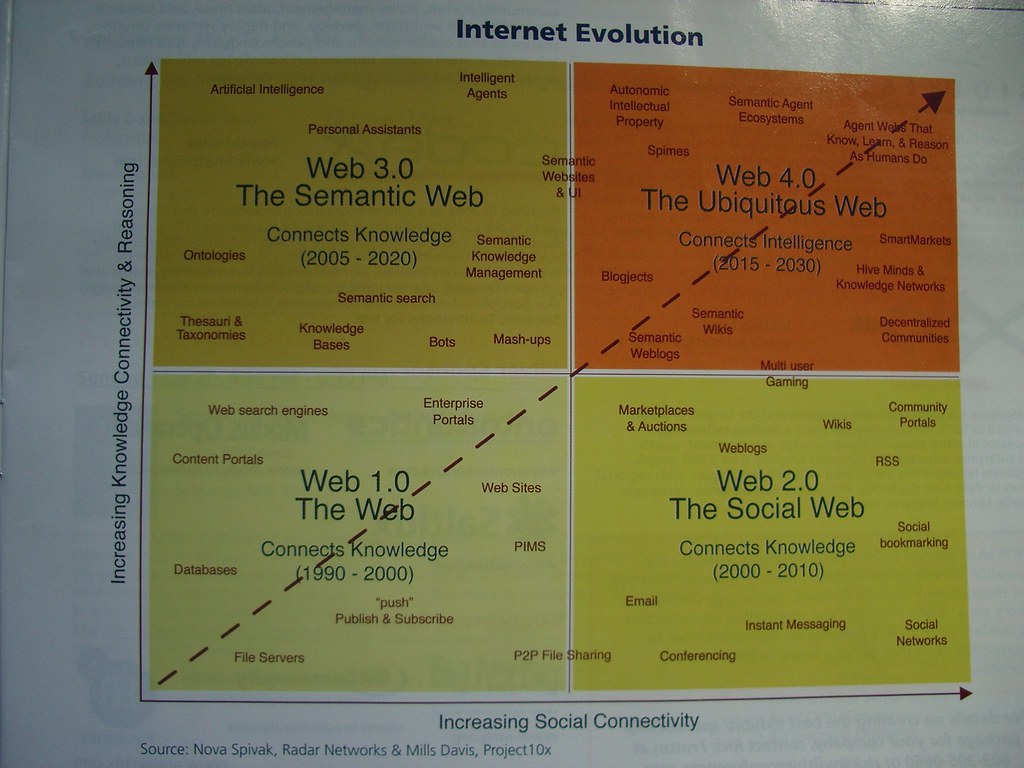
As we move towards the Semantic Web world of Web 3.0, the question of online identity takes on another dimension. This is the matter of ‘single sign-on’ – something that we are just getting instituted across the network of all our 80 schools. Nice when organisations finally get that sorted.

But what about the Web platform? A feature article from April online journal Ariadne covers OpenID and the ability for a person to have ‘single sign-on’ across multiple OpenID-enabled services.

OpenID: Decentralised Single Sign-on for the Web takes a brief look at OpenID and asks what relevance it has to e-learning.

Proponents of Learning 2.0 and Personal Learning Environments argue that we are going to see far greater use of ‘informal’ Web 2.0 services as part of the delivery of learning in our ‘formal’ learning institutions (schools, colleges, universities, etc.). If we accept this argument, then the use of OpenID is likely to become increasingly important to our learners.

Our learners are likely to want an online identity (or several online identities) that span the different phases of their education and that span the individual institutions within any particular phase.

Technorati Tags: , ,

Thinking about Web 3.0…with IEEE Internet Computing

For a long time now I have been thinking about Web 3.0 – not to join the hype, but to better understand the potential of web developments that will effectively merge thinking in disparate fields.

Unlike some of my colleagues, my thinking (and my blog) bounces between two distinctive fields or disciplines – education and pedagogy vs technology and information science. I think I am lucky, because too often I see the errors of thinking that some educators (and leaders) perpetuate in the guise of keeping up with the (21st century learning) Jones!

google.jpgWeb 3.0 is getting some blogosphere air-space – and about time too. Adaptive hypermedia research has been around for many years, nicely juxtaposed against developments in search alogorithms and enhancements with various serach engines. A dawn of a new era? Certainly not according to Jean-Noel Jeanneney in his book Google and the Myth of Universal Knowledge. Google’s digitisation project has provided a healthy jolt to our complacency, and the assumption that digital initatives = fantastic developments. Here is the true rub of machine generated, folksonomy driven hierachies where virtual information is being brewed in a global cauldron.

In my view, we should be less interested in the utopian dream of exhaustiveness than in aspiring to the richest, the most intelligent, the best orgainzed, the most accessible of all possible selections. …Jean-Noel Jeanneney

It is time to focus on the cultural and knowledge aspects of Web 2.0 as it moves to Web 3.0, if for no other reason than this digitisation of our society provides challenges and opportunities for equality or repression like never before.

For this discovery of yours will create forgetfulness in the learner’s souls, because they will not use their memories; they will trust to the external written characters and not remember themselves…….PLATO, Paedrus, translated by Benjamin Jowett

Phil Midwinter asks Is Google a Semantic Search Engine, and goes on to explain that Google is using semantic technology, though it is not yet a fully fledged semantic search engine. He is more optimistic about developments.

There are barriers that Google needs to overcome… is it capable of becoming fully semantic without modifying it’s index too drastically; can Google continue to keep the results simple and navigable for its varied user base? Most importantly, does Google intend to become a fully semantic search engine and to do so within a timescale that won’t damage their position and reputation? I like to think that although the dragon is sleeping, that doesn’t mean it’s not dreaming!

A business-oriented write-up, which nevertheless has important considerations for the educator/information professional. The key thing is that there appears to be a convergence in thinking around the fact that “semantics” will form the backbone of what might be dubbed “Web 3.0”. The Wikipedia entry on Web 3.0 talks of leveraging semantic web for 3-dimensional collaboration…even as far as to point to this as being on the evolutionary path to artificial intelligence! (the stuff of many SciFi stories)

However, what we are really needing to examine closely, is the rise of the API culture – as this is transforming what it is we can seek or serve our knowledge-seeking selves!

Read/Write Web to the rescue! Another excellent write-up from Alex Iskold on Web 3.0: When Web Sites Become Web Services. Well, I suggest that we need to do a lot of reading and learning about folksonomy and taxonomy … and more. Let’s say, more posts for another day.

BUT what we do know already is that the Semantic Web efforts are providing an approach to constructing flexible, intelligent information systems – and it is the synergies between ubiquity and semantics that are exciting, and in which we should expect to see significant future work.

Read more about this in Embracing “Web 3.0” in IEEE Internet Computing.


Technorati Tags: , , , , ,

Sometimes you have to read to talk!

One of the things that keeps being said is that social networking improves communication, and facilitates ‘being comfortable’ for the millenials. Kids use social networking to help them settle into their teen world. Because of Myspace or Beebo, teenagers can walk into a party, or walk around school and know people beyond their immediate ‘sphere of influence’. Better than vertical streaming of pastoral care groups in schools (used to help students associate with each other by putting kids of different ages together) online social networking can broaden and enable friends and conversation seamlessly and effectively. Those who are reluctant to talk, or who rarely contribute in a classroom setting, find themselves more able to communicate in a digital environment.

Isn’t it interesting that these same effects are observed when learning takes place within a virtual setting, such as Second Life. Students at Suffern Middle School in Second Life are learning how to manage their avatars and how to use this environment as their classroom.

You have to read the discussion to see just how to focus learning in Second Life, and how millenials can successfully communicate in Second Life.

This is an unedited, unabridged log of the discussion held today by the student group who are reading Snow Crash: (Please remember these are 8th grade students!) The remarkable thing is that in a typical classroom setting these kids would never be able to get to the level of thought and focus as they do in SL!

Capture the 20:20 Vision

We are not alone – not really! The global reach of ideas and subsequent inspiration we can draw from each other is just great! …….. and then the opportunity to share, and be willing to share, is the inspiration of Web 2.0…… communication, conversation, connection, community.

My recent trip to NewZealand gave me a wonderful opportunity to listen and learn from academic, public and school librarians – all involved in education and preservation and promotion of culture.  We all have our own challenges – but it is not surprising when these challenges sound the same “across the ditch” – their expression, not mine 🙂

I had a wonderful visit to Broadgreen Intermediate – their school library is a design inspiration, which houses NewZealand art (on loan from museums), and reflects design and innovation throughout. I wrote more about this here.

Enjoy the snaps of this wonderful library. View slideshow

I was able to talk about the inspiration of global leaders in libraries. My slideshare is a cut-down version of the presentation, which provides the key links to online sites and videos used. There is a slide that features Michael Stephens, a favourite amongst New Zealand blog readers. It’s a great snap of Michael’s online identity!

Links used in the Web 2.0 workshops I ran for Web 2.0 newbies can be found at Workshop Time!

Congratulations to my New Zealand colleagues.

‘What hath God wrought’

Lots of discussion in the blogosphere about the merits or hype associated with Web 2.0. Two particular posts challenge readers to slow down….

Bryan Appelyard writes in the Australian IT with a cautionary view of Web 2.0, suggesting that ultimately Web 2.0 will only be good for us if, somehow, it succeeds in evolving towards an identity-based discourse. All else is mere anarchy.

In the AASL blog heated debated, inspired by Twitter reflections, also indicates that people are in Web 2.0 overload. The pressure is on, particularly with our current API driven expansion of Web applications – as seen at the Museum of Modern betas! or that fascinating Web2.0 Directory.

Never mind.

From that most esteemed institution of American Librianship – the Library of Congress – we now have the Library of Congress Blog, launched today. The very first post links right into the idea of change, change, change – at the heart of Web 2.0.

How did I find out about this? Through Steven Cohen on Twitter of course 🙂

What hath God wrought? The blog leads right into the topic with….

Those were the first words ever transmitted electronically, in 1844, by Samuel Morse. That message and Morse’s invention of the telegraph marked what was undeniably, at the time, the most significant communications revolution since the advent of movable type.

Technorati Tags: , , , , , , ,

FINAL domain post

embarrassed.jpgSorry for all the mayhem! From sound advice from the Blogosphere I will keep Heyjude as the main site for this blog.

Forgive me if you scambled and changed your URL to http://judyoconnell.com. This will work of course, but the main one for tracking will remain at https://heyjude.wordpress.com. This allows me to keep my own domain, and use it in whatever way I wish to in the future, as well as still providing me with an ‘easy’ identity for presentations.

Everyone else? Status quo….but if you need to provide a quick URL for anyone (you know how it is, no pen, need an easy way to remember …feel free to point them to judyoconnell.com for starters!)