The future of digital diversity

Think digital – it’s  a ‘doing’ technology.  Trends from PewInternet Research Centre indicate that teens are digital denizens.

While the research is not Australia, it points the way to the behaviours or our own teens, and signals a need for some major shifts in thinking about learning and teaching contexts.   The interactivity of the web allows students to move very quickly from one application to another – remixing, remaking and montaging ‘content’.  Learning is promoted most effectively when students are making, creating, building, simulating, hypothesizing – all desirable higher-order thinking activities.

So, give these figures some thought!

Did you know what’s happening to the Internet?

This is another official update to the original “Shift Happens” video. This completely new September 2009 version includes facts and statistics focusing on the changing media landscape, including convergence and technology, and was developed in partnership with The Economist.

Thanks to Wes Fryer for the tip-off in his post Can you Imagine So Much Global Sharing?  My answer is – I never could, even though I’m an avid reader of SciFi. Dreaming and doing are quite different things!

Also in the same post – a peek at the state of the Internet. 

2010 is one amazing year!

Vodpod videos no longer available.

more about “JESS3 / The State of The Internet“, posted with vodpod

Tsunami – in the classroom?

I wonder how many classrooms in Australia will spend time this week talking about, reviewing and learning about the impact of earthquakes and tsunami  on countries and people?

This weekend saw the earthquake in Chile and the tsunami it created affecting many parts of the world.  The Chilean president declared a state of catastrophe after a deadly quake of magnitude 8.8. Subsequently warnings of tidal waves were issued in 53 other countries.

In the Guardian’s Report Chile Earthquake: Pacific nations brace for Tsunami we have a good lead article to set the scene for discussion.

The Tsunami raced across the Pacific and threatened Hawaii as it rushed toward the U.S. West Coast and hundreds of islands from the bottom of the planet to the top. Sirens blared in Hawaii to alert residents to the potential waves. As the waves expected arrival drew near, roads into tourist-heavy Waikiki were closed off.  Police patrolled main roads, telling tourists to get off the streets.

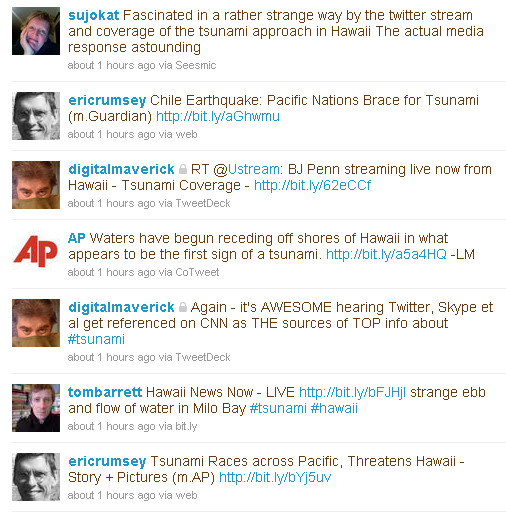
It’s not new – social media has a well established co-reporting global events!

But do your teachers know this?  Do they know powerful social media is in providing information and synchronous coverage of event?

Did they pick up the links they need via Twitter? of Facebook? or other social networking site?

Perhaps they already have the Associated News App on their iPhone (find it in the App store)  and were aware of events that way? or via another mobile App?  or heard it on the news?

Did they send out a message (text? IM?) to their geography students to alert them to the CBS News Stream via Ustream so they could experience live some of these events – even if only for a few minutes?

Not only were the media doing live reports online, as well as on TV, but people in the streets were contributing picture and live phone feeds and images to contribute to the pooling of information.

Twitter was buzzing.

Don’t forget to check out Diigo and Delicious during the week to find more links from other  ‘connected’ teachers.  

From a student’s point of view – social media tools allow them to experience these  incidents live and hear the authentic experiences of people observing the event.

By Monday there will be plenty of online media sites that will have stories, videos, etc to use for class review. But none of that is as good as experiencing a live report! How many teachers will be ready to immerse their students in learning with the very tools that students love to use?

Here’s someone ready to incorporate this type of learning into their uni classes – Magnitude vs Intensity in Chile. Learning can be amazing.

Larry Ferlazzo provides The Best Sites to Learn about the Earthquake in Chile (& possible Tsunami).

Go on teachers – give it a try!!  Here’s a great map of Estimated Tsunami arrival times to get you talking.

The picture below shows the live CBS News UStream.

Give credit where credit it due

Another year of school and the vital need to think through ‘plagiarism’ rears it’s ugly head again – particularly as the Open Content movement gains strength. The recently released Horizon Report 2010 explains:

A new educational perspective, focused on collective knowledge and the sharing and reuse of learning and scholarly content, has been gaining ground across the globe for nearly a decade. Open content has now come to the point that it is rapidly driving change in both the materials we use and the process of education. At its core, the notion of open content is to take advantage of the Internet as a global dissemination platform for collective knowledge and wisdom, and to design learning experiences that maximize the use of it.

Collective knowledge and wisdom depends on one thing though – giving credit where credit is due, whether it is courses, information, ideas, inspiration, motivation, etc. In fact, development of knowledge and scientific research has always depended on this.

But with the global reach of information and info-trash the ‘times, they are a changing‘.  Misinformation can become information. Knowledge can too readily become bias. So learning to give credit where credit is due is a critical and essential information fluency skill for our students to acquire.

Creative Commons

Let’s demonstrate to our students how easy it is to acknowledge inspiration in an online learning world. It takes a quote or a backlink – that’s all. What does it achieve?  Well, first and foremost, it builds learning conversation and creative endeavour,  and secondly it demonstrates that a learner is able to analyse and synthesize thinking from a global repository of possibilities. Sharing is so important, but so is sharing openly and inclusively.

It’s so easy to plagiarise, and call something your own!

Well why not, you might ask? Mashup? what’s wrong with that? There’s plenty of that around and it doesn’t really hurt does it?

Let’s face it, if I take myself as an example – I’m one in millions writing online. What does it matter if someone takes what I say and publishes it in China, or Russia or Timbuktu. Not much really, other than it misses the chance to develop better resources or better information about a topic.

However, educators and managers of technology supporting educational institutions online  understand the need to build that online info-puzzle together. We’re a big crowd with the potential to influence things!

That’s where book publishing and refereed journals  still have it ahead of the internet at this point in time – up to a point anyway. In addition, the notion of acknowledging ideas is a tradition in Western scholarship which for me has value in building credibility, personality, creativity, knowledge, and quality facts.

[Of course, what I’m talking about here is a very simplistic peek at the much more complex topic of knowledge  sharing which is at the heart of what we need to introduce our students to. Do drop over and read  If We Can’t Even Describe Knowledge Sharing, How Can We Support It? A nice ‘peppery’ look at the complexity of knowledge behaviours.]

How can we change the tendency in an online world to ‘copy and paste’ what suites for personal profit or gain?

Together, let’s entice our students into being captivated by the amazing opportunities that online learning presents. Introduce them to Creative Commons Licensing. Make sure that when they grow up they understand the power of the “By licence” (via Beth Kanter).

Teach your students the wisdom and value of giving credit where credit is due.

Subscribe

If you are enjoying reading this blog, please consider subscribing to my RSS feed. Thanks for visiting!

Shareaholic – always!

Thinking? Writing? BLogging?  Sharing?  That’s what Web 2.0 media is all about ~ it’s continually getting easier to share our online learning experiences with others 🙂

Thinking Beta – that’s what it is! Always thinking, always learning, always expecting change.

Rather later than others I know, I’ve discovered a useful addition to my Firefox suite of online tools in Shareaholic. I’m sure I’ve spotted @buffyhamilton using it!

Shareaholic supports 100+ destination services. Make sure you setup your favorite services from the options menu so that Shareaholic works exactly the way you want it to. The latest update tells me that the service is just getting better and better.

I recommend you give it a try. Perhaps you’d like to share your experiences if you’re an ‘old hand’.

Not just Twitter and Facebook ~ it’s a Poken!

Get the pokenPulse combination Poken device and USB Flash drive. Click for details.As John explains in his post on Integrating Social Media and Reality, we live in two separate, parallel worlds, with one foot in each. There’s the online world of text, email, online shopping, Internet search, Twitter, Facebook and LinkedIn. Then there’s the real world of food, shelter, family, friends, and work. The two intersect, but they’re not tied together in any robust way. Well, at least until now.

Enter Poken! a device you might keep on a lanyard around your neck or clipped to your jacket, backpack, or bag. Need to exchange information or keep up-to-date with a colleague? If you both have a Poken you can touch the hands of the Poken together and they’ll sense each other’s presence. After a wireless exchange of links, both hands will pulsate with a green glow to announce the successful transfer of information. The magic happens when the Poken is connected online to your personalized online portal.

Way better than a business card ~ amazing social networking! Is this new? Or have I been living under a rock?

Vodpod videos no longer available.

more about “Poken Explained on Vimeo“, posted with vodpod

Copyright changes – let’s fuel our imagination!

Under European Union law all books, poems and paintings pass into the public domain 70 years after the death of their creator.

At midnight last night the works of artists and thinkers who died throughout 1939 slipped out of copyright, meaning they can be reprinted and posted on the internet without incurring royalties.

In addition to Yeats and Freud, the list includes Arthur Rackham, the illustrator whose drawings appeared in early versions of children’s books such as Peter Pan and Alice’s Adventures in Wonderland, the novelist Ford Madox Ford, and Howard Carter, the archaeologist who discovered the tomb of Tutankhamen in Egypt.

A selection of works by the artists will be available on Wikisource, a sister website of the free online encyclopaedia Wikipedia, from today.

Wikimedia, the not-for-profit foundation that runs the sites, hopes that further works will be uploaded by the public throughout the year, providing near-complete and legal archives of the artists’ output.

The end of copyright also means that the works can be freely downloaded onto electronic reading devices such as the Amazon Kindle.

It’s an astonishing shift for us all. Copyright has always been expiring each year on works of writing and music – the key difference now in 2010 and beyond is the ready accessibility, transportability and share-ability of these resources.

On New Year’s Day 2009 the copyright expired on the Popeye cartoon character, following the death of the artist Elzie Segar in 1938. Works by Mikhail Bulgakov and F Scott Fitzgerald are among those due to pass into the public domain on New Year’s Day 2011.

Right at the fingertips of our students!

Posted via web from Heyjude’s posterous

Twitter borked again – but not Ask a Librarian!

Working ever so hard on editing some book materials, I found I was relying on my online connections to deliver quick answers to curly questions. One port of call was Ask a Librarian from the National Library of Australia.

I logged on for a quick real-time reference query. Wonderful personal service – and a nice chance to chuckle (via text) with a fellow professional. My chat log was emailed to me just as soon as I logged off – containing all the links to information I needed.

This is very cool!

My other port of call was – of course – twitter. My queries resulted in general responses, so quick Direct Message assistance, and some regular help with people willing to go home and ferret around to find specifically the information I needed.

BUT Twitter got Borked! We all went off line – mid conversation!  It’s times like this that I realise how having no Twitter is just like having no phone line used to be in ‘the old days’.

From Mashable: Twitter Has Been Hacked; BBC News: Pro Iranian Hackers Hit Twitter and Opposition Websites.

Reblog this post [with Zemanta]

Real and imagined ~ are the same!

Each school, each leadership team, each school library team and each teacher needs to learn how to restructure the core business of schooling in order to embrace learning in our changing online world.

We say this often and slowly the ship of state is turning ~ but fast enough for our students?

I came across two things today which brought a smile to my face. What we imagine is possible ~ is real these days!

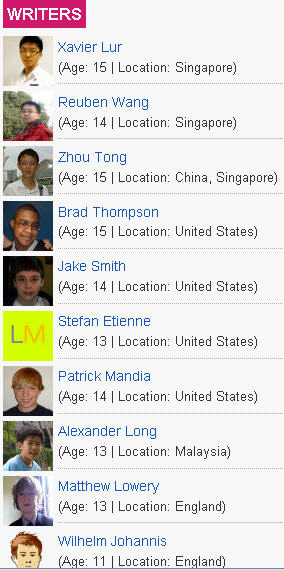
Take a look at TechXav –  seems to be as professional a website as any you might come across….. by 11-15 year old students?

TechXav is a technology blog written by a group of young and zealous teens, ranging from the age of 11-15.

Wait – they’re even located around the world!!

Right – and imagine what they think of being shown a powerpoint! or opening a text book!

I also read a post by Will Richardson about phones and about the disruption they are already creating for most schools (high schools at least) and about the huge brain shift we’re going to have to through collectively to capture the potential for learning in our kids’ pockets. I love the video he shared as well!

Yes, we’re facing a huge challenge ~ much bigger than just the roll-out of laptops in our schools in NSW. It’s a fundamental, seismic shift that likely will swallow some education institutions.

So this little promo video shared by Will also bought a smile to my face.

Making Twitter work for me – and you!

I’ve been using Twitter for what seems a long time – and in that time I have learnt that Twitter is an important part of  my whole toolkit of professional learning and sharing. I have also learnt that it is important to bend Twitter to the purpose I want to use it for!
Twitter has been growing and changing since it first arrived on the scene.  The advent of Twitter and other social networking sites, as well as the popularity of text messaging, have made short-form communication an everyday reality.  But expressing yourself clearly in short bursts-particularly in the 140-character limit of Twitter-takes special writing skill.
Carol L. Tilley, a professor of library and information science at the University of Illinois at Urbana-Champaign,  believes the character constraint of Twitter Texting can Enhance Writing Skills.
If renowned author Ernest Hemingway could write a full story in just six words (“For sale: baby shoes, never worn”), then teachers and librarians should encourage their students to use Twitter and text messages as part of their literacy lessons
For me, Twitter texting is about collaboration, sharing, and supporting my colleagues. My Twitter @heyjudeonline is a mix of information finds, queries, responses, and light chatter.
The information I  “put out there” is drawn from my RSS reading at Feedly and other sources. Twitter is the addition to my blog, and the quickest way I know to share!!  But thanks to Feedly, I can not only share on Twitter, but can (almost simultaneously) add important information to my delicious account for Heyjude, or post it on my Facebook profile.
For an evolving development  of Twitter, or to pick up the latest information, just take a peek at my Delicious link for Twitter.  I keep it all, and it’s certainly getting to be very extensive indeed!
The next key evolution has been the capability to keep lists!  At last – a way to organise the people you follow.   To be honest, I haven’t yet had time to organise mine. I’ve been busy thinking through other avenues.
I now run 3 Twitter accounts – the most recent addition being specifically for School Libraries.
@heyjudeonline Educator, learner, blogger, librarian, technology girl, book and library lover. Transforming education and libraries. Innovation for life.
@LibraryCloud Innovative ideas in one tweet for School Libraries everywhere!
@librarycloud is brand new – and really focussed on learning, teaching, and all things to help organise a fabulous school library.  I’m keeping this Twitter account clutter free – so that I can make a Twitter book out of it for you!

@Simplybooks Promoting reading and good literature, as well as providing links and information about quality approaches to reading education.

So you see, I’m keeping myself busy making Twitter work for me – and hopefully for you too!

Is there anything else I could do to help you?

Meanwhile – grab the Complete Guide to Twitter, or one of Tim Davies fabulous One Page Guides.