Excellence at ISTE 2010

Several intrepid educators have travelled across to Denver, Colorado  from various parts of Australia to attend one of the world’s leading conferences for learning and teaching with technology.

The conference  “Exploring Excellence” hosted by the International Society for Technology in Education is of a scale and variety that is never experienced here in Australia. Amazingly this conference gets underway a good day before the official launch.

Edubloggercon2010 was (as always) a totally crowd-sourced “unconference” event – built in the lead up to Saturday on a wiki, then finally voted upon and organized at the start of the day for the full day’s of busy activities. A list of of the shared link. My completely favourite fun session is always the Web 2.0 smack down of new media tools. Check them out and what others are saying.  We could really enjoy doing this for even longer than an hour – it’s just fabulous to get recommendations from practitioners. Overall,  it is amazing to see such grassroots activity resulting in such quality information.

Thanks to Scott Merrik for hosting a lovely evening at his brother’s home. So nice to spend time with Virtual Worlds educators, and to experience a little of Denver home life. I remember the first time I met Scott in ISTE island a few years back – and for his welcoming patience to a ‘newbie’ SecondLifer. 

The Opening Keynote on Sunday evening  by Jean-François Rischard of the World Bank  was a little disappointing – but the shared camaraderie of the crowd at the Bloggers Cafe certainly made up for this in spades. Nuts were shared, jokes were cracked, pictures were snapped, and Twitter humor abounded!

It’s my second trip to an ISTE international conference. It promises to be yet another inspirational conference.  I met one wonderful teacher – three years in the profession, three conferences at which she presented, and engaged in amazing innovation at her school. What an inspiration!

Technology innovation is everywhere! Already we have heard from schools that are integrating iTouch devices and now iPads into their overall curriculum delivery. This is very different to Australian schools who are stumped by network issues. Perhaps more of us should be at conferences like this to bump innovation along by disseminating crowd-sourced solutions to similar problems. This is where a personal learning network comes into it’s own. Someone can always help provide ideas and solutions.

I’m looking forward to learning more, interacting with old friends and new, and being excited about the future of learning. The program ‘at a glance’ gives a peep into the possibilities at ISTE2010.

If you dropped into my session on Monday, here is my presentation for review.

The world is now a global village

Marshall McLuhan explores  the world as a Global Village in 1960 –  with extraordinary relevance to our 21st century reality!

Electronic media haven’t wiped out the book. It’s used, read and wanted now more than ever. But the role of the book has changed. It’s no longer alone. It no longer has sole charge of our outlook nor our sensibilities. Of course the trouble is, we act as if we were still solely in the age of the book.

Oh yeah!

Digital literacy across the curriculum

Digital Literacy across the Curriculum (pdf), from FutureLab, UK, is a 63-page handbook aimed at educational practitioners and school leaders in both primary and secondary schools who are interested in creative and critical uses of technology in the classroom. The handbook is supported by case studies (pdf) of digital literacy in practice and video case studies.

The handbook aims to introduce educational practitioners to the concepts and contexts of digital literacy and to support them in developing their own practice aimed at fostering the components of digital literacy in classroom subject teaching and in real school settings.

Developing digital literacy is important  because it supports young people to be confident and competent in their use of technology in a way that will enable them to develop their subject knowledge by encouraging their curiosity, supporting their creativity, giving them a critical framing for their emerging understandings and allowing them to make discerning use of the increasing number of digital resources available to them. p.10

Developing digital literacy in the classroom can allow students to apply their existing knowledge of creating with digital technology to learning in school and in the process be supported to think more critically and creatively about what it is they are doing. p.24

Fostering creativity in the classroom involves applying elements of creativity to subject knowledge. This can be done in all subjects across the school curriculum. p.25

This is an outstanding document that can be used as an information primer for helping schools develop a whole-school approach – particularly relevant in the current 1:1 laptop scenario in Australia.

Horizon Report K-12 – future think!

What a buzz!  I helped with the Horizon Report K-12, which has been officially released.

This volume, the 2010 Horizon Report: K-12 Edition, examines emerging technologies for their potential impact on and use in teaching, learning, and creative expression within the environment of pre-college education.

Make sure you read it and circulate it to the leadership team in your school or institution.

Thanks to  Larry Johnson and Alan Levine of  NMC  for inviting me to join the 2010 K-12 Horizon Project Advisory Board as an Australian school representative.

Did you know what’s happening to the Internet?

This is another official update to the original “Shift Happens” video. This completely new September 2009 version includes facts and statistics focusing on the changing media landscape, including convergence and technology, and was developed in partnership with The Economist.

Thanks to Wes Fryer for the tip-off in his post Can you Imagine So Much Global Sharing?  My answer is – I never could, even though I’m an avid reader of SciFi. Dreaming and doing are quite different things!

Also in the same post – a peek at the state of the Internet. 

2010 is one amazing year!

Vodpod videos no longer available.

more about “JESS3 / The State of The Internet“, posted with vodpod

Library of the Future in Plain English

(via Tame the Web)

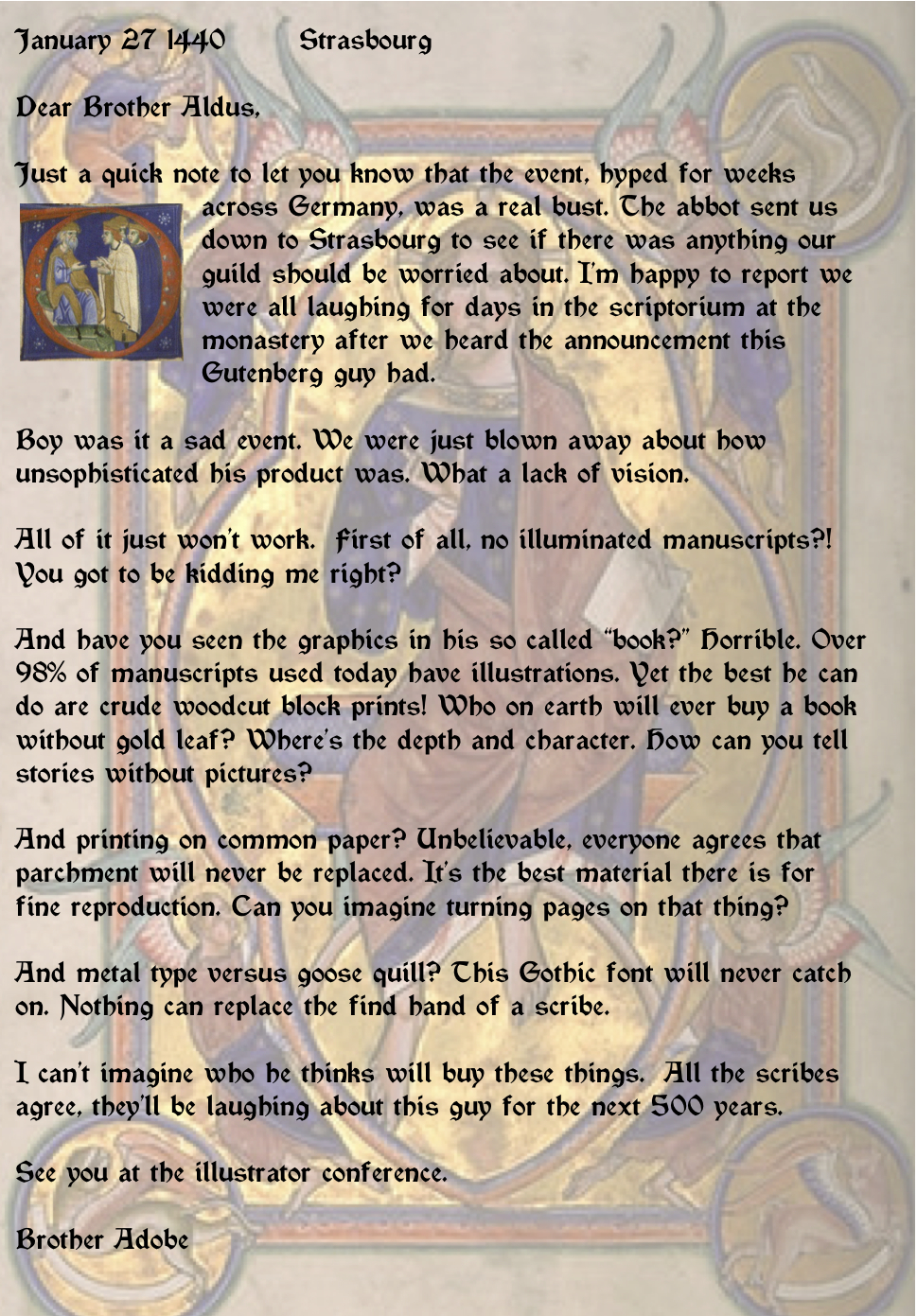
Printing on common paper? Unbelievable!

(via Memo From the Monastery)

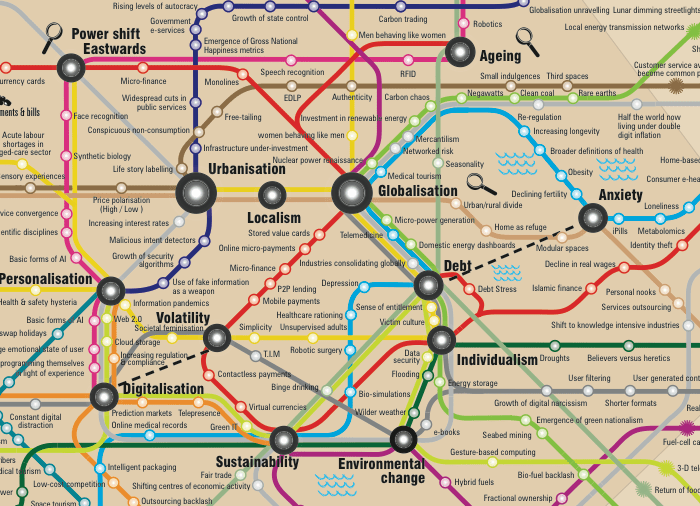
2010 – A roadmap for the future

Futurist Richard Watson has updated his annual trends and technology timeline for 2010.  What an interesting conversation starter at a meeting looking at technology!

2010-trendsmapfinal1.png

The map has 16 lines representing everything from society & culture to news & media. There are also 5 time zones representing 2010-2050, so everything that falls outside the central zone (zone 1) is obviously a prediction.

The map is published under a Creative Commons Share-A-Like Licence.

Be sure to look at the full A3 sized image to get the full impact! PDF version available here.

(via 2010 Trends – A Roadmap for the Future)

2010 Horizon Report ~ read it!

2010-Horizon-Cover-320The annual Horizon Report has been released, and should be on the reading list of all teachers and librarians around the nation. The Horizon Report is a global effort ~ reflecting the essential global dimensions and impacts on learning of emerging technologies.

For those who are new to the Horizon Report, since March 2002, under the banner of the Horizon Project, the New Media Consortium has held an ongoing series of conversations and dialogs with hundreds of technology professionals, campus technologists, faculty leaders from colleges and universities, and representatives of leading corporations from more than two dozen countries. In each of the past six years, these conversations have resulted in the publication each January of a report focused on emerging technologies relevant to higher education.

Each time a report is undertaken, the NMC uses qualitative research methods to identify the technologies selected for inclusion in that report, beginning with a survey of the work of other organizations and a review of the literature with an eye to spotting interesting emerging technologies.

What’s on the Horizon?

Technologies to Watch
One Year or Less: Mobile Computing
One Year or Less: Open Content
Two to Three Years: Electronic Books
Two to Three Years: Simple Augmented Reality
Four to Five Years: Gesture-Based Computing
Four to Five Years: Visual Data Analysis Methodology

Download the 2010 Horizon Report (316k PDF)

Is this the future of magazines?

Thanks to Daniel Pink for the heads-up on Apple Insider’s demo of the soon-to-be-launched digital edition Sports Illustrated.   Time Inc, the largest magazine publisher in the US,  has been plagued by declining subscription  revenue and layoffs according to Tech.Blorge, so it’s taking a new tact with its magazine content by testing this tablet-friendly version of Sports Illustrated.

Apparently Wired and others are also working on their own digital editions.

I know for sure that the boys at school will LOVE this!