Google – friend or foe?

ASCD SmartBrief Reports:

Google courting teachers with new tech resource
Google for Educators, a new Web site launched yesterday, offers guides and lesson plans detailing creative ways to use Blogger, Google Maps, Google Earth and nine other Google applications in the classroom. The site also offers links to a training academy that will allow teachers to become “Google certified.” Silicon.com (10/12)

Google says:

Google recognizes the central role that teachers play in breaking down the barriers between people and information, and we support educators who work each day to empower their students and expand the frontiers of human knowledge. This website is one of the ways we’re working to bolster that support and explore how Google and educators can work together.

The whole thrust is about ideas for using technology to innovate in the classroom. The Google Generation certainly deserves teachers who can think differently about the use of technology. But this list of tools smacks of the usual ‘tech tool’ approach – classrooms with more ‘bells and whistles’. Given the Google purchase of YouTube, the possibility is there that Google tools might actually reflect Web 2.0 think?
web1web2.png

On the other hand, the list is a tantalising one to throw before teachers who are starting out, if only because Google has become such a ‘staple’ friend of teachers and students alike.

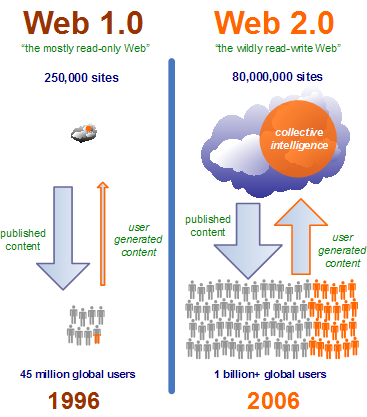
Let’s not forget the strength of the Read/Write web as demonstrated by this graphic from popoever.

Web 2.0 is about collaboration and remix, and syndication of data in such a way that anyone, anywhere can use use the results.

Web 2.0 does not lock the reader/writer into rigid technology actions — it intentionally forfeits that control in favor of much greater returns.

Let’s hope that Google remembers that! What I am particularly interested in is the concept of ‘expanding the frontiers of human knowledge’. Web 2.0 alone will not do this, nor even come close to facilitating this. Web 2.0 is a new environment, with new options, new possibilities, new dimensions to human cognitive engagement.

However, I see little evidence yet of Web 2.0 moving beyond into serious investigation of the semantic web and the new spaces for thinking deeply by extracting deep information! Web 2.0 Google tools for educators doesn’t address this at all – not even remotely.

Knowledge Strategy for school libraries

Who is going to guide educators in understanding cognitive information strucutures of the mind, of virtual and physical resources and new ways of interaction in a Web 2.0 environment. The technology evangelists in schools believe they have the answer!! Google the world, use wikipedia, and scrap the school library for a virtual information locker! Nuts! Or more frighteningly a solution as rigid and dangerous as ‘book burning’.
A hundred years before the advent of Hitler, the German-Jewish poet, Heinrich Heine, had declared: “Wherever books are burned, human beings are destined to be burned too.”

On the night of May 10, 1933, an event unseen in Europe since the Middle Ages occurred as German students from universities once regarded as among the finest in the world, gathered in Berlin to burn books.

In the new era of Web 2.0, school principals and technology evangelists are attacking school libraries by ‘burning’ the books – rather than doing to libraries exactly what we have to do to class rooms …… Change change change change…. and learn from the leading digital repositories in the world that are using technology to preserve literature, movies, images, etc. I hate lots of school libraries, the way that they are run, the way they look, the way school leaders ‘abuse’ their potential in the schooling of our students. But the solution is not to close their doors, but to initiate a reform as comprehensive as the one that needs to take place in our classrooms.

What does our Knowledge Strategy need to become? I’m thinking about it! Are you?


Podomatic excitement

Joseph, a senior maths and IT teacher writing at Computers & 21CEduk8n left a nice comment on my podomatic site about my podcast.

Thanks for the feedback! 🙂

But better still, Joseph followed it up with a great post on podomatic Podomatic = Podmail and the unique options possible with podmail. Now, that’s creative, distributive, digital learning!

Well worth a read.

Streaming media

I agree with Stephen Abram’s of Stephen’s Lighthouse….streaming media is definitely breaking out 😉 The Good, the Bad and the Ugly are definitely out there!

My workplace has yet to step into the streaming media phase – but we will be doing this with a rush and with considerable (learners!) enthusiasm very soon as we transform the lansdcape of our personalised learning environment. Stephen’s questions are important ones for us to consider right now.
Stephen says:

If it doesn’t already, your employer will be creating, licensing, storing and offering education, training, meeting, and communication events to its employees, partners and clients and maybe even the general public. Whether these are called streaming media, webcasts, e-learning, webinars, podcasts, Video On Demand, VODcasts, or whatever, we, as information professionals, should be ready. How do you use them? How are they acquired and what rights are licensed? How are they indexed, archived and made accessible? Can they be put into the OPAC and/or intranet? How are they preserved and stored? Can their contents be searched? Are there better formats and what are the trends? What recommendations should we be making for our companies intranet, Blackberries, browser plug-ins, etc.? There are plenty of questions!

From Islands in the Stream, Infotech Column, Information Outlook, July 2006 issue

Creative Commons and Second Life

Apologies for cross-posting – but this is too cool not to share 🙂

Creative Commons – this is important for educators. Creative Commons and Second Life combo – gives us an amazing digital event.

From the Creative Commons blog:

Mark your calenders: On Thursday, September 14 at 5PM (SL/Pacific), PopSci.com and Creative Commons will be hosting a special concert in Second Life featuring Jonathan Coulton as well as popular Second Life musicians Melvin Took, Kourosh Eusebio, Etherian Kamaboko, and Slim Warrior. From Jonathan Coulton’s blog:

I will be playing live from a secure, undisclosed location in the real world, but you will see my handsome avatar onstage at a venue called Menorca in the Second Life universe. You can also listen to the concert via a number of streaming type websites … The whole concert, audio and video, will be Creative Commons licensed, so feel free to record it.

More information is available on this wiki. We’ll post more information on the CC blog as soon as it becomes available.

Digital Students @ Analog Schools

I would like to introduce you to Marco Torres a social studies teacher, media coach, and education technology director at San Fernando High School. He has received numerous honors and awards for his work helping students empower themselves through the mastery of multimedia. He serves as one of Apple’s Distinguished Educators and is an advisory board member of The George Lucas Educational Foundation.

Not that I was able to attend the Building Learning Communities conference in Boston from the 17th to the 20th, but the blogosphere is agog with the ‘inspiration’ of this educator.

I know that we have a job ahead of us in convincing our teachers to engage with new technologies and change their thinking in order to engage with the Google Generation. But nothing is better than hearing the need for change from students.

Click Here to see a movie made by digital learners about how they are trapped in schools who still teach using analog strategies. This is American. This is College. But this is reality, and so this neatly packaged movie clip expresses student thoughts nicely, using media to communicate the message – that teachers NEED to change.

Students find their voice through multimedia.

Marc’s title words on his website are a motivational call to us all…..

stay curious, stay hungry, be creative!

Thanks to the 21st Century Collaborative for this info.

Curriculum As Connectivism

Roger Stack's recent post on curriculum as connectivism explores how the integral theory of AQAL relates to connectivism as a curriculum metaphor.

Roger talks about learning as network creation and how we might provide 'learning ecologies' to meet the needs of students and is exploring these ideas in the process of planning the implementation of the new Curriculum Framework in TAS.
He examines:

  • Curriculum as Content or Subjects
  • Curriculum as Discrete Tasks and Concepts
  • Curriculum as Experience
  • Curriculum as Cultural Reproduction
  • Curriculum as "Currere"
  • Curriculum as Intended Learning Outcomes
  • Curriculum as Connectivism.

He offers quite a compact journey through constructivism, and presents graphical representations of these. An excellent opportunity to revisit our thinking about curriculum in tandem with adressing the issues of curriculum as we repackage for a connected world.

Roger provides reading links that are also very useful. I have added Roger to my network at Del.ici.ous.

Managing Digital: Innovations, Initiatives & Insights

The 21st Annual Computers in Libraries conference and exhibition was held in Washington, D.C., on March 22-24, 2006.

Computers in Libraries is the leading conference for librarians and information professionals who need to know about the latest technologies, equipment, software, and services available.

Even if you couldn't attend the Computers in Libraries 2006 Conference, you can read the articles, view the powerpoint prentations, listen to the podcasts, or visit the web sites of the many presenters including Debbie Abilock (of NoodleTools fame), Joyce Valenza, and Alice Yucht, all of whom have the school library perspective.

There are almost five dozen presentations. Topics include:

  • Plagiarism: Confrontation or Collaboration?
  • Virtual School Libraries and 21st-Century Service
  • We Get the Picture: Visual Literacy in the Media Center and Beyond
  • Podcasting 101
  • The Exploding Future of Social Communication
  • Searching the New Digital Formats
  • Using RSS for Really Savvy "Resourcery
  • How Bloglines Made Me Look Brilliant
  • Collaborative e-Learning communities
  • Failing to innovate – Not and option
  • Many more

Available from InfoToday here.

Social software and learning

A quick post from the Information Literacy Weblog alerts us to an interesting report from Future Lab:Social software and learning. FutureLab stands apart for the level of innovation in their work in education.

This paper is one of the best papers I have read about social software and learning. The issues raised are significant, and grounded in the understanding that there is "a shift in the nature of knowledge and how knowledge is being created and organised." There are "new ways of working, living and learning outside of school. We see the emergence of new forms of interaction mediated by technology." As is to be expected from FutureLab, the paper is comprehensive, easy to follow, and for those new to the ideas, the paper provides explanations of the terms, commentary, useful links & references.

back to homepage

Link to FutureLab and the publication here.